
MEN 210 Final, Fall 2003
Notre Dame University–Louaize · Thermodynamics I · 12 pages · Dr. Walid Assaf

Showing the first 10 of 12 pages. Download the PDF to see all of it.
More MEN 210 files
- Final · Summer 2008Final examView
- Exam 1 with Solution · Spring 2008Exam · with solutionView
- Exam 1 with Solution · Spring 2007Exam · with solutionView
- Exam 2 · Spring 2007ExamView
- Exam 1 with Solution · Fall 2006Exam · with solutionView
- Exam 1 with Solution · Spring 2006Exam · with solutionView
- Exam 2 with Solution · Spring 2006Exam · with solutionView
- Exam 3 with Solution · Spring 2006Exam · with solutionView
Show the text of this final exam
NOTRE DAME UNIVERSITY
DEPARTMENT OF MECHANICAL ENGINEERING
THERMODYNAMICS FINAL EXAMINATION FALL SEMESTER 2003
MEN 210 DR. WALID C, ASSAF
NAME & IDNUMBER:
- No questions please
- No borrowing
- Circle the correct answer.
- Do not explain an answer unless the question asks for explanation.
- Answer as many questions as you can.
- Read each question very carefully.
- Do not spend more than a few minutes on each question.
- No penalty for wrong answers,
D216
cS AG™
4
mY
4 ‘
\
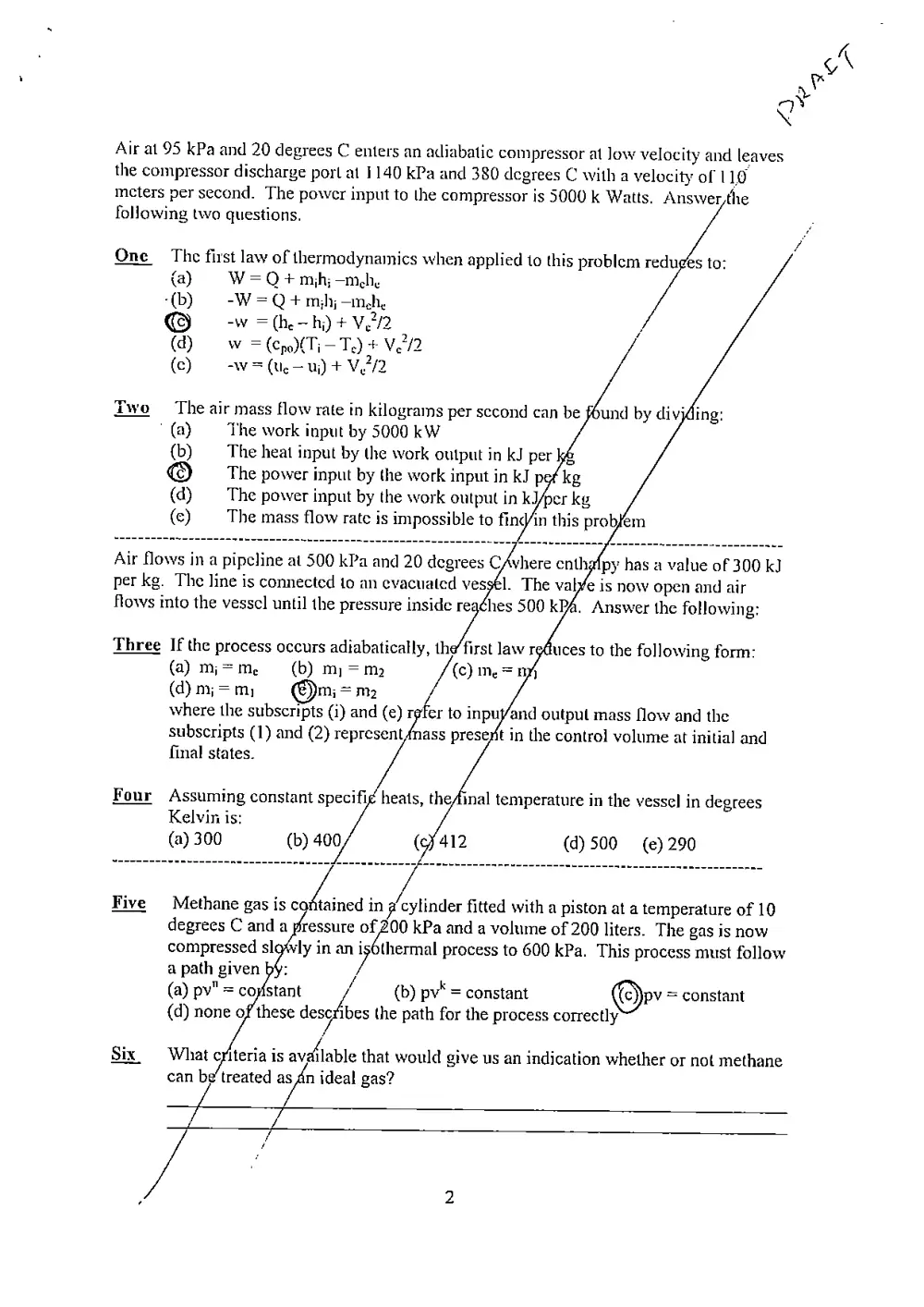
Air at 95 kPa and 20 degrees C enters an adiabatic compressor at low velocity and leaves
the compressor discharge port at 1140 kPa and 380 degrees C with a velocity of 110
meters per second. The power input to the compressor is 5000 k Watts. Answer,the
following two questions. é
,
One The first law of thermodynamics when applied to this problem redugés to:
(a) W= Q + mh; —m,hy
-(b) -W =Q+ mh; —n,h,
© -w =(h-h) + V2
() w= (ep Ti-T.) + Ve2/2
(ec) -w=(te-u) + V2/2
Two — The air mass flow rate in kilograms per sccond can be found by divjding:
* (a) The work input by 5000 kW
{b) The heat input by the work output in kJ per
© The power input by the work input in kJ pefkg
(d) The power input by the work output in kJ/per kg
(c) The mass flow rate is impossible to find/in this probYem
Air flows in a pipeline at 500 kPa and 20 degrees CAvhere enth py has a value of 300 kJ
per kg. The line is connected to an evacuated ves
flows into the vesscl until the pressure inside yi
Three If the process occurs adiabatically, the’first law r
(a) mj =m, (b) m) = m2 (c} m. = my
(d) m; =m, © =m
where the subscripts (i) and (e) refer to inpuy/and outpul mass flow and the
subscripts (1) and (2) represent fnass preserlt in the control volume at initial and
final states.
Four Assuming constant specifi
Kelvin is:
(a) 300 (b) 400
heats, theAinal temperature in the vessel in degrees
(d) 500 (e) 290
cylinder fitted with a piston at a temperature of 10
ressure of 200 kPa and a volume of 200 liters. The gas is now
‘ly in an is6thermal process to 600 kPa. This process must follow
Five Methane gas isc Let in a
degrees C and af
compressed sl
a path given bf:
(a) pv" = copstant oh (b) pv“ = constant PV = constant
(d) none of these describes the path for the process correctly
Six, Whit criteria is avalable that would give us an indication whether or not methane
can be’ treated as An ideal gas?
Qs burs
(3% -
2 (\- 0) (x) o> necessary tg raise air temperature to 250 degrees C in kJ is:
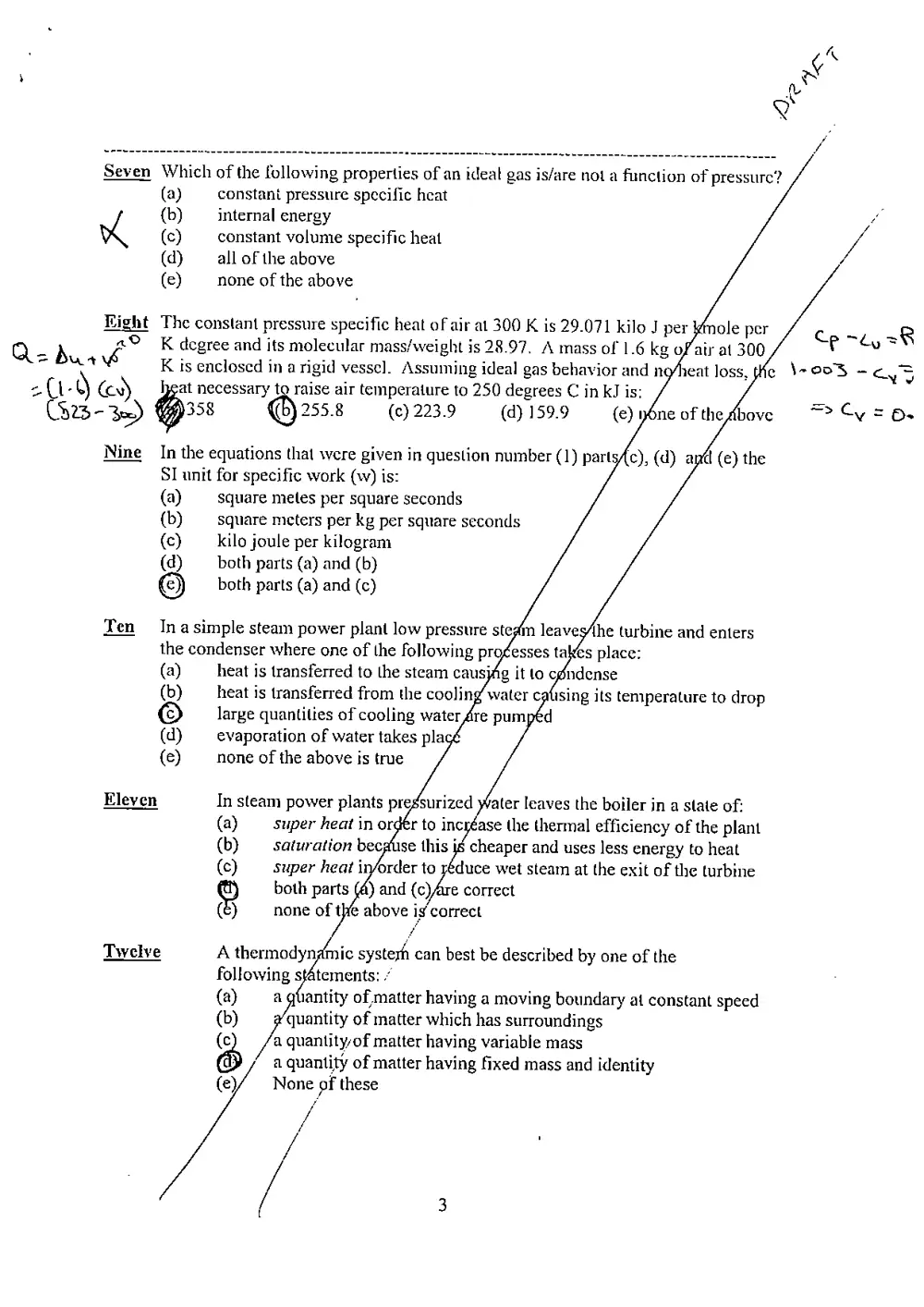
Seven Which of the following properties of an ideal gas is/are not a function of pressurc?
(a) constant pressure specific heat
{b) internal energy
ve (c) constant volume specific heat
(d) all of the above
(e) none of the above
Right The constant pressure specific heat of air at 300 K is 29.071 kilo J per
n° K degree and its molecular mass/weight is 28.97. A mass of 1.6 kg of air at 300
K ts enclosed in a rigid vesse]. Assuming ideal gas behavior and n
ee) 358 @)255. 8 (c) 223.9 (d) 159.9
Nine In the equations that were given in question number (1) part
SI unit for specific work (w) is:
(a) Square meles per square seconds
(b) square meters per kg per square seconds
(c) kilo joule per kilogram
(d) both parts (a) and (b)
both parts (a) and (c)
mole per
‘c), (d) ad (e) the
Ten Inasimple steam power plant low pressure stegin leaves/he turbine and enters
the condenser where one of the following progesses taxes place:
(a) heat is transferred to the steam causjig it to odndense
(b) _ heat is transferred from the cooling’ water cafising its temperature to drop
large quantilies of cooling water Are pumpéd
(d) evaporation of water takes pla
(e) none of the above is true
Eleven In steam power plants pregsurized
ater leaves the boiler in a state of:
(a) super heat in order to incyéase the thermal efficiency of the plant
(b) saturation bec
(c) super heat i
© both parts (4) and (c)/are correct
(e) none of the above is correct
se this j
Twelve A thermodyngmic systerh can best be described by one of the
following stAtements: /
(a) a
(b) quantity of matter which has surroundings
o a quantity/of matter having variable mass
a quantity of matter having fixed mass and identity
(ef None of these
/
cheaper and uses less energy to heat
order to yeduce wet steam at the exit of the turbine
lantity of matter having a moving boundary at constant speed
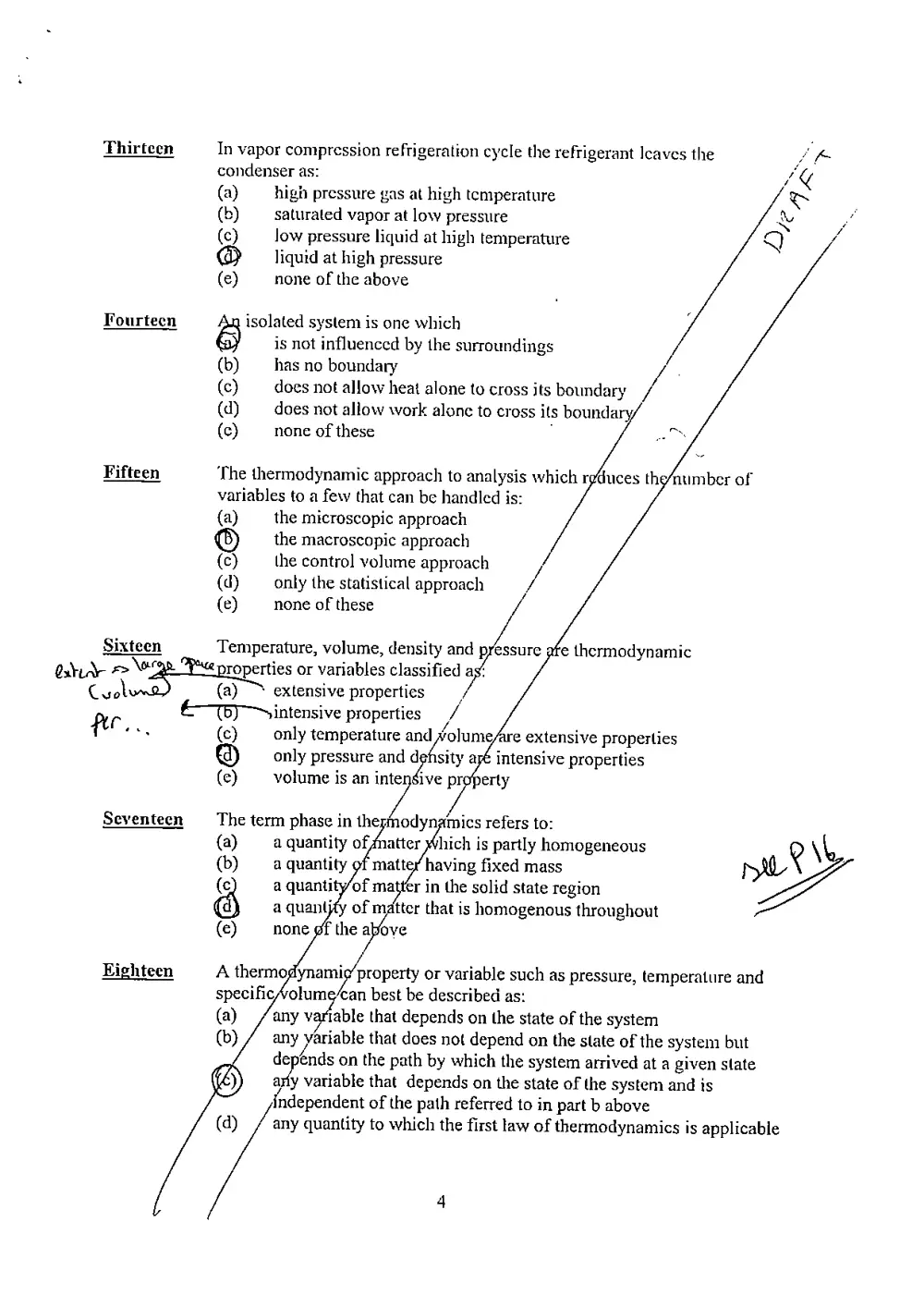
Thirteen In vapor compression refrigeration cycle the refrigerant Icaves the Se
fnirtecn ip g g !
condenser as: /&
(a) high pressure gas at high temperature eS
(b) saturated vapor at low pressure & y ,
(c) low pressure liquid at high temperature Q /
liquid at high pressure
(e) none of the above
Fourteen isolated system is one which
6 is not influenced by the surroundings
(b) has no boundary .
(c) does not allow heat alone to cross its boundary /
(d) does not allow work alonc to cross its boundary
(c) none of these :
Fifteen The thermodynamic approach to analysis which reduces the/iumber of
variables to a few that can be handled is:
(a) the microscopic approach
the macroscopic approach
(c) the control volume approach
(d) only the statistical approach /
(e) none of these
Sixteen Temperature, volume, density and pressure gfe thermodynamic
Ostia 7 ae Tec oroperties or variables classified as:
Cool (a) ~ extensive properties
r &—75) ~ intensive properties /
ft sy (c) only temperature ane xolny
only pressure and v4 sity a
(e) volume is an v/ 1Ve pr
e extensive properties
intensive properties
erty
Seventeen The term phase in thesmodynamics refers to:
(a) a quantity off hich is partly homogeneous g \
(b) a quantity of matter having fixed mass yi ‘
(c a quantity/of matter in the solid state region
a quanljty of matter that is homogenous throughout
(e) none gf the above
Eighteen A thermodynamie’property or variable such as pressure, temperature and
specificAolume/can best be described as:
any variable that depends on the state of the system
any yariable that does not depend on the slate of the system but
cepends on the path by which the system arrived at a given slate
ayy variable that depends on the state of the system and is
independent of the path referred to in part b above
any quantity to which the first law of thermodynamics is applicable
oe ‘
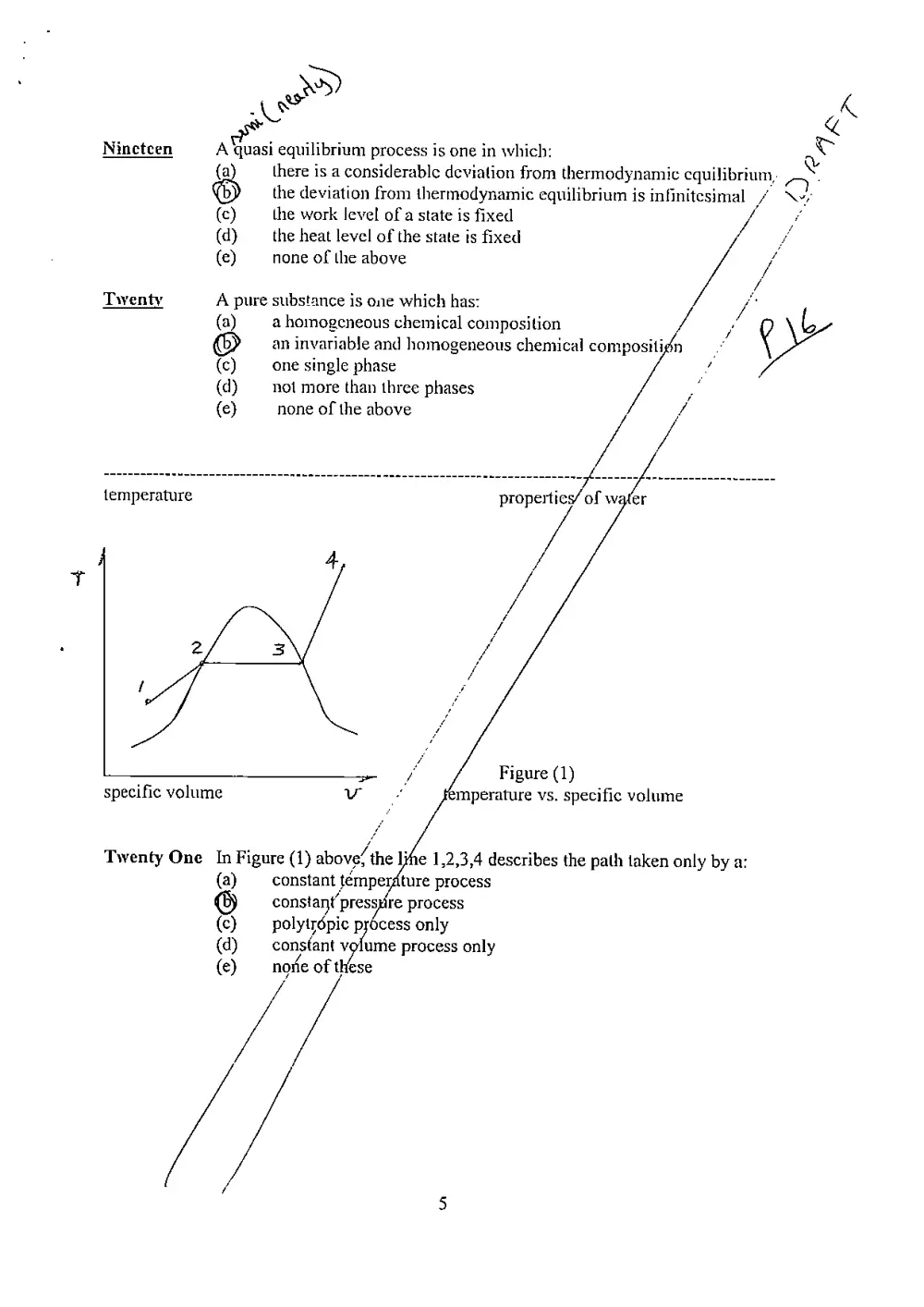
Ninctcen A quasi equilibrium process is one in which: ~~
(a there is a considerable deviation from thermodynamic equilibrium,
the deviation from thermodynamic equilibrium is infinitesimal / Nv
(c) the work level of a state is fixed
(d) the heat level of the state is fixed
(e) none of the above
Twenty A pure substance is one which has:
(a) a homogeneous chemical composition , L
@ an invariable and homogeneous chemical compositign —“ i
(c) one single phase ,
(d) not more than three phases
(e) none of the above /
temperature
4 4
2
f
f
f a
a Cl Figure (1)
specific volume Vv mperature vs. specific volume
Twenty One In Figure (1) above’ ‘the Ine 1,2,3,4 describes the path taken only by a:
(a) constant témperdture process
consta nt press re process
(c} polyinépic i cess only
(d) constant v2. fame process only
(ce) nowe of the the
//
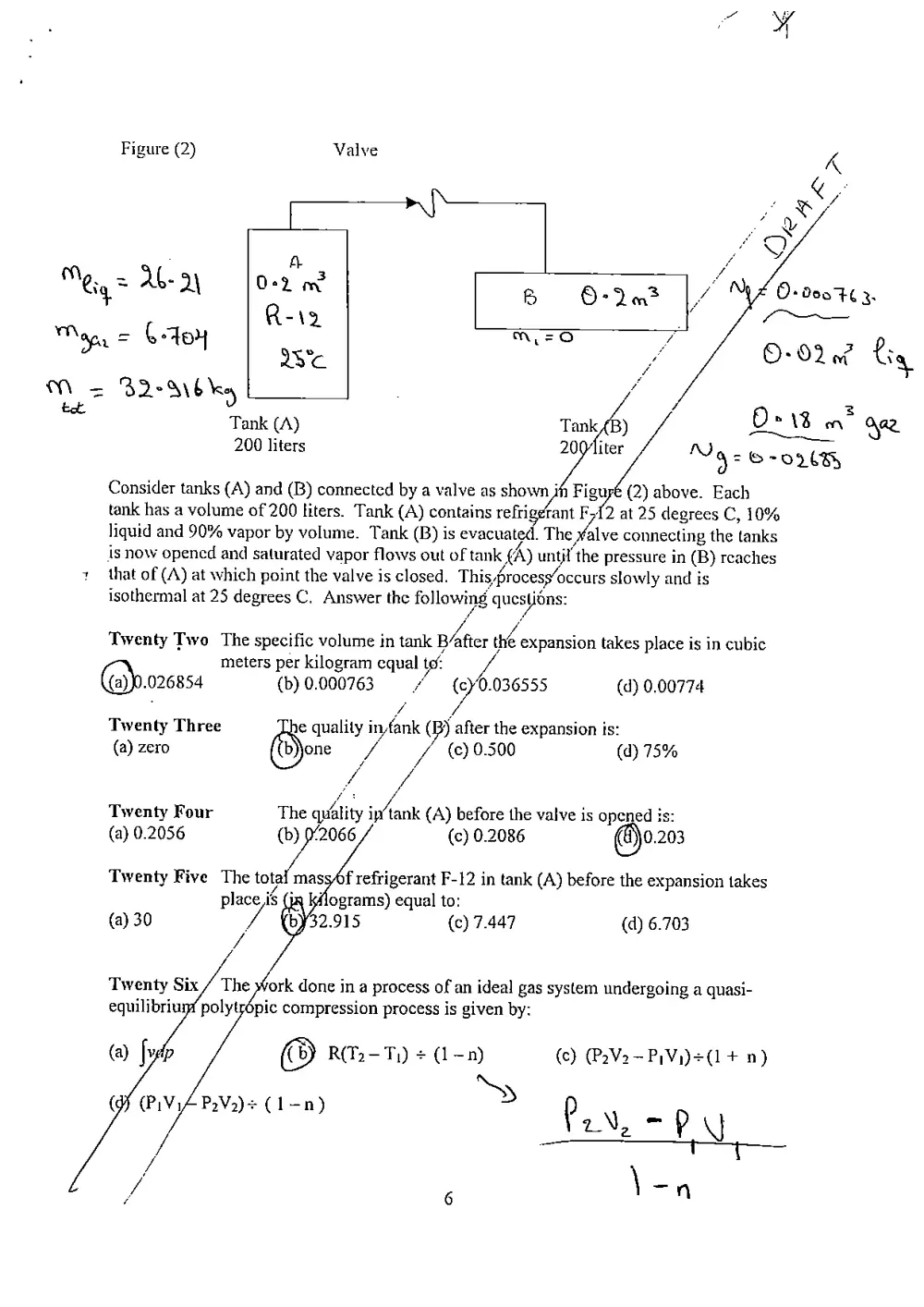
Figure (2) Valve
‘q. & © +23
Mae, = G44 AL=O 2
M1 = B2-Mb ke c
tt Tank (A) 3h /
200 liters iter
Consider tanks (A) and (B) connected by a valve as ettgch a (2) above. Each
tank has a volume of 200 liters. Tank (A) contains refriggh Theva F512 at 25 degrees C, 10%
liquid and 90% vapor by volume. Tank (B) is evacuated. The ya falve connecting the tanks
is now opencd and saturated vapor flows out of tank fA) unt the pressure in (B) reaches
+ that of (A) at which point the valve is closed. This process’ occurs slowly and is
isothermal at 25 degrees C. Answer the following questions:
Twenty Two The specific volume in tank WA wy, "4 expansion takes place is in cubic
meters per kilogram caval to:
(@p.026854 (b) 0.000763 * hi 036555 (d) 0.00774
Twenty Three ¢ quality in, Gok (B) after the expansion is:
(a) zero one / (c) 0.500 (d) 75%
f ZL
fet
Twenty Four The quality ip tank (A) before the valve is opened is:
(a) 0.2056 vay (c) 0.2086 0.203
Twenty Five The total mass/f refrigerant F-12 in tank (A) before the expansion takes
place_ji iS (in ki ograms) equal to:
(a) 30 / 32.915 (c) 7.447 (d) 6.703
/
Twenty Six / The Work done in a process of an ideal gas system undergoing a quasi-
equilibriuyy polytyépic compression process is given by:
R(T2—T)) = (1-n) () (P2V2~PiVi)=(1 + n)
Sy
P2V2)+ ( 1 —n)
Pa, - PE
/ 6 \=n
e
bot tise et
thet
Qf»
0,096
my
4 /
o-0d wd vA
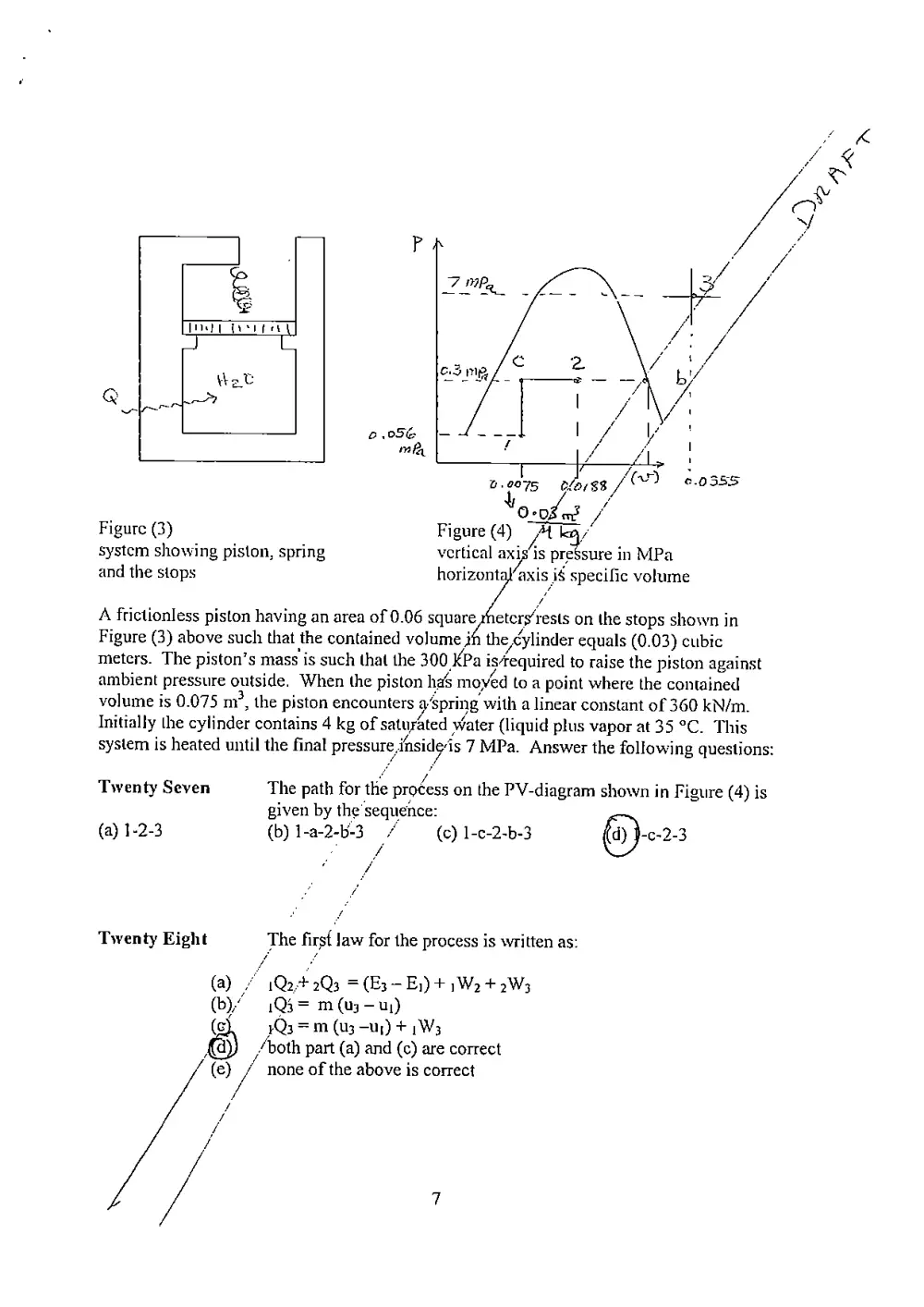
Figure (3) Figure (4) At key
system showing piston, spring vertical axis is preSsure in MPa
and the stops horizonta/‘axis if specific volume
4
A frictionless piston having an area of 0.06 square yhetcrg‘rests on the stops shown in
Figure (3) above such that the contained volume i the ¢ylinder equals (0.03) cubic
meters. The piston’s mass is such thal the 300 KPa isfequired to raise the piston against
ambient pressure outside. When the piston has moyed to a point where the contained
volume is 0.075 m?, the piston encounters spring with a linear constant of 360 kN/m.
Initially the cylinder contains 4 kg of saturated Water (liquid plus vapor at 35 °C. This
system is heated until the final pressure, insides 7 MPa. Answer the following questions:
Twenty Seven The path for the process on the PV-diagram shown in Figure (4) is
given by the’sequence:
(a) 1-2-3 (b) 1-a-2-b-3./ (c) 1-c-2-b-3 (o)<23
aa
f
f ,
Twenty Eight The first Jaw for the process is written as:
f
/ ’
(a) / 1Q2-+ 2Q3 = (E3— Ey) + 1W2 + 2W;
(b) — 1Q3= m (uj — uy)
(¢ ¥Q3 = m (U3 —u;) + 1W3
oO A both part (a) and (c) are correct
(e} / none of the above is correct
/
/
/
/
/
va
%
a
S00kR(y-0199 ~ 0-007) \ Fesses) [oes DeD13
2 e
7
re yp Py °3
/
Twenty Nine The work for the process in kilo J per kilogram is:
7
(a) 250 (b) 258 Oy (d) 68 (e)none of thése
A rigid container is filled with super heated steam at 700 kPa and 200 degrees C/ Answer
the following questions: é
Thirty Steam begins to condense when the container is cooled to tempgtalure of in
degrecs C equal to:
Ny =
(a) 165 Q's (c) 170 (d) 174 (c 400 §) = Or 2934
Thirty One _ Fifty percent of the sleam condenses at a teytperatytc measured in degrees
C equal to: .)
(a) 165 (b) 155 (c) 130 134 (e¥ 180 CTA and eter
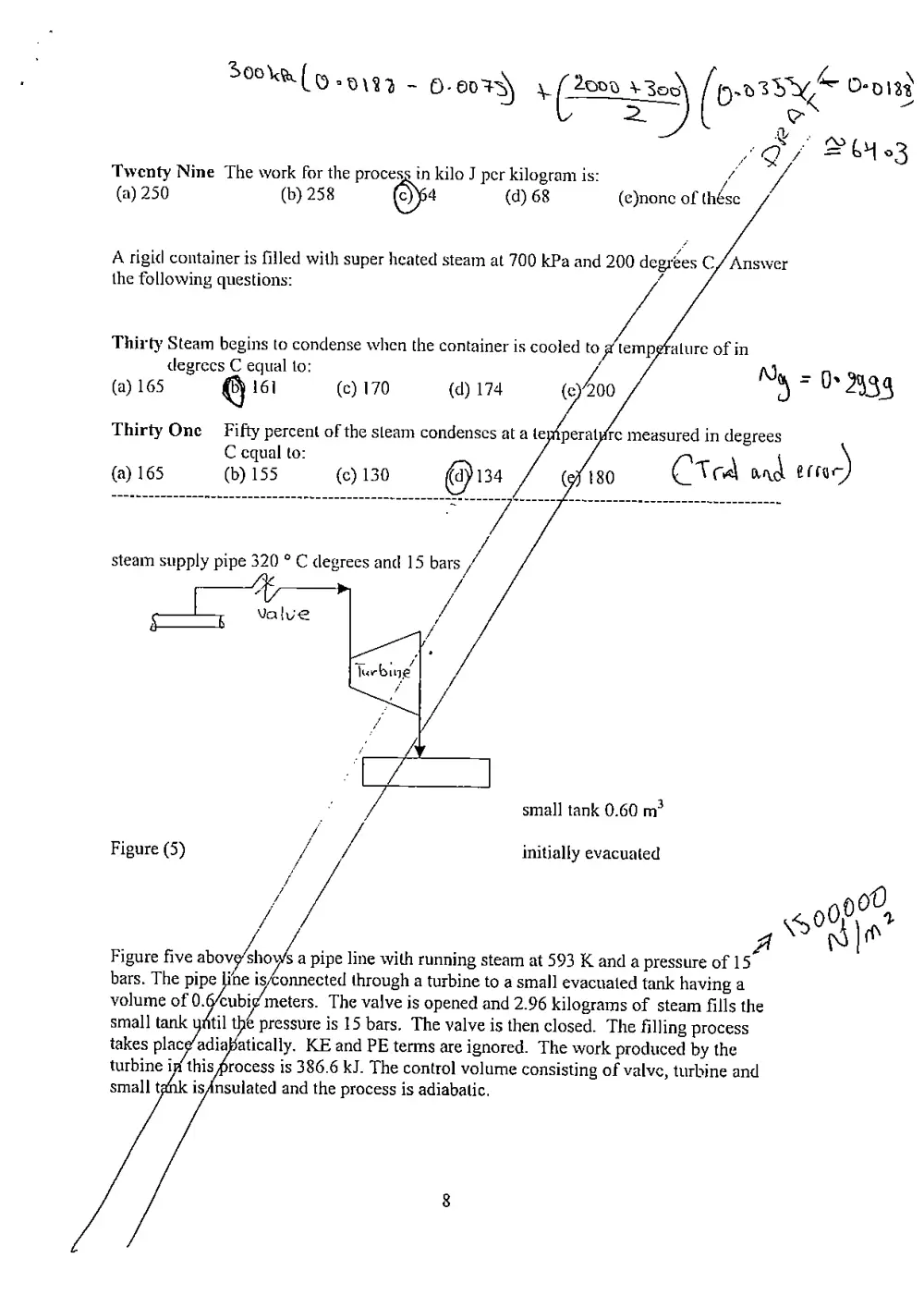
/ small tank 0.60 m?
/
Figure (5) / / initially evacuated
0 4
/ Pa
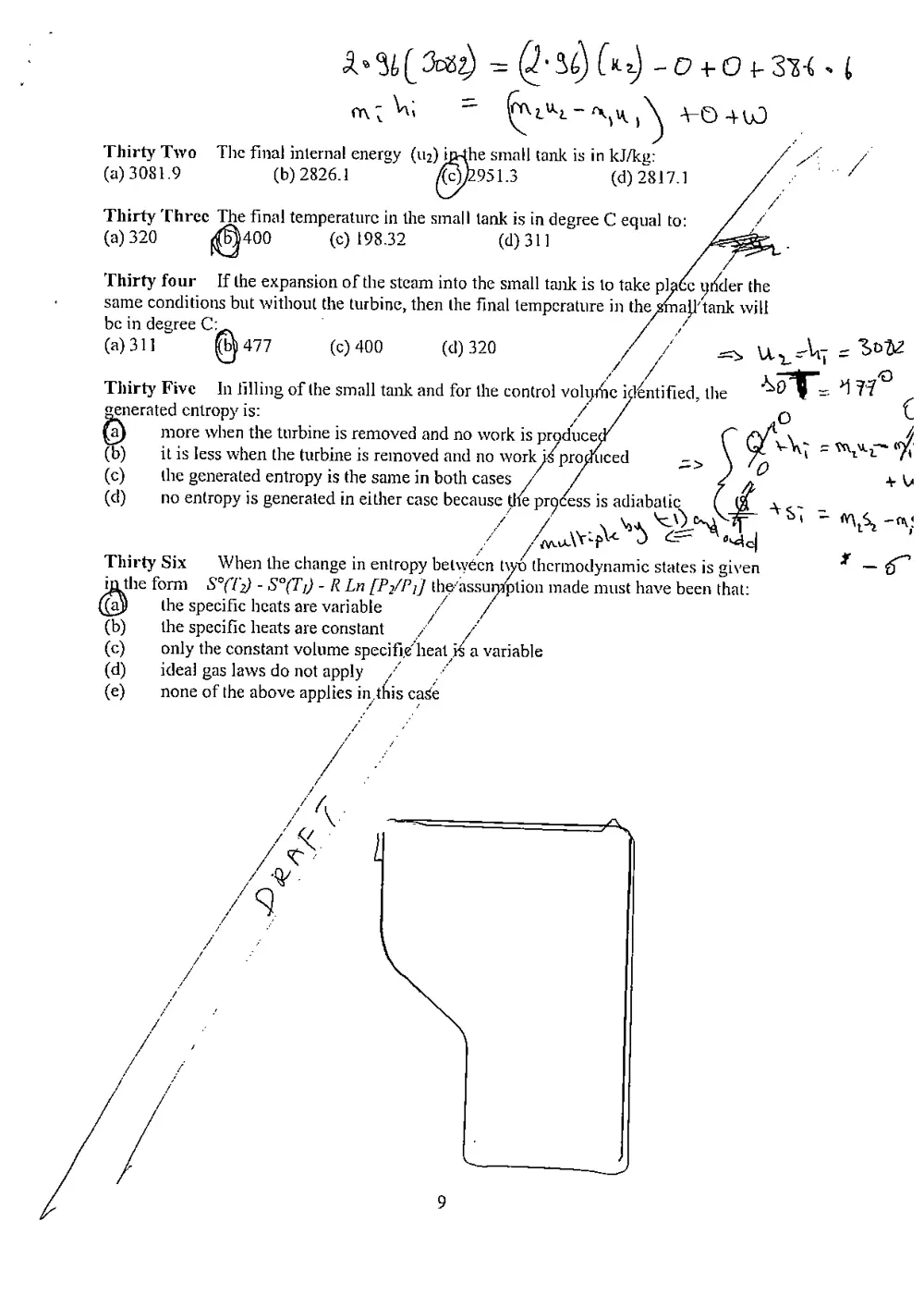
Figure five above’shows a pipe line with running steam at 593 K anda pressure of 15
bars. The pipe line isconnected through a turbine to a small evacuated tank having a
volume of 0.6/cubig’ meters. The valve is opened and 2.96 kilograms of steam fills the
smal] tank yatil the pressure is 15 bars. The valve is then closed. The filling process
takes place’adiapatically. KE and PE terms are ignored. The work produced by the
turbine ip this process is 386.6 kJ. The control volume consisting of valve, turbine and
small tank isAnsulated and the process is adiabatic.
444 ( S082) = (36) (ue) 0 OL 334 «|
mi hi = (ema, ) +O 400)
Thirty Two The final internal energy (uz) ip{he small tank is in kJ/kg: / 2 /
(a) 3081.9 (b) 2826.1 (ps3 (d) 2817.1 ° ;
y;
Thirty Three The final temperature in the small tank is in degree C equal to:
(a) 320 (0) 400 (c) 198.32 (d) 31]
Thirty four If the expansion of the steam into the small tank is to take plaéc yrider the
same conditions but without the turbine, then the final temperature in the gmail’tank will
be in degree C:
(a) 311 @ 477 (c) 400 (a) 320 / / 2s Uy ely = 30
©
Thirty Five In filling of the small tank and for the control volypie i iféntified, the OT. 477
generated entropy is: / oO €
more when the turbine is removed and no work is produce gy ht em of
(b) it is less when the turbine is removed and no work j&, progticed => 0 oes
(c) the generated entropy is the same in both cases Z Zz. +
(a) no entropy is generated in either case because ie process is adiabatig g +> :
a /. A) Vm MS, = ms
J feared rd
Thirty Six. = When the change in entropy between tio thermodynamic states is given 7H 6
iythe form S°(12} - ST) - R Ln [P2/P1] the: aia made must have been that:
@ the specific heats are variable /
(b) the specific heats are constant
(c) only the constant volume specific heat A variable
(d) ideal gas laws do not apply _”
(e) none of the above applies i in, this case
Figure (6) /
Air Standard Diesel Cycle fof
/
The displacement of an internal combustion engine if’ 3 liters. The processes within each
cl
cylinder of the engine are modeled as an airs andgtd Diesel cycle with a cut off ratio of
2.5. The state of the air al the start of comptession is fixed by:
P}=95kPa T)=22 va 1 = 3.17 liters
Refer to the above Figure (6). / at 4 ; ned ee) corey
/ stops, cur Ap aN,
— 9%
Problem 37 The ratio of thé volyimes V2/V3 is: = 2 -
(a)3 ()o.4 / (3.1 (d) 2.5 (e) none of these = \s
ff a.
jf Vp
Problem 38 The difference tween the volumes V2 and V, measured in liters is:
(a) 3.1 (b) 2.5 C 3 (d) 0.4 (e) we don’t know
Problem 39 When the value of v,; is 647.9 then the value of v . must be on of the
llowihg:
(647.9 ff (by 45.223 (c) 34.740 (d) 2.5
10