
MEN 320 Final with Solution, Spring 2006
Notre Dame University–Louaize · Fluid Mechanics I · 2 pages · Dr. Ali Hammoud · with solution
More MEN 320 files
Show the text of this final exam
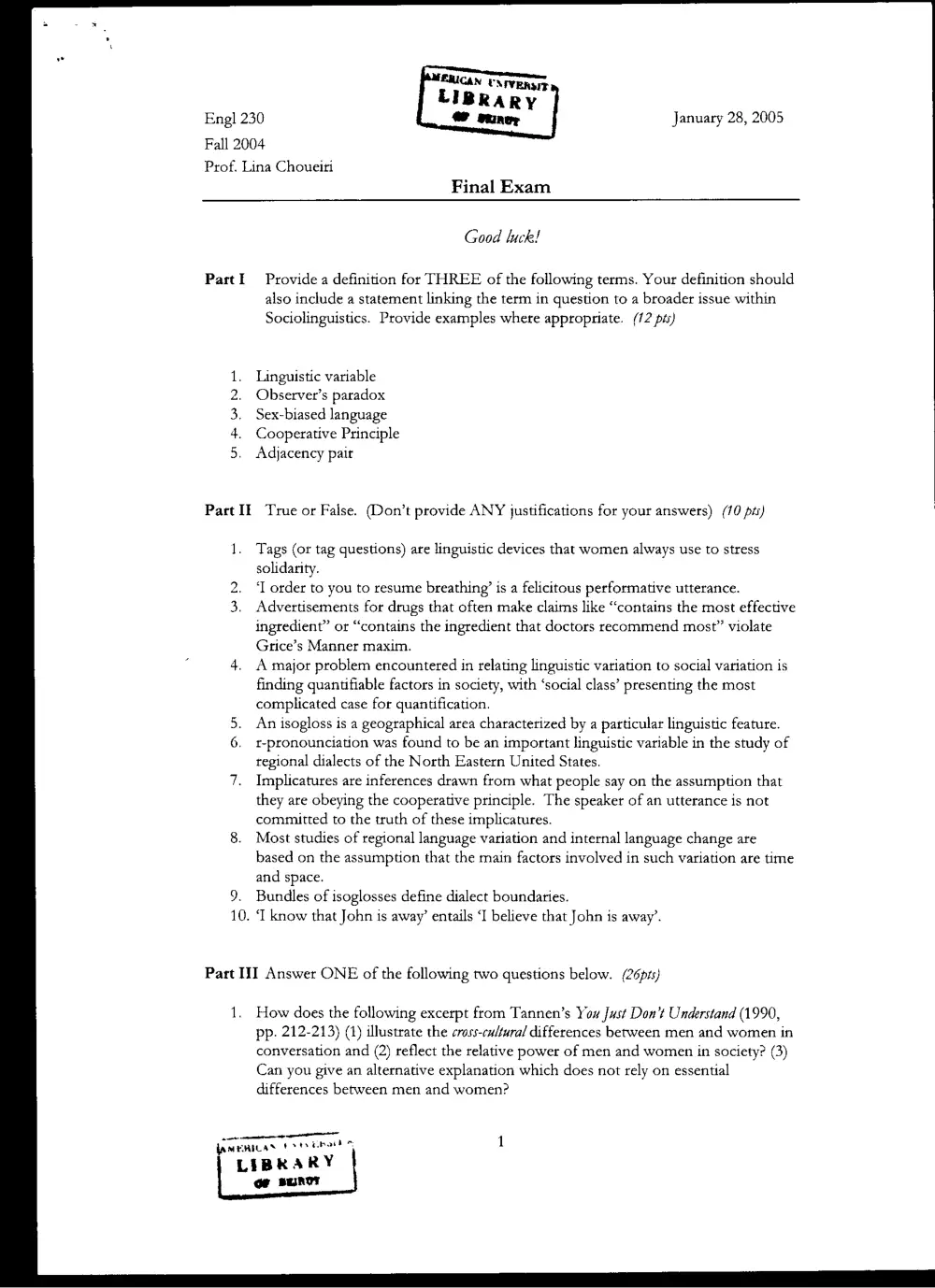
Engl 230
Fall 2004
Prof. Lina Choueiri
January 28, 2005
Final Exam
Good luck!
PartI Provide a definition for THREE of the following terms. Your definition should
also include a statement linking the term in question to a broader issue within
Sociolinguistics. Provide examples where appropriate. (12 pis)
Linguistic variable
Observer’s paradox
Sex-biased language
Cooperative Principle
Adjacency pair
PON
Part IE True or False. (Don’t provide ANY justifications for your answers) (70 pits) |
1. Tags (or tag questions) are linguistic devices that women always use to stress
solidarity.
2. ‘T order to you to resume breathing’ is a felicitous performative utterance.
3. Advertisements for drugs that often make claims like “contains the most effective
ingredient” or “contains the ingredient that doctors recommend most” violate
Grice’s Manner maxim.
4. A major problem encountered in relating linguistic variation to social variation is
finding quantifiable factors in society, with ‘social class’ presenting the most
complicated case for quantification.
5. An isogloss is a geographical area characterized by a particular linguistic feature.
6. 1-pronounciation was found to be an important linguistic variable in the study of
regional dialects of the North Eastern United States.
7. Implicatures are inferences drawn from what people say on the assumption that
they are obeying the cooperative principle. The speaker of an utterance is not
committed to the truth of these implicatures.
8. Most studies of regional language variation and internal language change are
based on the assumption that the main factors involved in such variation are time
and space.
9. Bundles of isoglosses define dialect boundaries.
10. ‘I know that John is away’ entails ‘I believe that John is away’.
Part IYI Answer ONE of the following two questions below. (26pts)
1. How does the following excerpt ftom Tannen’s You Just Don’t Understand (1990,
pp. 212-213) (1) illustrate the cross-cultural differences between men and women in
conversation and (2) reflect the relative power of men and women in society? (3)
Can you give an alternative explanation which does not rely on essential
differences between men and women?
a '
JAMERILas FeO EHS
LIBKARY
oF BURTT
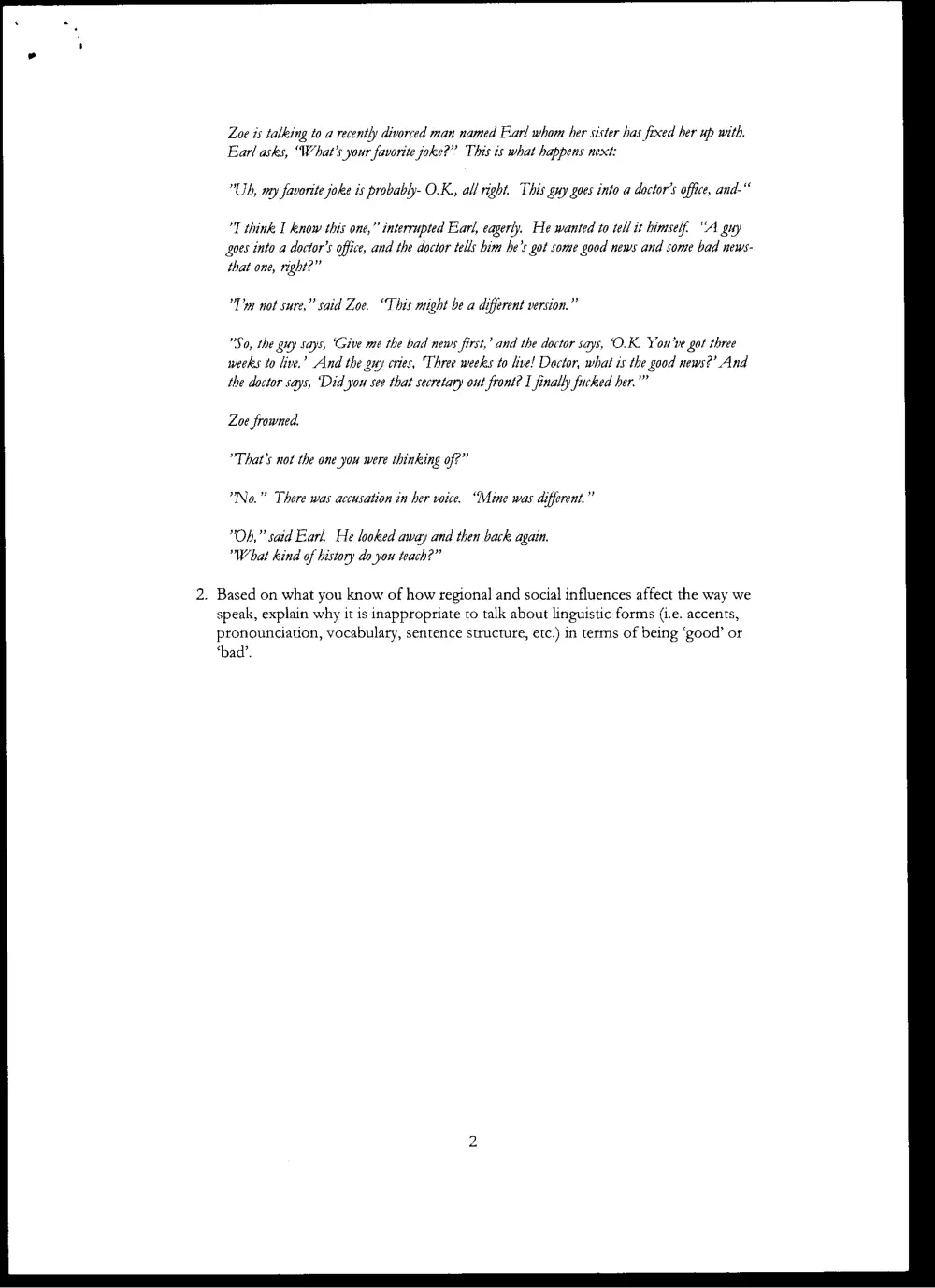
Zoe is talking to a recently divorced man named Earl whom her sister bas fixed her up with.
Earl asks, ‘What's your favorite joke?’ This is what happens next:
"Ub, my favorite joke is probably- O.K., all right. This guy goes into a doctor's office, and-“
"T think I know this one,” interrupted Earl, eagerly. He wanted to tell it himself. “A guy
goes into a doctor's office, and the doctor tells him he’s got some good news and some bad news-
that one, right?”
'T'n not sure,” said Zoe. “This might be a different version.”
"So, the guy says, ‘Give me the bad news first,’ and the doctor says, ‘O.K You've got three
weeks to live.’ And the guy cries, ‘Three weeks to live! Doctor, what is the good news?’ And
the doctor says, ‘Did you see that secretary out front? I finally fucked her.’”
Zoe frowned.
That's not the one you were thinking of?”
No.” There was accusation in her voice. “Mine was different.”
“Ob,” said Earl. He looked away and then back again.
What kind of history do you teach?”
2. Based on what you know of how regional and social influences affect the way we
speak, explain why it is inappropriate to talk about linguistic forms (i.e. accents,
pronounciation, vocabulary, sentence structure, etc.) in terms of being ‘good’ or
‘bad’.