
MRK 423 Notes CHAPTER 10, Spring 2013
Notre Dame University–Louaize · International Marketing · 34 pages



Showing the first 10 of 34 pages. Download the PDF to see all of it.
Show the text of this notes
The nearly complete destruction of the continental European economies by World
War II seriously endangered the stability of Europe’s social and political institutions.
Europe’s leaders knew that in order to rebuild from the ruins, it was essential to
form new kinds of international institutions to ensure prosperity, stability, and peace
in the region. The first of these institutions was the European Coal and Steel
Community established in 1952 to integrate the coal and steel industries of France,
West Germany, Italy, Belgium, The Netherlands, and Luxembourg. Fifty years later,
based on the success of this first small experiment in economic interdependence
based on the success of this first small experiment in economic interdependence,
we now see the European Union with twenty-seven member nations and three
candidate countries set to join during the next few years. The economies have
burgeoned, but more importantly peace has persisted.
Might such an approach work in the war-torn Middle East? Finally, Pulitzer Prize–
winner Jared Diamond points out that the Middle East, historically referred to as the
Fertile Crescent, was the cradle of civilization. It became so so long ago because of
,
g
g
innovation and trade in the region. One can only imagine what free trade in the area
would produce now.
This chapter covers such multinational market regions and market groups.
Follow along with the slides (or open book) as we cover Chapter 10.
1
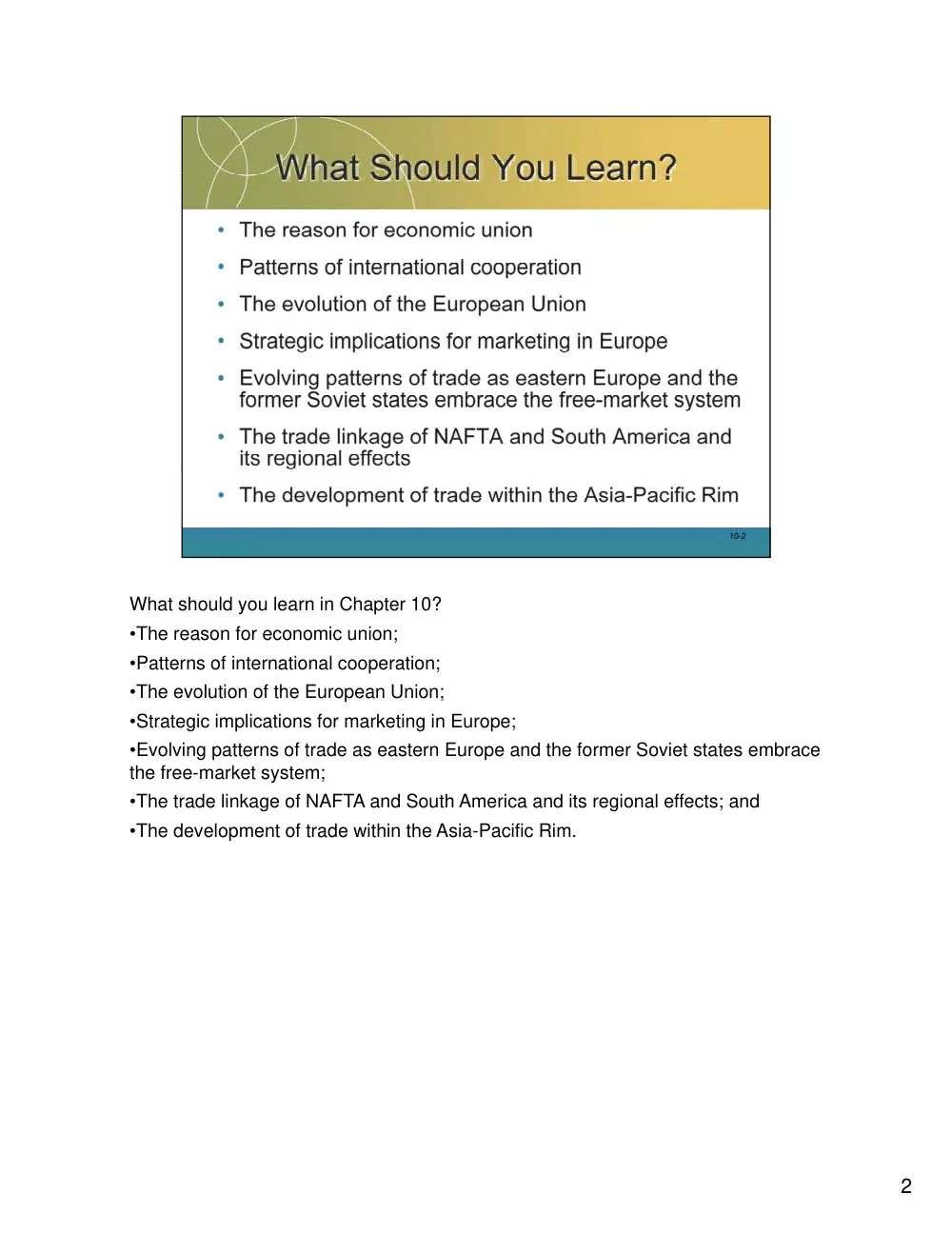
What should you learn in Chapter 10?
•The reason for economic union;
•Patterns of international cooperation;
•The evolution of the European Union;
•Strategic implications for marketing in Europe;
•Evolving patterns of trade as eastern Europe and the former Soviet states embrace
the free-market system;
•The trade linkage of NAFTA and South America and its regional effects; and
•The development of trade within the Asia-Pacific Rim.
2
The evolution and growth of multinational market regions — those groups of
countries that seek mutual economic benefit from reducing interregional trade and
tariff barriers — are the most important global trends today.
Organizational form varies widely among market regions, but the universal goals of
multinational cooperation are economic benefits for the participants and the
associated peace. The world is awash in economic cooperative agreements as
countries look for economic alliances to expand access to free markets.
Indeed, part of the 192 member countries in the United Nations efforts include
mutual economic development; and, of course, the World Trade Organization with
its 151 members and 31 observers is wholly dedicated to make trade among
nations more efficient.
Governments and businesses worry that the EU, NAFTA, and other cooperative
trade groups will become regional trading blocs without trade restrictions internally
b t
ith b
d
t
t d f
t id
B t
h
f th
t
d
but with borders protected from outsiders. But as each of these trade groups
continues to create new agreements with other countries and groups, the networked
global economy and free trade are clearly on the ascendance. The benefits are
clear for consumers; however, global companies face richer and more intense
competitive environments.
3
Successful economic union requires favorable economic, political, cultural, and
geographic factors as a basis for success. Major flaws in any one factor can destroy
a union unless the other factors provide sufficient strength to overcome the
weaknesses.
In general, the advantages of economic union must be clear-cut and significant, and
the benefits must greatly outweigh the disadvantages before nations forgo any part
of their sovereignty.
In the past, a strong threat to the economic or political security of a nation was the
impetus for cooperation.
The cooperative agreements among European countries that preceded the EU had
their roots in the need for economic redevelopment after World War II, the belief that
economic integration created peace between and the political concern for the
perceived threat of communism. Many felt that if Europe was to survive, there had
t
b
i
it
th
t
d
th
f
d th
d
k f
th
to be economic unity; the agreements made then formed the groundwork for the
European Union. The more recent creation of multinational market groups has been
driven by the fear that not to be part of a vital regional market group is to be left on
the sidelines of the global economic boom of the 21st century.
4
Every type of economic union shares the development and enlargement of market
opportunities as a basic orientation; usually, markets are enlarged through
preferential tariff treatment for participating members, common tariff barriers against
outsiders, or both. Enlarged, protected markets stimulate internal economic
development by providing assured outlets and preferential treatment for goods
produced within the customs union, and consumers benefit from lower internal tariff
barriers among the participating countries. In many cases, external as well as
internal barriers are reduced because of the greater economic security afforded
internal barriers are reduced because of the greater economic security afforded
domestic producers by the enlarged market.
Nations with complementary economic bases are least likely to encounter frictions
in the development and operation of a common market unit.
However, for an economic union to survive, it must have agreements and
mechanisms in place to settle economic disputes. In addition, the total benefit of
economic integration must outweigh individual differences that are sure to arise as
economic integration must outweigh individual differences that are sure to arise as
member countries adjust to new trade relationships.
The demise of the Latin American Free Trade Association (LAFTA) was the result of
economically stronger members not allowing for the needs of the weaker ones.
Many of the less well known attempts at common markets have languished
because of economic incompatibility that could not be resolved and the uncertainty
of future economic advantage.
5
g
Political amenability among countries is another basic requisite for development of a
supranational market arrangement. Participating countries must have comparable
aspirations and general compatibility before surrendering any part of their national
sovereignty.
State sovereignty is one of the most cherished possessions of any nation and is
relinquished only for a promise of significant improvement of the national position
through cooperation. Economic considerations are the basic catalyst for the
f
ti
f
t
i
b t
liti
l
l
t
ll i
t
t
formation of a customs union group, but political elements are equally important.
The uniting of the original European Union countries was partially a response to the
outside threat of the Soviet Union’s great political and economic power; the
countries of western Europe were willing to settle their “family squabbles” to present
a unified front to the Russian bear.
The communist threat no longer exists, but the importance of political unity to fully
achieve all the benefits of economic integration has driven European countries to
achieve all the benefits of economic integration has driven European countries to
form the Union (EU).
6
Although geographic and temporal proximity are not absolutely imperative for
cooperating members of a customs union, such closeness does facilitate the
functioning of a common market.
Indeed, the most recent research demonstrates that more important than physical
distance, are differences across time zones.
That is, trade tends to travel more easily in north–south directions than it did in
ancient times.
Countries that are widely separated geographically have major barriers to overcome
in attempting economic fusion. However, with increasing efficiencies in
communication and transportation, the importance of such factors appears to be
waning.
But, generally, cultural similarity eases the shock of economic cooperation with
other countries.
The more similar the culture, the more likely an agreement is to succeed because
members understand the outlook and viewpoints of their colleagues.
7
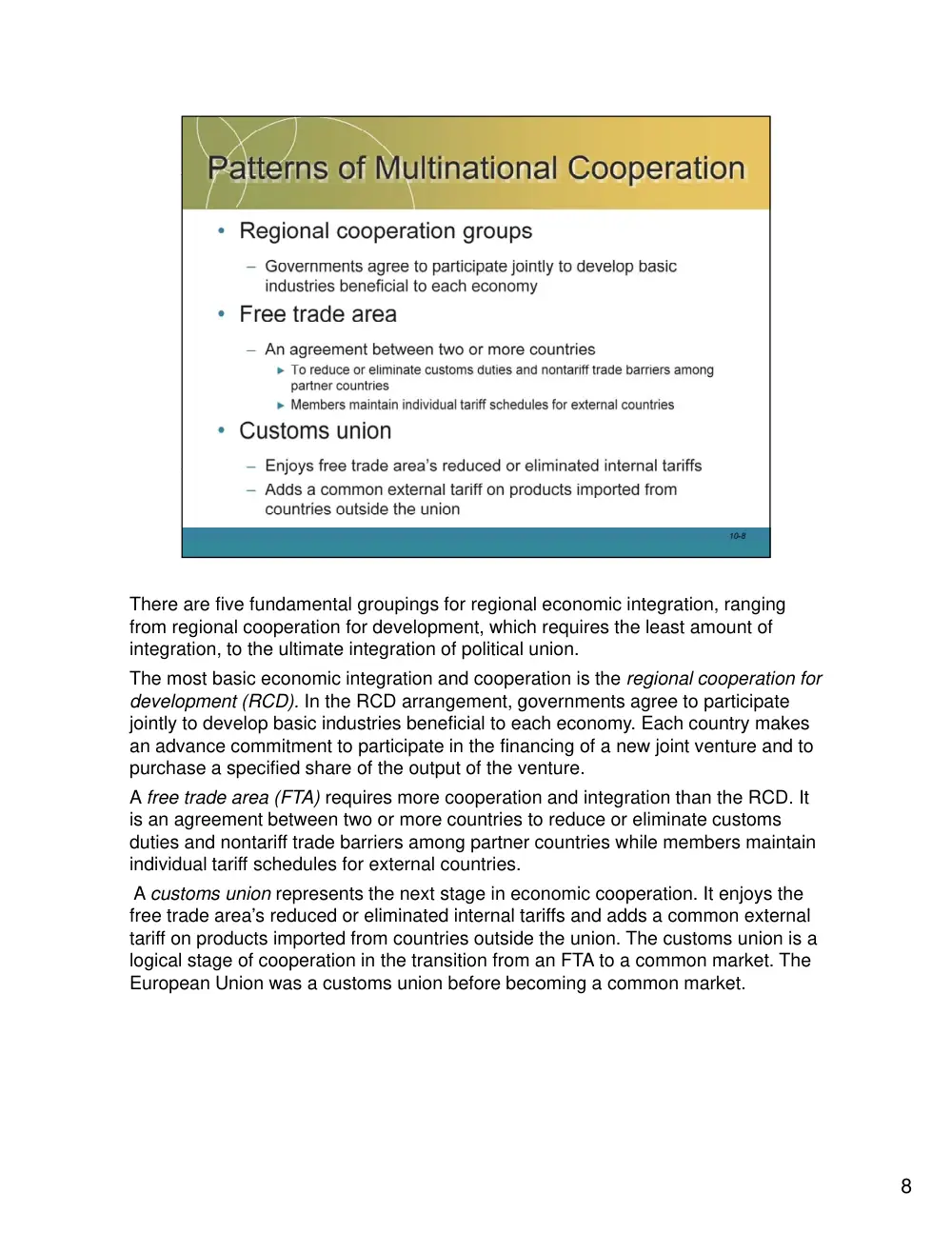
There are five fundamental groupings for regional economic integration, ranging
from regional cooperation for development, which requires the least amount of
integration, to the ultimate integration of political union.
The most basic economic integration and cooperation is the regional cooperation for
development (RCD). In the RCD arrangement, governments agree to participate
jointly to develop basic industries beneficial to each economy. Each country makes
an advance commitment to participate in the financing of a new joint venture and to
h
ifi d h
f th
t
t
f th
t
purchase a specified share of the output of the venture.
A free trade area (FTA) requires more cooperation and integration than the RCD. It
is an agreement between two or more countries to reduce or eliminate customs
duties and nontariff trade barriers among partner countries while members maintain
individual tariff schedules for external countries.
A customs union represents the next stage in economic cooperation. It enjoys the
f
t
d
’
d
d
li
i
t d i t
l t
iff
d
dd
t
l
free trade area’s reduced or eliminated internal tariffs and adds a common external
tariff on products imported from countries outside the union. The customs union is a
logical stage of cooperation in the transition from an FTA to a common market. The
European Union was a customs union before becoming a common market.
8
A common market agreement eliminates all tariffs and other restrictions on internal
trade, adopts a set of common external tariffs, and removes all restrictions on the
free flow of capital and labor among member nations. Thus a common market is a
common marketplace for goods as well as for services (including labor) and for
capital.
A political union is the most fully integrated form of regional cooperation. It involves
complete political and economic integration, either voluntary or enforced. The most
t bl
f
d
liti
l
i
th
C
il f
M t
l E
i A
i t
notable enforced political union was the Council for Mutual Economic Assistance
(COMECON), a centrally controlled group of countries organized by the Soviet
Union.
A commonwealth of nations is a voluntary organization providing for the loosest
possible relationship that can be classified as economic integration. The British
Commonwealth includes Britain and countries formerly part of the British Empire.
T
liti
l
i
i t
i t
i
th
1990
th
C
lth
f
Two new political unions came into existence in the 1990s: the Commonwealth of
Independent States (CIS), made up of the republics of the former Soviet Union, and
the European Union (EU). The European Union was created when the 12 nations of
the European Community ratified the Maastricht Treaty.
9
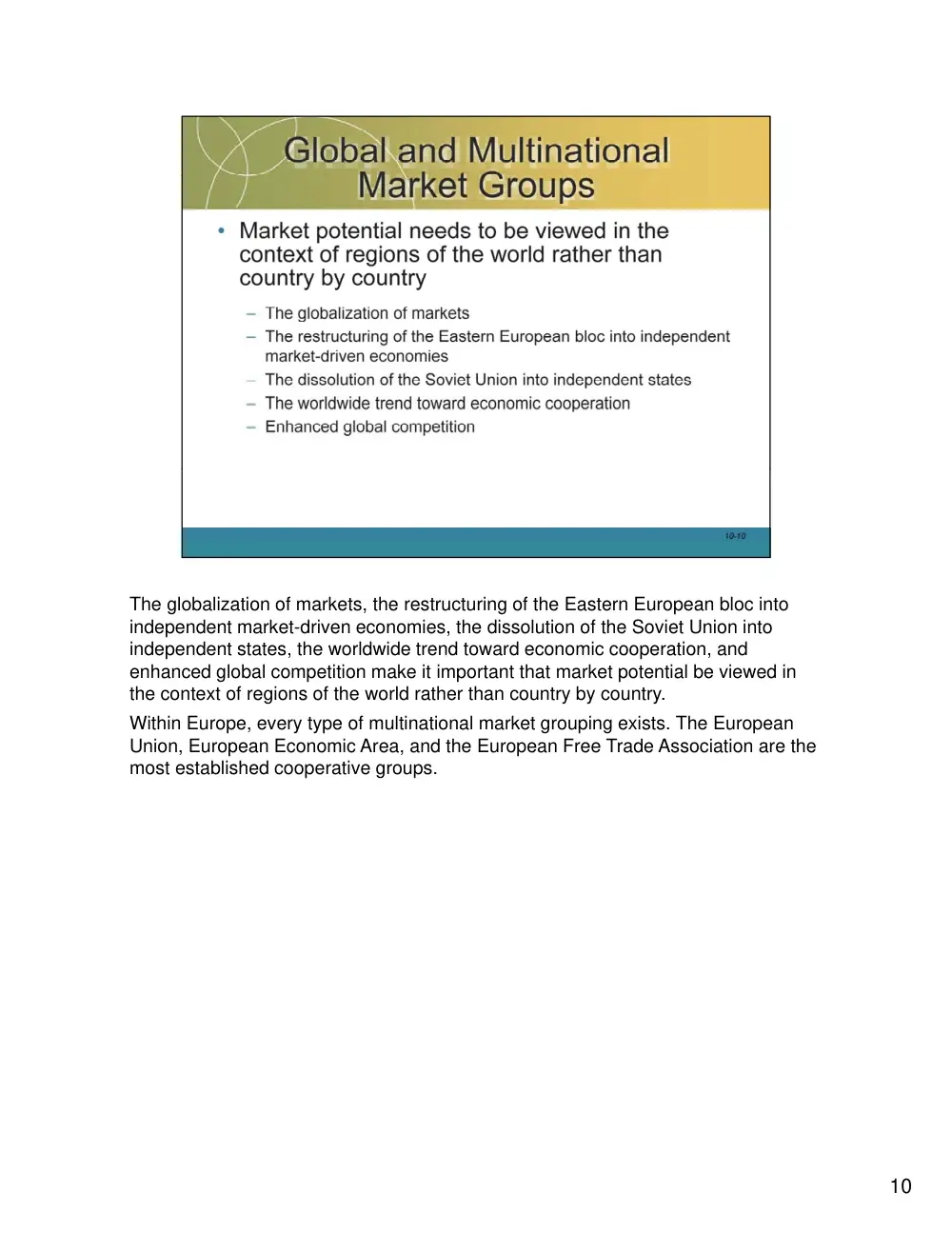
The globalization of markets, the restructuring of the Eastern European bloc into
independent market-driven economies, the dissolution of the Soviet Union into
independent states, the worldwide trend toward economic cooperation, and
enhanced global competition make it important that market potential be viewed in
the context of regions of the world rather than country by country.
Within Europe, every type of multinational market grouping exists. The European
Union, European Economic Area, and the European Free Trade Association are the
t
t bli h d
ti
most established cooperative groups.
10
In Exhibit 10.1, the GDP per capita at PPP for Germany is $27,438. (However, in
the last chapter in Exhibit 9.1, we reported the GDP per capita at PPP to be
“$33,000.” We point out this discrepancy to demonstrate that comparing such
statistics across international data bases is fraught with potential problems. For
Exhibit 9.1 we used Euromonitor as a source and in Exhibit 10.1, we used the World
Bank. Neither “estimate” of per capita income is inaccurate – they are just based on
different assumptions and different data collection methods.
11
Exhibit 10.2 illustrates the European economic area: including the EU, EFTA, and
Associates. As you can see, when Austria, Finland, and Sweden joined the EU in
1995, only Iceland, Liechtenstein, Norway, and Switzerland remained in EFTA.
12
Of all the multinational market groups, none is more secure in its cooperation or
more important economically than the European Union.
Historically, standards have been used to effectively limit market access. Germany
protected its beer market from the rest of Europe with a purity law requiring beer
sold in Germany to be brewed only from water, hops, malt, and yeast. Italy
protected its pasta market by requiring that pasta be made only from durum wheat.
Incidentally, the European Court of Justice has struck down both the beer and pasta
l ti
t
d
i l ti
regulations as trade violations.
The Single European Act (1987) was the agreement designed to finally remove all
barriers to trade and make the European Community a single internal market. In
addition to dismantling the existing barriers, the Single European Act proposed a
wide range of new commercial policies, including single European standards, one of
the more difficult and time-consuming goals to achieve.
13
Of all the multinational market groups, none is more secure in its cooperation or
more important economically than the European Union. Exhibit 10.3 demonstrates
the timeline dating from 1951 for the European Coal and Steel Industry to the
Monetary Union in 2007.
14
The European Union’s institutions form a federal pattern with executive,
parliamentary, and judicial branches: the European Commission, the Council of
Ministers, the European Parliament, and the Court of Justice. Their decision-making
processes have legal status and extensive powers in fields covered by common
policies. The European Union uses three legal instruments:
(1) regulations binding the member states directly and having the same strength as
national laws;
(2) directives also binding the member states but allowing them to choose the
means of execution; and
(3) decisions addressed to a government, an enterprise, or an individual, binding the
parties named.
Over the years, the Union has gained an increasing amount of authority over its
member states.
15
Britain, not wanting to join the EEC, conceived the European Free Trade
Association (EFTA) for those European nations not willing to join the EEC but
wanting to participate in a free trade area. Britain and other EFTA countries later
became members of the European Community in 1973.
When Austria, Finland, and Sweden joined the EU in 1995, Iceland, Liechtenstein,
Norway, and Switzerland remained in EFTA, which will most probably dissolve as its
members join either the European Economic Area (EEA) or the EU.
Because of the success of the EU, and concern that they might be left out of the
massive European market, five members of the European Free Trade Association
elected to join the 12 members of the EU in 1994 to form the European Economic
Area, a single market with free movement of goods, services, and capital.
The EFTA countries joining the EEA adopted most of the EU’s competition rules and
agreed to implement EU rules on company law; however, they maintain their
d
ti f
li i
domestic farm policies.
The EEA is governed by a special Council of Ministers composed of representatives
from EEA member nations.
16
The final step in the European Community’s march to union was ratification of the
Maastricht Treaty (1992).
The treaty provided for the Economic and Monetary Union (EMU) and European
Union. The treaty touched on all the missing links needed for a truly European
political union, including foreign policy.
Because procedures on how foreign policy and social legislation decisions are to be
made are so complex, another round of negotiations, which was concluded in the
Amsterdam Treaty (1997), was necessary.
Initially, the viability of a European Union was in considerable doubt. However,
within months of the ratification of the treaty, the EU was expanded to include
Austria, Finland, and Sweden — all members of the EEA. Norway voted not to join
the EU but remains a member of the European Economic Area. Much of the
concern persists even as the Economic and Monetary Union is put into place.
17
The EMU, a provision of the Maastricht Treaty, established the parameters of the
creation of a common currency for the EU, the euro, and established a timetable for
its implementation. In 2002, a central bank was established, conversion rates were
fixed, circulation of euro banknotes and coins was completed and the legal tender
status of participating members’ banknotes and coins was canceled.
Exhibit 10.4 describes the various denominations of the Euro:
Notes: There are seven euro notes in different colors and sizes, denominated in
500, 200, 100, 50, 20, 10 and 5 euros.
Coins: There are eight euro coins, denominated in 2 and 1 euros, then 50, 20, 10, 5,
2, and 1 cent. Every coin will carry a common European face—a map of the
European Union against a background of transverse lines to which are attached the
stars of the European flag. On the obverse, each member state will decorate the
coins with their own motifs, for example, the King of Spain or some national hero.
The graphic symbol for the euro was inspired by the Greek letter epsilon, in
reference to the cradle of European civilization and to the first letter of the word
Europe. It looks like an E with two clearly marked, horizontal parallel lines across it.
The parallel lines are meant to symbolize the stability of the euro. The official
abbreviation is “EUR.”
18
The Commonwealth of Independent States (Europe and Asia) have one other trade
group that has emerged and persisted since the dissolution of the Soviet Union: the
Commonwealth of Independent States (CIS).
The series of events after the aborted coup against Mikhail Gorbachev led to the
complete dissolution of the USSR. The first Soviet republics to declare
independence were the Baltic states, which quickly gained recognition by several
Western nations. The remaining 12 republics of the former USSR, collectively
k
th
N
l I d
d
t St t
(NIS)
d i t
th
C
lth
known as the Newly Independent States (NIS), regrouped into the Commonwealth
of Independent States.
The CIS is a loose economic and political alliance with open borders but no central
government. The main provisions of the commonwealth agreement are to repeal all
Soviet laws and assume the powers of the old regimes; launch radical economic
reforms, including freeing most prices; keep the ruble, but allow new currencies;
establish a European Union–style free trade association; create joint control of
establish a European Union–style free trade association; create joint control of
nuclear weapons; and fulfill all Soviet foreign treaties and debt obligations.
The 12 members of the CIS share a common history of central planning, and their
close cooperation could make the change to a market economy less painful, but
differences over economic policy, currency reform, and control of the military may
break them apart. How the CIS will be organized and what its ultimate importance
will be is anyone’s guess.
19
y
g
Similar to Exhibit 10.1, Exhibits 10.5 illustrates the same information for the 12
republics of the former USSR, known as the Newly Independent States (NIS).
regrouped into the Commonwealth of Independent States.
Russia ranks the highest is population, GDP, as well as both imports and exports of
goods and services.
While the three Slavic republics of Russia, Ukraine, and Belarus have interests and
history in common, as do the five Central Asian republics, the ties between these
two core groups of the CIS are tenuous and stem mainly from their former Soviet
membership.
20
Preceding the creation of the North American Free Trade Agreement (NAFTA), the
U it d St t
d C
d
h d th
ld’ l
t bil t
l t
d
t
h
United States and Canada had the world’s largest bilateral trade agreement; each was
the other’s largest trading partner. To further support trade activity, the two countries
established the United States–Canada Free Trade Area (CFTA), designed to eliminate
all trade barriers between the two countries. The CFTA created a single, continental
commercial market for all goods and most services. However, no economic or political
union of any kind was involved. It provided only for the elimination of tariffs and other
trade barriers.
Wh
NAFTA
ifi d
d b
ff
i
i
1994
i
l
k
f 360
illi
When NAFTA was ratified and became effective in 1994, a single market of 360 million
people with a $6 trillion GNP emerged. NAFTA required the three countries to remove
all tariffs and barriers to trade over 15 years, and beginning in 2008 all tariff barriers
were officially dropped But, for the most part, NAFTA is a comprehensive trade
agreement that addresses, and in most cases improves, all aspects of doing business
within North America.
The elimination of trade and investment barriers among Canada, Mexico, and the
United States creates one of the largest and richest markets in the world. Cross-
border cooperation seems to ameliorate other long-standing areas of conflict such as
legal and illegal immigration. NAFTA has paved the way for Wal-Mart to move into
Mexico and Mexican supermarket giant Gigante to move into the United States. Other
cross-border services are also thriving, including entertainment and health care. Job
losses have not been as drastic as once feared, in part because companies such as
Lucent Technologies have established maquiladora plants in anticipation of the
benefits from NAFTA
21
benefits from NAFTA.
Exhibit 10.6 lists some of the key provision of the trade agreement.
Market access − Within 10 years of implementation, all tariffs will be eliminated on
North American industrial products traded between Canada, Mexico, and the United
States.
Nontariff barriers − In addition to elimination of tariffs, Mexico will eliminate nontariff
barriers and other trade-distorting restrictions.
Rules of origin − NAFTA reduces tariffs only for goods made in North America Rules of
Rules of origin
NAFTA reduces tariffs only for goods made in North America. Rules of
origin are designed to prevent free riders from benefiting through minor processing or
transshipment of non-NAFTA goods.
Customs administration − Under NAFTA, Canada, Mexico, and the United States have
agreed to implement uniform customs procedures and regulations.
Investment − NAFTA will eliminate investment conditions that restrict the trade of goods
and services to Mexico
and services to Mexico.
Services – NAFTA establishes the first comprehensive set of principles governing
services trade.
Intellectual property – NAFTA will provide the highest standards of protection of
intellectual property available in any bilateral or international agreement.
Government procurement – NAFTA guarantees businesses fair and open competition
f
t i
N
th A
i
th
h t
t
d
di t bl
t
22
for procurement in North America through transparent and predictable procurement
procedures.
Standards – NAFTA prohibits the use of standards and technical regulations used as
obstacles to trade.
Mercosur (including Argentina, Bolivia, Brazil, Chile, Paraguay, and Uruguay) is the
second-largest common-market agreement in the Americas after NAFTA.
Since its inception, Mercosur has become the most influential and successful free trade
area in South America. With the addition of Bolivia and Chile in 1996, Mercosur became a
market of 220 million people with a combined GDP of nearly $1 trillion and is the third
largest free trade area in the world. In addition, negotiations have been under way since
1999 for a free trade agreement between the EU and Mercosur, the first region-to-region
f
t
d
d
free trade accord.
DR-CAFTA represents another important step toward the ultimate goal of a free trade
agreement encompassing all the Americas.
Another ambitious agreement, the Latin American Free Trade Association (LAFTA), gave
way to the Latin American Integration Association (LAIA or ALADI), with new rules of
organization that revitalized that group.
The success of the Caribbean Free Trade Association led to the creation of the Caribbean
Community and Common Market. CARICOM member countries continue in their efforts to
achieve true regional integration.
Initially NAFTA was envisioned as the blueprint for a free trade area extending from Alaska
to Argentina. The first new country to enter the NAFTA fold was to be Chile, then
membership was to extend south until there was a Free Trade Area of the Americas (FTAA)
b 2005 Th
ti
i
h th
th
ill b
FTAA
h th
th
ill b
t i
23
by 2005. The question now is whether there will be an FTAA or whether there will be a tri-
country NAFTA in the north and a South American Free Trade Area (SAFTA) led by Brazil
and the other member states of Mercosur in the south. The answer to this question rests in
part with the issue of fast-track legislation and the policies of the new American president.
Exhibit 10.7 lists countries of the Americas involved in trade associations.
Keeping track of all the proposed free trade areas in Latin America is a major
endeavor, because almost every country has either signed some type of trade
agreement or is involved in negotiations..
24
The primary multinational trade group in Asia is ASEAN. The goals of the group are
economic integration and cooperation through complementary industry programs;
preferential trading, including reduced tariff and nontariff barriers; guaranteed
member access to markets throughout the region; and harmonized investment
incentives.
Four major events account for the vigorous economic growth of the ASEAN
countries and their transformation from cheap-labor havens to industrialized nations:
(1) the ASEAN governments’ commitment to deregulation, liberalization, and
privatization of their economies;
(2) the decision to shift their economies from commodity based to manufacturing
based;
(3) the decision to specialize in manufacturing components in which they have a
comparative advantage (this created more diversity in their industrial output and
g
(
y
increased opportunities for trade); and
(4) Japan’s emergence as a major provider of technology and capital necessary to
upgrade manufacturing capability and develop new industries.
25
Exhibit 10.8 lists some of the fastest-growing economies in the region. The steps
countries took to expand and diversify their industrial base in order to foster
intraregional trade when ASEAN was first created have resulted in an increase in
trade among members.
26
The other important grouping that encompasses the Asian-Pacific Rim is the Asia-
Pacific Economic Cooperation. Formed in 1989, APEC provides a formal structure
for the major governments of the region, including the United States and Canada, to
discuss their mutual interests in open trade and economic collaboration. APEC is a
unique forum that has evolved into the primary regional vehicle for promoting trade
liberalization and economic cooperation. APEC includes all the major economies of
the region and the most dynamic, fastest-growing economies in the world.
APEC h
it
l
it
t t
t
d
t
i
i
APEC has as its common goal a commitment to open trade, to increase economic
collaboration, to sustain regional growth and development, to strengthen the
multilateral trading system, and to reduce barriers to investment and trade without
detriment to other economies.
27
Africa’s multinational market development activities can be characterized as a great
deal of activity but little progress. Despite the large number and assortment of paper
organizations, there has been little actual economic integration because of the political
instability that has characterized Africa in recent decades and the unstable economic
base on which Africa has had to build.
The Economic Community of West African States (ECOWAS) and the Southern
African Development Community (SADC) are the two most active regional cooperative
U f
t
t l
ECOWAS
ti
t
b
l
d
ith fi
i l
bl
groups. Unfortunately, ECOWAS continues to be plagued with financial problems,
conflict within the group, and inactivity on the part of some members. After 30 years,
the ECOWAS treaty and its much-defined objectives and the way they are to be
achieved over a 15-year period in three stages languishes; nothing has been achieved
and free trade remains a deferred dream.
The Southern African Development Community is the most advanced and viable of
Africa’s regional organizations Its 14 members encompass a landmass of 6 6 million
Africa s regional organizations. Its 14 members encompass a landmass of 6.6 million
square kilometers containing abundant natural resources and a population of over 200
million. South Africa, the region’s dominant economy, has a GDP of over $160 billion
and accounts for 76.8 percent of SADC market share. After years of negotiations, 11
members of SADC approved a free trade agreement aimed at phasing out a minimum
of 85 percent of tariffs within eight years, and all tariffs by the end of 2012.
28
Exhibit 10.9 lists the loosely defined African Union countries (except Morocco). In
addition, an estimated 200 other economic arrangements exist between
African countries.
29
The Middle East has been less aggressive in the formation of successfully
f
ti
i
lti
ti
l
k t
Th A
b C
M
k t h
t
l
functioning multinational market groups. The Arab Common Market has set goals
for free internal trade but has not succeeded. The Arab Gulf states, Egypt, and
Morocco have worked out an agreement on an Arab Free Trade Area, sometimes
called the Greater Arab Free Trade Area (GAFTA). This 2005 agreement is still in its
early stages of implementation and its success is thus uncertain.
The aim is to integrate the economies of the 22 Arab countries, but before that will
be feasible, a long history of border disputes and persisting ideological differences
ill h
b
will have to be overcome.
Iran, Pakistan, and Turkey, formerly the Regional Cooperation for Development
(R