
PHS 213 Final, Fall 2007
Notre Dame University–Louaize · Modern Physics · 1 page
Stuck on a question? A tutor can walk you through it.
More PHS 213 files
Show the text of this final exam
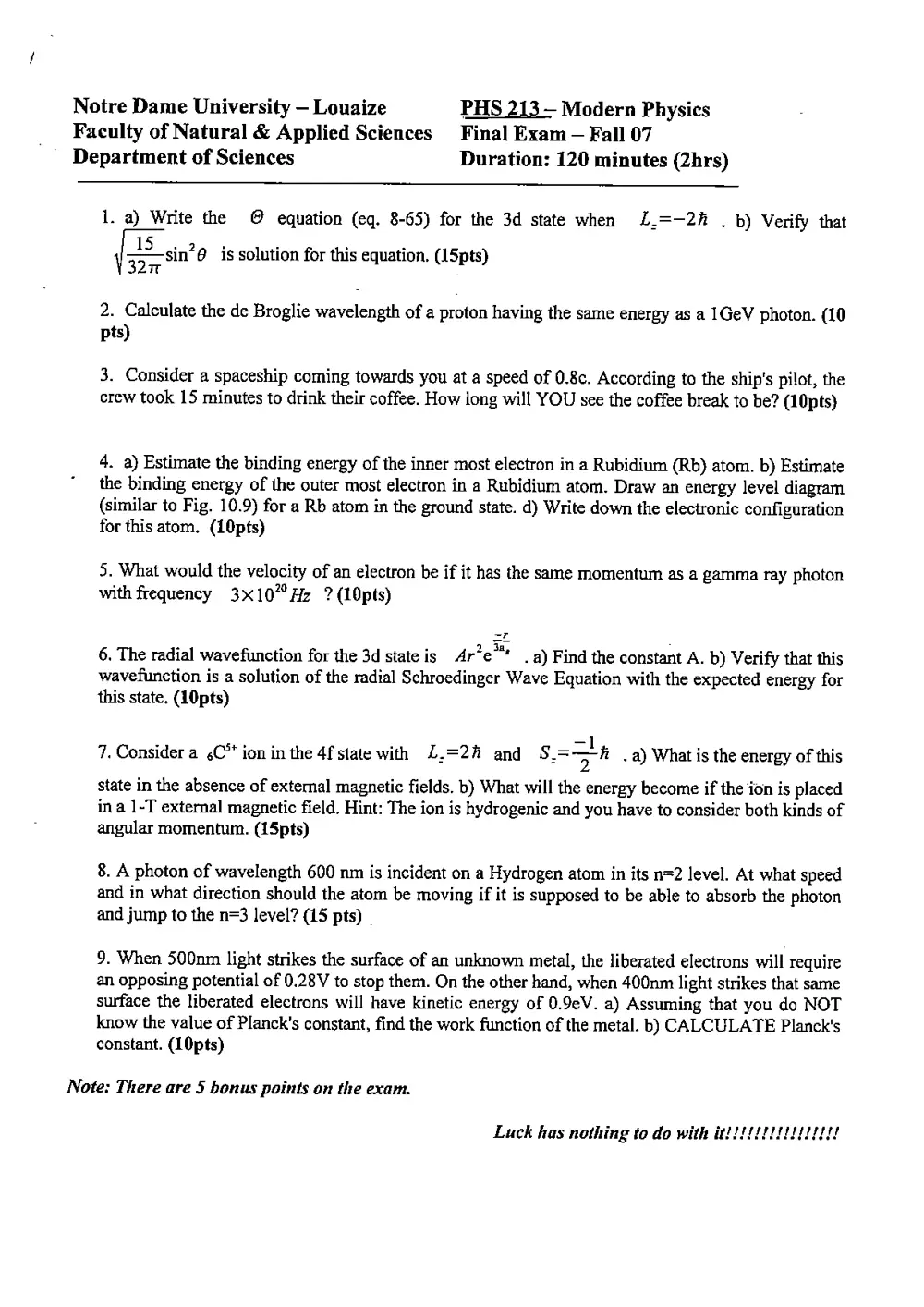
Notre Dame University — Louaize PHS 213 — Modern Physics
Faculty of Natural & Applied Sciences Final Exam — Fall 07
' Department of Sciences Duration: 120 minutes (2hrs)
1. a) Write the © equation (eq. 8-65) for the 3d state when L.=—2h . b) Verify that
{apsin’o is solution for this equation, (15pts)
TT .
2. Calculate the de Broglie wavelength of a proton having the same energy as a 1GeV photon. (10
pts)
3. Consider a spaceship coming towards you at a speed of 0.8c. According to the ship's pilot, the
crew took 15 minutes to drink their coffee. How long will YOU see the coffee break to be? (10pts)
4. a} Estimate the binding energy of the inner most electron in a Rubidium (Rb) atom. b) Estimate
the binding energy of the outer most electron in a Rubidium atom. Draw an energy level diagram
(similar to Fig. 10.9) for a Rb atom in the ground state. d) Write down the electronic configuration
for this atom. (10pts)
5. What would the velocity of an electron be if it has the same momentum as a gamma ray photon
with frequency 3x10" Hz ? (10pts)
ta
6. The radial wavefunction for the 3d state is. Ar’e™* a) Find the constant A. b) Verify that this
wavefunction is a solution of the radial Schroedinger Wave Equation with the expected energy for
this state. (10pts)
7. Consider a C** ion in the 4f state with 2.=2% and sath . a) What is the energy of this
state in the absence of external magnetic fields. b) What will the energy become if the ion is placed
ina 1-T external magnetic field. Hint: The ion is hydrogenic and you have to consider both kinds of
angular momentum. (15pts)
8. A photon of wavelength 600 nm is incident on a Hydrogen atom in its n=2 level. At what speed
and in what direction should the atom be moving if it is supposed to be able to absorb the photon
and jump to the n=3 level? (15 pis) _
9. When 500nm light strikes the surface of an unknown metal, the liberated electrons will require
an opposing potential of 0.28V to stop them. On the other hand, when 400nm light strikes that same
surface the liberated electrons will have kinetic energy of 0.9eV. a) Assuming that you do NOT
know the value of Planck's constant, find the work function of the metal. b) CALCULATE Planck's
constant. (10pts)
Note; There are 5 bonus points on the exam.