
POS 201 Midterm, Spring 2016
Notre Dame University–Louaize · Introduction to Political Science · 3 pages · Ms. Queen Salame
More POS 201 files
- Exam 1 Exam 1 Ndu Barsa Campus · Fall 2016ExamView
- Exam 1 · Fall 2013ExamView
- Midterm Also Exam 2 · Fall 2013ExamView
- Chapter 1 · Fall 2016ChapterView
- Chapter Anarchism · Fall 2016ChapterView
- Chapter Democracy · Fall 2016ChapterView
- Chapter Fascism · Fall 2016ChapterView
- Chapter Marxism · Fall 2016ChapterView
Show the text of this exam
Se ae a
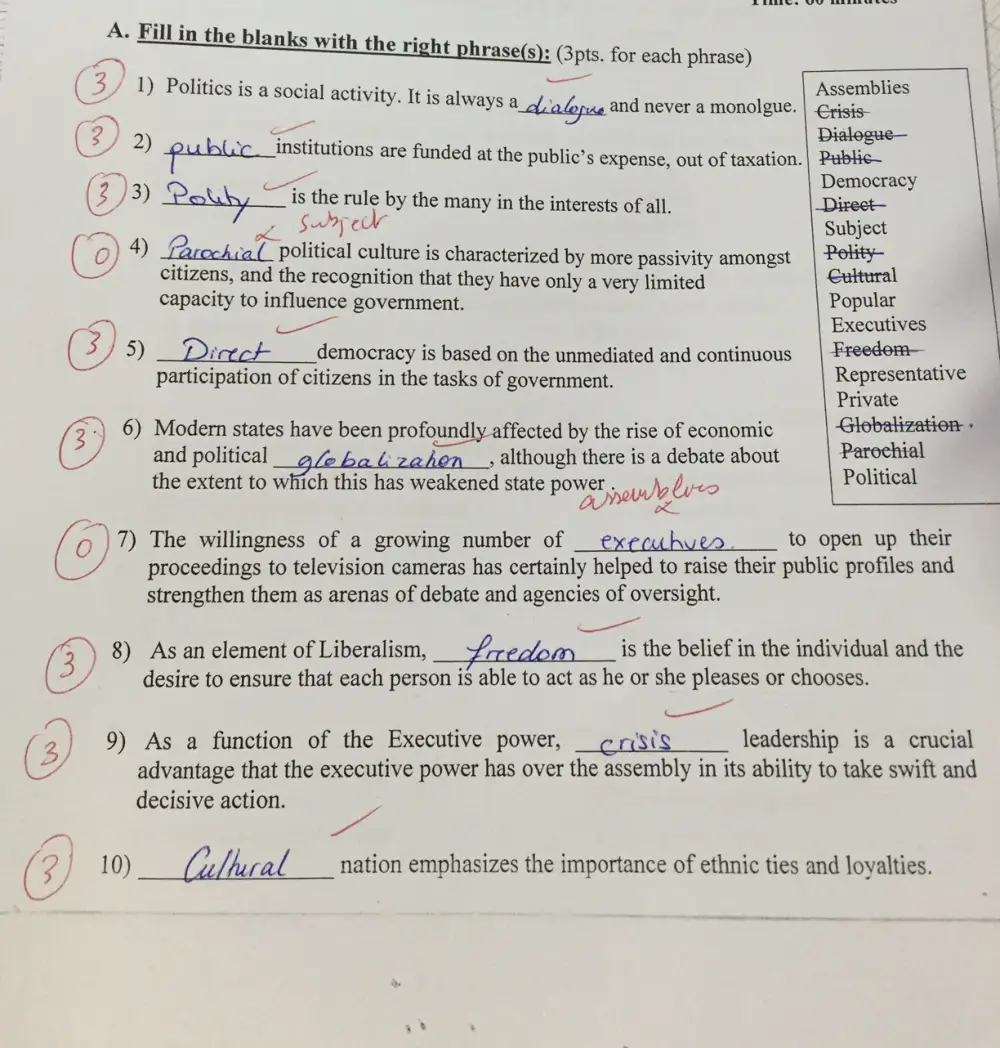
A. Fill in the blanks wi
t :
ie with the right phrase(s): (3pts. for each phrase)
' 3/ 1) Politics is a soci ivi ; Assemblies
L - . Cial activity. It is always A dialopue and never a monolgue. | €+jsi5-
( “4 %) ot si Di S
LY 2) -purbisc institutions are funded at the public’s expense, out of taxation.| Public
2 .) 3) ge Democracy
(3 / Path, — Is a se the many in the interests of all. Direet-
cee oe we pee yee Subject
(o) 4) SLarechia( political culture is characterized by more passivity amongst | Potty
citizens, and the recognition that they have only a very limited Caltural
capacity to influence government. Popular
5; ae Executives
(7) 5) _—Dirrc# __ democracy is based on the unmediated and continuous | Freeéem—
participation of citizens in the tasks of government. Representative
Private
2°) 6) Modern states have been profoundly affected by the rise of economic Globalization :
iti ; Parochial
and political — pleat eatin, although there is a debate about Taree
the extent to which this has weakened state power, wh! byxo Political
(9) 7) The willingness of a growing number of _ execuhver. to open up their
proceedings to television cameras has certainly helped to raise their public profiles and
strengthen them as arenas of debate and agencies of oversight.
jae
3) 8) As an element of Liberalism, Srredom is the belief in the individual and the
(3 i
vw %
desire to ensure that each person is able to act as he or she pleases or chooses.
cape
9) As a function of the Executive power, rst leadership is a crucial
advantage that the executive power has over the assembly in its ability to take swift and
decisive action.
Callural
g
ve
10) nation emphasizes the importance of ethnic ties and loyalties.
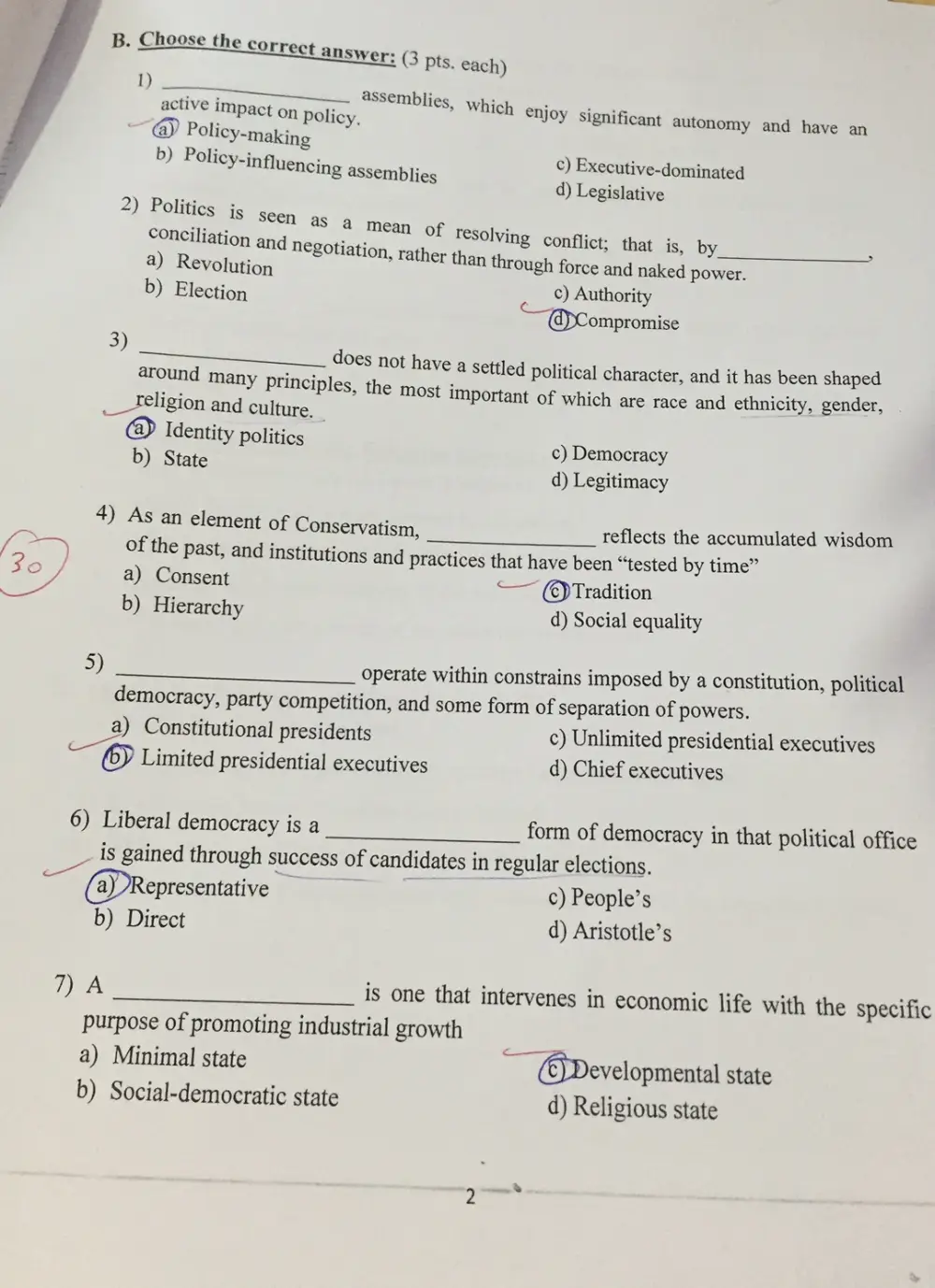
@ Policy-making
. : # ae
Icy. influencing assemblies x a ee
2) Politics
conciliation aie wean of resolving conflict; that is, by :
: aa negotiation, rather than through force and naked Owen cae
a) Revolution ; Power.
b) Election “oh Authority
@ompromise
3)
does not have a settled
: political character, and it has been shaped
around many Principles, th
ae © most important of which are race and ethnicity, gender,
_eligion and culture,
@ Identity Politics c) Democracy
) State d) Legitimacy
4) As an element of Conservatism, reflects the accumulated wisdom
ee. of the past, and institutions and practices that have been “tested by time”
ee a) Consent ——~ @Tradition
b) Hierarchy d) Social equality
5) operate within constrains imposed by a constitution, political
democracy, party competition, and some form of separation of powers.
a) Constitutional presidents c) Unlimited presidential executives
) Limited presidential executives d) Chief executives
6) Liberal democracy is a
form of democracy in that political office
ee is gained through success of candidates in regular elections.
(a Representative c) People’s
b) Direct d) Aristotle’s
7) A
is one that intervenes in economic life with the specific
purpose of promoting industrial growth
a) Minimal state
~~ ©Developmental state
b) Social-democratic state
d) Religious state
a) Weste lo
tm yalty
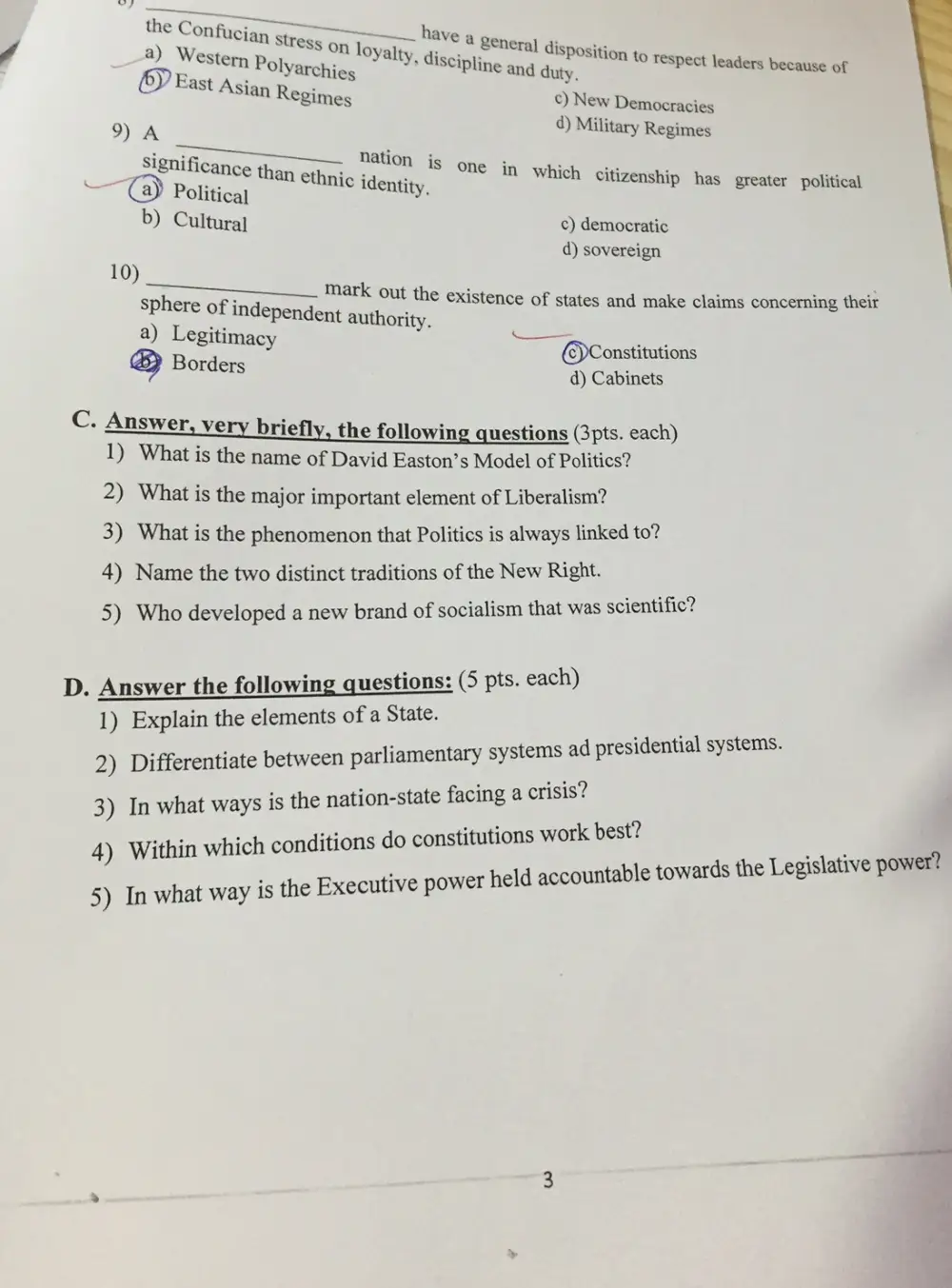
& Sted Aa ) discipline er pot to respect leaders because of
N Regime %
Ss c ;
9) A pe Democracies
Signifi i athe
nificance th nation is :
a i one : Ae
Political n ethnic identity, sn which citizenship has greater political
b) Cultural
¢) democratic
d) sovereign
mark A
spher : Out the ex
Phere of independent authority istence of states and make claims concerning their
a ae
) Legitimacy Ce
B Borders (Constitutions
d) Cabinets
CG: Answer. .
very briefly, the following questions (3pts. each)
1) What is the name of David Easton’s Model of Politics?
2) What is the major important element of Liberalism?
3) What is the phenomenon that Politics is always linked to?
4) Name the two distinct traditions of the New Right.
5) Who developed a new brand of socialism that was scientific?
D. Answer the following questions: (5 pts. each)
1) Explain the elements of a State.
2) Differentiate between parliamentary systems ad presidential sy
3) In what ways is the nation-state facing a crisis?
4) Within which conditions do constitutions work best?
ecutive power held accountable towards th
stems.
5) In what way is the Ex e Legislative power?