
PSL 201 Midterm, Spring 2015
Notre Dame University–Louaize · Introduction to Psychology · 10 pages · Dr. Maral Boyadjian
More PSL 201 files
Show the text of this exam
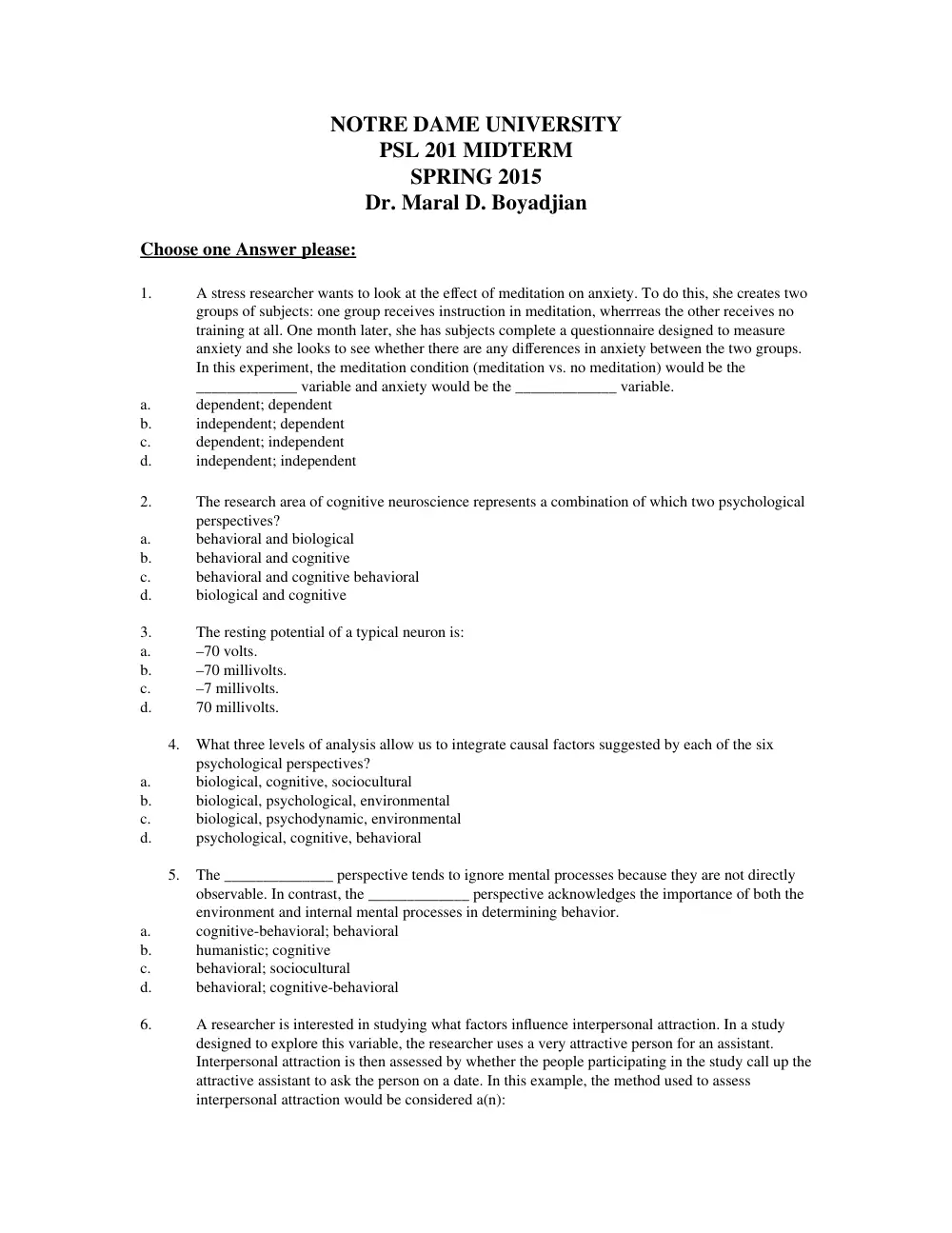
NOTRE DAME UNIVERSITY
PSL 201 MIDTERM
SPRING 2015
Dr. Maral D. Boyadjian
Choose one Answer please:
1.
A stress researcher wants to look at the effect of meditation on anxiety. To do this, she creates two
groups of subjects: one group receives instruction in meditation, wherrreas the other receives no
training at all. One month later, she has subjects complete a questionnaire designed to measure
anxiety and she looks to see whether there are any differences in anxiety between the two groups.
In this experiment, the meditation condition (meditation vs. no meditation) would be the
_____________ variable and anxiety would be the _____________ variable.
a.
dependent; dependent
b.
independent; dependent
c.
dependent; independent
d.
independent; independent
2.
The research area of cognitive neuroscience represents a combination of which two psychological
perspectives?
a.
behavioral and biological
b.
behavioral and cognitive
c.
behavioral and cognitive behavioral
d.
biological and cognitive
3.
The resting potential of a typical neuron is:
a.
–70 volts.
b.
–70 millivolts.
c.
–7 millivolts.
d.
70 millivolts.
4.
What three levels of analysis allow us to integrate causal factors suggested by each of the six
psychological perspectives?
a.
biological, cognitive, sociocultural
b.
biological, psychological, environmental
c.
biological, psychodynamic, environmental
d.
psychological, cognitive, behavioral
5.
The ______________ perspective tends to ignore mental processes because they are not directly
observable. In contrast, the _____________ perspective acknowledges the importance of both the
environment and internal mental processes in determining behavior.
a.
cognitive-behavioral; behavioral
b.
humanistic; cognitive
c.
behavioral; sociocultural
d.
behavioral; cognitive-behavioral
6.
A researcher is interested in studying what factors influence interpersonal attraction. In a study
designed to explore this variable, the researcher uses a very attractive person for an assistant.
Interpersonal attraction is then assessed by whether the people participating in the study call up the
attractive assistant to ask the person on a date. In this example, the method used to assess
interpersonal attraction would be considered a(n):
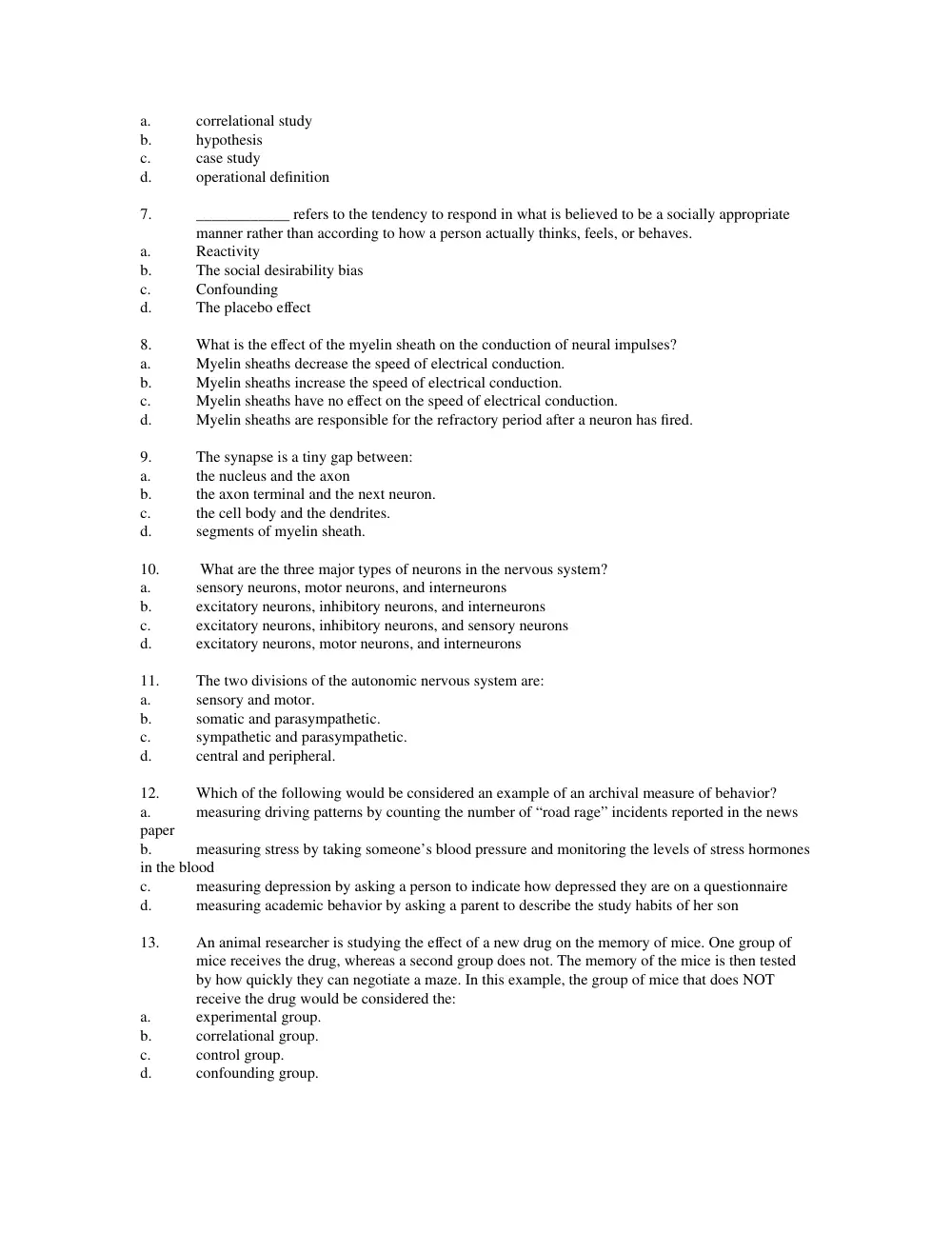
a.
correlational study
b.
hypothesis
c.
case study
d.
operational definition
7.
____________ refers to the tendency to respond in what is believed to be a socially appropriate
manner rather than according to how a person actually thinks, feels, or behaves.
a.
Reactivity
b.
The social desirability bias
c.
Confounding
d.
The placebo effect
8.
What is the effect of the myelin sheath on the conduction of neural impulses?
a.
Myelin sheaths decrease the speed of electrical conduction.
b.
Myelin sheaths increase the speed of electrical conduction.
c.
Myelin sheaths have no effect on the speed of electrical conduction.
d.
Myelin sheaths are responsible for the refractory period after a neuron has fired.
9.
The synapse is a tiny gap between:
a.
the nucleus and the axon
b.
the axon terminal and the next neuron.
c.
the cell body and the dendrites.
d.
segments of myelin sheath.
10.
What are the three major types of neurons in the nervous system?
a.
sensory neurons, motor neurons, and interneurons
b.
excitatory neurons, inhibitory neurons, and interneurons
c.
excitatory neurons, inhibitory neurons, and sensory neurons
d.
excitatory neurons, motor neurons, and interneurons
11.
The two divisions of the autonomic nervous system are:
a.
sensory and motor.
b.
somatic and parasympathetic.
c.
sympathetic and parasympathetic.
d.
central and peripheral.
12.
Which of the following would be considered an example of an archival measure of behavior?
a.
measuring driving patterns by counting the number of “road rage” incidents reported in the news
paper
b.
measuring stress by taking someone’s blood pressure and monitoring the levels of stress hormones
in the blood
c.
measuring depression by asking a person to indicate how depressed they are on a questionnaire
d.
measuring academic behavior by asking a parent to describe the study habits of her son
13.
An animal researcher is studying the effect of a new drug on the memory of mice. One group of
mice receives the drug, whereas a second group does not. The memory of the mice is then tested
by how quickly they can negotiate a maze. In this example, the group of mice that does NOT
receive the drug would be considered the:
a.
experimental group.
b.
correlational group.
c.
control group.
d.
confounding group.
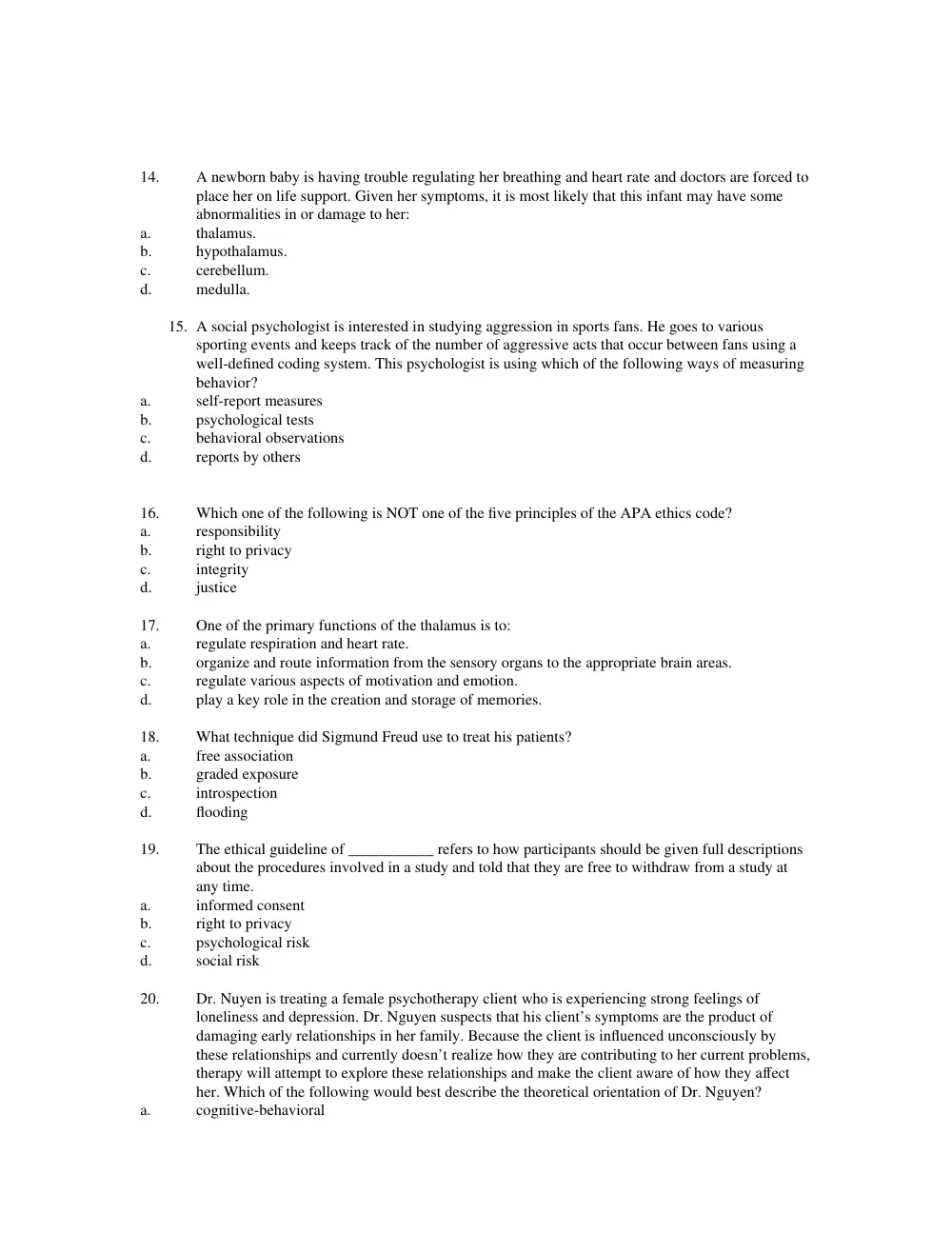
14.
A newborn baby is having trouble regulating her breathing and heart rate and doctors are forced to
place her on life support. Given her symptoms, it is most likely that this infant may have some
abnormalities in or damage to her:
a.
thalamus.
b.
hypothalamus.
c.
cerebellum.
d.
medulla.
15. A social psychologist is interested in studying aggression in sports fans. He goes to various
sporting events and keeps track of the number of aggressive acts that occur between fans using a
well-defined coding system. This psychologist is using which of the following ways of measuring
behavior?
a.
self-report measures
b.
psychological tests
c.
behavioral observations
d.
reports by others
16.
Which one of the following is NOT one of the five principles of the APA ethics code?
a.
responsibility
b.
right to privacy
c.
integrity
d.
justice
17.
One of the primary functions of the thalamus is to:
a.
regulate respiration and heart rate.
b.
organize and route information from the sensory organs to the appropriate brain areas.
c.
regulate various aspects of motivation and emotion.
d.
play a key role in the creation and storage of memories.
18.
What technique did Sigmund Freud use to treat his patients?
a.
free association
b.
graded exposure
c.
introspection
d.
flooding
19.
The ethical guideline of ___________ refers to how participants should be given full descriptions
about the procedures involved in a study and told that they are free to withdraw from a study at
any time.
a.
informed consent
b.
right to privacy
c.
psychological risk
d.
social risk
20.
Dr. Nuyen is treating a female psychotherapy client who is experiencing strong feelings of
loneliness and depression. Dr. Nguyen suspects that his client’s symptoms are the product of
damaging early relationships in her family. Because the client is influenced unconsciously by
these relationships and currently doesn’t realize how they are contributing to her current problems,
therapy will attempt to explore these relationships and make the client aware of how they affect
her. Which of the following would best describe the theoretical orientation of Dr. Nguyen?
a.
cognitive-behavioral
b.
behavioral
c.
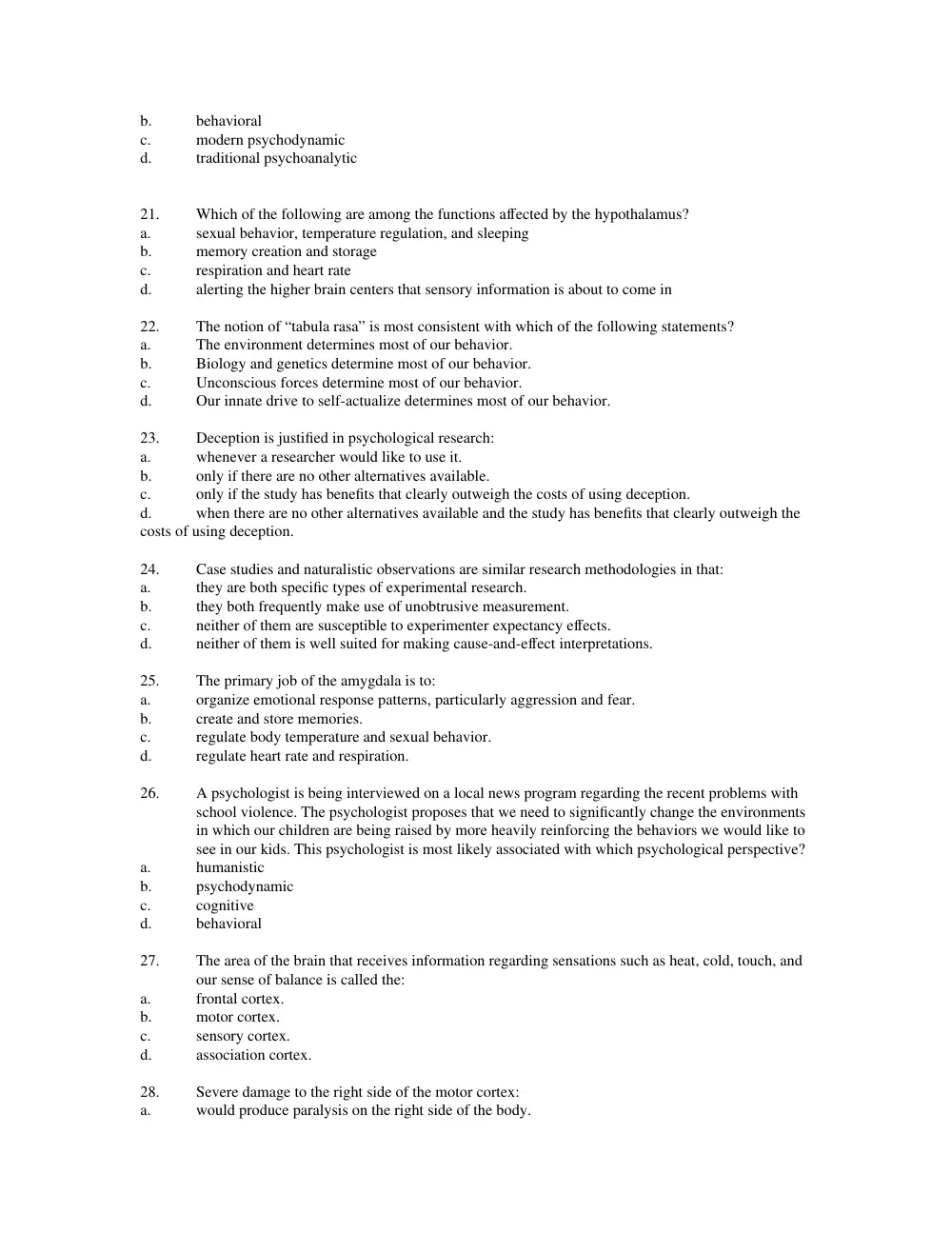
modern psychodynamic
d.
traditional psychoanalytic
21.
Which of the following are among the functions affected by the hypothalamus?
a.
sexual behavior, temperature regulation, and sleeping
b.
memory creation and storage
c.
respiration and heart rate
d.
alerting the higher brain centers that sensory information is about to come in
22.
The notion of “tabula rasa” is most consistent with which of the following statements?
a.
The environment determines most of our behavior.
b.
Biology and genetics determine most of our behavior.
c.
Unconscious forces determine most of our behavior.
d.
Our innate drive to self-actualize determines most of our behavior.
23.
Deception is justified in psychological research:
a.
whenever a researcher would like to use it.
b.
only if there are no other alternatives available.
c.
only if the study has benefits that clearly outweigh the costs of using deception.
d.
when there are no other alternatives available and the study has benefits that clearly outweigh the
costs of using deception.
24.
Case studies and naturalistic observations are similar research methodologies in that:
a.
they are both specific types of experimental research.
b.
they both frequently make use of unobtrusive measurement.
c.
neither of them are susceptible to experimenter expectancy effects.
d.
neither of them is well suited for making cause-and-effect interpretations.
25.
The primary job of the amygdala is to:
a.
organize emotional response patterns, particularly aggression and fear.
b.
create and store memories.
c.
regulate body temperature and sexual behavior.
d.
regulate heart rate and respiration.
26.
A psychologist is being interviewed on a local news program regarding the recent problems with
school violence. The psychologist proposes that we need to significantly change the environments
in which our children are being raised by more heavily reinforcing the behaviors we would like to
see in our kids. This psychologist is most likely associated with which psychological perspective?
a.
humanistic
b.
psychodynamic
c.
cognitive
d.
behavioral
27.
The area of the brain that receives information regarding sensations such as heat, cold, touch, and
our sense of balance is called the:
a.
frontal cortex.
b.
motor cortex.
c.
sensory cortex.
d.
association cortex.
28.
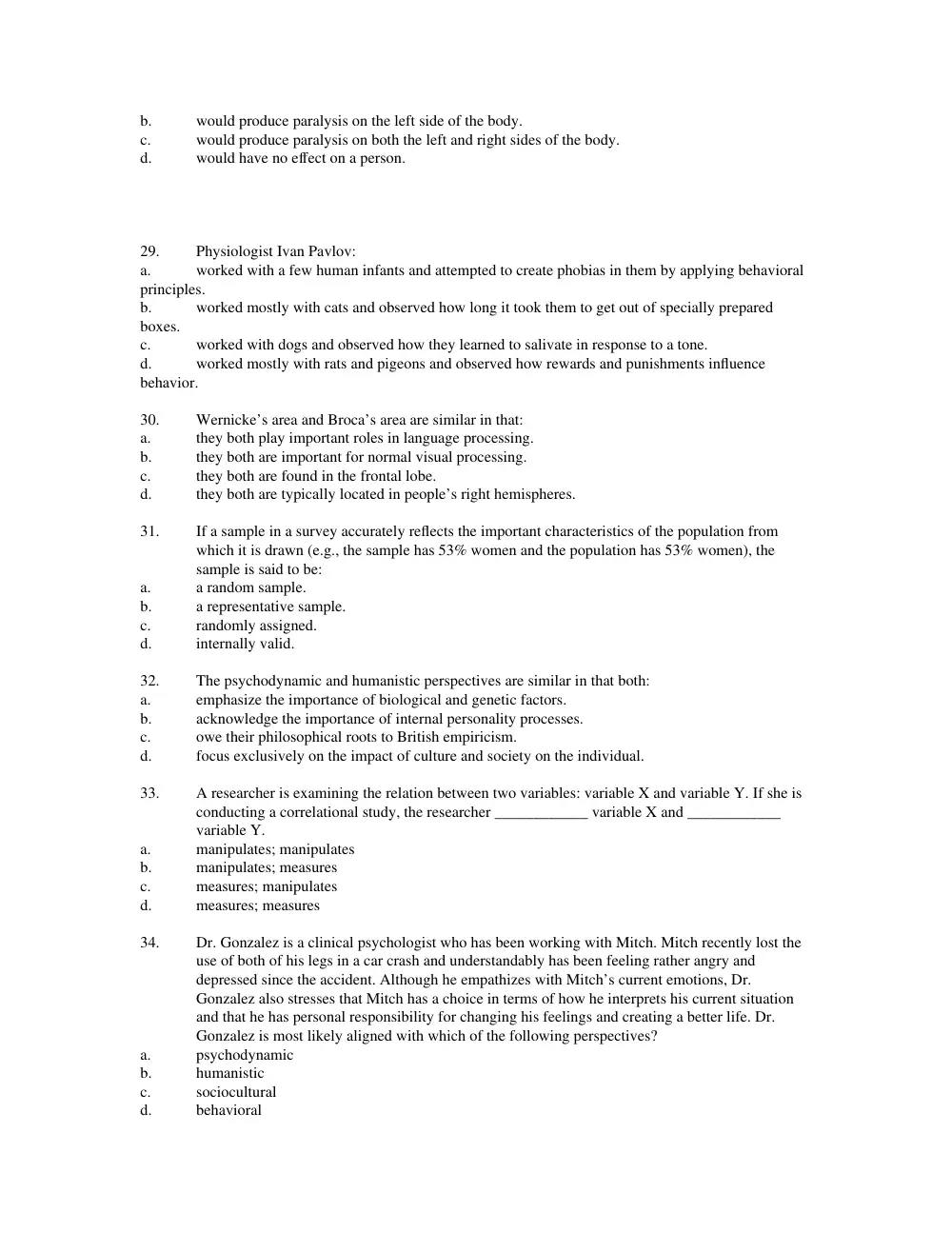
Severe damage to the right side of the motor cortex:
a.
would produce paralysis on the right side of the body.
b.
would produce paralysis on the left side of the body.
c.
would produce paralysis on both the left and right sides of the body.
d.
would have no effect on a person.
29.
Physiologist Ivan Pavlov:
a.
worked with a few human infants and attempted to create phobias in them by applying behavioral
principles.
b.
worked mostly with cats and observed how long it took them to get out of specially prepared
boxes.
c.
worked with dogs and observed how they learned to salivate in response to a tone.
d.
worked mostly with rats and pigeons and observed how rewards and punishments influence
behavior.
30.
Wernicke’s area and Broca’s area are similar in that:
a.
they both play important roles in language processing.
b.
they both are important for normal visual processing.
c.
they both are found in the frontal lobe.
d.
they both are typically located in people’s right hemispheres.
31.
If a sample in a survey accurately reflects the important characteristics of the population from
which it is drawn (e.g., the sample has 53% women and the population has 53% women), the
sample is said to be:
a.
a random sample.
b.
a representative sample.
c.
randomly assigned.
d.
internally valid.
32.
The psychodynamic and humanistic perspectives are similar in that both:
a.
emphasize the importance of biological and genetic factors.
b.
acknowledge the importance of internal personality processes.
c.
owe their philosophical roots to British empiricism.
d.
focus exclusively on the impact of culture and society on the individual.
33.
A researcher is examining the relation between two variables: variable X and variable Y. If she is
conducting a correlational study, the researcher ____________ variable X and ____________
variable Y.
a.
manipulates; manipulates
b.
manipulates; measures
c.
measures; manipulates
d.
measures; measures
34.
Dr. Gonzalez is a clinical psychologist who has been working with Mitch. Mitch recently lost the
use of both of his legs in a car crash and understandably has been feeling rather angry and
depressed since the accident. Although he empathizes with Mitch’s current emotions, Dr.
Gonzalez also stresses that Mitch has a choice in terms of how he interprets his current situation
and that he has personal responsibility for changing his feelings and creating a better life. Dr.
Gonzalez is most likely aligned with which of the following perspectives?
a.
psychodynamic
b.
humanistic
c.
sociocultural
d.
behavioral
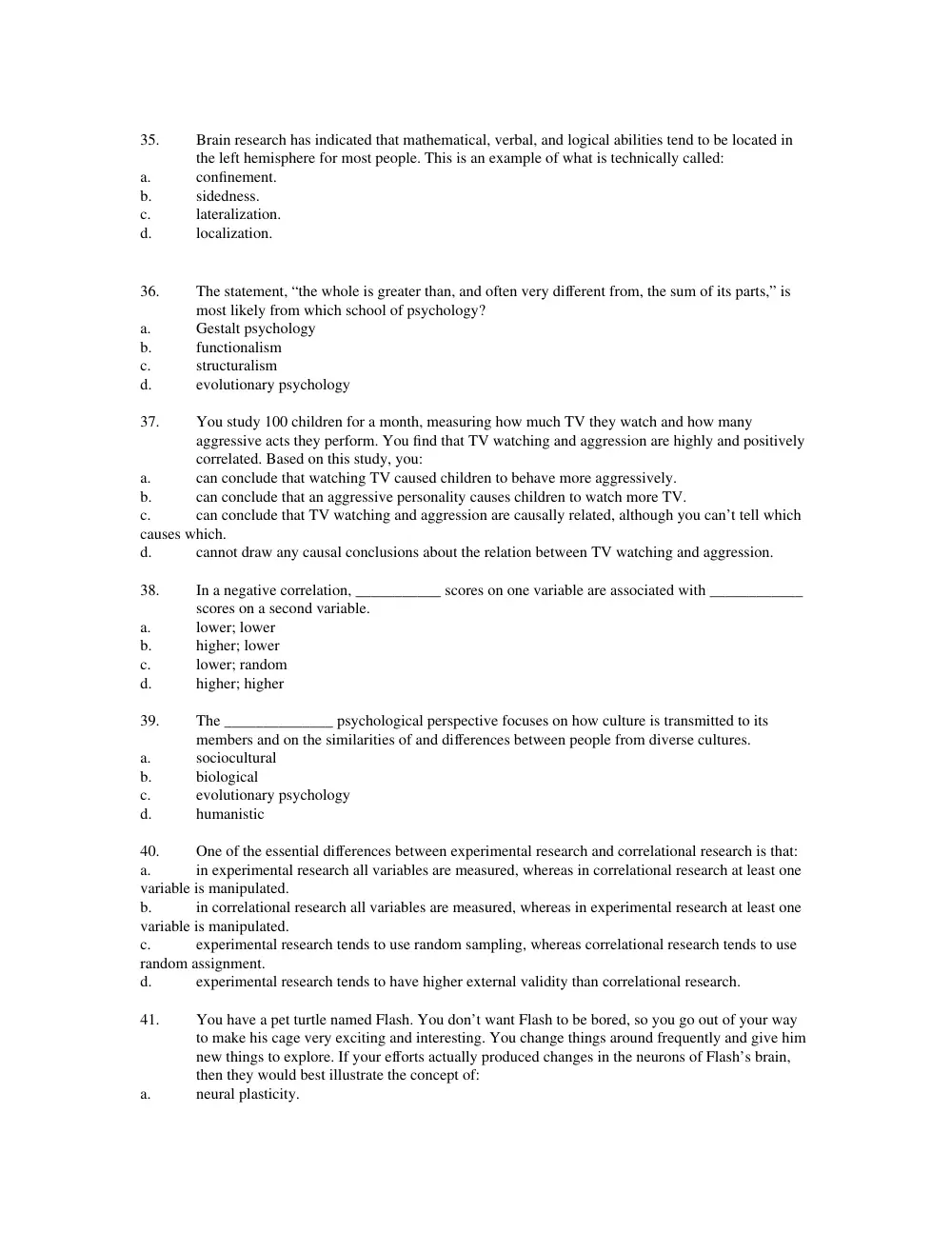
35.
Brain research has indicated that mathematical, verbal, and logical abilities tend to be located in
the left hemisphere for most people. This is an example of what is technically called:
a.
confinement.
b.
sidedness.
c.
lateralization.
d.
localization.
36.
The statement, “the whole is greater than, and often very different from, the sum of its parts,” is
most likely from which school of psychology?
a.
Gestalt psychology
b.
functionalism
c.
structuralism
d.
evolutionary psychology
37.
You study 100 children for a month, measuring how much TV they watch and how many
aggressive acts they perform. You find that TV watching and aggression are highly and positively
correlated. Based on this study, you:
a.
can conclude that watching TV caused children to behave more aggressively.
b.
can conclude that an aggressive personality causes children to watch more TV.
c.
can conclude that TV watching and aggression are causally related, although you can’t tell which
causes which.
d.
cannot draw any causal conclusions about the relation between TV watching and aggression.
38.
In a negative correlation, ___________ scores on one variable are associated with ____________
scores on a second variable.
a.
lower; lower
b.
higher; lower
c.
lower; random
d.
higher; higher
39.
The ______________ psychological perspective focuses on how culture is transmitted to its
members and on the similarities of and differences between people from diverse cultures.
a.
sociocultural
b.
biological
c.
evolutionary psychology
d.
humanistic
40.
One of the essential differences between experimental research and correlational research is that:
a.
in experimental research all variables are measured, whereas in correlational research at least one
variable is manipulated.
b.
in correlational research all variables are measured, whereas in experimental research at least one
variable is manipulated.
c.
experimental research tends to use random sampling, whereas correlational research tends to use
random assignment.
d.
experimental research tends to have higher external validity than correlational research.
41.
You have a pet turtle named Flash. You don’t want Flash to be bored, so you go out of your way
to make his cage very exciting and interesting. You change things around frequently and give him
new things to explore. If your efforts actually produced changes in the neurons of Flash’s brain,
then they would best illustrate the concept of:
a.
neural plasticity.
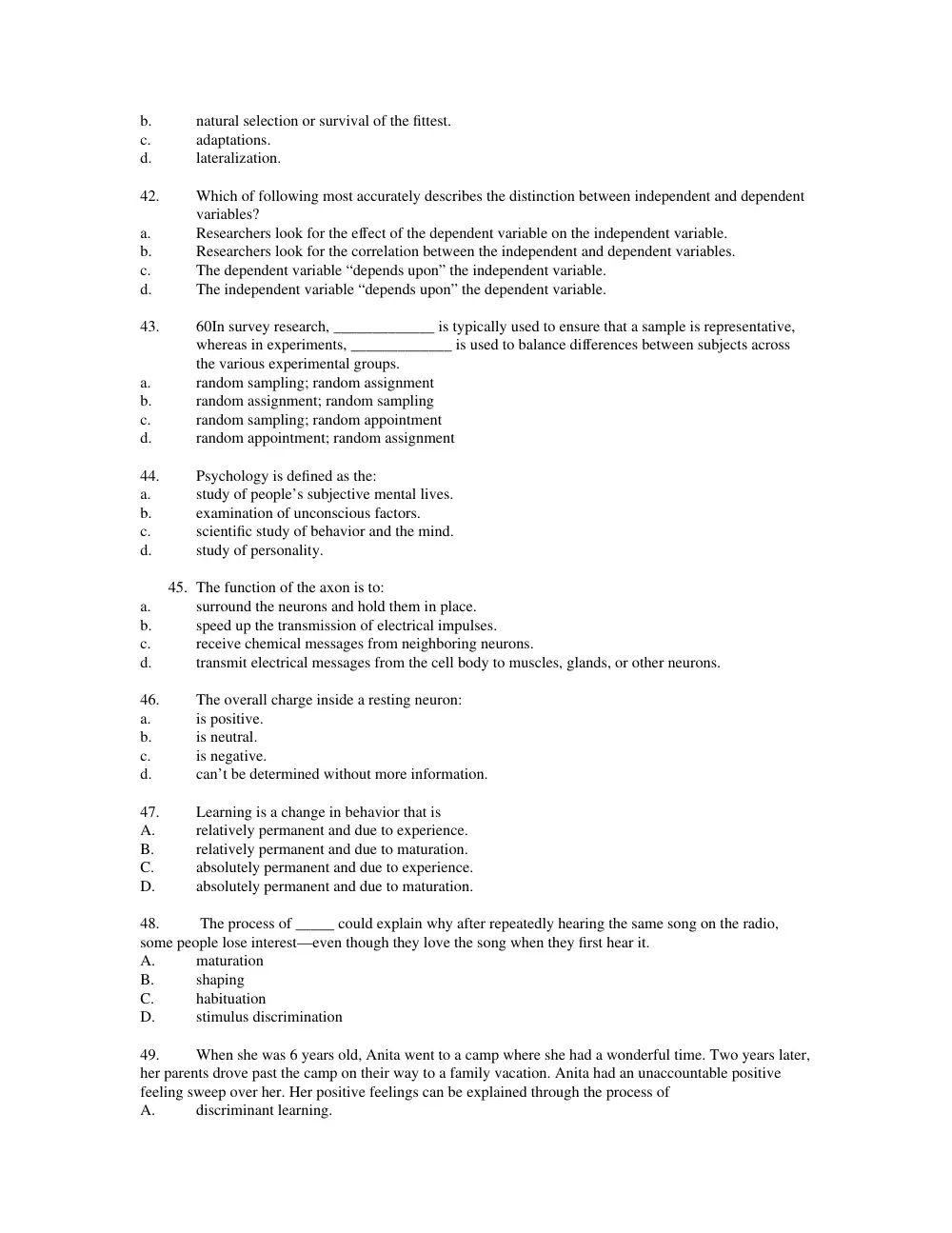
b.
natural selection or survival of the fittest.
c.
adaptations.
d.
lateralization.
42.
Which of following most accurately describes the distinction between independent and dependent
variables?
a.
Researchers look for the effect of the dependent variable on the independent variable.
b.
Researchers look for the correlation between the independent and dependent variables.
c.
The dependent variable “depends upon” the independent variable.
d.
The independent variable “depends upon” the dependent variable.
43.
60In survey research, _____________ is typically used to ensure that a sample is representative,
whereas in experiments, _____________ is used to balance differences between subjects across
the various experimental groups.
a.
random sampling; random assignment
b.
random assignment; random sampling
c.
random sampling; random appointment
d.
random appointment; random assignment
44.
Psychology is defined as the:
a.
study of people’s subjective mental lives.
b.
examination of unconscious factors.
c.
scientific study of behavior and the mind.
d.
study of personality.
45. The function of the axon is to:
a.
surround the neurons and hold them in place.
b.
speed up the transmission of electrical impulses.
c.
receive chemical messages from neighboring neurons.
d.
transmit electrical messages from the cell body to muscles, glands, or other neurons.
46.
The overall charge inside a resting neuron:
a.
is positive.
b.
is neutral.
c.
is negative.
d.
can’t be determined without more information.
47.
Learning is a change in behavior that is
A.
relatively permanent and due to experience.
B.
relatively permanent and due to maturation.
C.
absolutely permanent and due to experience.
D.
absolutely permanent and due to maturation.
48.
The process of _____ could explain why after repeatedly hearing the same song on the radio,
some people lose interest—even though they love the song when they first hear it.
A.
maturation
B.
shaping
C.
habituation
D.
stimulus discrimination
49.
When she was 6 years old, Anita went to a camp where she had a wonderful time. Two years later,
her parents drove past the camp on their way to a family vacation. Anita had an unaccountable positive
feeling sweep over her. Her positive feelings can be explained through the process of
A.
discriminant learning.
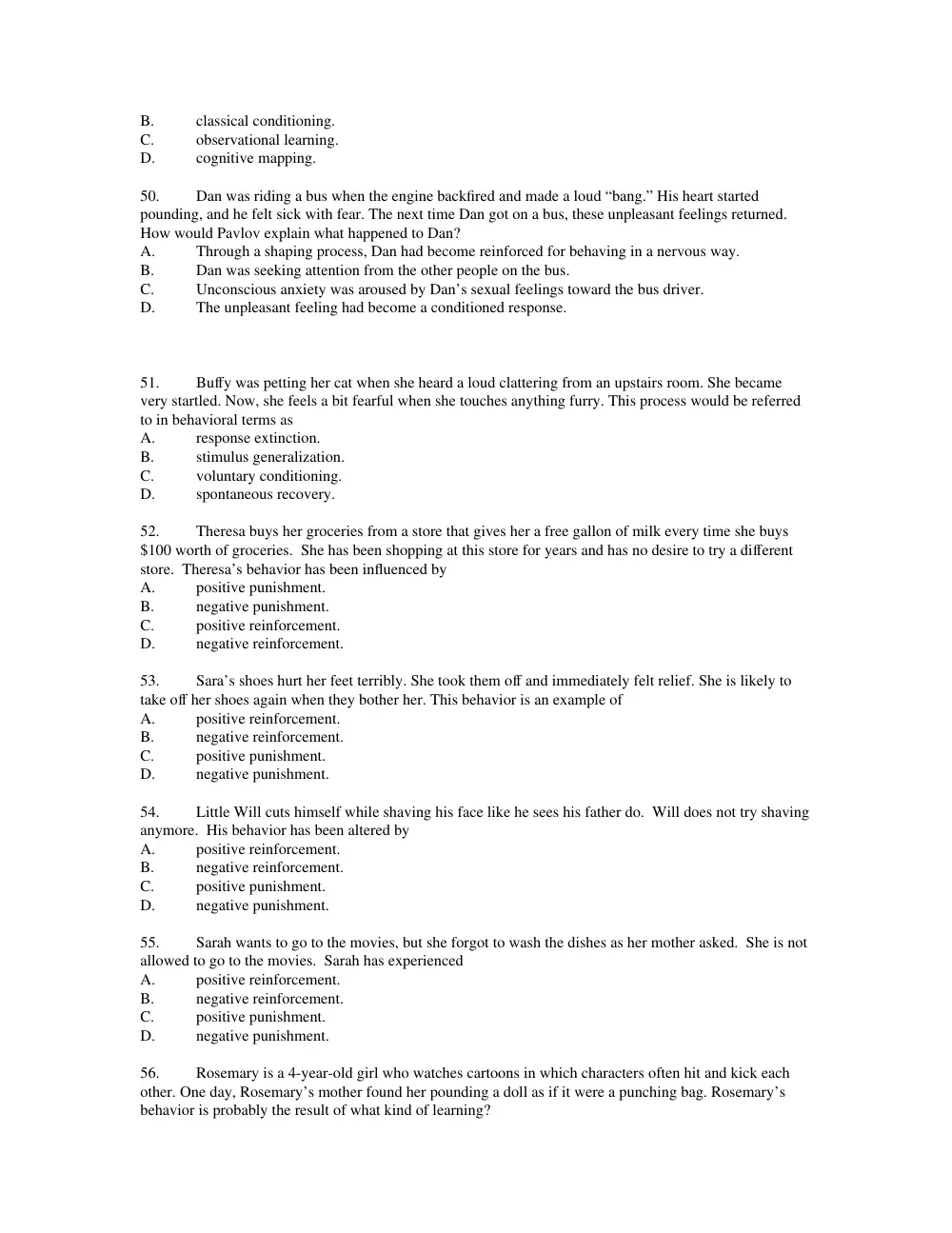
B.
classical conditioning.
C.
observational learning.
D.
cognitive mapping.
50.
Dan was riding a bus when the engine backfired and made a loud “bang.” His heart started
pounding, and he felt sick with fear. The next time Dan got on a bus, these unpleasant feelings returned.
How would Pavlov explain what happened to Dan?
A.
Through a shaping process, Dan had become reinforced for behaving in a nervous way.
B.
Dan was seeking attention from the other people on the bus.
C.
Unconscious anxiety was aroused by Dan’s sexual feelings toward the bus driver.
D.
The unpleasant feeling had become a conditioned response.
51.
Buffy was petting her cat when she heard a loud clattering from an upstairs room. She became
very startled. Now, she feels a bit fearful when she touches anything furry. This process would be referred
to in behavioral terms as
A.
response extinction.
B.
stimulus generalization.
C.
voluntary conditioning.
D.
spontaneous recovery.
52.
Theresa buys her groceries from a store that gives her a free gallon of milk every time she buys
$100 worth of groceries. She has been shopping at this store for years and has no desire to try a different
store. Theresa’s behavior has been influenced by
A.
positive punishment.
B.
negative punishment.
C.
positive reinforcement.
D.
negative reinforcement.
53.
Sara’s shoes hurt her feet terribly. She took them off and immediately felt relief. She is likely to
take off her shoes again when they bother her. This behavior is an example of
A.
positive reinforcement.
B.
negative reinforcement.
C.
positive punishment.
D.
negative punishment.
54.
Little Will cuts himself while shaving his face like he sees his father do. Will does not try shaving
anymore. His behavior has been altered by
A.
positive reinforcement.
B.
negative reinforcement.
C.
positive punishment.
D.
negative punishment.
55.
Sarah wants to go to the movies, but she forgot to wash the dishes as her mother asked. She is not
allowed to go to the movies. Sarah has experienced
A.
positive reinforcement.
B.
negative reinforcement.
C.
positive punishment.
D.
negative punishment.
56.
Rosemary is a 4-year-old girl who watches cartoons in which characters often hit and kick each
other. One day, Rosemary’s mother found her pounding a doll as if it were a punching bag. Rosemary’s
behavior is probably the result of what kind of learning?
A.
classical
B.
observational
C.
instrumental
D.
fixed-ratio
.
57.
Martha Yasso, who fell asleep repeatedly throughout the day, suffered from
A.
REM sleep behavior disorder.
B.
non-REM conduct syndrome.
C.
sleep apnea.
D.
narcolepsy.
58.
In stage 1 sleep, the transitional stage between waking and sleep is characterized by brain waves
that are relatively
A.
rapid, with high amplitude.
B.
rapid, with low amplitude.
C.
slow, with low amplitude.
D.
slow, with high amplitude.
59.
During a typical night of sleep, the length of stage 4 sleep _____, and the length of REM sleep
_____.
A.
lengthens; lengthens
B.
shortens; shortens
C.
lengthens; shortens
D.
shortens; lengthens
True/False Questions
60.
Free-running circadian rhythms are typically a little shorter than 24 hours.
61.
Both jet lag and seasonal affective disorder can be treated by controlled exposure to light.
62.
During REM sleep, your body is typically less physiologically aroused than during wakefulness.
63.
REM sleep decreases consistently across the lifespan from infancy to late adulthood.
64.
Research has shown that both short-term total sleep deprivation (up to 45 hours without sleep) and
partial sleep deprivation (sleeping no more than 5 hours per night for one or more consecutive nights) can
have large negative effects on mood, cognitive performance, and physical performance.
65.
Research has shown that when people are awoken during NREM sleep, they report experiencing a
dream between 15 and 50 percent of the time.
66.
Extinction will usually occur if the CS is presented several times without the UCS.
67.
In classical conditioning, a neutral stimulus eventually becomes an unconditioned stimulus.
68.
Higher-order conditioning occurs when a neutral stimulus is paired repeatedly with an already
established CS.
69.
In operant conditioning, a discriminative stimulus is one that signals when a particular response
will be followed by specific consequences.
70.
Punishment and negative reinforcement are similar in that they both serve to weaken behavior or
make it less likely to occur in the future.
71.
A child who has her TV-watching privileges taken away because she lied to her parents is
receiving a response cost punishment.
72.
In a fourth-grade classroom, a teacher rewards his students for keeping their desks clean by
awarding them stars for every day they do this. At the end of the school year, the stars can be redeemed for
prizes such as coloring books or pencil sets. This teacher is using what is called a token economy.
73.
The sleep disorder called Insomnia is when a person is not capable of breathing in their sleep and
is one of the causes of SIDS.
74.
When a person is falling asleep and is going through the stage of REM sleep their body is
fully awake and they are capable of acting out their dreams.
75.
Classical conditioning is when two stimuli or more are associated with each other
76.
The more children watch violence on TV the more the tendency that they will be habituated to the
sight of violence.
77.
Martha has a very strong headache and decides to treat it with Advil. She is resorting to negative
reinforcement to relieve her headaches.
78.
Night terrors are usually more intense than nightmares and typically occur during stages 3 and 4
sleep.
79.
According to Freud, the primary purpose of dreaming is wish fulfillment.
80.
In Classical conditioned, an organism learns an association between two stimuli, whereas in
operant conditioning the organism learns an association between behavior and its consequences.