
ACCT 210 Lecture, Fall 2009
American University of Beirut · Financial Accounting · 13 pages


Showing the first 10 of 13 pages. Download the PDF to see all of it.
More ACCT 210 files
Show the text of this lab
15 Minutes, Medium
PROBLEM 2.4A
RANKIN TRUCK RENTAL
Owners'
Assets
= Liabilities Equity
Accounts
Office
Notes
Accounts
Capital
Cash Receivab Truck Equipme Payable Payable
Stock
December $ 9,500 $ 13,900 $ 68,000 $ 3,800 $ 20,000 $ 10,200 $ 65,000
(1)
(2,700)
2,700
Balances
$ 6,800 $ 13,900 $ 68,000 $ 6,500 $ 20,000 $ 10,200 $ 65,000
(2)
4,000 (4,000)
Balances
$ 10,800 $ 9,900 $ 68,000 $ 6,500 $ 20,000 $ 10,200 $ 65,000
(3)
(3,200)
(3,200)
Balances
$ 7,600 $ 9,900 $ 68,000 $ 6,500 $ 20,000 $ 7,000 $ 65,000
(4)
10,000
10,000
Balances
$ 17,600 $ 9,900 $ 68,000 $ 6,500 $ 30,000 $ 7,000 $ 65,000
(5)
(15,000)
30,500
15,500
Balances
$ 2,600 $ 9,900 $ 98,500 $ 6,500 $ 45,500 $ 7,000 $ 65,000
(6)
75,000
75,000
Balances
$ 77,600 $ 9,900 $ 98,500 $ 6,500 $ 45,500 $ 7,000
###
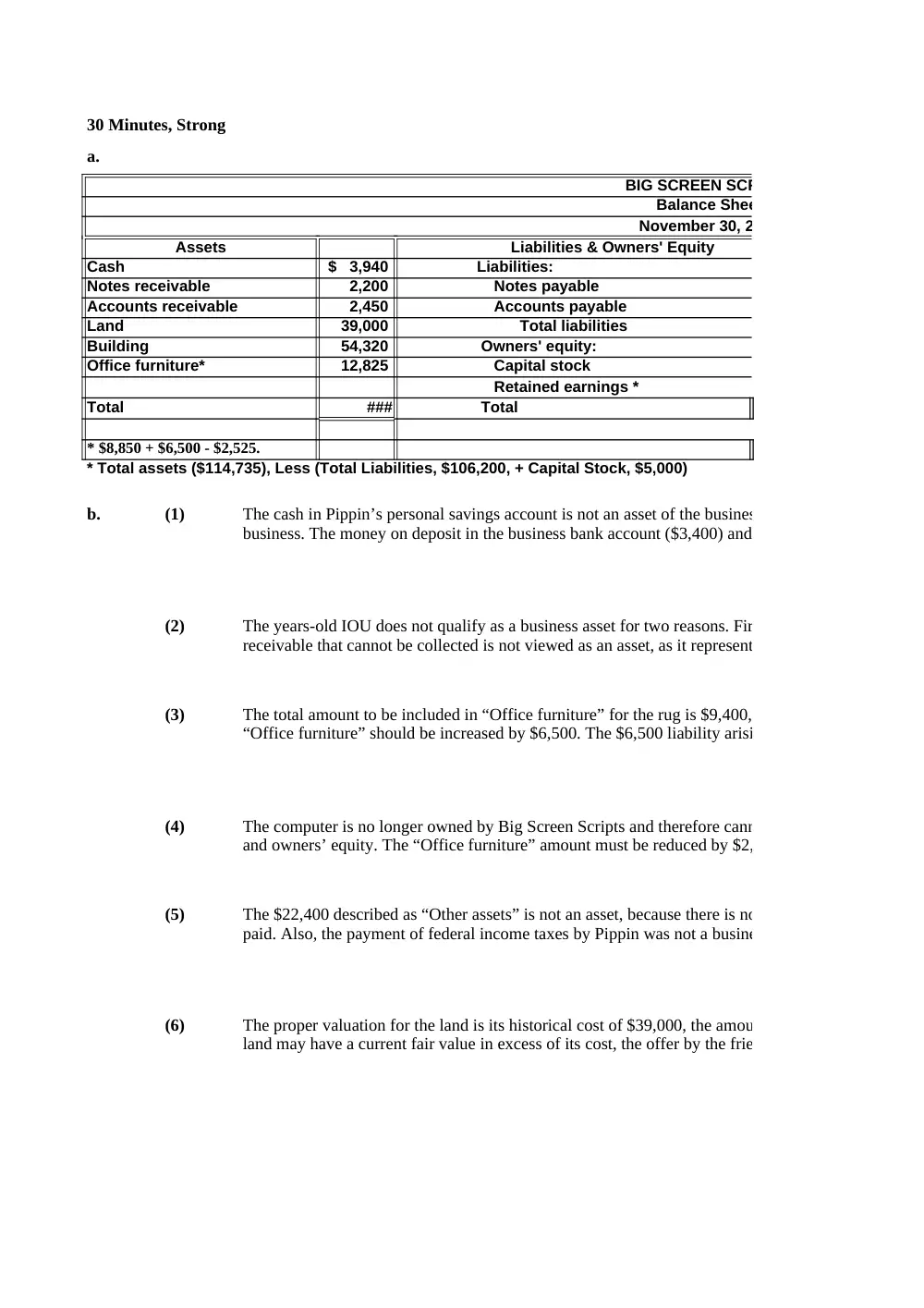
30 Minutes, Strong
a.
BIG SCREEN SCRIPTS
Balance Sheet
November 30, 2005
Assets
Liabilities & Owners' Equity
Cash
$ 3,940
Liabilities:
Notes receivable
2,200
Notes payable
Accounts receivable
2,450
Accounts payable
Land
39,000
Total liabilities
Building
54,320
Owners' equity:
Office furniture*
12,825
Capital stock
Retained earnings *
Total
###
Total
* $8,850 + $6,500 - $2,525.
* Total assets ($114,735), Less (Total Liabilities, $106,200, + Capital Stock, $5,000)
b.
(1)
(2)
(3)
(4)
(5)
(6)
The cash in Pippin’s personal savings account is not an asset of the business entity Big Screen Scrip
business. The money on deposit in the business bank account ($3,400) and in the company safe ($54
The years-old IOU does not qualify as a business asset for two reasons. First, it does not belong to th
receivable that cannot be collected is not viewed as an asset, as it represents no future e
The total amount to be included in “Office furniture” for the rug is $9,400, the total cost, regardless
“Office furniture” should be increased by $6,500. The $6,500 liability arising from the purchase
The computer is no longer owned by Big Screen Scripts and therefore cannot be included in the asse
and owners’ equity. The “Office furniture” amount must be reduced by $2,525.
The $22,400 described as “Other assets” is not an asset, because there is no valid legal claim or any
paid. Also, the payment of federal income taxes by Pippin was not a business transaction by Big Scr
The proper valuation for the land is its historical cost of $39,000, the amount established by the tran
land may have a current fair value in excess of its cost, the offer by the friend to buy the land
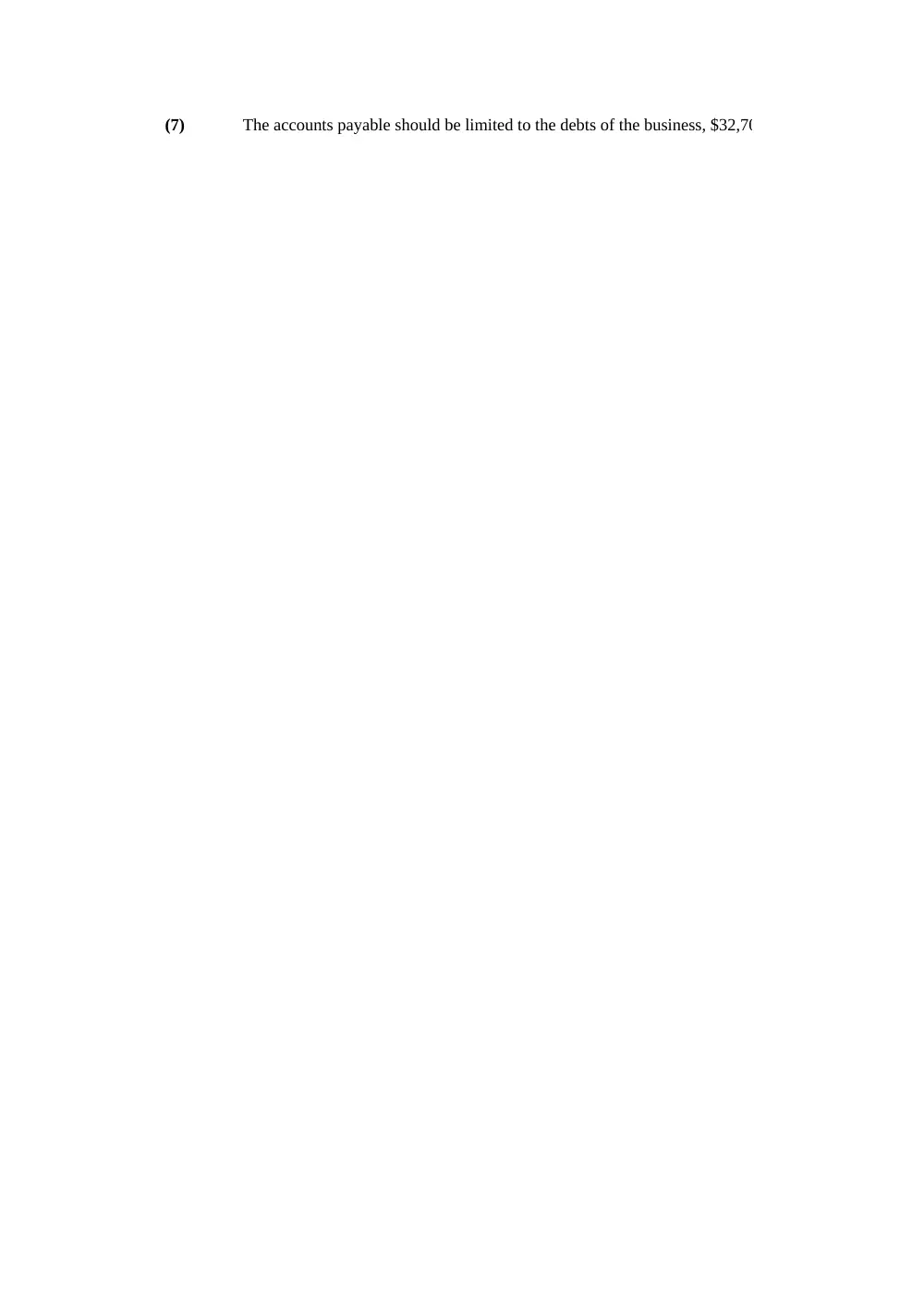
(7)
The accounts payable should be limited to the debts of the business, $32,700, and should not include
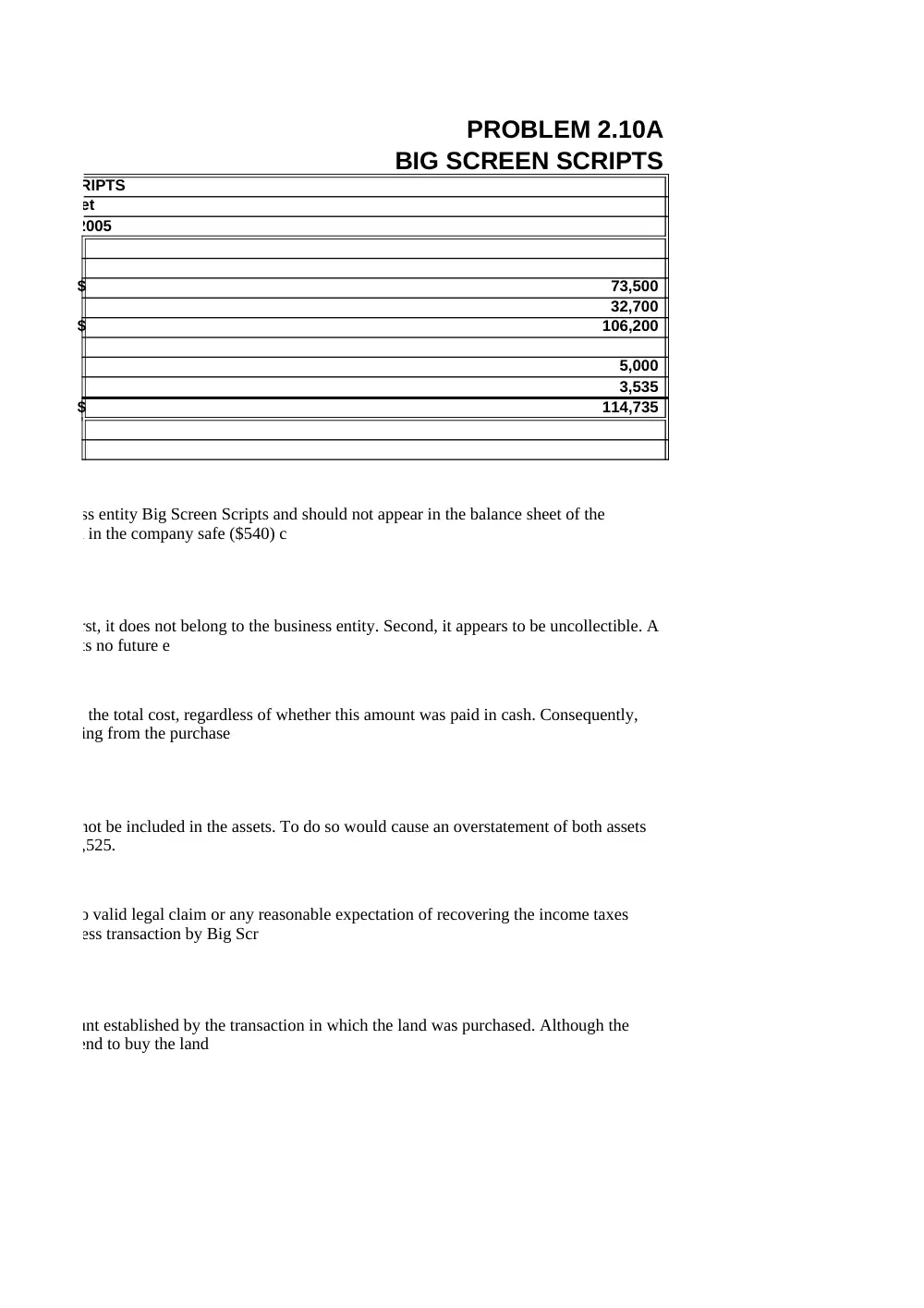
PROBLEM 2.10A
BIG SCREEN SCRIPTS
CREEN SCRIPTS
alance Sheet
vember 30, 2005
$ 73,500
32,700
$ 106,200
5,000
3,535
$ 114,735
of the business entity Big Screen Scripts and should not appear in the balance sheet of the
($3,400) and in the company safe ($540) c
o reasons. First, it does not belong to the business entity. Second, it appears to be uncollectible. A
s it represents no future e
ug is $9,400, the total cost, regardless of whether this amount was paid in cash. Consequently,
liability arising from the purchase
herefore cannot be included in the assets. To do so would cause an overstatement of both assets
duced by $2,525.
se there is no valid legal claim or any reasonable expectation of recovering the income taxes
s not a business transaction by Big Scr
00, the amount established by the transaction in which the land was purchased. Although the
er by the friend to buy the land
iness, $32,700, and should not include Pippin’s personal liabilities.
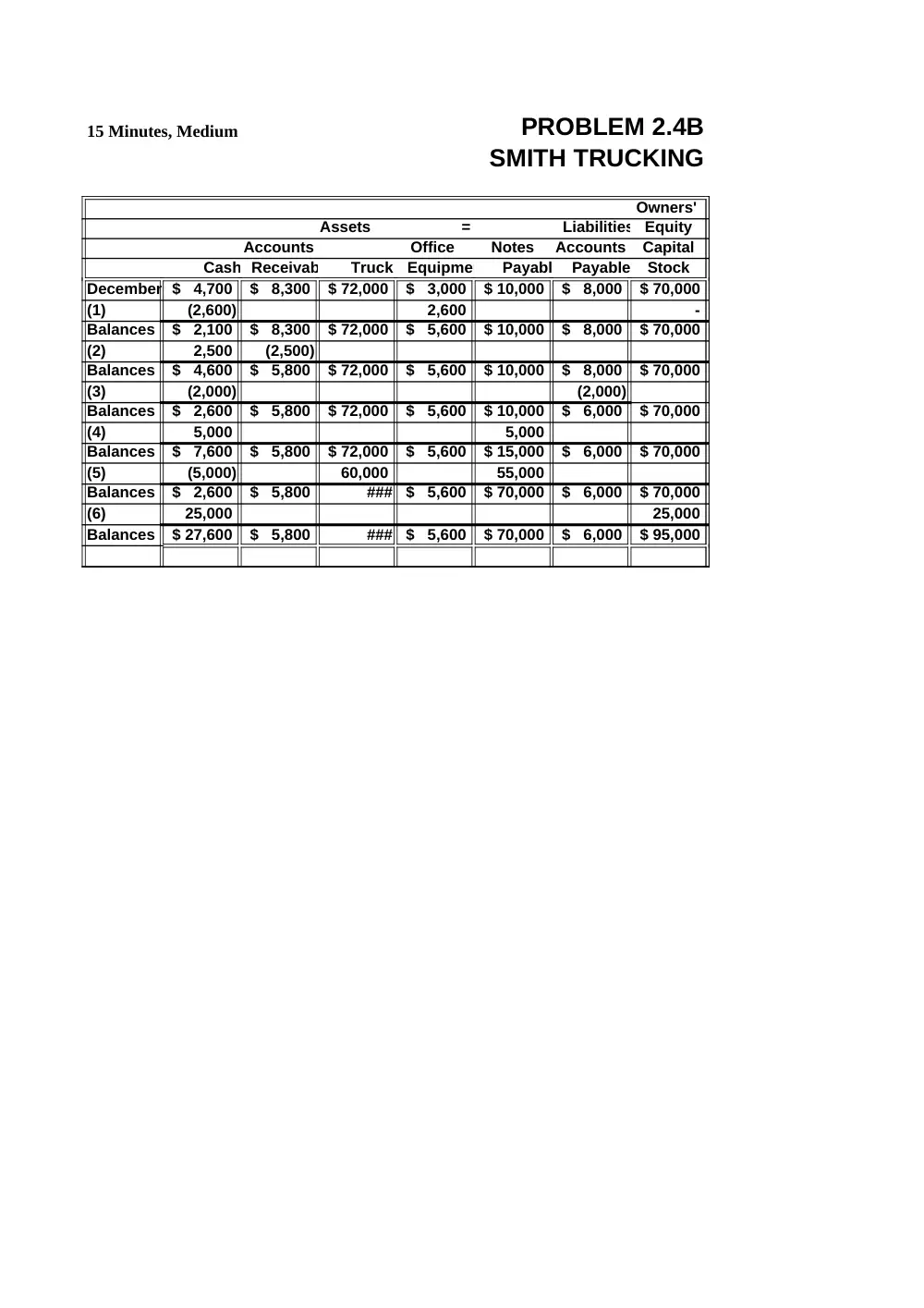
15 Minutes, Medium
PROBLEM 2.4B
SMITH TRUCKING
Owners'
Assets
= Liabilities Equity
Accounts
Office
Notes
Accounts
Capital
Cash Receivab Truck Equipmen Payabl Payable
Stock
December $ 4,700 $ 8,300 $ 72,000 $ 3,000 $ 10,000 $ 8,000 $ 70,000
(1)
(2,600)
2,600
-
Balances
$ 2,100 $ 8,300 $ 72,000 $ 5,600 $ 10,000 $ 8,000 $ 70,000
(2)
2,500 (2,500)
Balances
$ 4,600 $ 5,800 $ 72,000 $ 5,600 $ 10,000 $ 8,000 $ 70,000
(3)
(2,000)
(2,000)
Balances
$ 2,600 $ 5,800 $ 72,000 $ 5,600 $ 10,000 $ 6,000 $ 70,000
(4)
5,000
5,000
Balances
$ 7,600 $ 5,800 $ 72,000 $ 5,600 $ 15,000 $ 6,000 $ 70,000
(5)
(5,000)
60,000
55,000
Balances
$ 2,600 $ 5,800
### $ 5,600 $ 70,000 $ 6,000 $ 70,000
(6)
25,000
25,000
Balances
$ 27,600 $ 5,800
### $ 5,600 $ 70,000 $ 6,000 $ 95,000
35 Minutes, Strong
PROBLEM 2.9B
OLD TOWN PLAYHOUSE
a.
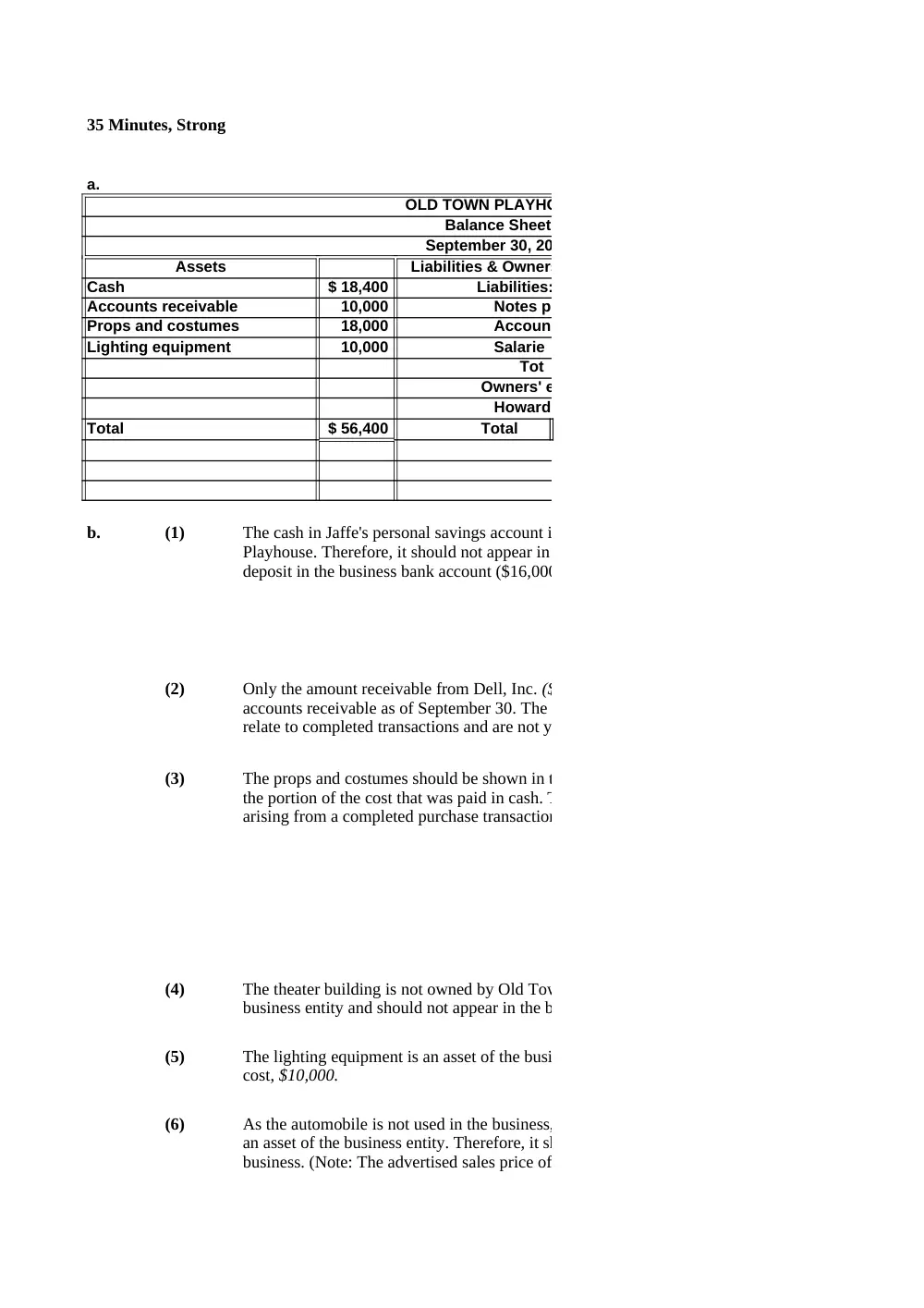
OLD TOWN PLAYHOUSE
Balance Sheet
September 30, 2005
Assets
Liabilities & Owners' Equity
Cash
$ 18,400
Liabilities:
Accounts receivable
10,000
Notes p
Props and costumes
18,000
Accoun
Lighting equipment
10,000
Salarie
Tot
Owners' equity:
Howard
Total
$ 56,400
Total
b.
(1)
(2)
(3)
(4)
(5)
(6)
The cash in Jaffe's personal savings account is not an asset of the business entity Old Town
Playhouse. Therefore, it should not appear in the balance sheet of the business. The money on
deposit in the business bank account ($16,000) and in the company sa
Only the amount receivable from Dell, Inc. ($10,000) should be included in the company’s
accounts receivable as of September 30. The amounts expected from future tickets sales do not
relate to completed transactions and are not yet assets of the business.
The props and costumes should be shown in the balance sheet at their cost, $18,000, not at just
the portion of the cost that was paid in cash. The $15,000 note payable is a debt of the business
arising from a completed purchase transaction. Therefore, it
The theater building is not owned by Old Town Playhouse. Therefore, it is not an asset of this
business entity and should not appear in the balance sheet.
The lighting equipment is an asset of the business and should be valued in the balance sheet at its
cost, $10,000.
As the automobile is not used in the business, it appears to be Jaffe’s personal asset rather than
an asset of the business entity. Therefore, it should not be included in the balance sheet of the
business. (Note: The advertised sales price of a similar a
(7)
PROBLEM 2.9B
OLD TOWN PLAYHOUSE (concluded)
(8)
(9)
As the automobile is not used in the business, it appears to be Jaffe’s personal asset rather than
an asset of the business entity. Therefore, it should not be included in the balance sheet of the
business. (Note: The advertised sales price of a similar a
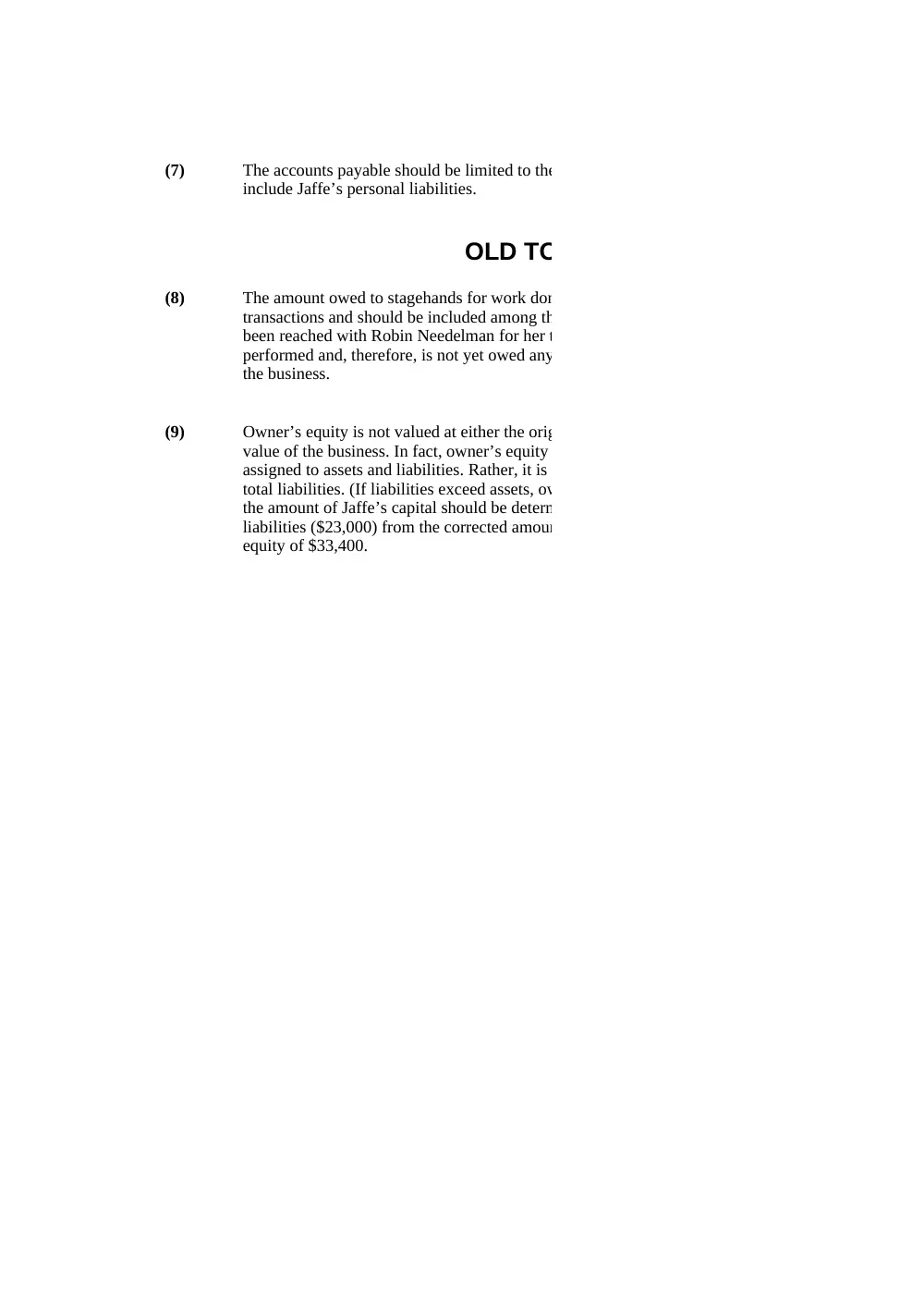
The accounts payable should be limited to the debts of the business, $6,000,and should not
include Jaffe’s personal liabilities.
The amount owed to stagehands for work done through September 30 is the result of completed
transactions and should be included among the liabilities of the business. Even if agreement has
been reached with Robin Needelman for her to perform in a future play, she has not yet
performed and, therefore, is not yet owed any money. Thus, this $30,000 is not yet a liability of
the business.
Owner’s equity is not valued at either the original amount invested or at the estimated market
value of the business. In fact, owner’s equity cannot be valued independently of the values
assigned to assets and liabilities. Rather, it is a residual figure—the excess of total assets over
total liabilities. (If liabilities exceed assets, owner’s equity would be a negative amount.) Thus,
the amount of Jaffe’s capital should be determined by subtracting the corrected figure for total
liabilities ($23,000) from the corrected amount of total assets ($56,400). This indicates owner’s
equity of $33,400.
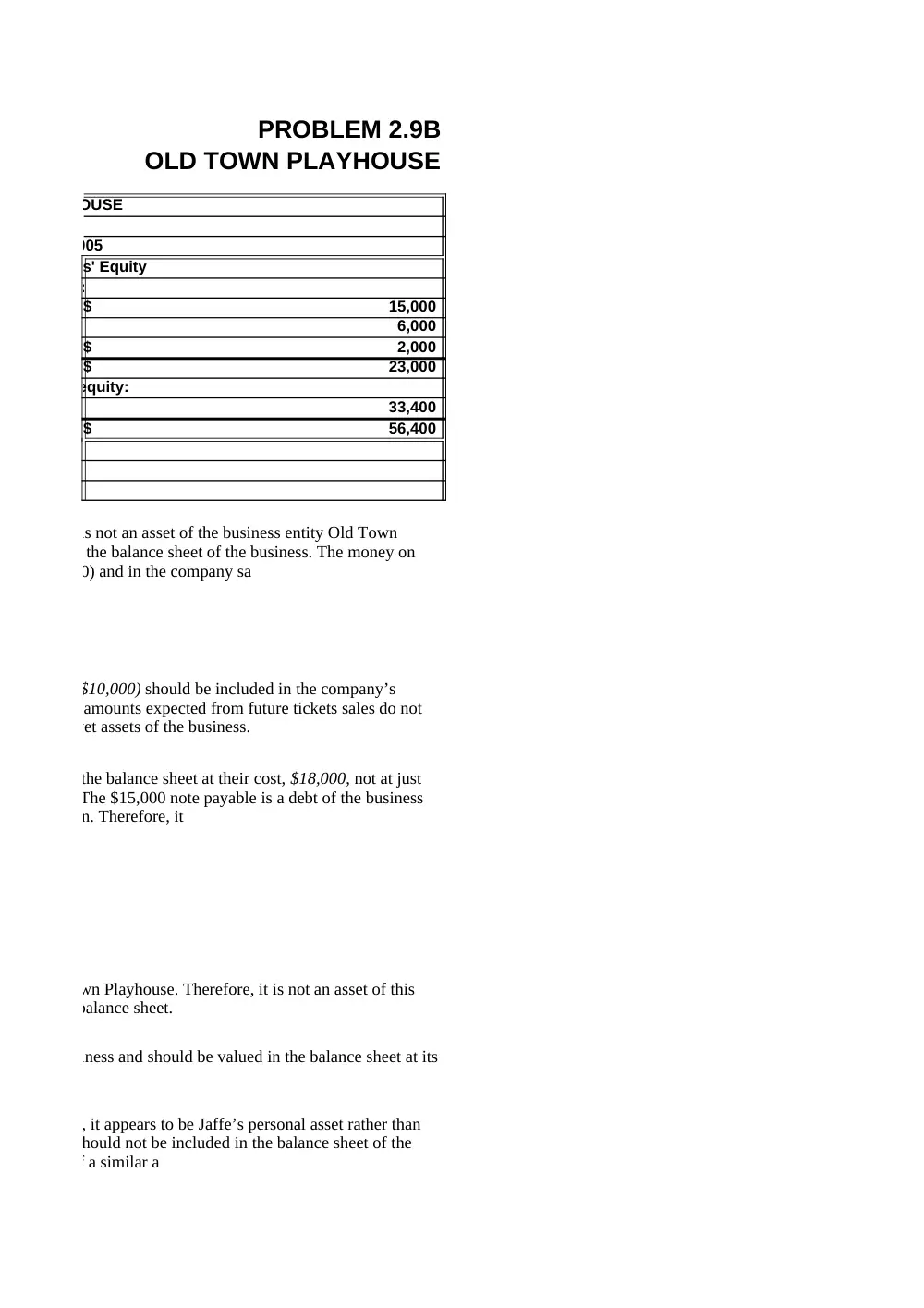
PROBLEM 2.9B
OLD TOWN PLAYHOUSE
WN PLAYHOUSE
lance Sheet
mber 30, 2005
es & Owners' Equity
Liabilities:
$ 15,000
6,000
$ 2,000
$ 23,000
Owners' equity:
33,400
$ 56,400
ngs account is not an asset of the business entity Old Town
not appear in the balance sheet of the business. The money on
ount ($16,000) and in the company sa
m Dell, Inc. ($10,000) should be included in the company’s
mber 30. The amounts expected from future tickets sales do not
and are not yet assets of the business.
be shown in the balance sheet at their cost, $18,000, not at just
aid in cash. The $15,000 note payable is a debt of the business
se transaction. Therefore, it
d by Old Town Playhouse. Therefore, it is not an asset of this
ppear in the balance sheet.
et of the business and should be valued in the balance sheet at its
the business, it appears to be Jaffe’s personal asset rather than
herefore, it should not be included in the balance sheet of the
sales price of a similar a
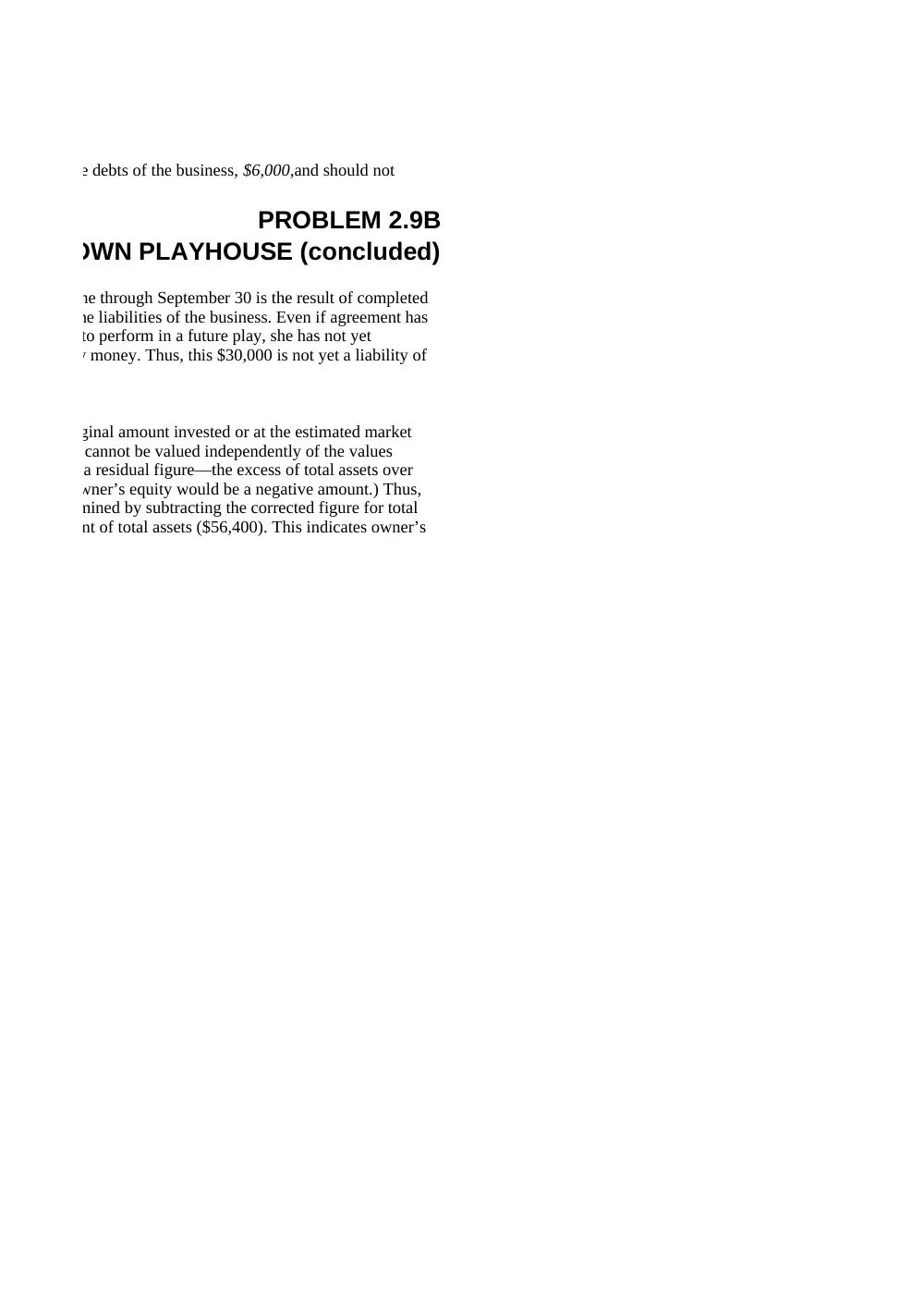
PROBLEM 2.9B
OLD TOWN PLAYHOUSE (concluded)
the business, it appears to be Jaffe’s personal asset rather than
herefore, it should not be included in the balance sheet of the
sales price of a similar a
limited to the debts of the business, $6,000,and should not
s.
for work done through September 30 is the result of completed
ded among the liabilities of the business. Even if agreement has
man for her to perform in a future play, she has not yet
yet owed any money. Thus, this $30,000 is not yet a liability of
ither the original amount invested or at the estimated market
ner’s equity cannot be valued independently of the values
Rather, it is a residual figure—the excess of total assets over
eed assets, owner’s equity would be a negative amount.) Thus,
uld be determined by subtracting the corrected figure for total
rected amount of total assets ($56,400). This indicates owner’s
30 Minutes, Medium
CASE 2.3
USING A BALANCE SHEET
a.
b.
Bankers considering a loan application are particularly interested in the ability
of the company to pay its debts. They want to make loans that will be repaid
promptly and in full at the agreed maturity date. Therefore, they give close
attention to the am
A banker is also interested in the amount of owners’ equity, since this
ownership capital serves as a protecting buffer between the banker and any
losses that may befall the business. Although Star Corporation has slightly
greater owners’ equity than Moon
As an investor, you would probably be willing to pay a higher price to buy the
capital stock of Star Corporation. Since both companies are newly organized
and the cost of assets shown on the balance sheet approximates fair market
value, we can assume in t
An important consideration for an investor interested in Star Corporation is
that it may be necessary to invest a significant additional amount of cash in
the business in the near future to enable the company to pay the large note
payable due in 60 days.
An investor would of course be interested in the earnings prospects of the
companies, but no income statements or other information on income potential
are provided in the problem. Profitability of the two companies cannot really
be compared by the balanc
35 Minutes, Medium
CASE 2.5
ETHICS AND WINDOW DRESSING
1.
2.
3.
4.
Postponing the cash purchase of WordMaster would indeed leave Omega
Software with an additional $8 million in cash at year-end, which would make
the company appear more liquid. There is nothing illegal or unethical about
postponing this transaction. Howev
The deliberate omission of liabilities from the balance sheet would be
unethical and illegal. This action would be in direct violation of the federal
securities laws, and the responsible officers would probably face criminal
charges. Further, the idea tha
There is nothing unethical or illegal about renegotiating the due date of a
liability. In fact, as Omega needs to borrow money anyway, extending this
obligation to Delta at a 12% interest rate may be a good idea. The due date of
this liability may require
The intentional violation of generally accepted accounting principles with the
intent to mislead financial statement users is both unethical and illegal.
Federal securities laws require that publicly owned corporations prepare their
financial statements i
*Note to instructor: Investments in some marketable securities now are presented in the
balance sheet at market value. We discuss this change in traditional accounting theory
(called “mark-to-market”) in Chapter 7. But at present, the cost principle still
15 Minutes, Easy
PROBLEM 2.2A
AJAX MOVING COMPANY
Description of transactions:
a.
Purchased equipment for cash at a cost of $3,200.
b.
Received $900 cash from collection of accounts receivable.
c.
d.
Paid $14,500 of accounts payable.
e.
$15,000 cash was received from the sale of capital stock.
f.
Purchased equipment on account for $7,500.
Purchased equipment at a cost of $13,500; paid $3,500 cash as down
payment and incurred a liability (account payable) for the remaining
$10,000.