
ACCT 210 Syllabus, Fall 2011
American University of Beirut · Financial Accounting · 6 pages · Dr. Ali Rkein



More ACCT 210 files
Show the text of this lab
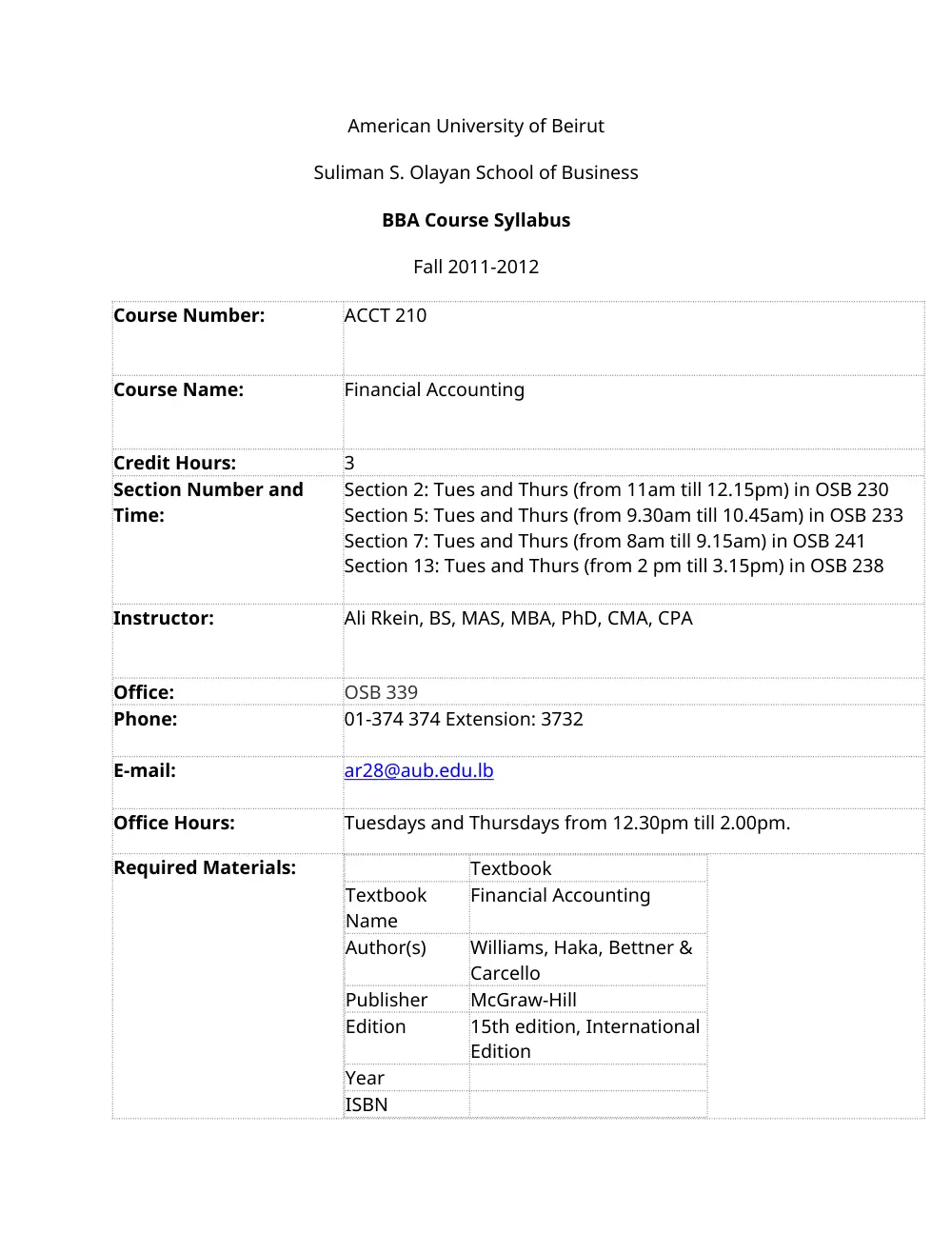
American University of Beirut
Suliman S. Olayan School of Business
BBA Course Syllabus
Fall 2011-2012
Course Number:
ACCT 210
Course Name:
Financial Accounting
Credit Hours:
3
Section Number and
Time:
Section 2: Tues and Thurs (from 11am till 12.15pm) in OSB 230
Section 5: Tues and Thurs (from 9.30am till 10.45am) in OSB 233
Section 7: Tues and Thurs (from 8am till 9.15am) in OSB 241
Section 13: Tues and Thurs (from 2 pm till 3.15pm) in OSB 238
Instructor:
Ali Rkein, BS, MAS, MBA, PhD, CMA, CPA
Office:
OSB 339
Phone:
01-374 374 Extension: 3732
E-mail:
ar28@aub.edu.lb
Office Hours:
Tuesdays and Thursdays from 12.30pm till 2.00pm.
Required Materials:
Textbook
Textbook
Name
Financial Accounting
Author(s)
Williams, Haka, Bettner &
Carcello
Publisher
McGraw-Hill
Edition
15th edition, International
Edition
Year
ISBN
Required /
Recommende
d
Other: Moodle announcements & news.
Prerequisites:
None
Co requisites:
None
Course Description: An introduction to financial accounting that covers the use,
interpretation, and analysis of the principal financial
statements and other sources of financial information from
a national and international perspective.
Relationship to
Other Coursework:
Financial Accounting is an introductory core business course.
It introduces students to the language of business and its
use as a tool for the decision making process. Students learn
the underlying principles of externally reported financial
information governed by the US GAAP. They learn the
accounting cycle that enables them to prepare and analyze
the financial statements. Students will be required to use
this knowledge in other business courses that require them
to make decisions based on reported financial information
such as finance and management courses in that it provides
them with the ability to understand the underlying
economics of the financial statements and their implications.
BBA Learning Goals
Emphasized
This course is a core course – In this course students acquire
basic accounting knowledge in preparing and
communicating and understanding information which
supports economic decision-making.
To this end the following BBA program learning goals are
addressed throughout the course as follows:
B-LG1: Professional Business Knowledge – Through
this course, students will acquire basic financial
accounting knowledge that will allow them to
understand accounting careers, the accounting cycle,
the preparation of financial statements.
B-LG2 Decision Making – In this course, students will
recognize and describe analytical quantitative
approaches to business and decision-making
situations, through the use of financial ratios and
application of alternative accounting principles. They
will also demonstrate competency in their application.
Instructional
Methodology:
Specific Learning
Objectives for the
Course:
Different teaching methodologies will be used such as
lecture, class discussion, research, group project, and
technology.
The Specific Learning Objectives (SLOs) for this course that
map to the BBA program learning goals mentioned above
are as follows:
B-LG1: Professional Business Knowledge
By the end of this course, students will:
1. Use the accounting cycle to account for economic events.
2. Prepare basic financial statements.
3. Identify accounting career options.
B-LG2: Decision Making
4. Recognize the impact of alternative accounting principles
in the decision making process.
5. Interpret the financial statements from the perspective of
external users.
Course Assignments HW : Home work exercises are posted on Moodle & should
be turned in on Moodle by the due date posted. Five HW will
be selected at random and graded for the effort.
Research assignment: Please refer to the link for details.
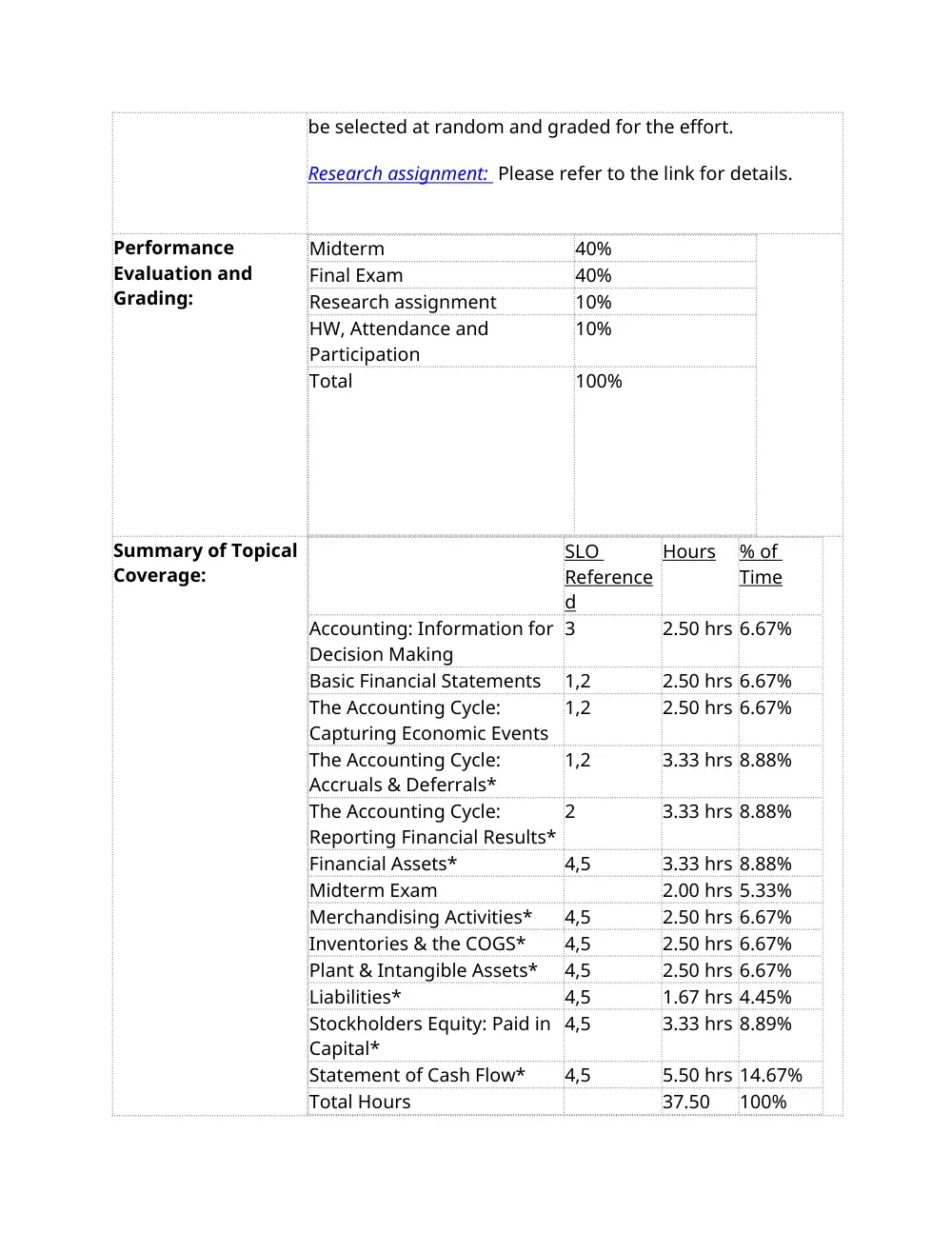
Performance
Evaluation and
Grading:
Midterm
40%
Final Exam
40%
Research assignment
10%
HW, Attendance and
Participation
10%
Total
100%
Summary of Topical
Coverage:
SLO
Reference
d
Hours
% of
Time
Accounting: Information for
Decision Making
3
2.50 hrs 6.67%
Basic Financial Statements
1,2
2.50 hrs 6.67%
The Accounting Cycle:
Capturing Economic Events
1,2
2.50 hrs 6.67%
The Accounting Cycle:
Accruals & Deferrals*
1,2
3.33 hrs 8.88%
The Accounting Cycle:
Reporting Financial Results*
2
3.33 hrs 8.88%
Financial Assets*
4,5
3.33 hrs 8.88%
Midterm Exam
2.00 hrs 5.33%
Merchandising Activities*
4,5
2.50 hrs 6.67%
Inventories & the COGS*
4,5
2.50 hrs 6.67%
Plant & Intangible Assets*
4,5
2.50 hrs 6.67%
Liabilities*
4,5
1.67 hrs 4.45%
Stockholders Equity: Paid in
Capital*
4,5
3.33 hrs 8.89%
Statement of Cash Flow*
4,5
5.50 hrs 14.67%
Total Hours
37.50
100%
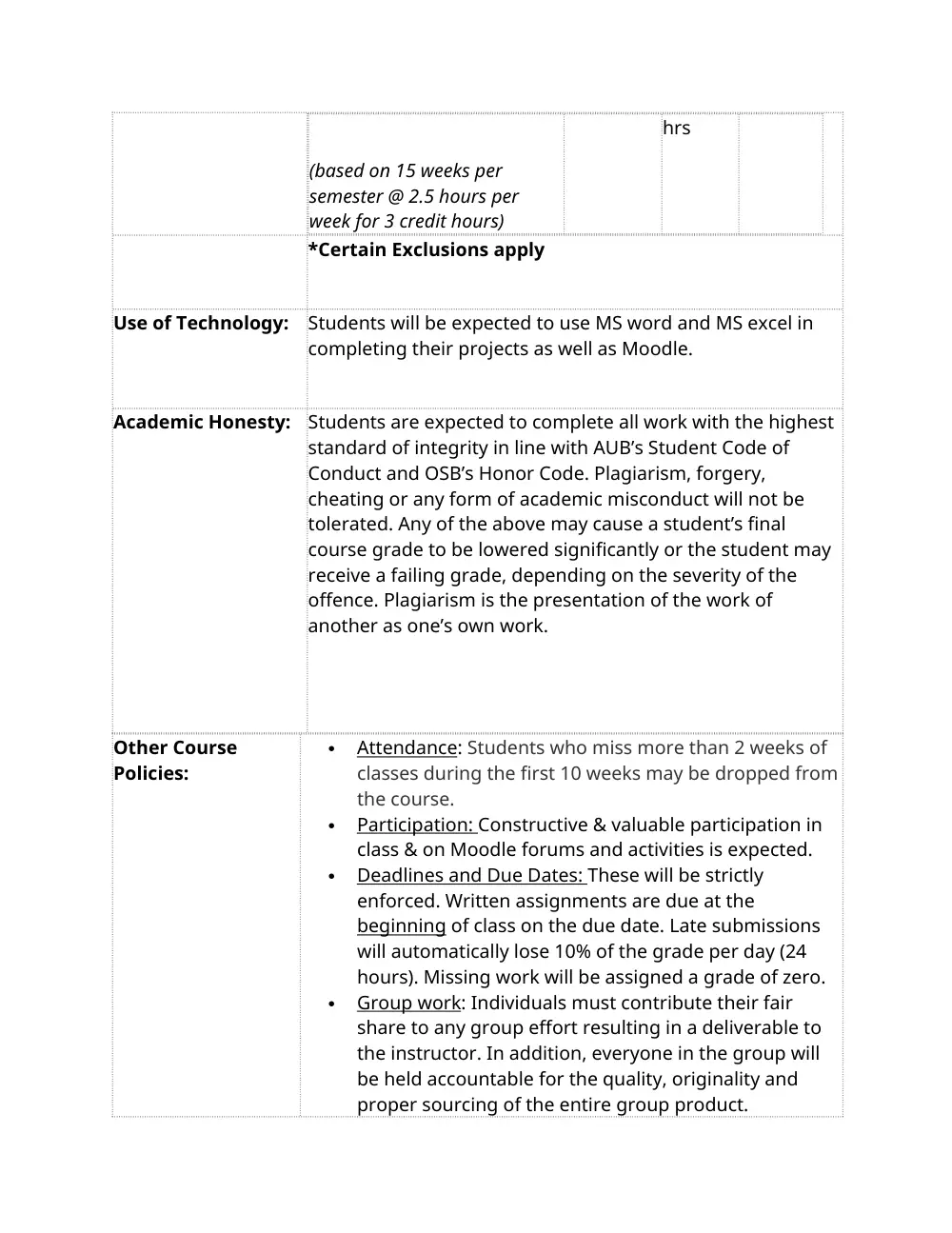
(based on 15 weeks per
semester @ 2.5 hours per
week for 3 credit hours)
hrs
*Certain Exclusions apply
Use of Technology: Students will be expected to use MS word and MS excel in
completing their projects as well as Moodle.
Academic Honesty: Students are expected to complete all work with the highest
standard of integrity in line with AUB’s Student Code of
Conduct and OSB’s Honor Code. Plagiarism, forgery,
cheating or any form of academic misconduct will not be
tolerated. Any of the above may cause a student’s final
course grade to be lowered significantly or the student may
receive a failing grade, depending on the severity of the
offence. Plagiarism is the presentation of the work of
another as one’s own work.
Other Course
Policies:
Attendance
: Students who miss more than 2 weeks of
classes during the first 10 weeks may be dropped from
the course.
Participation:
Constructive & valuable participation in
class & on Moodle forums and activities is expected.
Deadlines and Due Dates:
These will be strictly
enforced. Written assignments are due at the
beginning of class on the due date. Late submissions
will automatically lose 10% of the grade per day (24
hours). Missing work will be assigned a grade of zero.
Group work
: Individuals must contribute their fair
share to any group effort resulting in a deliverable to
the instructor. In addition, everyone in the group will
be held accountable for the quality, originality and
proper sourcing of the entire group product.
Missing an Examination:
A valid medical excuse from
the infirmary is required to justify missing an
examination. It is up to the instructor to allow a make-
up exam.