
ACCT 210 Notes Chapter 2, Summer 2017
American University of Beirut · Financial Accounting · 6 pages
More ACCT 210 files
- Notes Accounting 210 Ch 13 · Fall 2018NotesView
- Notes Ch 11 · Fall 2018NotesView
- Useful File Notes · Fall 2018NotesView
- Notes Ch 9 · Fall 2018NotesView
- Notes Ch 10 · Fall 2018NotesView
- Notes Chapter 3 · Summer 2017NotesView
- Notes Chapter 4 · Summer 2017NotesView
- Notes Useful Notes · Fall 2010NotesView
Show the text of this notes
Chapter 2
Basic Financial Statements
Basic financial statements:
1.
The income statement shows revenues and expenses.
2.
The statement of financial position is a listing of all asset, liability, and equity account
balances that do not appear on the income statement.
3.
The statement of cash flows shows how the company receives and spends its cash.
The statement of financial position:
Describes the financial position of a company at a specific point in time.
May be prepared monthly, quarterly, or annually depending on the needs of
management and external users.
Sometimes referred to as the statement of financial position.
Income Statement:
Profit is defined as the excess of revenues over expenses.
Financial statements begin with a three-line title comprised of the company name, the
name of the statement, and the period covered by the report.
The income statement lists revenues and expenses that were incurred over a period of
time.
Most companies prepare monthly income statements.
In the long-run, revenues will generate positive cash inflows to the company and
expenses will result in negative cash flows to the company.
Just remember, revenues and expenses that appear on the income statement may not
always produce cash flows in the current accounting period.
Profit (or loss) is simply the difference between revenues and expenses.
When revenues exceed expenses, the result is profit.
When expenses exceed revenues, the result is a loss.
Statement of Cash Flows:
•
The statement of cash flows is divided into three major sections:
o
cash flows from operating activities
o
cash flows from investing activities
o
cash flows from financing activities
•
The statement describes cash inflows and outflows over a period of time.
A Starting Point: Statement of Financial Position
The statement of financial position, commonly referred to as the statement of financial position,
is an inventory of assets, liabilities, and equity at the end of the month.
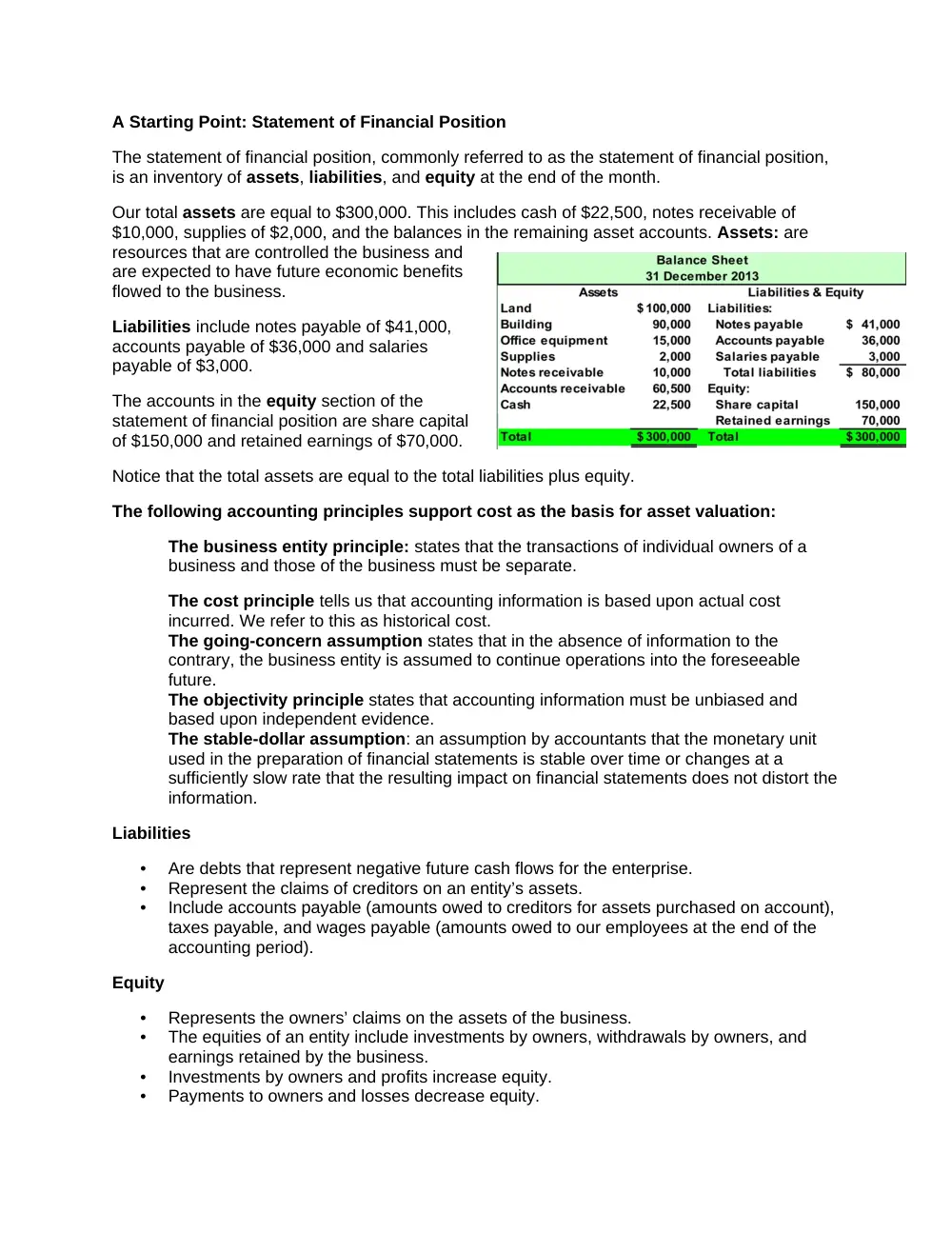
Our total assets are equal to $300,000. This includes cash of $22,500, notes receivable of
$10,000, supplies of $2,000, and the balances in the remaining asset accounts. Assets: are
resources that are controlled the business and
are expected to have future economic benefits
flowed to the business.
Liabilities include notes payable of $41,000,
accounts payable of $36,000 and salaries
payable of $3,000.
The accounts in the equity section of the
statement of financial position are share capital
of $150,000 and retained earnings of $70,000.
Notice that the total assets are equal to the total liabilities plus equity.
The following accounting principles support cost as the basis for asset valuation:
The business entity principle: states that the transactions of individual owners of a
business and those of the business must be separate.
The cost principle tells us that accounting information is based upon actual cost
incurred. We refer to this as historical cost.
The going-concern assumption states that in the absence of information to the
contrary, the business entity is assumed to continue operations into the foreseeable
future.
The objectivity principle states that accounting information must be unbiased and
based upon independent evidence.
The stable-dollar assumption: an assumption by accountants that the monetary unit
used in the preparation of financial statements is stable over time or changes at a
sufficiently slow rate that the resulting impact on financial statements does not distort the
information.
Liabilities
•
Are debts that represent negative future cash flows for the enterprise.
•
Represent the claims of creditors on an entity’s assets.
•
Include accounts payable (amounts owed to creditors for assets purchased on account),
taxes payable, and wages payable (amounts owed to our employees at the end of the
accounting period).
Equity
•
Represents the owners’ claims on the assets of the business.
•
The equities of an entity include investments by owners, withdrawals by owners, and
earnings retained by the business.
•
Investments by owners and profits increase equity.
•
Payments to owners and losses decrease equity.
Revenues: the price of goods and services charged to customers for goods and services
rendered by a business.
Expenses: the costs of the goods and services used up in the process of obtaining revenue.
Adequate disclosure: the accounting principle of providing with financial statements any
financial and other facts that are necessary for proper interpretation of those statements.
Accounting Equation
The basic accounting equation states that assets are equal to liabilities plus equity of a
company.
The equation makes sense because it states that assets must be equal to the claims against
those assets.
There are two broad categories of claims against an asset: Claims by creditors (called
liabilities), or after all creditor claims are satisfied, the residual owners (the shareholders) have a
claim on those assets.
1.
Accounting equation: ASSETS = LIABILITIES + OWNER'S EQUITY
o
Assets are something the business owns or has control of
o
Liabilities are something the business owes
o
Equity represents the amount of assets that are left over after the company has paid
its liabilities, or net worth
2.
Transaction analysis using the accounting equation
o
Key: Both sides of the accounting equation must always be equal
3.
financial statements
o
Income Statement
o
Balance Sheet or statement of financial position (uses the same accounts as the
accounting equation)
o
Statement of Cash Flows
o
Headings on statements always listed as:
Name of company
Name of statement
Descriptive date
4.
Revenues and expenses affect equity
o
Revenues are increases (earned) in equity from providing goods or services to
customers
o
Expenses are decreases (incurred) in equity through the operation of a business
Using up assets
Or increasing liabilities
5.
The major Account categories are Assets, Liabilities, and Stockholder’s Equity
i.
Under these Accounts, there are common accounts that occur in most
businesses.
1.
Assets
a.
Cash includes bank account balances and cash on hand.
b.
Accounts Receivable represents amounts owed to the
business by customers.
c.
Notes Receivable represents a written promise
(promissory note) that the customer or borrower will pay a
fixed amount of money by a certain date. Often includes
interest charges.
d.
Prepaid Expenses are assets of a business because they
represent items that have been purchased but will be used
later.
i.
Examples include Insurance paid a year in
advance.
e.
Land is used to track the cost of land a business owns and
uses in its operations.
f.
Buildings represent the cost of a business’s buildings,
offices, warehouses, etc.
g.
Equipment, Furniture and Fixtures represent items such
computer equipment, office equipment, store equipment,
and furniture and fixtures. A business will typically have a
separate asset account for each type of equipment.
Liabilities
h.
Accounts Payable reflects how much cash the business
must pay to suppliers for goods or services that have
already been received.
i.
Notes Payable represents amounts the business must pay
because it signed a promissory note to borrow money.
j.
Accrued Liabilities represents liabilities for expenses that
have been incurred but have not yet been paid.
i.
Examples are Taxes Payable, Interest Payable,
and Salaries Payable.
2.
Stockholders’ Equity
a.
Share capital represents the investment of assets, usually
cash, the stockholders have invested into a business in
exchange for the company’s stock.
b.
Retained Earnings tracks the cumulative earnings of the
business since it began, less any dividends given to
stockholders.
c.
Revenues are increases in Retained Earnings that
represent amounts earned by the company.
d.
Expenses are decreases in Retained Earnings from using
resources to deliver goods and services to customers.
e.
Dividends reflect the amount of earnings that have been
distributed to the stockholders. Dividends decrease
Retained Earnings.
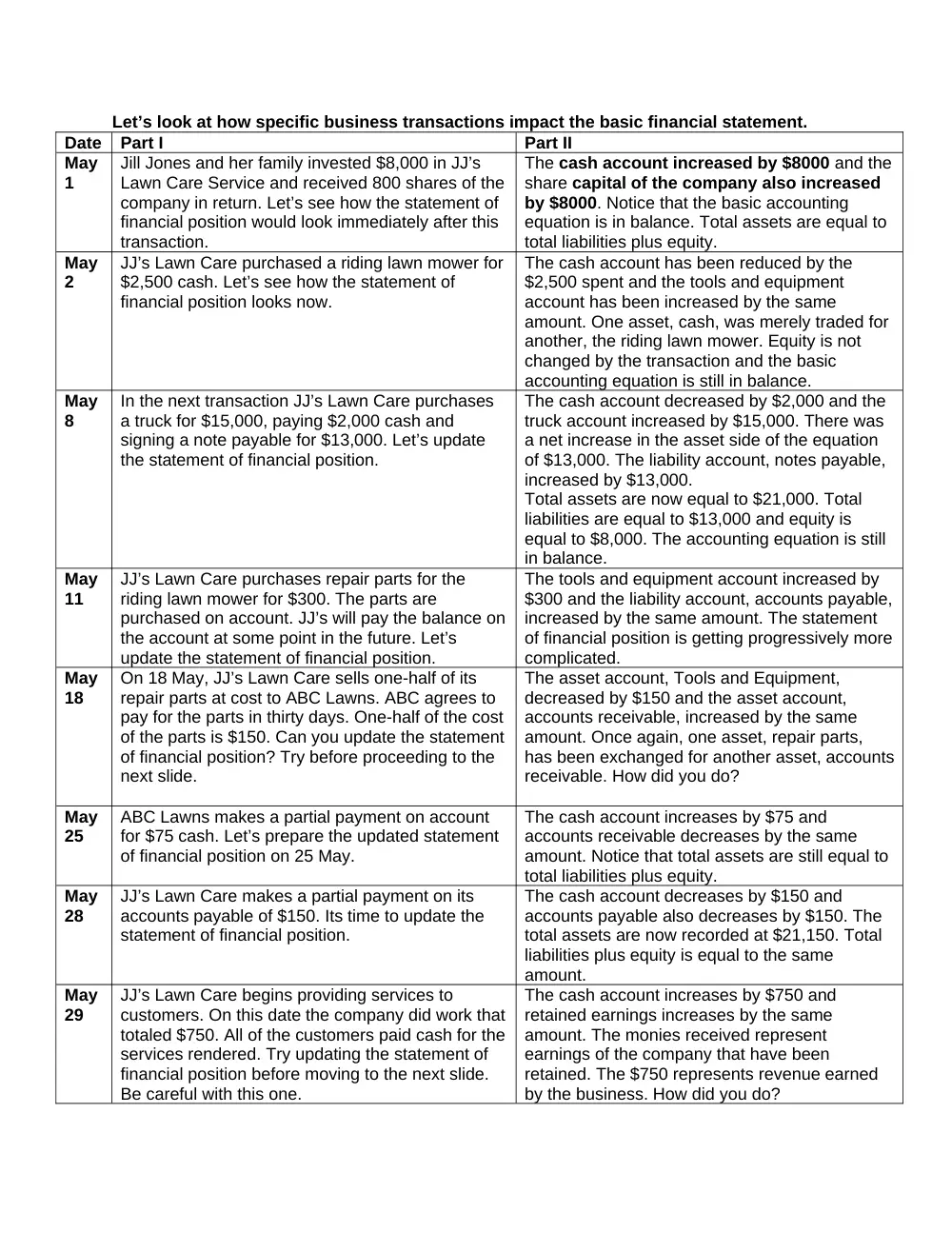
Let’s look at how specific business transactions impact the basic financial statement.
Date
Part I
Part II
May
1
Jill Jones and her family invested $8,000 in JJ’s
Lawn Care Service and received 800 shares of the
company in return. Let’s see how the statement of
financial position would look immediately after this
transaction.
The cash account increased by $8000 and the
share capital of the company also increased
by $8000. Notice that the basic accounting
equation is in balance. Total assets are equal to
total liabilities plus equity.
May
2
JJ’s Lawn Care purchased a riding lawn mower for
$2,500 cash. Let’s see how the statement of
financial position looks now.
The cash account has been reduced by the
$2,500 spent and the tools and equipment
account has been increased by the same
amount. One asset, cash, was merely traded for
another, the riding lawn mower. Equity is not
changed by the transaction and the basic
accounting equation is still in balance.
May
8
In the next transaction JJ’s Lawn Care purchases
a truck for $15,000, paying $2,000 cash and
signing a note payable for $13,000. Let’s update
the statement of financial position.
The cash account decreased by $2,000 and the
truck account increased by $15,000. There was
a net increase in the asset side of the equation
of $13,000. The liability account, notes payable,
increased by $13,000.
Total assets are now equal to $21,000. Total
liabilities are equal to $13,000 and equity is
equal to $8,000. The accounting equation is still
in balance.
May
11
JJ’s Lawn Care purchases repair parts for the
riding lawn mower for $300. The parts are
purchased on account. JJ’s will pay the balance on
the account at some point in the future. Let’s
update the statement of financial position.
The tools and equipment account increased by
$300 and the liability account, accounts payable,
increased by the same amount. The statement
of financial position is getting progressively more
complicated.
May
18
On 18 May, JJ’s Lawn Care sells one-half of its
repair parts at cost to ABC Lawns. ABC agrees to
pay for the parts in thirty days. One-half of the cost
of the parts is $150. Can you update the statement
of financial position? Try before proceeding to the
next slide.
The asset account, Tools and Equipment,
decreased by $150 and the asset account,
accounts receivable, increased by the same
amount. Once again, one asset, repair parts,
has been exchanged for another asset, accounts
receivable. How did you do?
May
25
ABC Lawns makes a partial payment on account
for $75 cash. Let’s prepare the updated statement
of financial position on 25 May.
The cash account increases by $75 and
accounts receivable decreases by the same
amount. Notice that total assets are still equal to
total liabilities plus equity.
May
28
JJ’s Lawn Care makes a partial payment on its
accounts payable of $150. Its time to update the
statement of financial position.
The cash account decreases by $150 and
accounts payable also decreases by $150. The
total assets are now recorded at $21,150. Total
liabilities plus equity is equal to the same
amount.
May
29
JJ’s Lawn Care begins providing services to
customers. On this date the company did work that
totaled $750. All of the customers paid cash for the
services rendered. Try updating the statement of
financial position before moving to the next slide.
Be careful with this one.
The cash account increases by $750 and
retained earnings increases by the same
amount. The monies received represent
earnings of the company that have been
retained. The $750 represents revenue earned
by the business. How did you do?
May
31
In the final transaction for May, JJ’s Lawn Care
purchased $50 worth of gasoline for its riding
mower and truck. Let’s make the final update to
the statement of financial position on 31 May.
The cash account decreased by $50 and so did
the retained earnings of the company. JJ’s Lawn
Care used $50 of its earnings to pay for the
gasoline. The $50 spent is an expense of the
business.
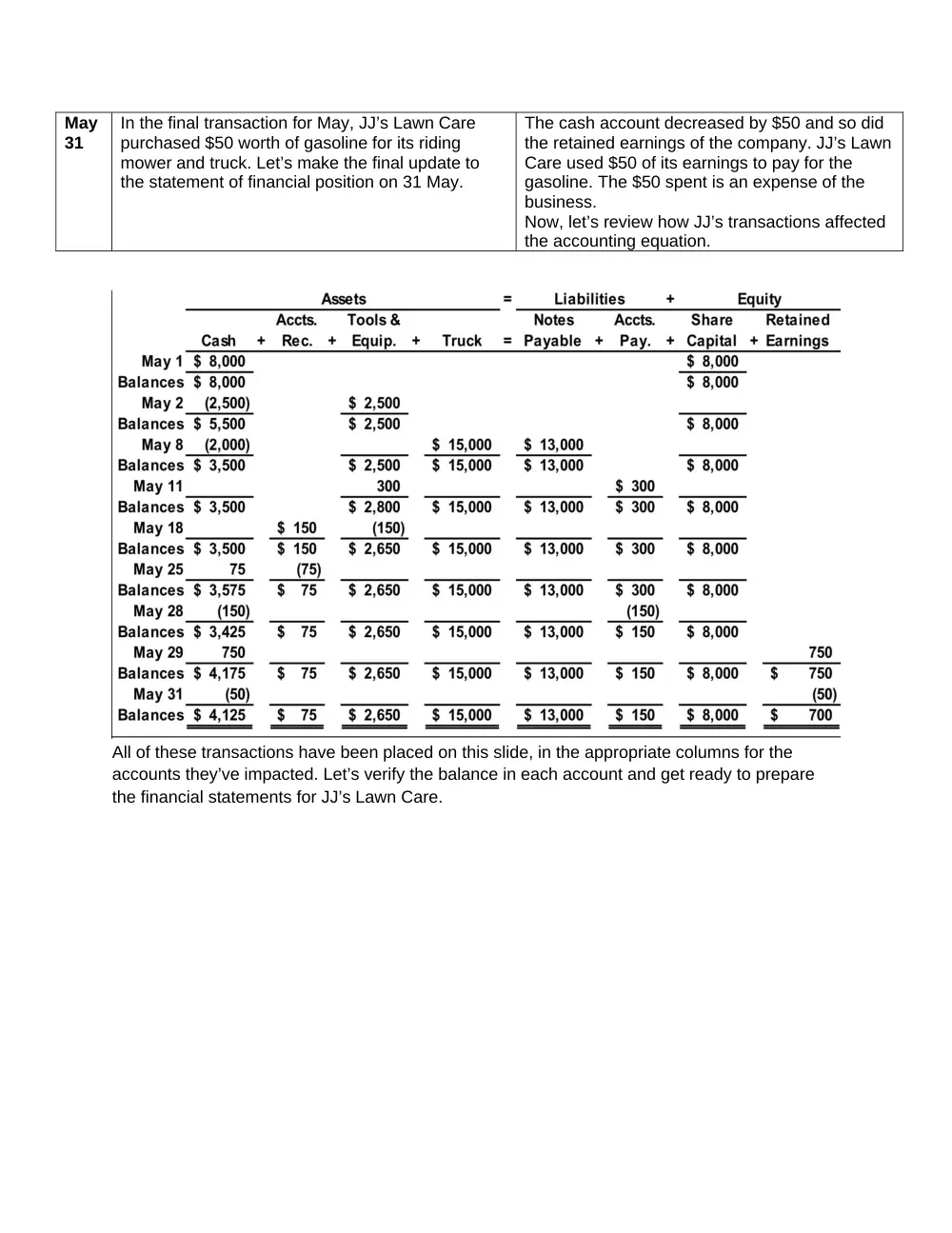
Now, let’s review how JJ’s transactions affected
the accounting equation.
All of these transactions have been placed on this slide, in the appropriate columns for the
accounts they’ve impacted. Let’s verify the balance in each account and get ready to prepare
the financial statements for JJ’s Lawn Care.