
ACCT 210 Notes Chapter 4, Summer 2017
American University of Beirut · Financial Accounting · 5 pages



More ACCT 210 files
- Notes Accounting 210 Ch 13 · Fall 2018NotesView
- Notes Ch 11 · Fall 2018NotesView
- Useful File Notes · Fall 2018NotesView
- Notes Ch 9 · Fall 2018NotesView
- Notes Ch 10 · Fall 2018NotesView
- Notes Chapter 2 · Summer 2017NotesView
- Notes Chapter 3 · Summer 2017NotesView
- Notes Useful Notes · Fall 2010NotesView
Show the text of this notes
a)
The accounting cycle is repeated for every accounting period.
i)
The accounting period can be defined as a month, a quarter, or a year.
(1) May or may not follow the same period as a calendar year.
(2) A fiscal year is any consecutive 12-month period that a business adopts as its accounting
year.
How Does a Company Accurately Report Its Income?
2)
Understand the revenue recognition and matching principles.
a)
Cash-basis accounting is the accounting method that records revenues when cash is received and
expenses when cash is paid.
b)
Accrual accounting is the accounting method that records revenues when earned and expenses
when incurred without regard to when cash is exchanged.
i)
Required by GAAP, accrual accounting must follow the revenue recognition and matching
principles.
(1) The revenue recognition principle states that revenues should be recognized, or
recorded, when they are earned regardless of when cash is received.
(2) The matching principle states that expenses should be matched with the revenues they
helped generate. In other words, expenses should be recorded when they are incurred
regardless of when they are paid for.
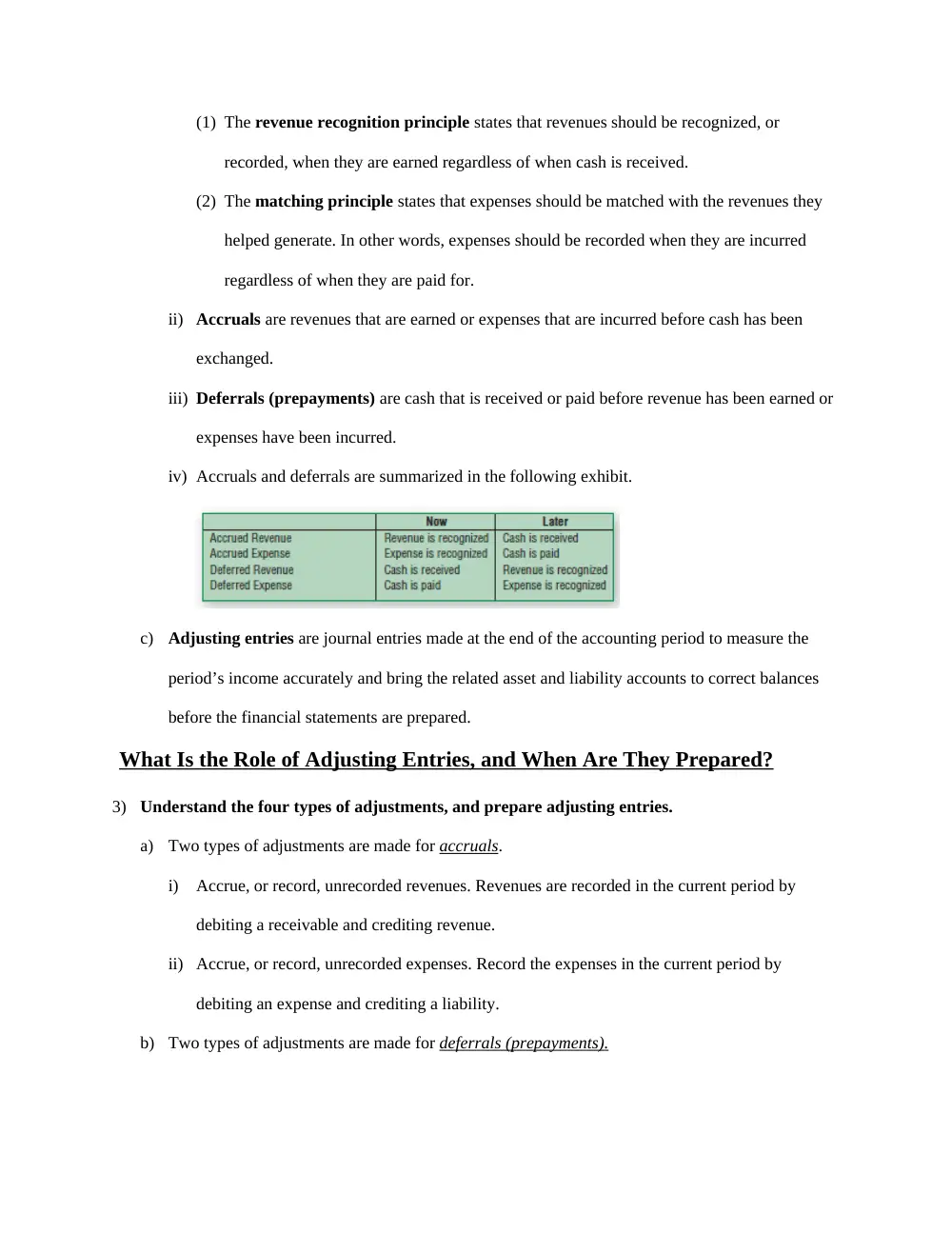
ii) Accruals are revenues that are earned or expenses that are incurred before cash has been
exchanged.
iii) Deferrals (prepayments) are cash that is received or paid before revenue has been earned or
expenses have been incurred.
iv) Accruals and deferrals are summarized in the following exhibit.
c)
Adjusting entries are journal entries made at the end of the accounting period to measure the
period’s income accurately and bring the related asset and liability accounts to correct balances
before the financial statements are prepared.
What Is the Role of Adjusting Entries, and When Are They Prepared?
3)
Understand the four types of adjustments, and prepare adjusting entries.
a)
Two types of adjustments are made for accruals.
i)
Accrue, or record, unrecorded revenues. Revenues are recorded in the current period by
debiting a receivable and crediting revenue.
ii) Accrue, or record, unrecorded expenses. Record the expenses in the current period by
debiting an expense and crediting a liability.
b)
Two types of adjustments are made for deferrals (prepayments).
i)
Divide unearned revenues between periods. When payment is received in advance from a
customer for goods or services, cash is debited. Since the customers are owed for the goods
or services, a liability account, Unearned Revenue, is credited (also called deferred
revenue). Once the customer receives the goods or services, an adjusting entry is prepared in
which the Unearned Revenue account is debited for the value of the goods or services
received and a Revenue account is credited for this same amount (since the exchange is
complete and the revenue is now earned).
ii) Prepaid expenses are amounts that are assets of a business because they represent items that
have been paid for but will be used later (also called deferred expenses). Divided into
periods, examples include these following: prepaid expenses, supplies, buildings, equipment,
and other assets. These items are recorded as assets when they are purchased because the item
that was paid for has not yet been used up. Therefore, an asset account is debited and cash is
credited to record the purchase. Once part, or all, of the item is used up, an adjusting entry is
prepared in which an expense account is debited and the related asset is credited for that
portion that has been used.
c)
An unadjusted trial balance is a trial balance report that is prepared at the end of the accounting
period prior to the recording of adjusting entries.
d)
Accounts receivable are recorded, representing accrued revenues, when a customer receives a
product or service before payment is made.
e)
Salaries payable, accrued expenses, represents a liability owed to employees who have earned
their wages, but not yet been paid. Accrued expenses are expenses that have been incurred prior
to being paid for.
f)
Deferred revenue is a liability that is created when a business collects cash from customers in
advance of providing goods or services (also called unearned revenue). An example, using
consulting services, is illustrated.
g)
Deferred expenses are amounts that are assets of a business because they represent items which
have been paid for, but will be used at a later date. Also called prepaid expenses.
i)
Examples to illustrate the initial and adjusting journal entries include prepaid rent, supplies
inventory and long-term assets.
ii) Long-term assets, or fixed assets, are assets that last for more than one year.
(1) Examples include land, buildings, equipment, and furniture.
(2) Depreciation is the allocation of the cost of a long-term asset to expense over its useful
life. Land is never depreciated as it is never “used up.”
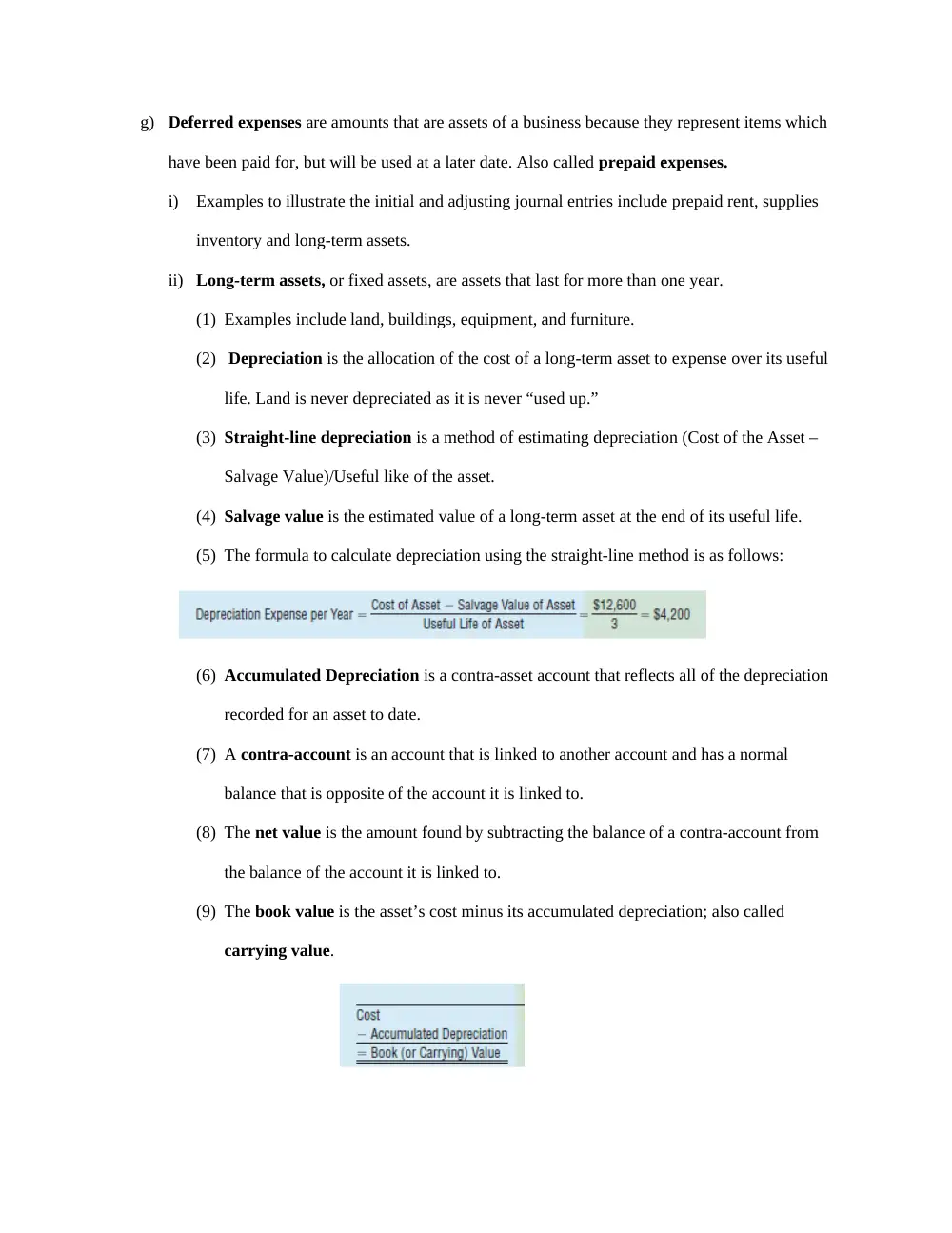
(3) Straight-line depreciation is a method of estimating depreciation (Cost of the Asset –
Salvage Value)/Useful like of the asset.
(4) Salvage value is the estimated value of a long-term asset at the end of its useful life.
(5) The formula to calculate depreciation using the straight-line method is as follows:
(6) Accumulated Depreciation is a contra-asset account that reflects all of the depreciation
recorded for an asset to date.
(7) A contra-account is an account that is linked to another account and has a normal
balance that is opposite of the account it is linked to.
(8) The net value is the amount found by subtracting the balance of a contra-account from
the balance of the account it is linked to.
(9) The book value is the asset’s cost minus its accumulated depreciation; also called
carrying value.
How Are Financial Statements Prepared from an Adjusted Trial Balance?
4)
Prepare financial statements from an adjusted trial balance.
a)
An adjusted trial balance is a list of all accounts of a business with their adjusted balances.
i)
Prepared prior to preparing the financial statements to make sure debits equal credits.
Accruals and deferrals can be summarized as follows:
(1) With an accrued revenue or expense, a revenue or expense is recorded first when the
revenue is earned or the expense is incurred and cash is received or paid later.
(2) With a deferred revenue or expense, cash is received or paid first. The revenue or
expense is recorded later as the revenue is earned or the expense is incurred.
(3) The below Exhibit summarizes the accrual and deferral adjustments.