
AGSC 212 Midterm, Fall 2012
American University of Beirut · Agricultural Economic Principles and Policy · 7 pages

More AGSC 212 files
- Final + Solution · Fall 2018Final exam · with solutionView
- Useful File Test Bank · Spring 2015FileView
- Syllabus · Fall 2015LabView
- Useful File 4 · Spring 2014FileView
- Useful File 2 · Spring 2014FileView
- Useful File 5 · Spring 2014FileView
- Useful File 6 · Spring 2014FileView
- Useful File 7 · Spring 2014FileView
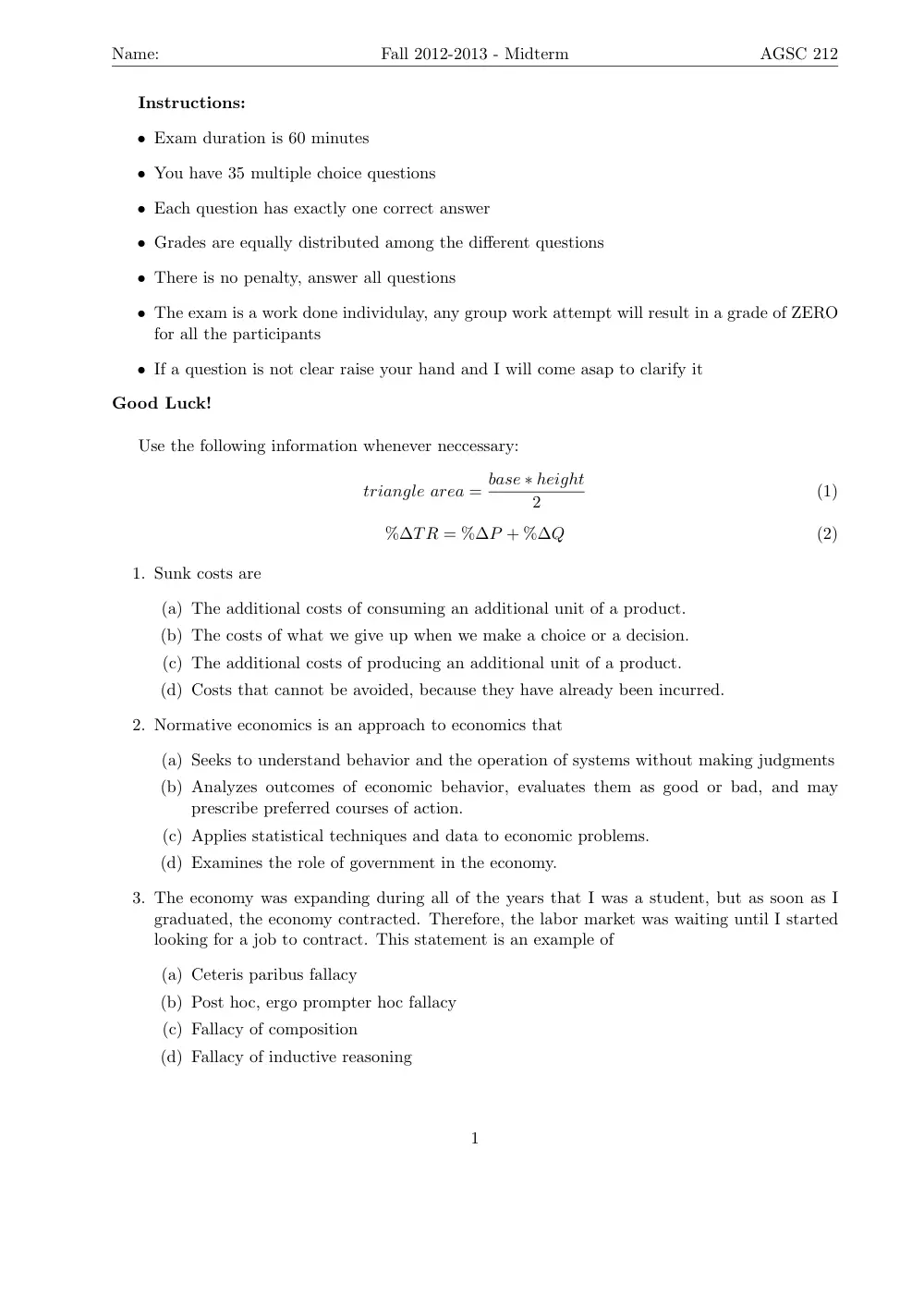
Show the text of this exam
Name:
Fall 2012-2013 - Midterm
AGSC 212
Instructions:
• Exam duration is 60 minutes
• You have 35 multiple choice questions
• Each question has exactly one correct answer
• Grades are equally distributed among the different questions
• There is no penalty, answer all questions
• The exam is a work done individulay, any group work attempt will result in a grade of ZERO
for all the participants
• If a question is not clear raise your hand and I will come asap to clarify it
Good Luck!
Use the following information whenever neccessary:
triangle area = base ∗ height
2
(1)
%∆TR = %∆P + %∆Q
(2)
1. Sunk costs are
(a) The additional costs of consuming an additional unit of a product.
(b) The costs of what we give up when we make a choice or a decision.
(c) The additional costs of producing an additional unit of a product.
(d) Costs that cannot be avoided, because they have already been incurred.
2. Normative economics is an approach to economics that
(a) Seeks to understand behavior and the operation of systems without making judgments
(b) Analyzes outcomes of economic behavior, evaluates them as good or bad, and may
prescribe preferred courses of action.
(c) Applies statistical techniques and data to economic problems.
(d) Examines the role of government in the economy.
3. The economy was expanding during all of the years that I was a student, but as soon as I
graduated, the economy contracted. Therefore, the labor market was waiting until I started
looking for a job to contract. This statement is an example of
(a) Ceteris paribus fallacy
(b) Post hoc, ergo prompter hoc fallacy
(c) Fallacy of composition
(d) Fallacy of inductive reasoning
1
Name:
Fall 2012-2013 - Midterm
AGSC 212
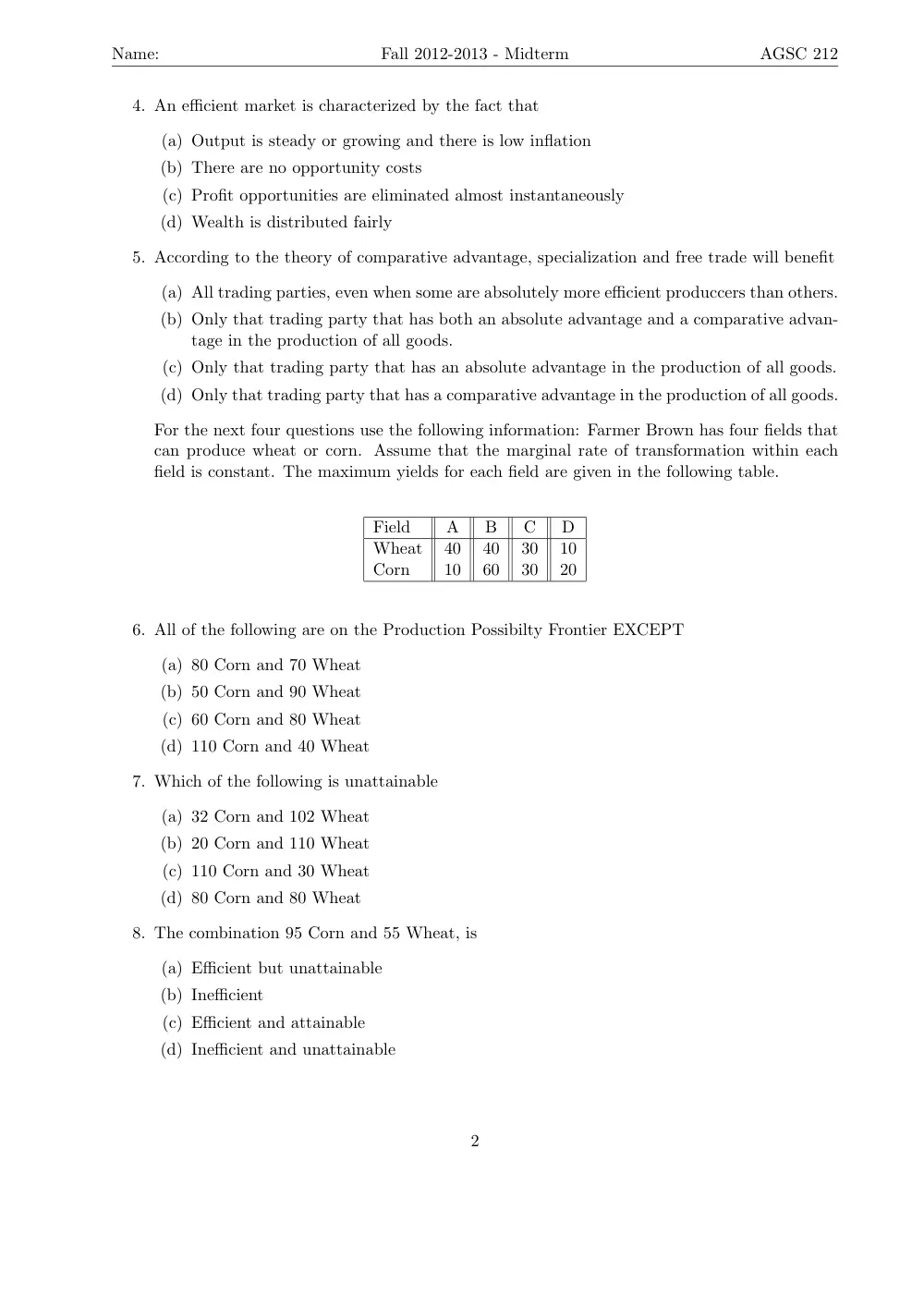
4. An efficient market is characterized by the fact that
(a) Output is steady or growing and there is low inflation
(b) There are no opportunity costs
(c) Profit opportunities are eliminated almost instantaneously
(d) Wealth is distributed fairly
5. According to the theory of comparative advantage, specialization and free trade will benefit
(a) All trading parties, even when some are absolutely more efficient produccers than others.
(b) Only that trading party that has both an absolute advantage and a comparative advan-
tage in the production of all goods.
(c) Only that trading party that has an absolute advantage in the production of all goods.
(d) Only that trading party that has a comparative advantage in the production of all goods.
For the next four questions use the following information: Farmer Brown has four fields that
can produce wheat or corn. Assume that the marginal rate of transformation within each
field is constant. The maximum yields for each field are given in the following table.
Field
A
B
C
D
Wheat
40
40
30
10
Corn
10
60
30
20
6. All of the following are on the Production Possibilty Frontier EXCEPT
(a) 80 Corn and 70 Wheat
(b) 50 Corn and 90 Wheat
(c) 60 Corn and 80 Wheat
(d) 110 Corn and 40 Wheat
7. Which of the following is unattainable
(a) 32 Corn and 102 Wheat
(b) 20 Corn and 110 Wheat
(c) 110 Corn and 30 Wheat
(d) 80 Corn and 80 Wheat
8. The combination 95 Corn and 55 Wheat, is
(a) Efficient but unattainable
(b) Inefficient
(c) Efficient and attainable
(d) Inefficient and unattainable
2
Name:
Fall 2012-2013 - Midterm
AGSC 212
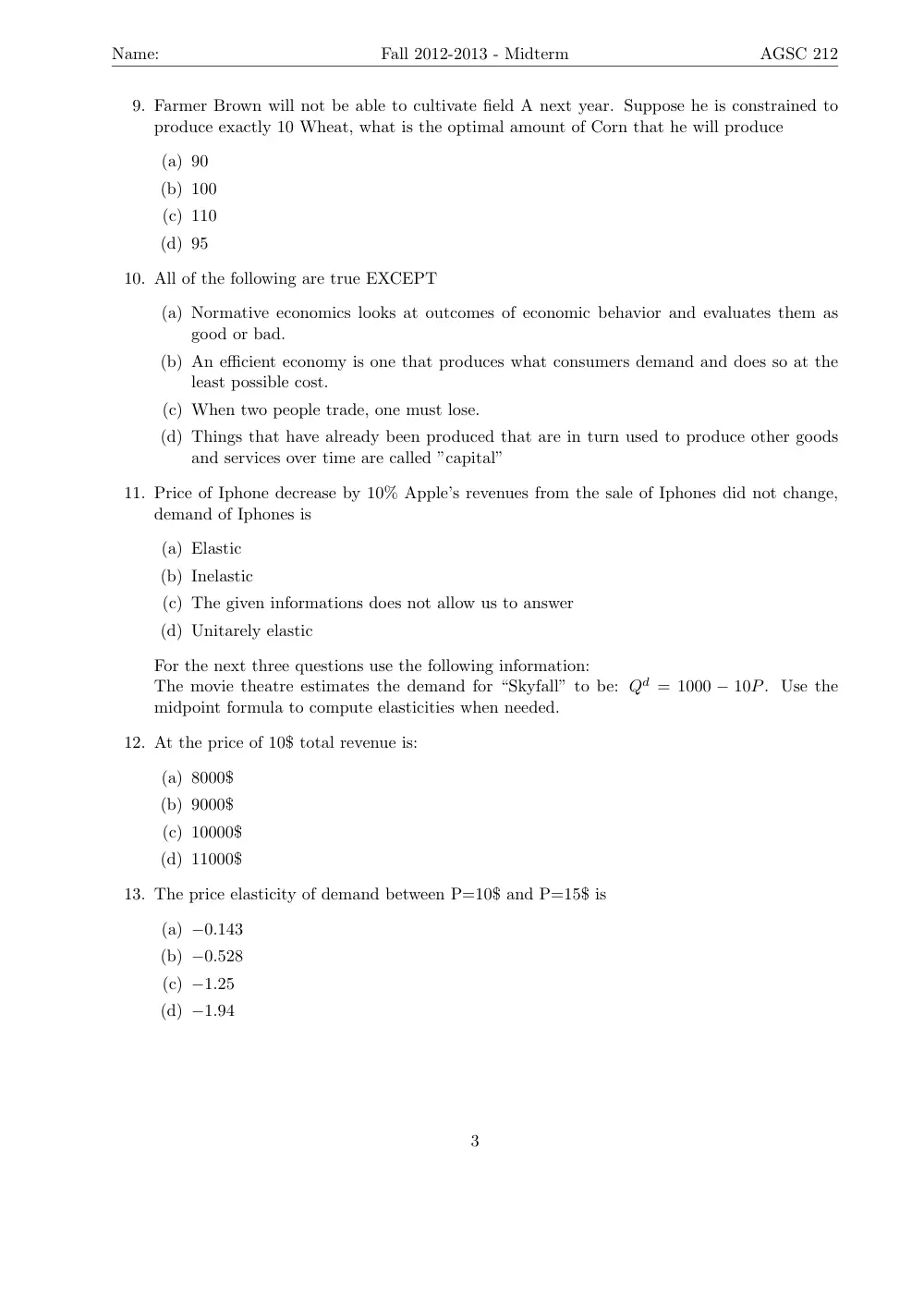
9. Farmer Brown will not be able to cultivate field A next year. Suppose he is constrained to
produce exactly 10 Wheat, what is the optimal amount of Corn that he will produce
(a) 90
(b) 100
(c) 110
(d) 95
10. All of the following are true EXCEPT
(a) Normative economics looks at outcomes of economic behavior and evaluates them as
good or bad.
(b) An efficient economy is one that produces what consumers demand and does so at the
least possible cost.
(c) When two people trade, one must lose.
(d) Things that have already been produced that are in turn used to produce other goods
and services over time are called ”capital”
11. Price of Iphone decrease by 10% Apple’s revenues from the sale of Iphones did not change,
demand of Iphones is
(a) Elastic
(b) Inelastic
(c) The given informations does not allow us to answer
(d) Unitarely elastic
For the next three questions use the following information:
The movie theatre estimates the demand for “Skyfall” to be: Qd = 1000 − 10P. Use the
midpoint formula to compute elasticities when needed.
12. At the price of 10$ total revenue is:
(a) 8000$
(b) 9000$
(c) 10000$
(d) 11000$
13. The price elasticity of demand between P=10$ and P=15$ is
(a) −0.143
(b) −0.528
(c) −1.25
(d) −1.94
3
Name:
Fall 2012-2013 - Midterm
AGSC 212
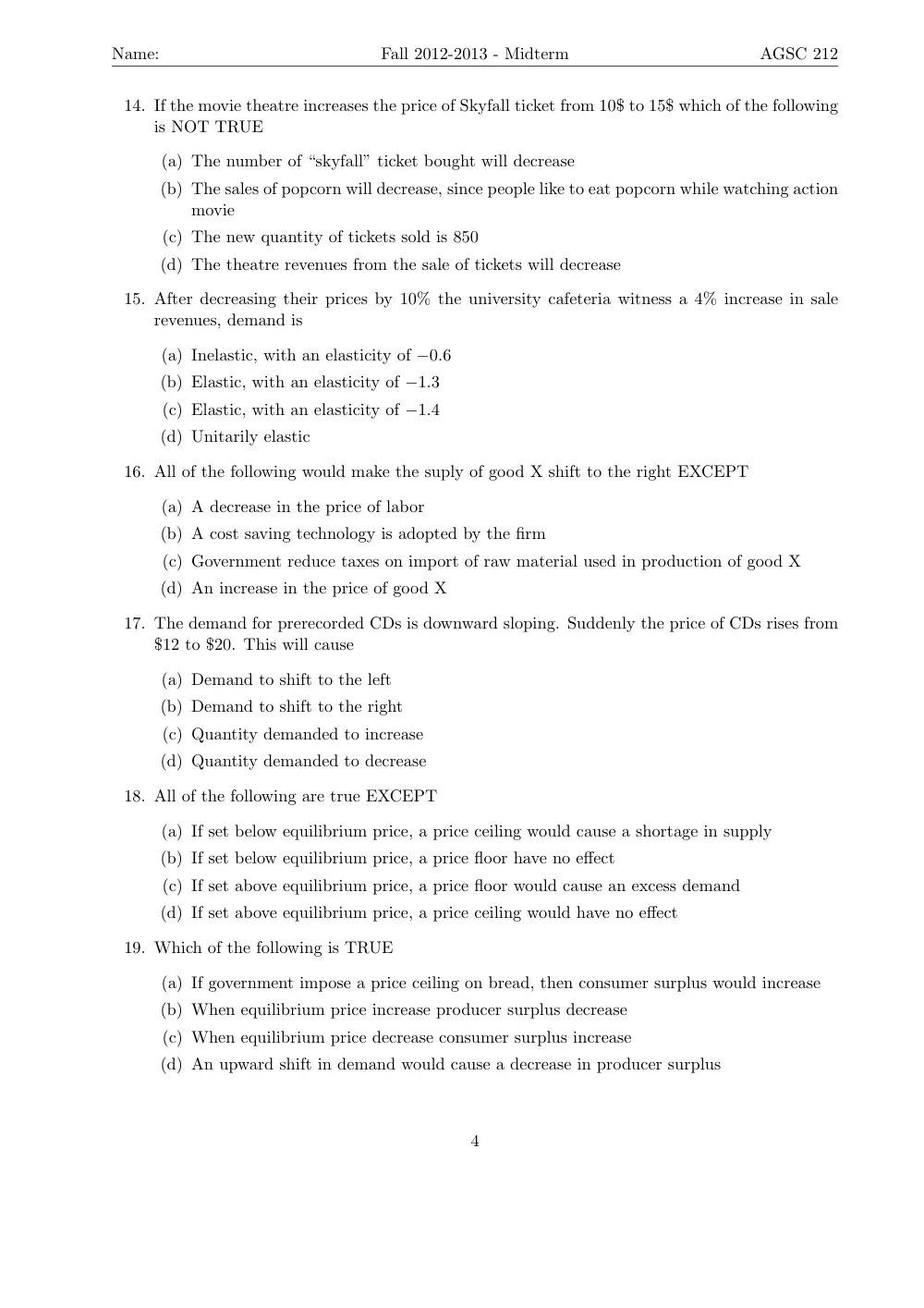
14. If the movie theatre increases the price of Skyfall ticket from 10$ to 15$ which of the following
is NOT TRUE
(a) The number of “skyfall” ticket bought will decrease
(b) The sales of popcorn will decrease, since people like to eat popcorn while watching action
movie
(c) The new quantity of tickets sold is 850
(d) The theatre revenues from the sale of tickets will decrease
15. After decreasing their prices by 10% the university cafeteria witness a 4% increase in sale
revenues, demand is
(a) Inelastic, with an elasticity of −0.6
(b) Elastic, with an elasticity of −1.3
(c) Elastic, with an elasticity of −1.4
(d) Unitarily elastic
16. All of the following would make the suply of good X shift to the right EXCEPT
(a) A decrease in the price of labor
(b) A cost saving technology is adopted by the firm
(c) Government reduce taxes on import of raw material used in production of good X
(d) An increase in the price of good X
17. The demand for prerecorded CDs is downward sloping. Suddenly the price of CDs rises from
$12 to $20. This will cause
(a) Demand to shift to the left
(b) Demand to shift to the right
(c) Quantity demanded to increase
(d) Quantity demanded to decrease
18. All of the following are true EXCEPT
(a) If set below equilibrium price, a price ceiling would cause a shortage in supply
(b) If set below equilibrium price, a price floor have no effect
(c) If set above equilibrium price, a price floor would cause an excess demand
(d) If set above equilibrium price, a price ceiling would have no effect
19. Which of the following is TRUE
(a) If government impose a price ceiling on bread, then consumer surplus would increase
(b) When equilibrium price increase producer surplus decrease
(c) When equilibrium price decrease consumer surplus increase
(d) An upward shift in demand would cause a decrease in producer surplus
4
Name:
Fall 2012-2013 - Midterm
AGSC 212
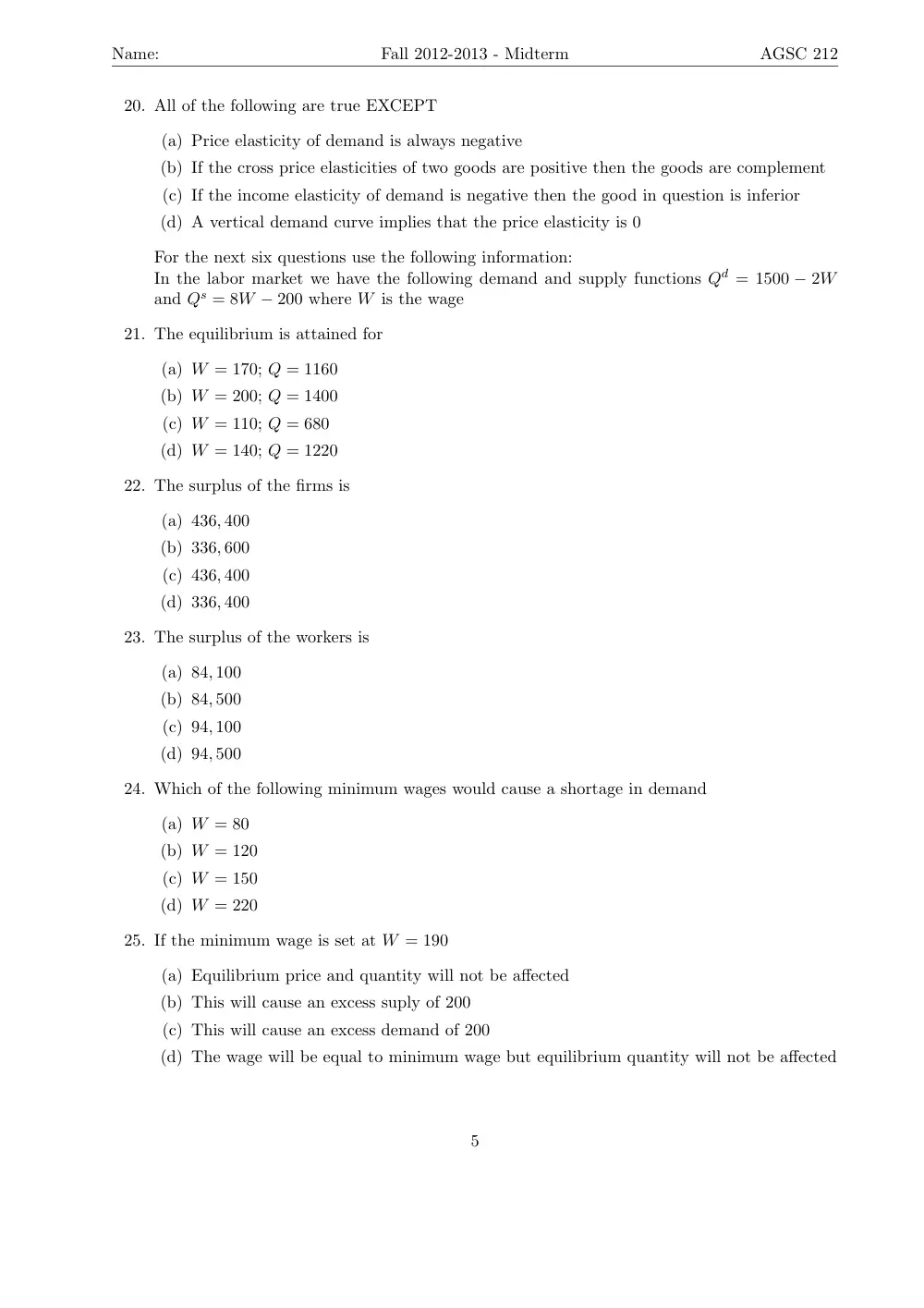
20. All of the following are true EXCEPT
(a) Price elasticity of demand is always negative
(b) If the cross price elasticities of two goods are positive then the goods are complement
(c) If the income elasticity of demand is negative then the good in question is inferior
(d) A vertical demand curve implies that the price elasticity is 0
For the next six questions use the following information:
In the labor market we have the following demand and supply functions Qd = 1500 − 2W
and Qs = 8W − 200 where W is the wage
21. The equilibrium is attained for
(a) W = 170; Q = 1160
(b) W = 200; Q = 1400
(c) W = 110; Q = 680
(d) W = 140; Q = 1220
22. The surplus of the firms is
(a) 436, 400
(b) 336, 600
(c) 436, 400
(d) 336, 400
23. The surplus of the workers is
(a) 84, 100
(b) 84, 500
(c) 94, 100
(d) 94, 500
24. Which of the following minimum wages would cause a shortage in demand
(a) W = 80
(b) W = 120
(c) W = 150
(d) W = 220
25. If the minimum wage is set at W = 190
(a) Equilibrium price and quantity will not be affected
(b) This will cause an excess suply of 200
(c) This will cause an excess demand of 200
(d) The wage will be equal to minimum wage but equilibrium quantity will not be affected
5
Name:
Fall 2012-2013 - Midterm
AGSC 212
26. At the minimum wage of W = 150 the deadweight loss is
(a) 0
(b) 250
(c) 500
(d) 750
Use the following information to answer the next two questions:
Barney and Hank each have dollars and bottles of Beer. Barney values a bottle of beer at
10$ whereas Hank values a bottle of beer at 5$.
27. If the market is efficient which of the following is TRUE
(a) Hank is willing to sell beer at any price
(b) Hank will buy beer from Barney
(c) Barney is willing to buy beer at any price
(d) Barney would buy beer from Hank, if the price is between 5$ and 10$
28. If market price is 15$
(a) Barney would buy beer from Hank
(b) Hank would buy beer from Barney
(c) No trade would take place since both of them want to drink their beer
(d) No trade would take place since none is willing to pay this price
For the next three question use the following information:
Sheldon and Leonard are roomates. Sheldon can clean 3 rooms or wash 30 dishes in one hour,
while Leonard can clean 2 rooms or wash 40 dishes in one hour.
29. For Sheldon the opportunity cost of cleaning 1 room is
(a) Washing 5 dishes
(b) Washing 10 dishes
(c) Washing 15 dishes
(d) No opportunity cost since he can clean the dishes after he finish cleaning the rooms
30. For Leonard the opportunity cost of washing 1 dish is
(a) 1/20 rooms
(b) no opportunity cost since he can clean the rooms after he finishes washing dishes
(c) 1/10 rooms
(d) 1/40 rooms
31. Which of the following is TRUE
(a) Leonard has an absolute advantage in performing both tasks
(b) Leonard has a comparative advantage in cleaning rooms
(c) Sheldon has a comparative in washing dishes
(d) Sheldon has an absolute advantage in cleaning rooms
6
Name:
Fall 2012-2013 - Midterm
AGSC 212
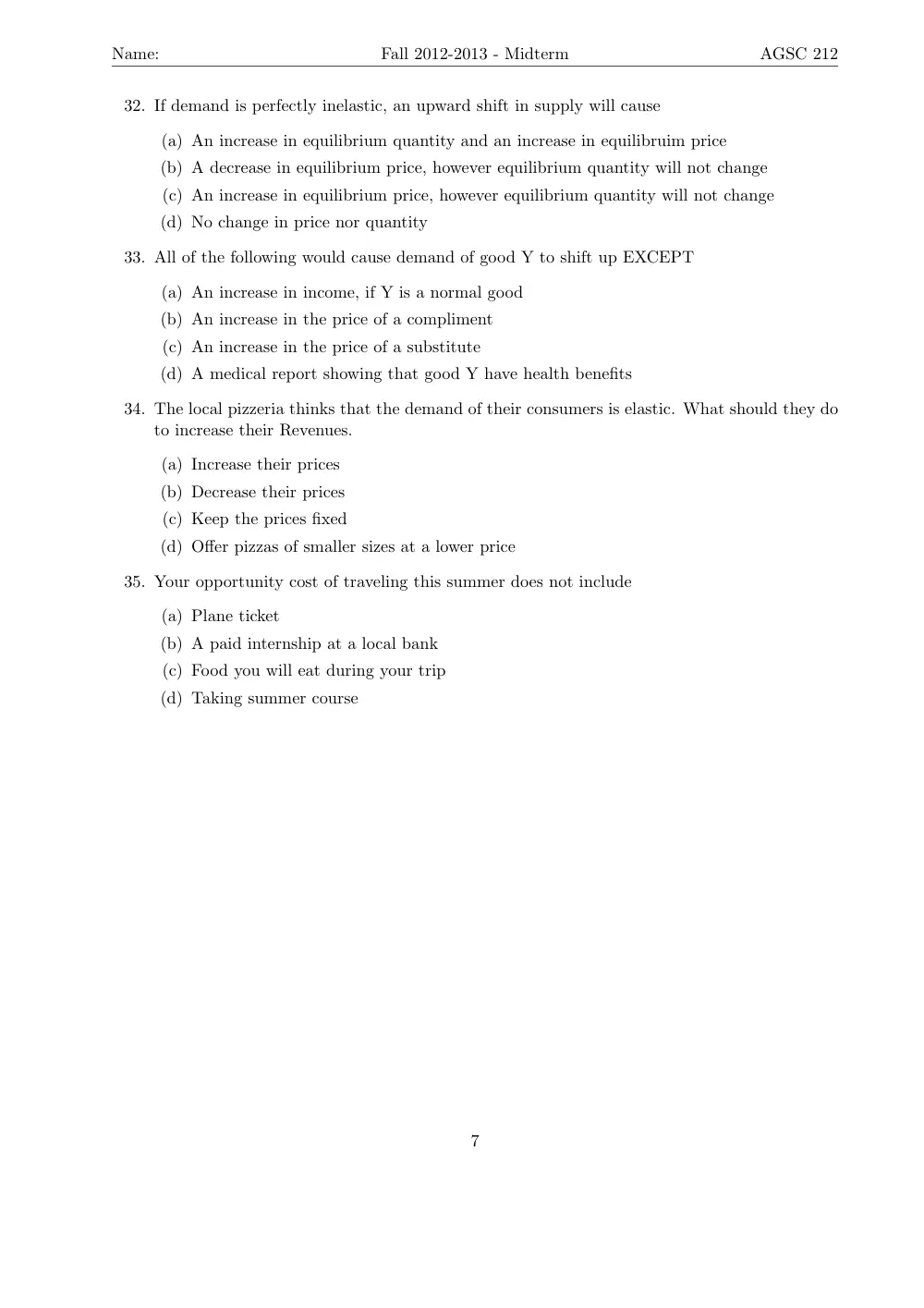
32. If demand is perfectly inelastic, an upward shift in supply will cause
(a) An increase in equilibrium quantity and an increase in equilibruim price
(b) A decrease in equilibrium price, however equilibrium quantity will not change
(c) An increase in equilibrium price, however equilibrium quantity will not change
(d) No change in price nor quantity
33. All of the following would cause demand of good Y to shift up EXCEPT
(a) An increase in income, if Y is a normal good
(b) An increase in the price of a compliment
(c) An increase in the price of a substitute
(d) A medical report showing that good Y have health benefits
34. The local pizzeria thinks that the demand of their consumers is elastic. What should they do
to increase their Revenues.
(a) Increase their prices
(b) Decrease their prices
(c) Keep the prices fixed
(d) Offer pizzas of smaller sizes at a lower price
35. Your opportunity cost of traveling this summer does not include
(a) Plane ticket
(b) A paid internship at a local bank
(c) Food you will eat during your trip
(d) Taking summer course
7