
AGSC 212 Problems Chapter 1, Spring 2013
American University of Beirut · Agricultural Economic Principles and Policy · 2 pages
More AGSC 212 files
- Final + Solution · Fall 2018Final exam · with solutionView
- Useful File Test Bank · Spring 2015FileView
- Syllabus · Fall 2015LabView
- Useful File 4 · Spring 2014FileView
- Useful File 2 · Spring 2014FileView
- Useful File 5 · Spring 2014FileView
- Useful File 6 · Spring 2014FileView
- Useful File 7 · Spring 2014FileView
Show the text of this chapter
Problem Set 1
AGSC 212
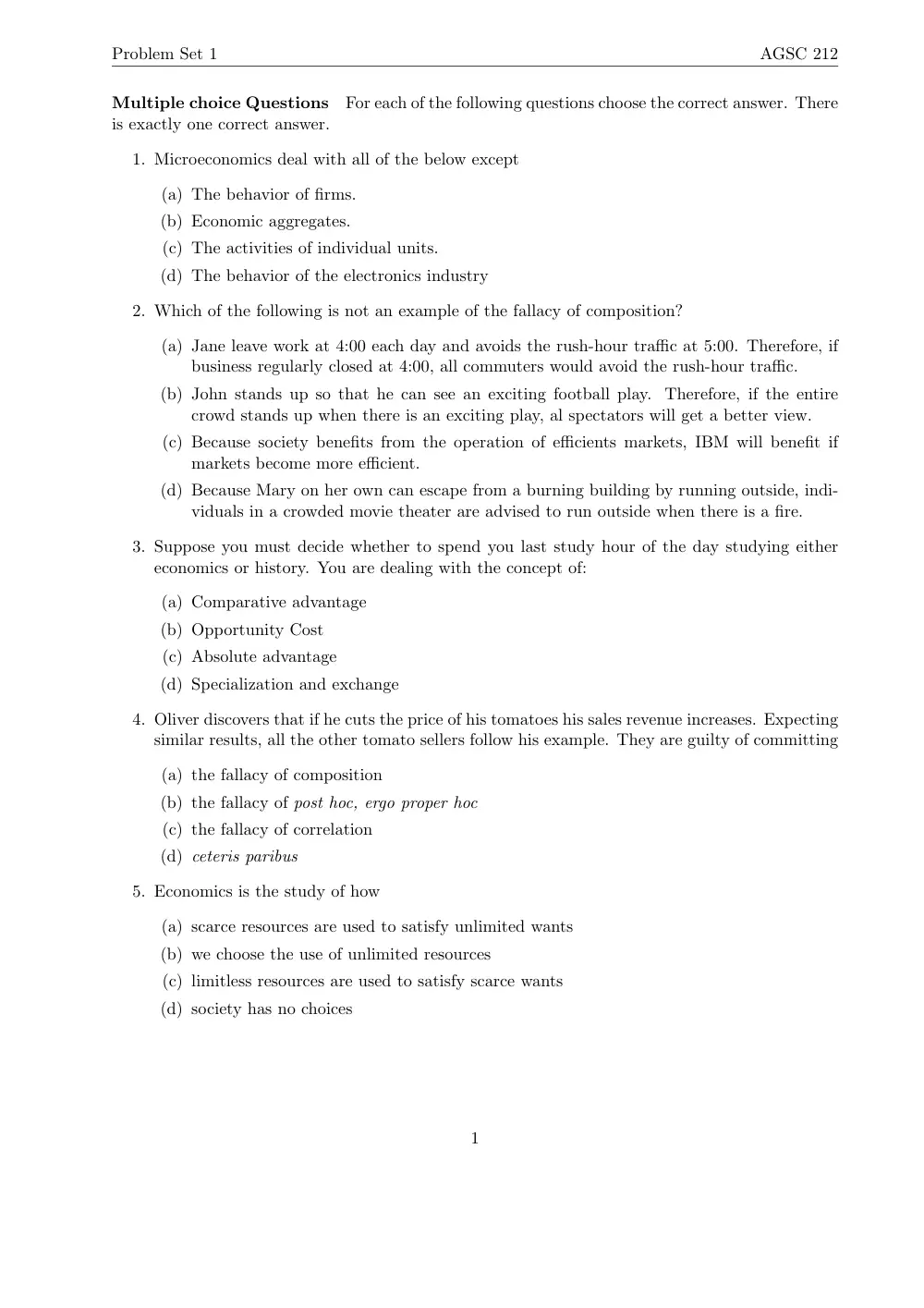
Multiple choice Questions
For each of the following questions choose the correct answer. There
is exactly one correct answer.
1. Microeconomics deal with all of the below except
(a) The behavior of firms.
(b) Economic aggregates.
(c) The activities of individual units.
(d) The behavior of the electronics industry
2. Which of the following is not an example of the fallacy of composition?
(a) Jane leave work at 4:00 each day and avoids the rush-hour traffic at 5:00. Therefore, if
business regularly closed at 4:00, all commuters would avoid the rush-hour traffic.
(b) John stands up so that he can see an exciting football play. Therefore, if the entire
crowd stands up when there is an exciting play, al spectators will get a better view.
(c) Because society benefits from the operation of efficients markets, IBM will benefit if
markets become more efficient.
(d) Because Mary on her own can escape from a burning building by running outside, indi-
viduals in a crowded movie theater are advised to run outside when there is a fire.
3. Suppose you must decide whether to spend you last study hour of the day studying either
economics or history. You are dealing with the concept of:
(a) Comparative advantage
(b) Opportunity Cost
(c) Absolute advantage
(d) Specialization and exchange
4. Oliver discovers that if he cuts the price of his tomatoes his sales revenue increases. Expecting
similar results, all the other tomato sellers follow his example. They are guilty of committing
(a) the fallacy of composition
(b) the fallacy of post hoc, ergo proper hoc
(c) the fallacy of correlation
(d) ceteris paribus
5. Economics is the study of how
(a) scarce resources are used to satisfy unlimited wants
(b) we choose the use of unlimited resources
(c) limitless resources are used to satisfy scarce wants
(d) society has no choices
1
Problem Set 1
AGSC 212
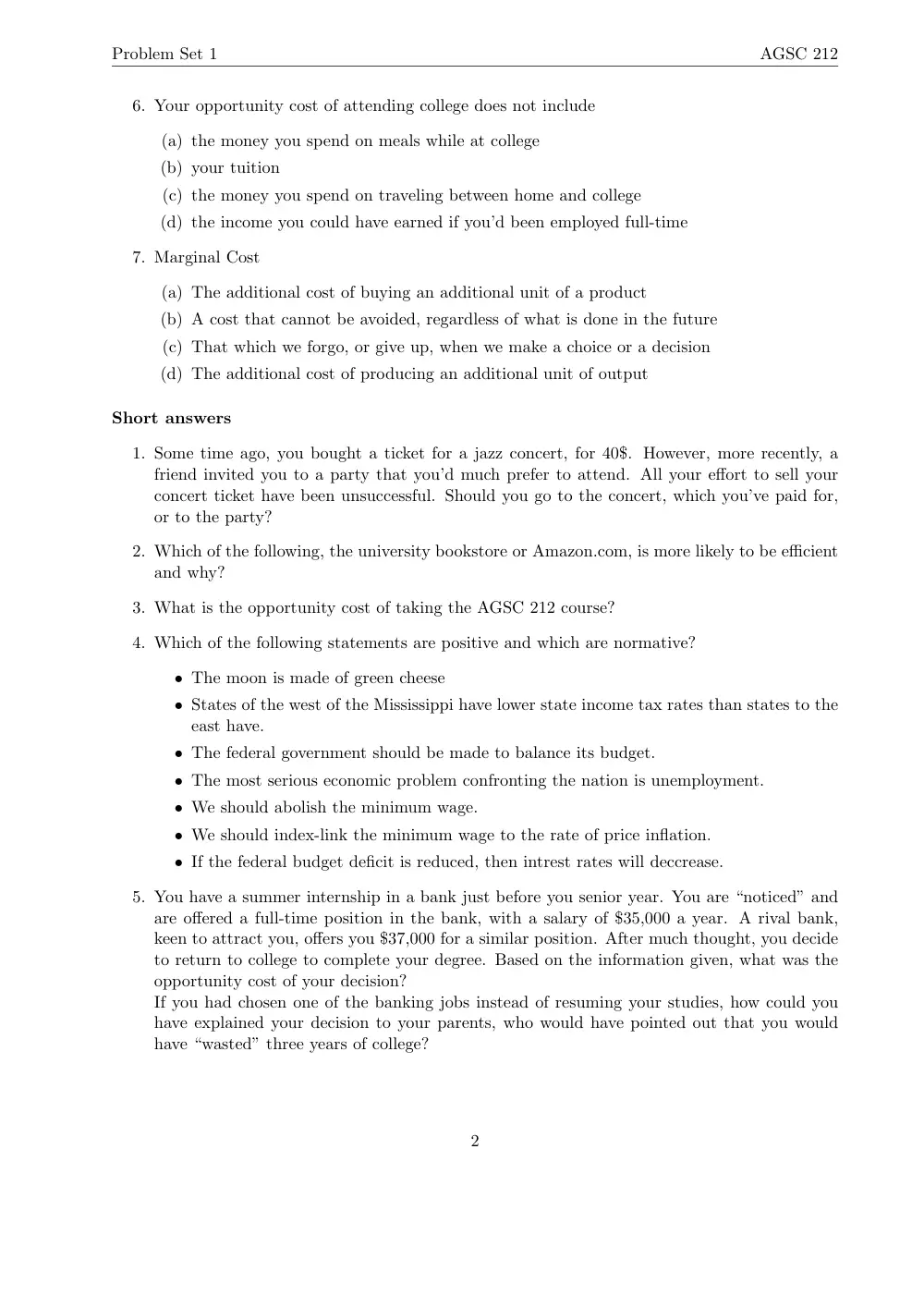
6. Your opportunity cost of attending college does not include
(a) the money you spend on meals while at college
(b) your tuition
(c) the money you spend on traveling between home and college
(d) the income you could have earned if you’d been employed full-time
7. Marginal Cost
(a) The additional cost of buying an additional unit of a product
(b) A cost that cannot be avoided, regardless of what is done in the future
(c) That which we forgo, or give up, when we make a choice or a decision
(d) The additional cost of producing an additional unit of output
Short answers
1. Some time ago, you bought a ticket for a jazz concert, for 40$. However, more recently, a
friend invited you to a party that you’d much prefer to attend. All your effort to sell your
concert ticket have been unsuccessful. Should you go to the concert, which you’ve paid for,
or to the party?
2. Which of the following, the university bookstore or Amazon.com, is more likely to be efficient
and why?
3. What is the opportunity cost of taking the AGSC 212 course?
4. Which of the following statements are positive and which are normative?
• The moon is made of green cheese
• States of the west of the Mississippi have lower state income tax rates than states to the
east have.
• The federal government should be made to balance its budget.
• The most serious economic problem confronting the nation is unemployment.
• We should abolish the minimum wage.
• We should index-link the minimum wage to the rate of price inflation.
• If the federal budget deficit is reduced, then intrest rates will deccrease.
5. You have a summer internship in a bank just before you senior year. You are “noticed” and
are offered a full-time position in the bank, with a salary of $35,000 a year. A rival bank,
keen to attract you, offers you $37,000 for a similar position. After much thought, you decide
to return to college to complete your degree. Based on the information given, what was the
opportunity cost of your decision?
If you had chosen one of the banking jobs instead of resuming your studies, how could you
have explained your decision to your parents, who would have pointed out that you would
have “wasted” three years of college?
2