
BIO 202 Chapter 28, Spring 2018
American University of Beirut · General Biology II · 100 pages · Dr. Sawsan Kreydiyyeh


Showing the first 10 of 100 pages. Download the PDF to see all of it.
More BIO 202 files
- Chapter 34 · Spring 2018ChapterView
- Questions Chapter 36 · Fall 2013ChapterView
- Questions Chapter 40 · Fall 2010ChapterView
- Questions Chapter 45 · Fall 2010ChapterView
- Useful File Frog Skeleton Labeling Empty · Spring 2018FileView
- Syllabus Seedless Plants · Spring 2016LabView
- Questions Test Banks Ch 1 · Fall 2015ProblemsView
- Questions Test Banks Ch 31 · Fall 2015ProblemsView
Show the text of this chapter
© 2017 Pearson Education, Ltd.
Lecture Presentation by
Cindy S. Malone, PhD,
California State University Northridge
28
Green Algae
and
Land Plants
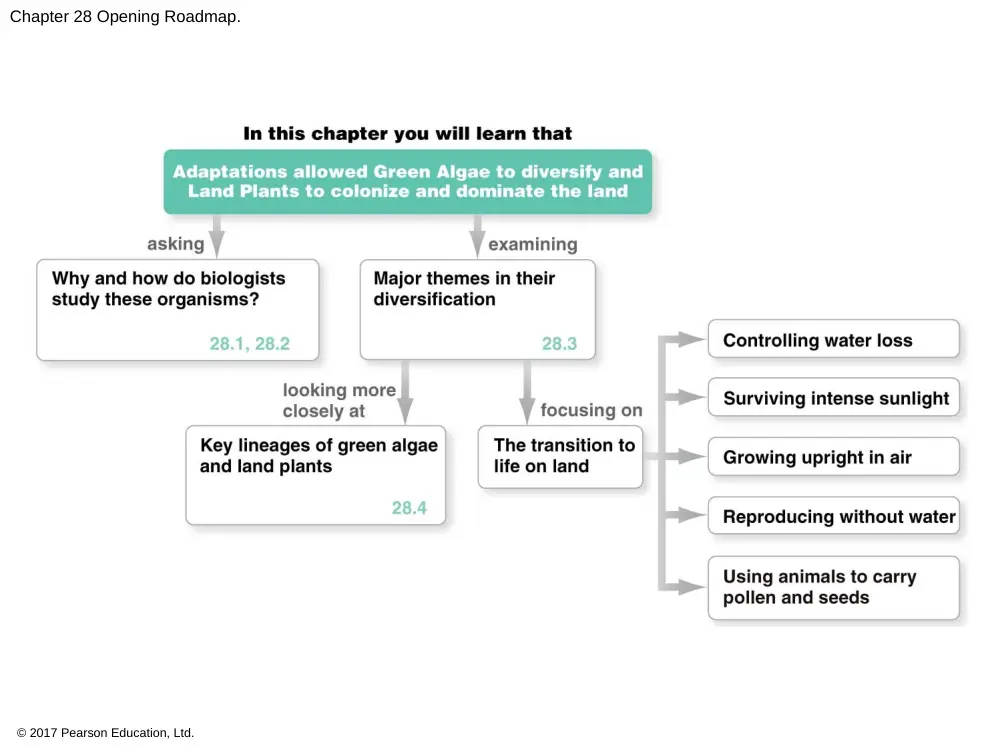
Chapter 28 Opening Roadmap.
© 2017 Pearson Education, Ltd.
© 2017 Pearson Education, Ltd.
Introduction
• The Viridiplantae, or green plants, consist of the
green algae and land plants
• Green algae are important photosynthetic organisms
in freshwater habitats
• Land plants are the key photosynthesizers in
terrestrial environments
© 2017 Pearson Education, Ltd.
Introduction
• Green algae have traditionally been considered
protists, but we study them along with land plants for
two reasons:
1. They are the closest living relatives to land plants
2. The transition from aquatic to terrestrial life occurred
when land plants evolved from green algae
© 2017 Pearson Education, Ltd.
Introduction
• Land plants were the first organisms that could
thrive with their tissues completely exposed to the
air
• Before land plants evolved, terrestrial life was limited
to bacteria, archaea, and single-celled protists
• Plants transformed the nature of life on Earth
© 2017 Pearson Education, Ltd.
Why Do Biologists Study Green Plants?
• Biologists study plants not only because they are
fascinating organisms but also because we could
not live without them
• People rely on plants for food, fuel, the fibers used to
make clothing and other products, building materials,
and pharmaceuticals
• Agriculture, forestry, and horticulture are among the
most important industries based on plants
© 2017 Pearson Education, Ltd.
Why Do Biologists Study Green Plants?
• Biologists also study plants that cause problems for
humans:
• Weeds that decrease crop productivity
• Newly introduced species that invade and then
degrade natural areas
© 2017 Pearson Education, Ltd.
Plants Provide Ecosystem Services
• An ecosystem consists of
• All of the organisms in a particular area
• Nonliving physical components of the environment,
such as
• The atmosphere
• Precipitation
• Surface water
• Sunlight
• Soil
• Nutrients
© 2017 Pearson Education, Ltd.
Plants Provide Ecosystem Services
• Ecosystem services provided by green algae and
land plants include
• Producing oxygen via oxygenic photosynthesis
• Building soil by providing food for decomposers
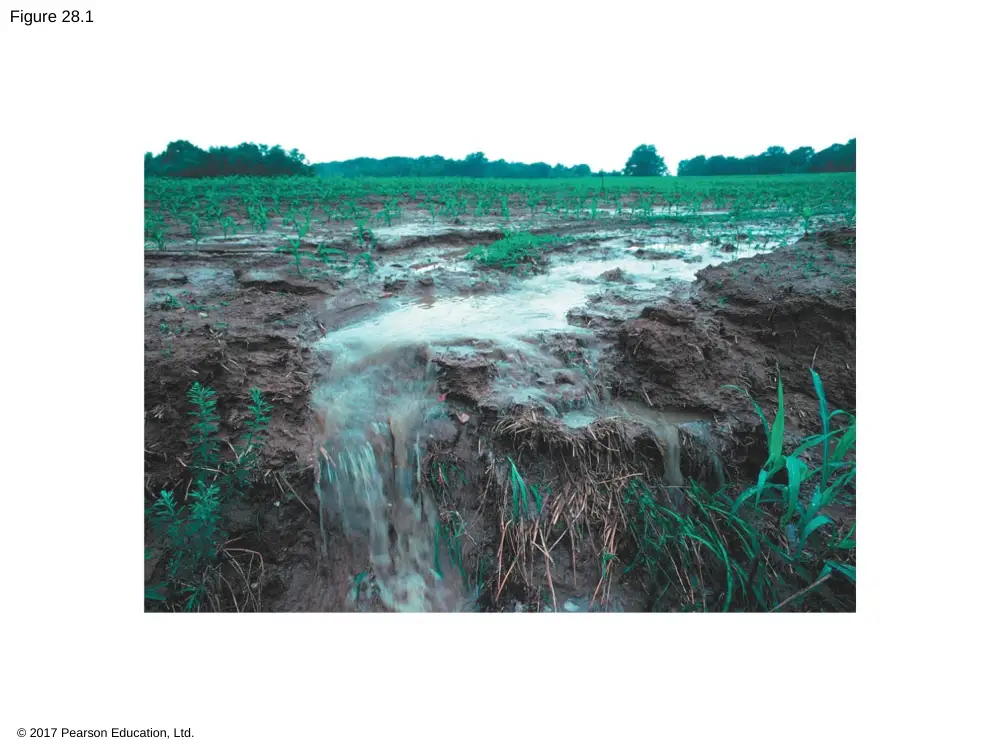
• Holding soil and preventing nutrients from being lost
to wind or water erosion
• Holding water in the soil
• Moderating the local climate by providing shade and
reducing the impact of wind on landscapes
Figure 28.1
© 2017 Pearson Education, Ltd.
© 2017 Pearson Education, Ltd.
Plants Are Primary Producers
• Land plants are the dominant primary producers in
terrestrial ecosystems
• They convert energy in sunlight into chemical energy
• The sugars produced by land plants support virtually
all other organisms in terrestrial habitats
© 2017 Pearson Education, Ltd.
Plants Are Primary Producers
• Land plants are the key to the carbon cycle
• Take CO2 from the atmosphere and reduce it to make
sugars
• Fix much more CO2 than they release
• The loss of plant-rich prairies has contributed to
increased concentrations of CO2 in the atmosphere
• Partly responsible for rising temperatures associated
with global climate change
© 2017 Pearson Education, Ltd.
Plants Provide Humans with Food, Fuel, Fiber,
Building Materials, and Medicines
• Food
• Agricultural research began with the initial
domestication of crop plants
• Artificial selection for plants with certain properties
has led to dramatic changes in plant characteristics
Figure 28.2
(a) Plants were domesticated at an array of locations.
Wheat
Sunflower
Maize
Potato
Millet
Barley
Rice
Soybeans
(b) Artificial selection changes the traits of
domesticated species.
Domestic maize
Wild maize (teosinte)
© 2017 Pearson Education, Ltd.
© 2017 Pearson Education, Ltd.
Plants Provide Humans with Food, Fuel, Fiber,
Building Materials, and Medicines
• Fuel
• Historically, humans relied on wood burning for
energy
• In industrialized countries, fossil fuels including coal
and petroleum or natural gas have replaced wood
• Fossil fuels are derived from plants—living or
long-deceased
© 2017 Pearson Education, Ltd.
Plants Provide Humans with Food, Fuel, Fiber,
Building Materials, and Medicines
• Fiber and Building Materials
• Plants provide us with important sources of raw
material for clothing, rope, and household articles
such as towels and linens
• Woody plants provide
• Lumber for houses and furniture
• Fibers used to make paper
© 2017 Pearson Education, Ltd.
Plants Provide Humans with Food, Fuel, Fiber,
Building Materials, and Medicines
• Medicines
• About 25% of the prescriptions written in the United
States each year include at least one molecule
derived from plants
• Most of these compounds are synthesized by plants
to repel herbivores
Table 28.1
© 2017 Pearson Education, Ltd.
© 2017 Pearson Education, Ltd.
How Do Biologists Study Green Algae and Land
Plants ?
• To understand diversification:
1. Compare morphological traits
2. Analyze the fossil record
3. Estimate phylogenetic trees
© 2017 Pearson Education, Ltd.
Analyzing Morphological Traits
• The green algae include species that
• Are unicellular, colonial, or multicellular
• Live in marine, freshwater, or moist terrestrial habitats
• The vast majority of green algae are aquatic
• The vast majority of land plants are terrestrial
© 2017 Pearson Education, Ltd.
Similarities between Green Algae and Land
Plants
• Biologists have long hypothesized that green algae
are closely related to plants on the basis of several
key traits:
• Their chloroplast structure is the same
• Their thylakoid arrangements are similar
• Their cell walls, sperm, and peroxisomes are similar
in structure and composition
• Their chloroplasts synthesize starch as a storage
product
© 2017 Pearson Education, Ltd.
Major Morphological Differences among Land
Plants
1. Nonvascular plants
• Lack vascular tissue
• Specialized groups of cells
that conduct water or
dissolved nutrients
throughout the plant body
• Include mosses
• Use spores, not seeds, for
reproduction and dispersal
© 2017 Pearson Education, Ltd.
Major Morphological Differences among Land
Plants
2. Seedless vascular plants
• Have well-developed
vascular tissue
• Do not make seeds; use
spores for reproduction
• Includes ferns
© 2017 Pearson Education, Ltd.
Major Morphological Differences among Land
Plants
3. Seed plants
• Have vascular tissue
• Make seeds
• Seeds consist of an embryo
and a store of nutritive
tissue, surrounded by a
tough protective layer
• Include angiosperms
(“encased-seeds”), or flowering plants and
gymnosperms (“naked seeds’)
© 2017 Pearson Education, Ltd.
Preventing Water Loss: Cuticle and Stomata
• Cuticle is a watertight sealant that covers the
aboveground parts of the plant and gives them the
ability to survive in dry environments
• However, cuticle also keeps CO2 out of plant
• Most plants solve this problem with stoma (“mouth”;
plural: stomata) that consists of an opening
surrounded by specialized guard cells
• Pore opens and closes as guard cells change shape
• Gas exchange accomplished through pore
Figure 28.7
(a) Cuticle is a waxy layer that prevents
water loss from stems and leaves.
Leaf cross section
Cuticle
Moist
photosynthetic
cells
(b) Stomata have pores that allow gas
exchange in photosynthetic tissues.
Pore
25 µm
Guard cell
Cuticle
Stoma
© 2017 Pearson Education, Ltd.
© 2017 Pearson Education, Ltd.
Providing Protection from UV Irradiation
• Plants out of water exposed to harmful UV rays of
the sun
• UV light damages DNA by causing thymine dimers
• Water absorbs UV light, so algae did not face this
problem to the same extent
© 2017 Pearson Education, Ltd.
Providing Protection from UV Irradiation
• Many species of algae probably colonized wet soil
near home ponds, but only some were able to
survive the harsh sunlight
• The plants that survived were those that by chance
made compounds that absorb UV light
• Most plants today accumulate UV-absorbing
compounds (flavonoids) that protect DNA from
damage
© 2017 Pearson Education, Ltd.
The Importance of Upright Growth
• First land plants were small or had a low, sprawling
growth habit
• Had to grow in a way that kept many or most of their
tissues in direct contact with moist soil
• Competition for space and light would have become
intense soon after the first plants began growing on
land
• In a terrestrial environment, individuals that can
grow upright have much better access to sunlight
than individuals that cannot
© 2017 Pearson Education, Ltd.
Elaboration of Vascular Tissue: Tracheids and
Vessels
• Simple water-conducting tissues evolved by natural
selection into more complex, efficient supportive and
water-conducting tissues
• Long, thin, tapering, water-conducting cells called
tracheids evolved about 380 mya
© 2017 Pearson Education, Ltd.
Elaboration of Vascular Tissue: Tracheids and
Vessels
• Tracheids have
• A thickened, lignin-containing secondary cell wall in
addition to a cellulose-based primary cell wall
• Pits in the sides and ends of the cell, which allow
water to flow efficiently between tracheids
• The secondary cell wall increased structural support,
but water could still move easily through the cells
because of the pits
• Today, all vascular plants contain tracheids
© 2017 Pearson Education, Ltd.
Elaboration of Vascular Tissue: Tracheids and
Vessels
• Vessel elements, the most specialized type of water-
conducting cell, appeared about 250 to 270 mya
• Vessel elements
• Are shorter and wider than tracheids
• Have gaps on both ends where both cell walls are
missing
• In stems and branches of some vascular plants,
tracheids or a combination of tracheids and vessels
form wood
• Strong support material
© 2017 Pearson Education, Ltd.
Mapping Evolutionary Changes on the
Phylogenetic Tree
• Cuticle, stomata, and vascular tissue were key
adaptations that allowed early plants to colonize
land
• Fundamental adaptations to dry conditions—such as
cuticle, pores, stomata, vascular tissue, and
tracheids—evolved just once
• Convergent evolution also occurred, as vessels
evolved independently in angiosperms, gnetophytes,
and several species of seedless vascular plants
© 2017 Pearson Education, Ltd.
How Do Plants Reproduce in Dry Conditions?
• Life cycles of sexually reproducing eukaryotes
serve several functions:
• Increasing genetic variability due to meiosis and
fertilization
• Increasing the number of individuals
• Dispersing individuals to new habitats
© 2017 Pearson Education, Ltd.
How Do Plants Reproduce in Dry Conditions?
• Three innovations were instrumental for efficient
plant reproduction in a dry environment:
1. Spores that resist drying because they are encased
in a tough coat of sporopollenin
2. Gametes that were produced in complex,
multicellular structures (gametangia: archegonie
and antheridia)
3. Embryos that were retained on and nourished by
the parent plant
© 2017 Pearson Education, Ltd.
Desiccation-Resistant Spores
• Spores resist drying because they are encased in a
tough coat of sporopollenin
• Tough outer coating of spores helps them survive for
fairly long periods of time
• Can be dispersed hundreds of miles by wind
currents
• Resistant, lightweight nature of spores helps increase
their chances of being dispersed to a suitable
environment for growth
© 2017 Pearson Education, Ltd.
Protective, Complex Reproductive Organs
• Individuals produce distinctive male and female
gametangia
• Antheridium (plural: antheridia)—sperm-producing
• Archegonium (plural: archegonia)—egg-producing
• Analogous to the testes and ovaries of animals
Figure 28.10
Male
Antheridia
(containing sperm)
Female
Eggs
Archegonia
Moss gametophytes are either
male or female
0.2 mm
0.2 mm
© 2017 Pearson Education, Ltd.
© 2017 Pearson Education, Ltd.
Embryos Nourished by Parental Tissues
• Instead of shedding their eggs into the water or soil,
as did their ancestors, land plants retain them
• Eggs form inside archegonia
• In contrast to most green algae, zygotes of land
plants
• Begin development on the parent plant
• Form multicellular embryos that remain attached to
and can be nourished by the parent plant
© 2017 Pearson Education, Ltd.
Embryos Nourished by Parental Tissues
• The retention of the embryo was a key event in land
plant evolution
• The group’s formal name is Embryophyta, literally,
the “embryo-plants”
• The retention of the fertilized egg in embryophytes is
analogous to pregnancy in mammals
© 2017 Pearson Education, Ltd.
Alternation of Generations
• All land plants undergo alternation of generations,
in which individuals have
• A multicellular haploid phase called the gametophyte
• A multicellular diploid phase known as the
sporophyte
• The two phases of the life cycle are connected by
distinct types of reproductive cells—gametes and
spores
© 2017 Pearson Education, Ltd.
Alternation of Generations
• Alternation of generations does not occur in the algal
groups most closely related to land plants
Figure 28.11
Haploid (n)
Diploid (2n)
Spores (n)
Multicellular
adult (n)
Zygote (2n)
(retained on
parent)
Sperm (n)
Gametes are
produced in
gametangia
Egg (n)
© 2017 Pearson Education, Ltd.
© 2017 Pearson Education, Ltd.
Alternation of Generations
• Alternation of generations always involves the same
sequence of events:
1.
The sporophyte produces haploid spores by meiosis
2.
Spores germinate and divide by mitosis and develop into
multicellular, haploid gametophytes
3.
Gametophytes produce unicellular haploid gametes by
mitosis
4.
Two gametes unite during fertilization to form a diploid
zygote
5.
The zygote divides by mitosis and develops into a
multicellular, diploid sporophyte
Figure 28.12
Haploid (n)
Diploid (2n)
Spores (n)
(2n)
Sporophyte
(multicellular,
diploid)
Gametophyte
(multicellular,
haploid)
(n)
Zygote
(2n)
Gametes
(n)
2
3
3
4
1
5
MITO
SIS
© 2017 Pearson Education, Ltd.
© 2017 Pearson Education, Ltd.
Alternation of Generations
• Compare and contrast zygotes, spores, and gametes:
• Zygotes and spores are both single cells that divide by
mitosis to form a multicellular individual. Zygotes develop
into sporophytes; spores develop into gametophytes
• Zygotes are diploid and spores and gametes are haploid
• Zygotes result from the fusion of two haploid cells, such
as a sperm and an egg, but spores are not formed by the
fusion of gametes
• Spores are produced by meiosis inside structures called
sporangia; gametes are produced by mitosis inside
gametangia
© 2017 Pearson Education, Ltd.
From Gametophyte-Dominant to Sporophyte-
Dominant
• In nonvascular plants, sporophyte is small and short
lived and is largely dependent on gametophyte for
nutrition
• Gametophyte-dominant life cycle
• In ferns and other vascular plants, sporophyte is
much larger and longer lived than gametophyte
• Sporophyte-dominant life cycle
• Gametophytes of gymnosperms and angiosperms
are microscopic
Figure 28.13
Haploid (n)
Mature
sporophyte
(2n)
Diploid (2n)
Spores dispersed
by wind (n)
Developing
gametophytes (n)
Sperm
swim to
egg
Developing
sporophyte
(2n)
Mature female
gametophyte
(n)
Zygote
(2n)
Egg
(n)
Sperm
develop in
antheridia
2 µm
Mature female
gametophyte
(n)
Mature male
gametophyte
(n)
FERTILIZATION
Archegonium
2 µm
Eggs develop
in archegonia
© 2017 Pearson Education, Ltd.
Figure 28.14
Developing
gametophyte (n)
1 mm
Haploid (n)
Spores are
produced in
sporangia
Spores
dispersed
by wind (n)
Diploid (2n)
Mature
gametophyte
(n)
Sporophyte
(2n)
Sperm (n)
develop
in antheridia
Zygote
(2n)
Sperm
swim to egg
Egg (n)
Gametophyte
(n; side view)
Mature
sporophyte (2n)
Archegonium
Eggs develop
in archegonia
© 2017 Pearson Education, Ltd.
© 2017 Pearson Education, Ltd.
From Gametophyte-Dominant to Sporophyte-
Dominant
• The transition from gametophyte-dominated life
cycles to sporophyte-dominated life cycles is striking
• Sporophyte-dominated life cycles were
advantageous
• Diploid cells can respond to varying environmental
conditions more efficiently than haploid cells can
• This is especially true if the individual is heterozygous
at many genes
© 2017 Pearson Education, Ltd.
Heterospory
• Heterospory—production of two distinct types of
spores by different structures
• All of the nonvascular plants and most of the
seedless vascular plants are homosporous
• Produce a single type of spore
• Spores develop into bisexual gametophyte that
produces both eggs and sperm
• These gametophytes can self-fertilize and produce
offspring
Figure 28.16a
(a) Nonvascular plants and most seedless vascular plants
are homosporous.
© 2017 Pearson Education, Ltd.
© 2017 Pearson Education, Ltd.
Heterospory
• The two types of spore-producing structures in
heterosporous species are microsporangia and
megasporangia
• Microsporangia produce microspores that develop
into male gametophytes, which produce small
gametes called sperm
• Megasporangia produce megaspores that develop
into female gametophytes, which produce large
gametes called eggs
• The gametophytes of seed plants are either male or
female, but never both
Figure 28.16b
(b) Seed plants are heterosporous.
© 2017 Pearson Education, Ltd.
© 2017 Pearson Education, Ltd.
Pollen
• Sperm of the nonvascular and seedless vascular
plants have to swim to the egg to fertilize it
• Water must be available for fertilization to occur
• Pollen grain in land plants allowed plants living in
dry habitats to reproduce efficiently
• Tiny male gametophytes surrounded by a tough coat
of sporopollenin
• Can be exposed to air for long periods of time without
drying out
• Carried to female gametophyte by wind or animals
© 2017 Pearson Education, Ltd.
Seeds
• The evolution of embryo retention had a downside:
• In ferns and horsetails, sporophytes have to live in
the same place as their parent gametophyte
• Seed plants overcome this limitation
• Embryos of seed plants are portable and can
disperse to new locations
© 2017 Pearson Education, Ltd.
Seeds
• A seed is a structure that includes an embryo and a
store of nutrients provided by the mother and
surrounded by a tough, protective coat
• Spores are an effective dispersal stage for
nonvascular plants and seedless vascular plants, but
they lack the stored nutrients found in seeds
Figure 28.17
Embryo
Nutritive tissue
Protective coat
1 mm
© 2017 Pearson Education, Ltd.
© 2017 Pearson Education, Ltd.
Seeds
• Life cycle of a pine tree—typical heterospory in
gymnosperms:
1.
Starting with the sporophyte on the left, note separate
structures, called cones, where microsporangia and
megasporangia develop
2.
Microsporangia contain microspore mother cells that
divide by meiosis to form microspores, which then divide
by mitosis to form pollen grains
3.
Megasporangia are found inside protective structures
called ovules. Each megasporangium contains a
megaspore mother cell that divides by meiosis to form a
megaspore
© 2017 Pearson Education, Ltd.
Seeds
• Life cycle of a pine tree—typical heterospory in
gymnosperms:
4.
Megaspore undergoes mitosis to form the female
gametophyte, which then produces egg cells through
further rounds of mitosis
5.
The female gametophyte stays attached to the
sporophyte as pollen grains arrive and produce sperm
that fertilize the eggs
6.
Seeds mature as the embryo develops. Inside the seed,
cells derived from the female gametophyte become
packed with nutrients provided by the sporophyte