
BIO 202 Chapter 34, Spring 2018
American University of Beirut · General Biology II · 70 pages · Dr. Khouzama Knio

Showing the first 10 of 70 pages. Download the PDF to see all of it.
More BIO 202 files
- Chapter 28 · Spring 2018ChapterView
- Questions Chapter 36 · Fall 2013ChapterView
- Questions Chapter 40 · Fall 2010ChapterView
- Questions Chapter 45 · Fall 2010ChapterView
- Useful File Frog Skeleton Labeling Empty · Spring 2018FileView
- Syllabus Seedless Plants · Spring 2016LabView
- Questions Test Banks Ch 1 · Fall 2015ProblemsView
- Questions Test Banks Ch 31 · Fall 2015ProblemsView
Show the text of this chapter
© 2017 Pearson Education, Ltd.
Lecture Presentation by
Cindy S. Malone, PhD,
California State University Northridge
34
Plant Form
and Function
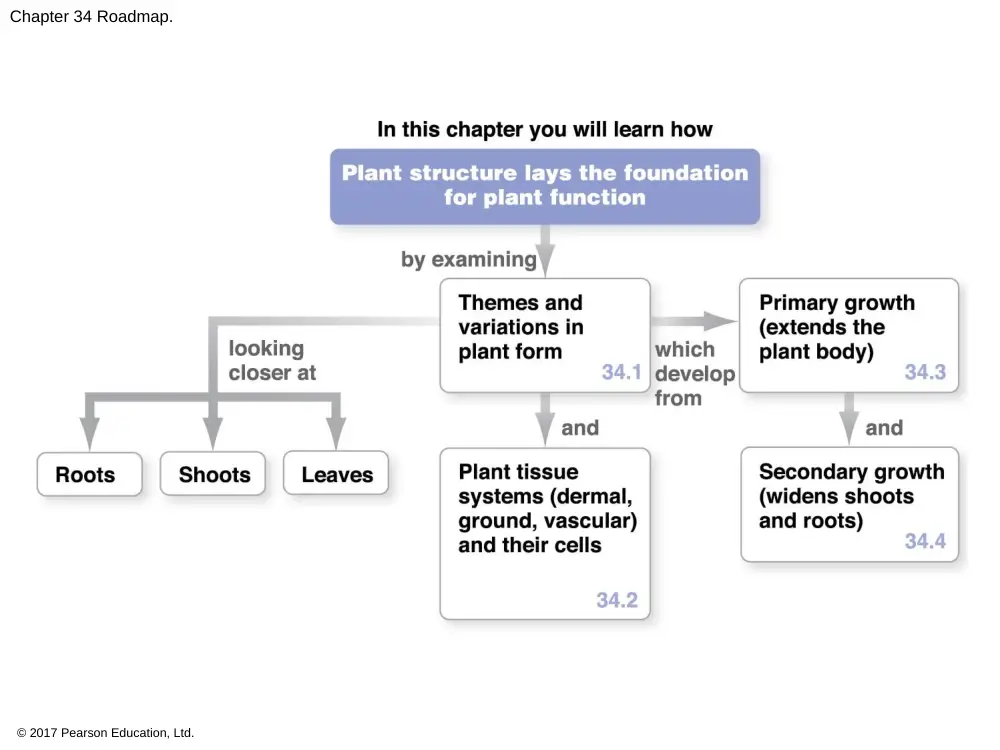
Chapter 34 Roadmap.
© 2017 Pearson Education, Ltd.
© 2017 Pearson Education, Ltd.
Introduction
• Plants make their own food through photosynthesis,
using the energy from sunlight
• They stay in one place, extending their roots and
shoots to harvest diffuse resources
• The structure of a plant’s body is dynamic, because
most plants grow throughout their lives and exhibit
indeterminate growth
© 2017 Pearson Education, Ltd.
Introduction
• We will look at three fundamental questions,
focusing on angiosperms:
1. How is the plant body organized?
2. Why are plants so diverse in size and shape?
3. How do plants grow throughout their lives?
© 2017 Pearson Education, Ltd.
Plant Form
• Plants use light energy to synthesize carbohydrates
from carbon dioxide in the air and water from the soil
• Plants must also obtain nitrogen, phosphorus,
potassium, magnesium, and other nutrients
• These key elements exist in nature primarily as ions
dissolved in soil water
© 2017 Pearson Education, Ltd.
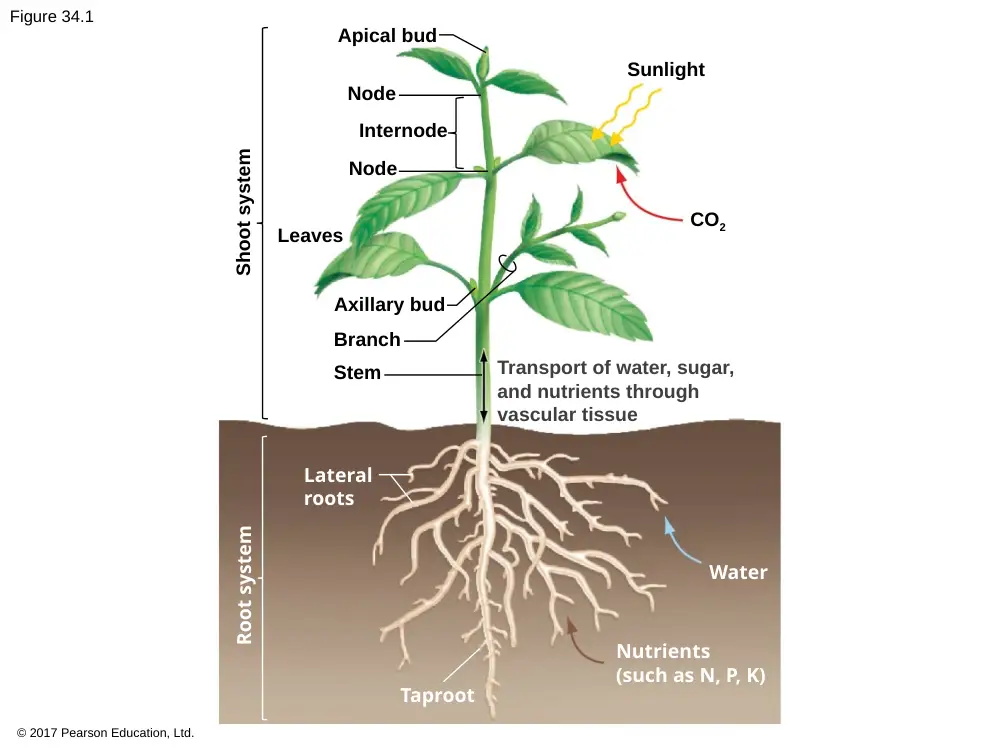
How Is the Plant Body Organized?
• Belowground, the root system anchors the plant
and takes in water and nutrients from the soil
• Aboveground, the shoot system harvests light and
carbon dioxide from the atmosphere to
produce sugars
• Together, these systems make up the plant body
Figure 34.1
Apical bud
Sunlight
Node
Internode
Shoot system
Node
CO2
Leaves
Axillary bud
Branch
Stem
Transport of water, sugar,
and nutrients through
vascular tissue
Lateral
roots
Root system
Water
Nutrients
(such as N, P, K)
Taproot
© 2017 Pearson Education, Ltd.
© 2017 Pearson Education, Ltd.
Importance of Surface Area and Volume
Relationships
• Root and shoot systems both function in absorption
• Roots absorb water and key nutrients
• Shoots absorb light
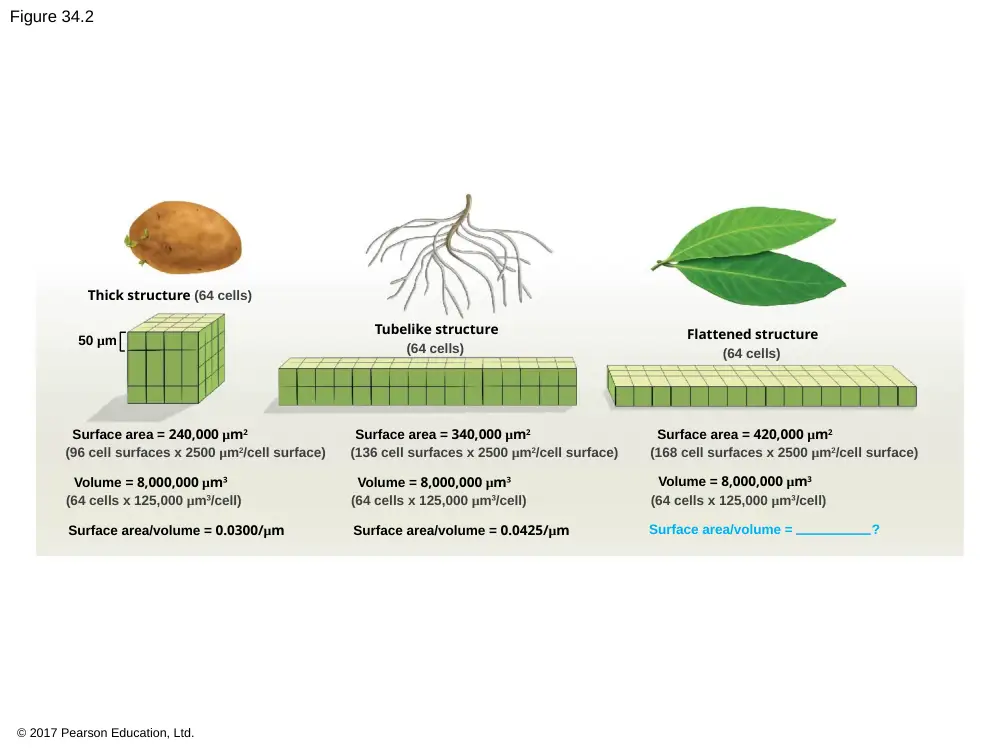
• Absorption takes place across a surface, but the
cells that use the absorbed light and molecules
occupy a volume
• A plant is efficient in absorption if it has a large
surface area relative to its volume
Figure 34.2
Thick structure (64 cells)
50 µm
Tubelike structure
(64 cells)
Flattened structure
(64 cells)
Surface area = 240,000 µm2
(96 cell surfaces x 2500 µm2/cell surface)
Volume = 8,000,000 µm3
(64 cells x 125,000 µm3/cell)
Surface area/volume = 0.0300/µm
Surface area = 340,000 µm2
(136 cell surfaces x 2500 µm2/cell surface)
Volume = 8,000,000 µm3
(64 cells x 125,000 µm3/cell)
Surface area/volume = 0.0425/µm
Surface area = 420,000 µm2
(168 cell surfaces x 2500 µm2/cell surface)
Volume = 8,000,000 µm3
(64 cells x 125,000 µm3/cell)
Surface area/volume =
?
© 2017 Pearson Education, Ltd.
© 2017 Pearson Education, Ltd.
The Root System
• Many root systems have a taproot and
lateral roots
• There are many key functions of the root system:
• Roots anchor the plant to the soil
• Roots absorb ions and water from soil
• Roots conduct water and ions to the shoot system
• Roots obtain energy from the sugar in the
shoot system
• Roots store molecules produced in the shoot system
© 2017 Pearson Education, Ltd.
The Root System
• Although most root systems contain the same
general structures, root systems are diverse
• This diversity can be analyzed on three levels:
1. Morphological diversity among species
2. Phenotypic plasticity in response to the environment
3. Modified roots that are specialized for
unusual functions
© 2017 Pearson Education, Ltd.
Morphological Diversity in Root Systems
• Consider prairie plants
• Prairies are grassland ecosystems that support many
herbaceous plants
• The root systems of prairie grasses are perennial,
surviving fire or drought
• A new shoot system is produced each spring or
after fire
• Prairie grasses show diversity among species,
minimizing competition for water and resources
Figure 34.3
Pale purple
coneflower
Nonnative lawn
grass, for
comparison
Lead
plant
Compass
plant
Switchgrass
Junegrass
Depth (m)
Fibrous
roots
Taproot
© 2017 Pearson Education, Ltd.
© 2017 Pearson Education, Ltd.
Phenotypic Plasticity in Root Systems
• Morphological diversity in roots also occurs
within species
• Roots show phenotypic plasticity, with form that
changes with environmental conditions
• The environment can determine the type and depth of
the root system
• Roots die back in areas lacking resources
• For example, spruce trees in waterlogged soils have
shallow roots due to lack of oxygen
© 2017 Pearson Education, Ltd.
Modified Roots
• Modified roots are formed by various types of plants
• Adventitious roots grow from the shoot system
• In ivy, adventitious roots act to anchor the plant
• The prop roots of corn brace the plant
• Root systems can produce modified roots
• Mangroves produce pneumatophores for gas
exchange
• The taproots of beets and carrots store carbohydrates
Table 34.1
© 2017 Pearson Education, Ltd.
© 2017 Pearson Education, Ltd.
The Shoot System
• The shoot system has many anatomical features:
• Stems are vertical aboveground structures consisting
of nodes, where leaves are attached, and
internodes, or segments between nodes
• Axillary (or lateral) buds form at nodes just above
the site of leaf attachment
• An axillary bud may grow into a branch
• The tip of each stem and branch contains an
apical bud
• Apical and axillary buds may develop into flowers
© 2017 Pearson Education, Ltd.
The Shoot System
• Shoot diversity can also be analyzed on three levels:
1. Morphological diversity among species
2. Phenotypic plasticity within individuals
3. Modified shoots with specialized functions
© 2017 Pearson Education, Ltd.
Morphological Diversity in Shoot Systems
• Shoot systems range in size from tiny duckweed
(< 5 mm diameter) to giant redwood trees
(100 m tall)
• Variation in the size and shape of the shoot system
of various species minimizes competition for light
• Silversword plants native to Hawaii have shoot
systems that are particularly diverse
• Lush environments and competition for light favors
taller shoot systems, while dry, windblown habitats
favor short stems that are more anchored to the soil
© 2017 Pearson Education, Ltd.
Phenotypic Plasticity in Shoot Systems
• The size and shape of a plant’s shoot system can
vary based on variation in growing conditions:
temperature, wind exposure, and availability of
water, nutrients, and light
• Genetically identical herbaceous plants were grown
from cuttings taken from the same plant
• The cuttings were grown at different elevations from
sea level to alpine habitats, resulting in a variety of
shoot systems
Figure 34.4
1. Take cuttings from individuals of Potentilla
glandulosa growing in low-, medium-, and high-
elevation habitats in the Sierra Nevada mountains.
2. Propagate genetically identical individuals.
3. Transplant individuals from each source
population into each habitat (low, medium,
and high elevation). Allow to grow and
observe mature plants.
How much does a plant’s growth form depend on its
environment?
(No explicit hypothesis—the goal of this experiment was to explore the
interaction between genetic makeup versus environmental influence on size and shape.)
High
3000 m
Medium
Low
“High” plant
grown at
low elevation
“High” plant
grown at
medium elevation
“High” plant
grown at
high elevation
Environmental conditions have a profound influence on body size and
shape (genetically identical plants look different at each site). BUT, genetic makeup also has
a large influence on plant morphology. (Though not pictured here, plants from the different
source populations looked different, even when all were grown in the same habitat.)
Examples of mature plants observed:
(No explicit predictions.)
© 2017 Pearson Education, Ltd.
© 2017 Pearson Education, Ltd.
Modified Stems
• Stems of many plants serve specialized functions
• Cactus stems are modified to store water and for
photosynthesis
• Stolons are modified stems that grow horizontally,
producing adventitious roots and leaves at each node
• Rhizomes are stems that grow horizontally and
function in asexual reproduction
• Tubers are underground, swollen rhizomes that
function as carbohydrate-storage organs
• Thorns are modified stems that protect plants
Table 34.2
© 2017 Pearson Education, Ltd.
© 2017 Pearson Education, Ltd.
The Leaf
• The vast majority of photosynthesis occurs in leaves
• The leaf’s relatively large surface area is available for
absorbing photons and supporting photosynthesis
• A simple leaf has two main structures, an expanded
blade and a stalk called a petiole
• In a compound leaf, the blade is divided into a
series of leaflets
• Needlelike leaves reduce water loss by transpiration
Figure 34.5
(a) A simple leaf has a
petiole and a single blade.
(b) A compound leaf has
a blade divided into leaflets.
(c) A doubly compound leaf is
large yet rarely damaged by wind
or rain.
(d) Needlelike leaves are
characteristic of species
adapted to very cold or
hot climates.
Blade
Petiole
© 2017 Pearson Education, Ltd.
© 2017 Pearson Education, Ltd.
Morphological Diversity in Leaves
• Not all leaves are thin, with a large surface area
• Plants that thrive in deserts and in cold, dry habitats
tend to have small, needlelike leaves, interpreted as
adaptations to minimize transpiration in water-scarce
habitats
• Two observations support this hypothesis:
1. Water is scarce in deserts and frozen (and thus
unavailable) in cold habitats
2. Leaves with a large surface area lose large amounts
of water through transpiration
© 2017 Pearson Education, Ltd.
Morphological Diversity in Leaves
• The arrangement of leaves on a stem may vary
• Leaves may
• Alternate on either side of the stem
• Pair opposite each other on the stem
• Be arranged in a whorl
• Form a compact basal arrangement where internodes
are extremely short—leading to a rosette growth form
Figure 34.6
(a) Alternate leaves
(b) Opposite leaves
(c) Whorled leaves
(d) Rosette
© 2017 Pearson Education, Ltd.
© 2017 Pearson Education, Ltd.
Phenotypic Plasticity in Leaves
• Although leaves do not grow continuously, they do
exhibit phenotypic plasticity
• Oak tree leaves vary depending on the amount of
sunlight they are exposed to:
• Sun leaves have a relatively small surface area,
reducing water loss in areas of the body where light
is abundant
• Shade leaves are relatively large and broad,
providing a high surface area to maximize
photon absorption
Figure 34.7
© 2017 Pearson Education, Ltd.
Grown
in shade
Grown
in sun
© 2017 Pearson Education, Ltd.
Modified Leaves
• Onion bulbs store nutrients
• The leaves of succulents store water
• Tendrils enable vines to climb
• The bright red leaves of poinsettias
attract pollinators
• The tubelike leaves of the pitcher plant trap insects
• Cactus spines protect the stem
Table 34.3
© 2017 Pearson Education, Ltd.
© 2017 Pearson Education, Ltd.
Plant Cells
• Although eukaryotic cells share many key features,
plant cells have several features not found in
animal cells
• Plant cells are surrounded by a cellulose-rich
primary cell wall
• Some plant cells have a rigid secondary cell wall
• Plant cells are connected by plasmodesmata
Figure 34.8
© 2017 Pearson Education, Ltd.
(a) Plant cells have cell walls, vacuoles, and chloroplasts.
(b) Adjacent plant cells are connected by plasmodesmata.
Cell 2
Smooth ER
Cell wall
Plasmodesma
Plasma
membrane
Vacuole
Cell 1
Plasma membrane
Cell wall
Cell wall
Plasma membrane
Chloroplast
Mitochondrion
Rough endoplasmic reticulum
Smooth endoplasmic reticulum
Golgi apparatus
© 2017 Pearson Education, Ltd.
Plant Cells
• Plant cells may contain chloroplasts and a large
vacuole that fills most of the cell’s volume
• Chloroplasts are the site of photosynthesis
• Non-photosynthetic cells may have organelles that
are similar to chloroplasts, but modified for storage of
pigments, starch, oil, or proteins
• Vacuoles contain an aqueous solution called cell
sap and store waste, water, and nutrients
© 2017 Pearson Education, Ltd.
Plant Tissue Systems
• Plant tissues are grouped into tissue systems, based
on their structural features and location within the
plant
• Simple tissues consist of a single cell type; complex
tissues contain several types of cells
• Three tissue systems are found in plants:
1. The dermal tissue system
2. The ground tissue system
3. The vascular tissue system
© 2017 Pearson Education, Ltd.
The Dermal Tissue System
• Dermal tissue is made up of several different cell
types and thus represents a complex tissue
• Epidermal cells protect the surface of the plant
• They secrete a waxy cuticle to reduce water loss and
protect against pathogens
• Stomata regulate gas exchange and water loss
• A stoma is surrounded by two specialized guard
cells, which change shape to open and close
the stoma
Figure 34.9
Guard
cells
Pore
Stoma closed
Stoma open
10 µm
© 2017 Pearson Education, Ltd.
© 2017 Pearson Education, Ltd.
Trichomes Perform an Array of Functions
• Trichomes are hairlike appendages made up of
specialized epidermal cells that perform
various functions:
• They keep the plant’s surface cool by reflecting
sunlight
• They reduce water loss by limiting transpiration
• They provide barbs or toxins to protect from
herbivores
• They trap and digest insects
Figure 34.10
200 µm
© 2017 Pearson Education, Ltd.
© 2017 Pearson Education, Ltd.
The Ground Tissue System
• Most photosynthesis and carbohydrate storage
takes place in the ground tissue system
• Ground tissue is a complex tissue made up of three
distinct tissues:
1. Parenchyma
2. Collenchyma
3. Sclerenchyma
© 2017 Pearson Education, Ltd.
Parenchyma Consists of “Workhorse” Cells
• Parenchyma is a simple tissue
• Parenchyma cells have relatively thin primary
cell walls
• They are the most abundant and versatile plant cells
• In leaves, parenchyma tissue is the primary site of
photosynthesis
• In roots, parenchyma cells store starch granules
© 2017 Pearson Education, Ltd.
Parenchyma Consists of “Workhorse” Cells
• Many parenchyma cells are totipotent, retaining the
capacity to divide and develop into a complete plant
• This allows the plant to heal wounds and
reproduce asexually
• The totipotency of parenchyma cells allows
gardeners to clone plants by making cuttings
• The parenchyma cells form a mass of
undifferentiated cells called a callus
• Roots develop from the callus, and the new individual
can be planted in soil
Figure 34.11
© 2017 Pearson Education, Ltd.
(a) In leaves: photosynthesis and gas exchange
(b) In roots: carbohydrate storage
Chloroplasts
25 µm
Starch granules
(stained purple)
25 µm
© 2017 Pearson Education, Ltd.
Collenchyma Functions Primarily in
Shoot Support
• Collenchyma is a simple tissue
• Collenchyma cells have unevenly thickened primary
cell walls and provide flexible structural support to
actively growing parts of the plant
• Collenchyma is often found just under the epidermis
of stems, especially outside vascular bundles
Figure 34.12
© 2017 Pearson Education, Ltd.
(a) Cross section of celery stalk
(b) Close-up of “string,” in cross
section
(c) Collenchyma cells, in cross section
One cell
Cytoplasm
Cell wall
100 µm
10 µm
© 2017 Pearson Education, Ltd.
Sclerenchyma: Two Types of Specialized
Support Cells
• The cells of sclerenchyma tissue have a thin primary
cell wall and a thick, rigid secondary cell wall
• The secondary cell wall contains tough, rigid lignin
as well as cellulose
• Sclerenchyma is a complex tissue with two types
of cells:
1. Fibers are elongated
2. Sclereids are short, with variable shapes, and
function in protection
Figure 34.13
© 2017 Pearson Education, Ltd.
(a) Fibers
(b) Sclereids
20 µm
50 µm
© 2017 Pearson Education, Ltd.
The Ground Tissue System
• Schlerenchyma and collenchyma cells differ
• Collenchyma cells have expandable primary cell
walls and support growing tissue in stems
• Sclerenchyma cells are dead at maturity and function
to support stems and other structures after growth
has ceased
© 2017 Pearson Education, Ltd.
The Vascular Tissue System
• The vascular tissue system is made up of two
complex tissues: xylem and phloem
• Xylem conducts water and dissolved nutrients from
the root system to the shoot system
• Phloem conducts sugars, amino acids, hormones,
and other substances from roots to shoots and from
shoots to roots
© 2017 Pearson Education, Ltd.
Xylem Structure
• Xylem is a complex tissue containing water-
conducting cells, parenchyma cells, and fibers
• There are two types of water-conducting cells:
1. The xylem of all vascular plants contains tracheids
with pits through which water moves
2. In angiosperms, xylem also contains vessel
elements with perforations for water transport
Figure 34.14
(a) Tracheids are long, tapered,
and have pits.
(b) Vessel elements are short and wide
and have perforations as well as pits.
(c) Tracheids and vessel elements
are found together in vascular tissue.
Pits
Perforations
Pits
Pits
25 µm
50 µm
100 µm
Tracheids
Vessel
elements
© 2017 Pearson Education, Ltd.
© 2017 Pearson Education, Ltd.
Phloem Structure
• Phloem is a complex tissue containing two types of
specialized cells:
1. Sieve-tube elements are long, thin cells with
perforated ends called sieve plates
2. Companion cells maintain the cytoplasm and
plasma membrane of sieve-tube elements
• Sieve-tube elements lack nuclei and are directly
connected to adjacent companion cells by
plasmodesmata
Figure 34.15
Sieve-tube
element
(few
organelles)
Companion
cell
(many
organelles)
Sieve
plate
Companion
cell
Sieve plate
25 µm
Companion
cell
Longitudinal section
Cross section
Sieve plate
50 µm
© 2017 Pearson Education, Ltd.
© 2017 Pearson Education, Ltd.
Primary Growth Extends the Plant Body
• Plants grow throughout their lives because they
have many meristems—populations of
undifferentiated cells that retain the ability to
undergo mitosis
• Apical meristems are found at the tip of each root
and shoot and are responsible for primary growth
• The cells and tissues derived from apical meristems
make up the primary plant body
© 2017 Pearson Education, Ltd.
Primary Growth Extends the Plant Body
• Apical meristems give rise to three distinct primary
meristems:
1. Protoderm gives rise to the dermal tissue system
2. Ground meristem gives rise to the ground tissue
system
3. Procambium gives rise to the vascular tissue
system
Figure 34.16
(a) Apical and primary meristems in a shoot
(b) Apical and primary meristems in a root
Newly
forming
leaves
Apical
meristem
at tip of
shoot
Primary
meristems:
Procambium
Protoderm
Apical
meristem
in axillary
bud
Ground
meristem
100 µm
300 µm
Apical
meristem
at tip of
root
© 2017 Pearson Education, Ltd.
© 2017 Pearson Education, Ltd.
How Is the Primary Root System Organized?
• The root apical meristem is protected by a group of
cells called the root cap
• Cells produced by the meristem constantly replenish
the cap, which regularly loses cells
• The root cap also senses gravity to determine the
direction of growth and secretes a slimy lubricant to
reduce friction as the apical meristem is pushed
through soil
© 2017 Pearson Education, Ltd.
How Is the Primary Root System Organized?
• Three distinct populations of cells are found behind
the root cap:
1. The zone of cellular division contains the apical
meristem, as well as the protoderm, ground
meristem, and procambium
2. Cells in the zone of cellular elongation increase
in length
3. Cells in the zone of cellular maturation
differentiate into dermal, vascular, or ground tissue,
and absorb water and nutrients through root hairs
Figure 34.18a
(a) Longitudinal section of a root
Lateral
root
Root hairs
Zone of
cellular elongation
Vascular tissue
Ground tissue
Epidermal tissue
Zone of
cellular division
Apical meristem
Sloughed-off
root cap cells
Root cap
Zone of
cellular maturation
© 2017 Pearson Education, Ltd.