
CHEM 208 Problems Important Exercises, Spring 2016
American University of Beirut · Brief Survey of Organic Chemistry · 8 pages

More CHEM 208 files
Show the text of this problems
1. Multiple Choice Questions. Circle the correct answer, no penalty for a wrong answer.
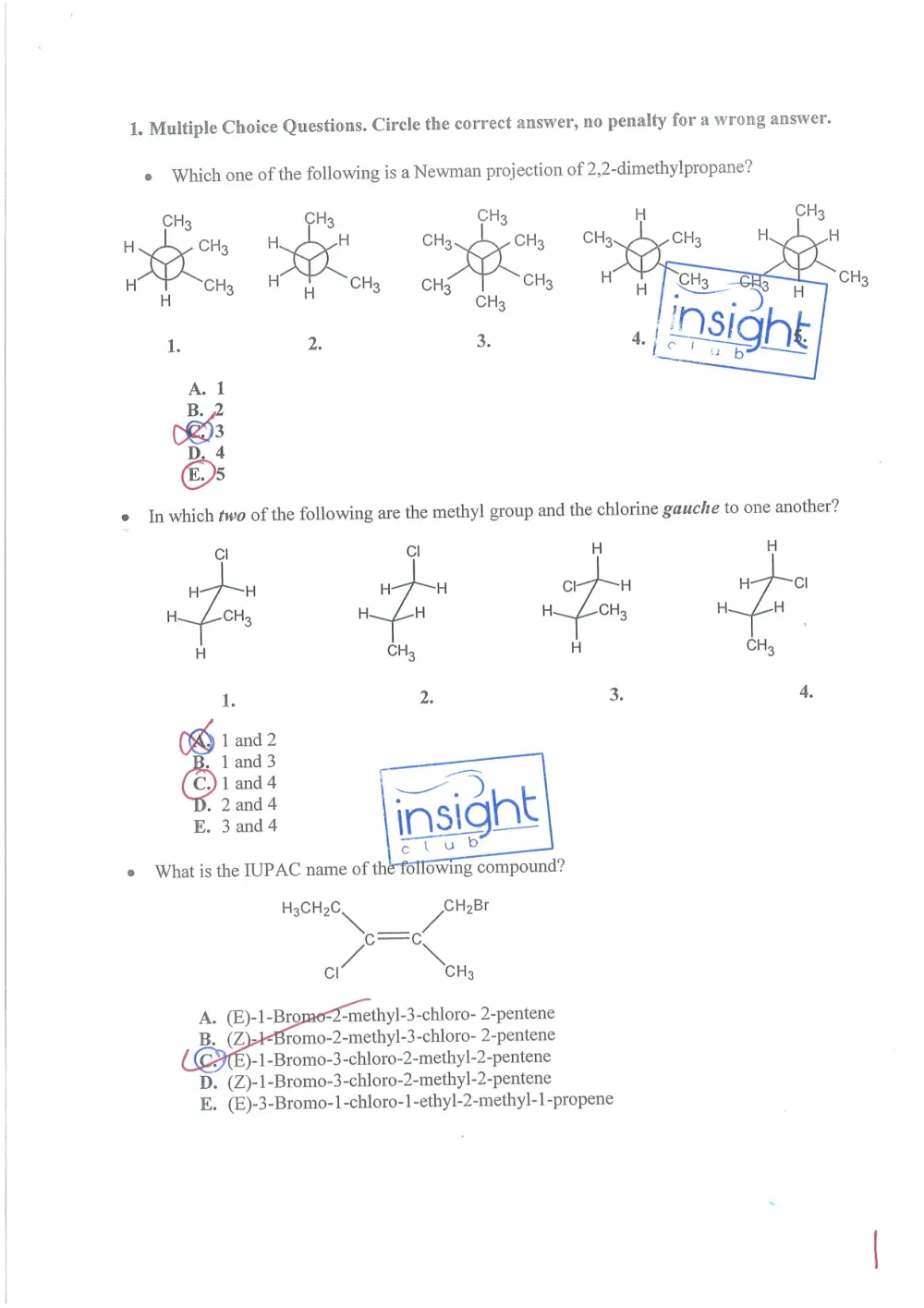
© Which one of the following is a Newman projection of 2,2-dimethylpropane?
CH3 CHg CHs
See Ser’ CH3 CH3
H i CH3 Hf ~CH3 CHS CH3
CH
1. 2. 3.
A. 1
B. 2
cess
D. 4
5
e Inwhich two of the following are the methyl group and the chlorine gauche to one another?
cl cl H H
H H H H ClI-7—H H7—~Ccl
H CH H H H CH, H H
H CH3 H CH,
1 2 3. 4
What is the IUPAC name of the following compound?
Se
c——C.
4 oN
Cl CHg
H3CH2C CH2Br
3(E)-1-Bromo-3-chloro-2-methyl-2-pentene
D. (Z)-1-Bromo-3-chloro-2-methyl-2-pentene
E. (E)-3-Bromo-1-chloro-1-ethyl-2-methyl-1-propene
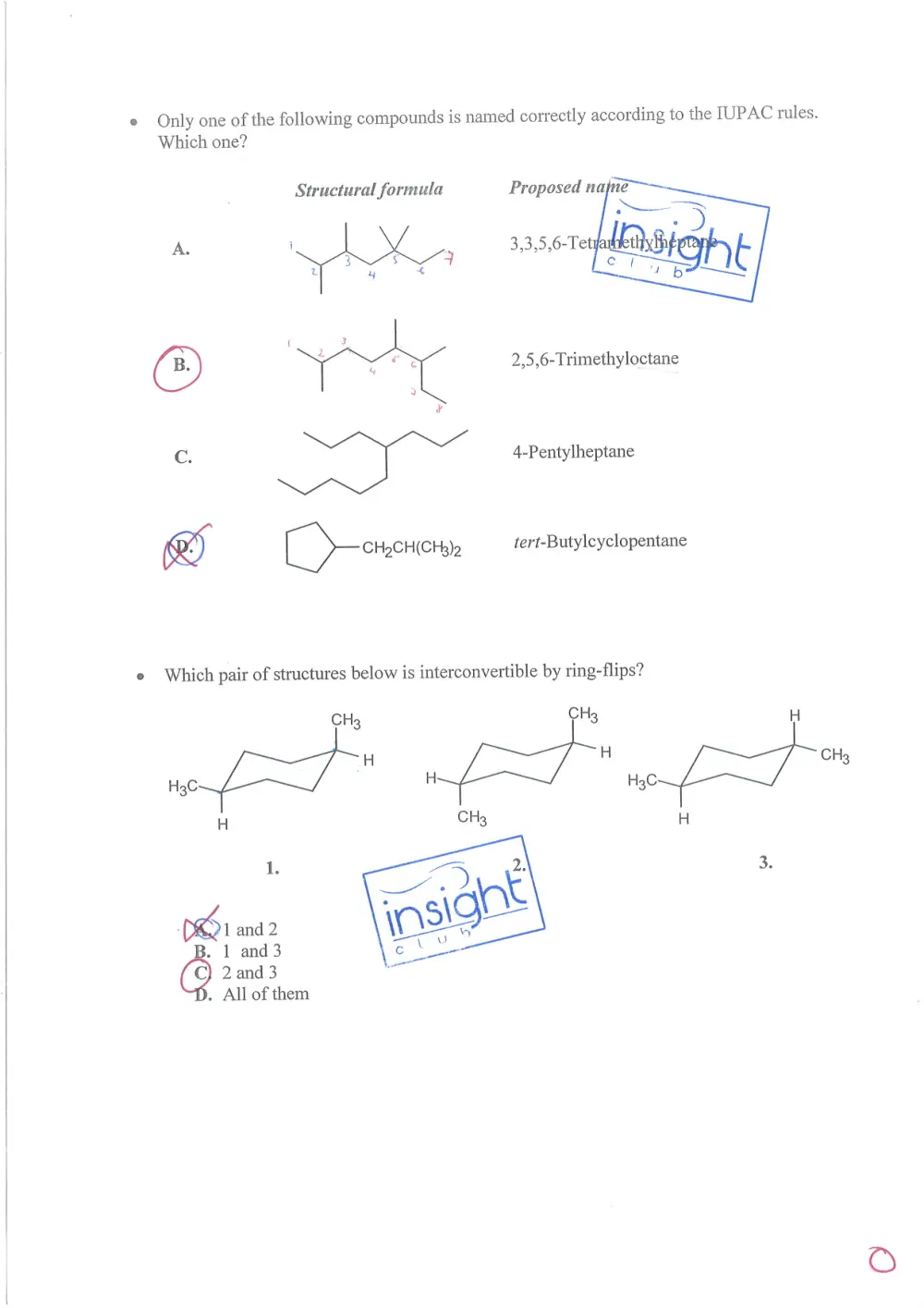
e Only one of the following compounds is named correctly according to the IUPAC rules.
Which one?
Structural formula Proposed najné-—~
Ss
ssserefdlOsighyp
2,5,6-Trimethyloctane
4-Pentylheptane
@ [> CH2CH(CHs)2 tert-Butylcyclopentane
e Which pair of structures below is interconvertible by ring-flips?
CH CHg H
H H CHg
HgC H H3C
. 1 and 3
2 and 3
. All of them
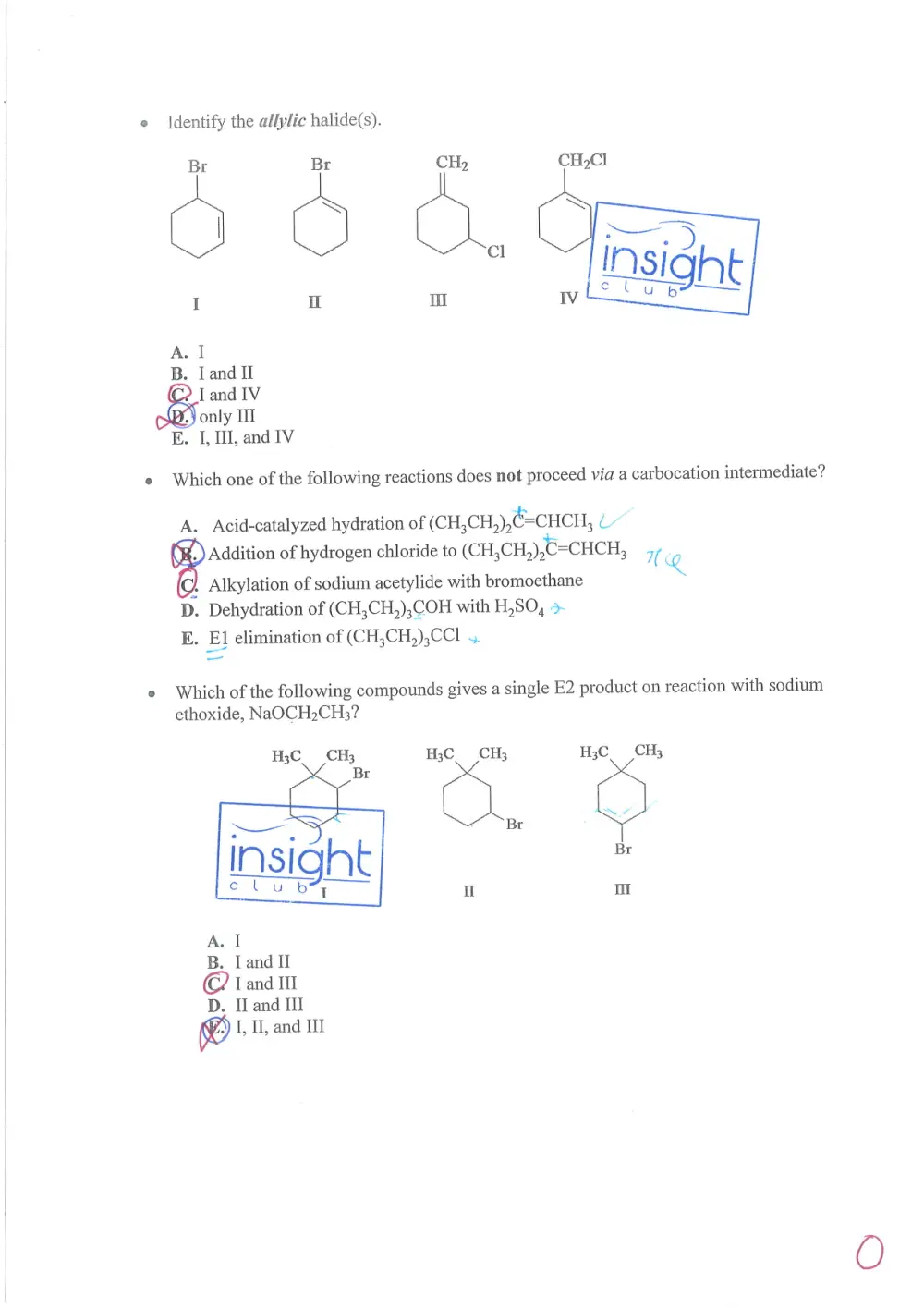
e Identify the allplic halide(s).
Br Br CH) CH)Cl
cl
A. I
B. Land II
Tand IV
only HI
E. 1, UL, and IV
© Which one of the following reactions does not proceed via a carbocation intermediate?
A. Acid-catalyzed hydration of (CH,CH,),C=CHCH, d
Addition of hydrogen chloride to (CH,CH,),C-CHCH, q
¥, Alkylation of sodium acetylide with bromoethane
D. Dehydration of (CH,CH,),COH with H,SO, >
E. E] elimination of (CH,CH,),;CCI .
e Which of the following compounds gives a single E2 product on reaction with sodium
ethoxide, NaOCH2CH3?
H3;C CH; H3C CH;
Br
Br
i Ol
A. I
B. Land II
@ [and Ill
D. and Ill
© I, Il, and III
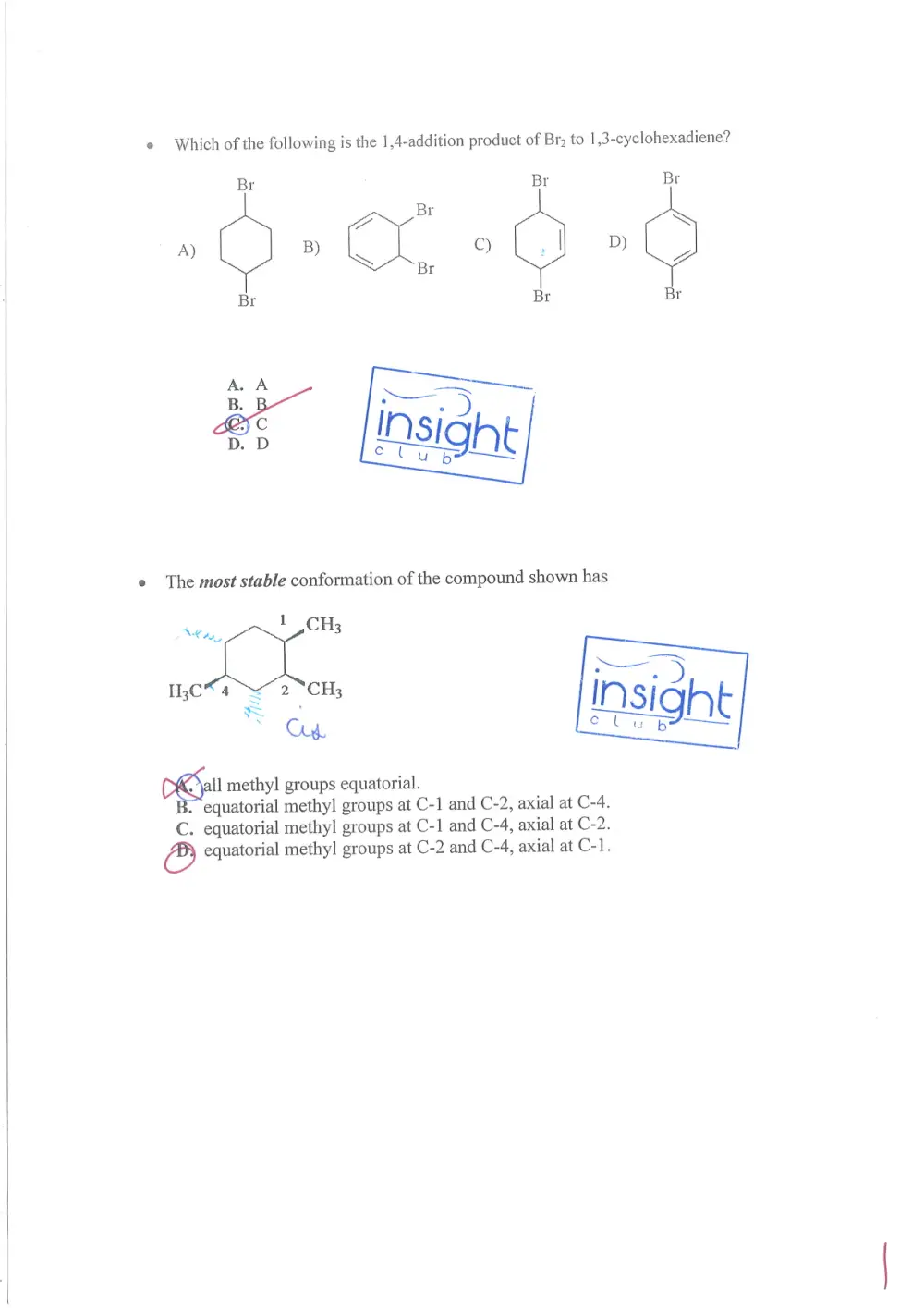
e Which of the following is the 1,4-addition product of Br, to 1,3-cyclohexadiene?
Br
A)
Br
—]
SQs
vaWw>
© The most stable conformation of the compound shown has
0K ‘all methyl groups equatorial.
. equatorial methyl groups at C-1 and C-2, axial at C-4.
C. equatorial methyl groups at C-1 and C-4, axial at C-2.
as, equatorial methyl groups at C-2 and C-4, axial at C-1.
2. Draw clear depictions of two nonequivalent chair conformations of cis-1-Isopropyl-4-
methylcyclohexane, indicate which is more stable. Justify your answer.
[Ss
INSIQ
Me vtable,
ANE MEMY|C HMONG ,
IS MACE Over, MG oF Hag CoLutona
3. Draw the structures of all alkenes including stereoisomers that can be formed from the E»
elimination of 3-bromo-2,3-dimethylpentane with sodium ethoxide NaOCH,CH; in
Ca, Be -
COCEC + Moc; = __,
CH.
Ho Na wilt Bade with He/ Wolo WOR and Ha skudivre
Will Fo on ateinoret-
alcnono)
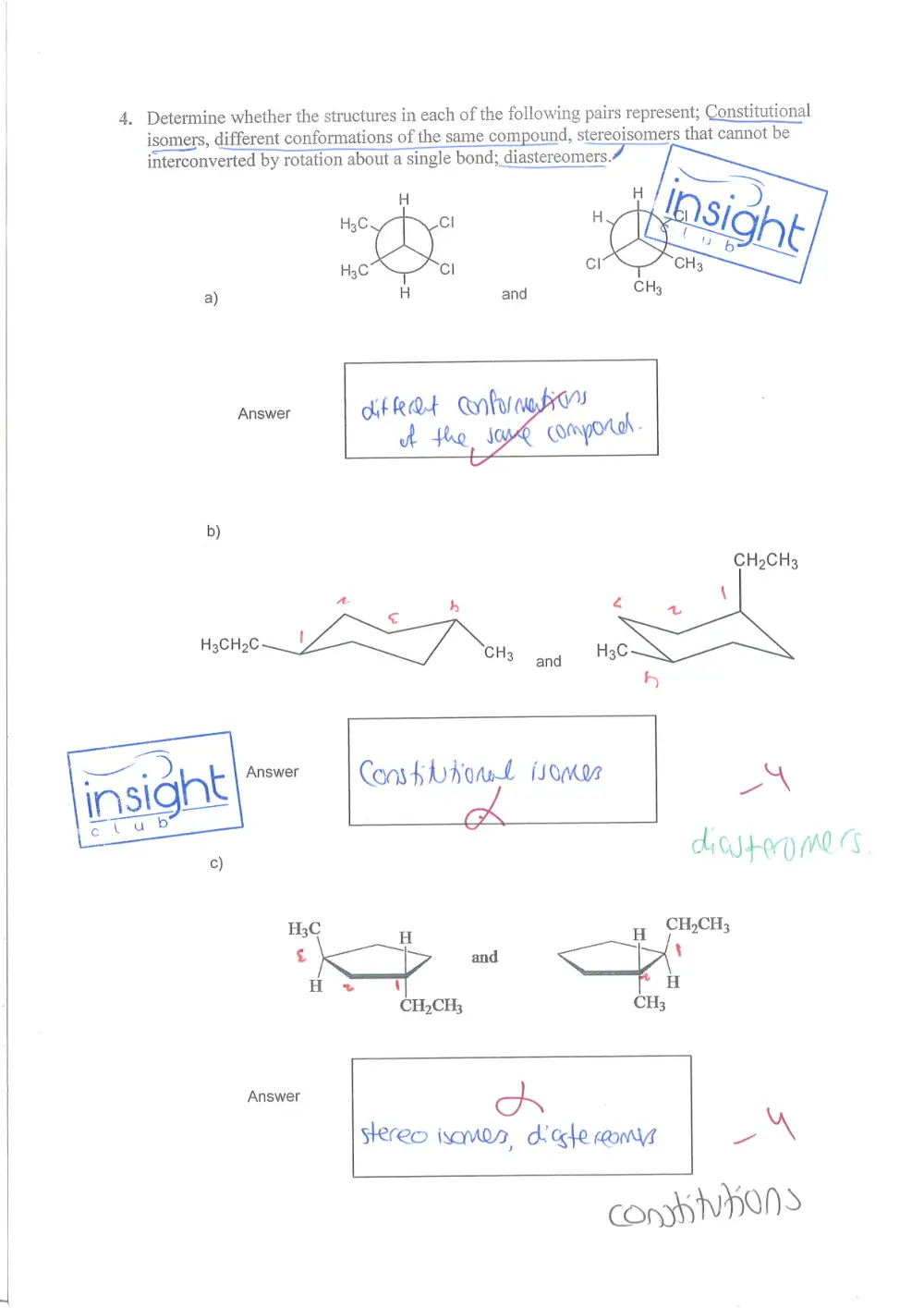
4. Determine whether the structures in each of the following pairs represent, Constitutional
isomers, different conformations of the same compound, stereoisomers that cannot be
interconverted by rotation about a single bond; diastereomers.
Answer
b)
Answer
H
H and
difkat cnily wu
Ue tho J cannyoah
CH2CH3
sHereo isavar, diccle ceomys Lv mh,
Connon
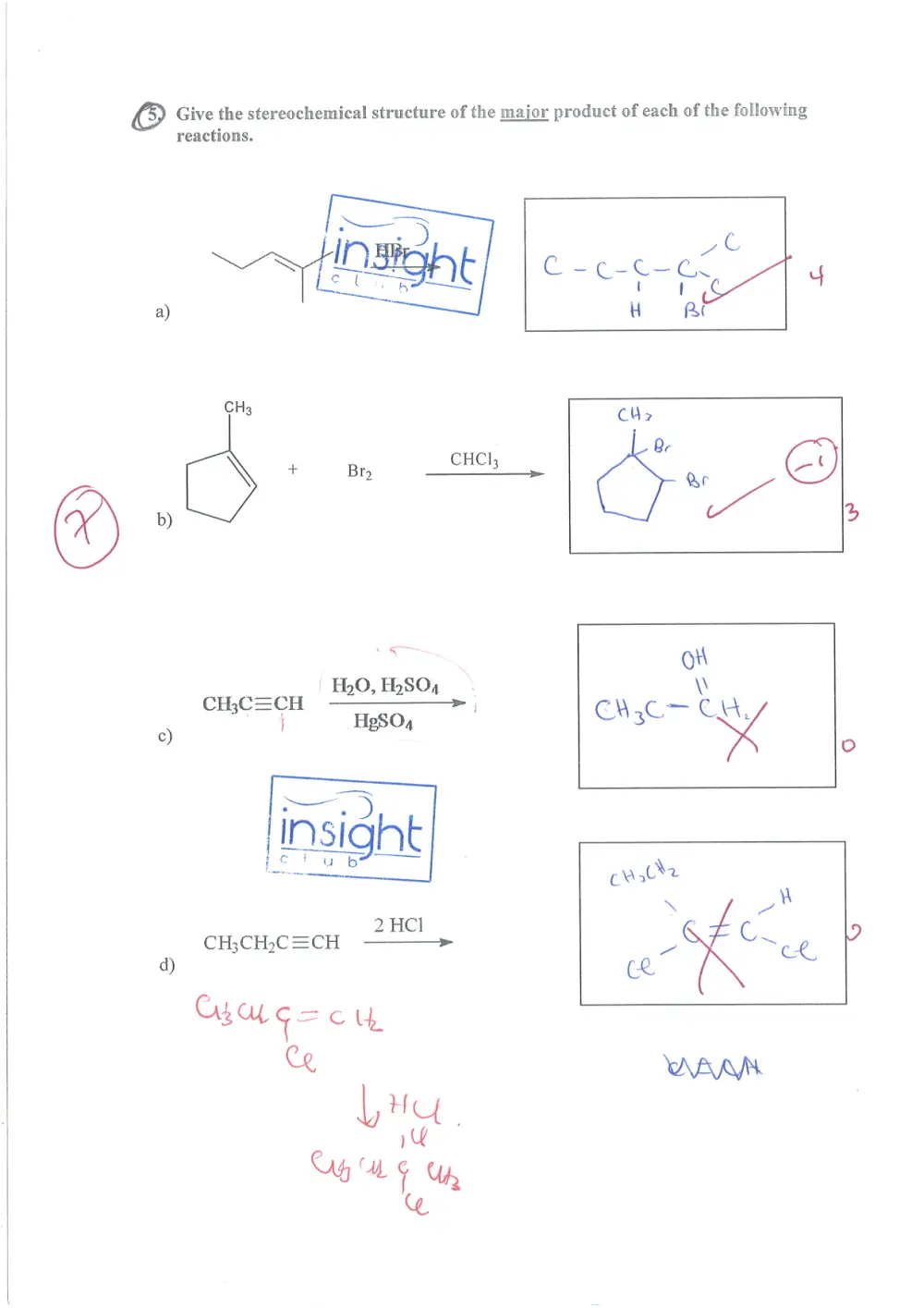
Give the stereochemical structure of the major product of each of the following
reactions.
a)
CHs
\ Bry CHCl,
b)
HLO, HySO,
CH;C=CH >
8 j HgSO,
2 HCl
Chica ———»
d)
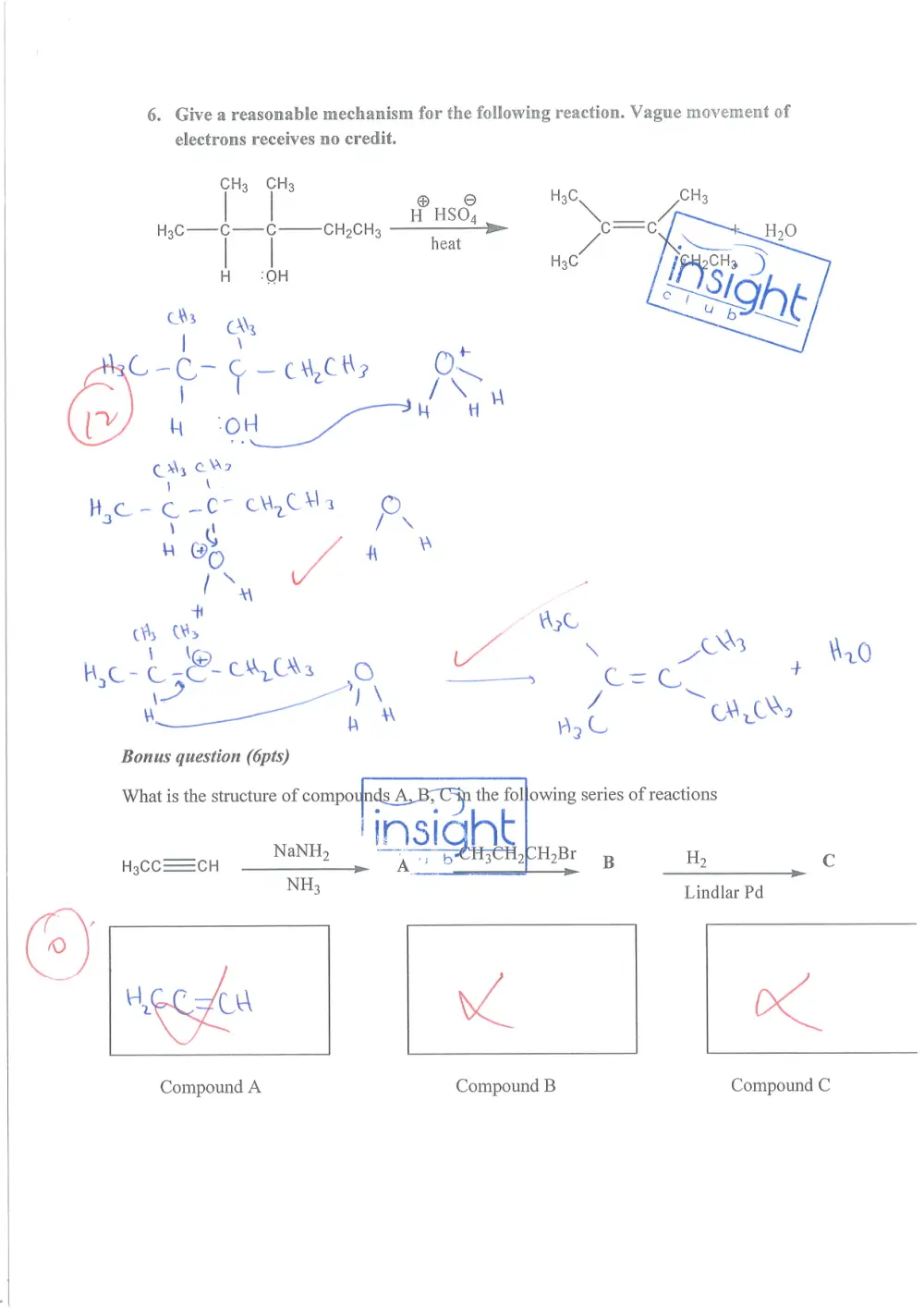
6. Give a reasonable mechanism for the following reaction. Vague movement of
electrons receives no credit.
CH; CH3
|| sO,
H3C- —-C——C CH2CH3 pe
| | heat
H OH
CAs O&
| \
| i)
4 on U7
Xs c¥2
\
H en tat chCa ©
ro /\
H 2H JS 4 any
/ \
4 *
A2C
ch Ws / 2
ro \ Ss 0
KC - se CROs a aa C= co toe
the following series of reactions
What is the structure of compo nds A Bh
k rials
NE Lindlar Pd
Heese al OX
Compound A Compound B Compound C