
CHEM 217 Problems Set 1, Fall 2011
American University of Beirut · Thermodynamics and Chemical Dynamics · 2 pages
More CHEM 217 files
- Problems Problem Quiz 2 · Fall 2017ProblemsView
- Problems Set 1 Solution · Fall 2011Problems · with solutionView
- Problems Set 2 · Fall 2011ProblemsView
- Problems Set 5 Solution · Fall 2011Problems · with solutionView
- Problems Set 7 · Fall 2011ProblemsView
- Exam 1 with Solution · Fall 2011Exam · with solutionView
- Exam 2 with Solution · Fall 2011Exam · with solutionView
- Exam 3 with Solution · Fall 2011Exam · with solutionView
Show the text of this problems
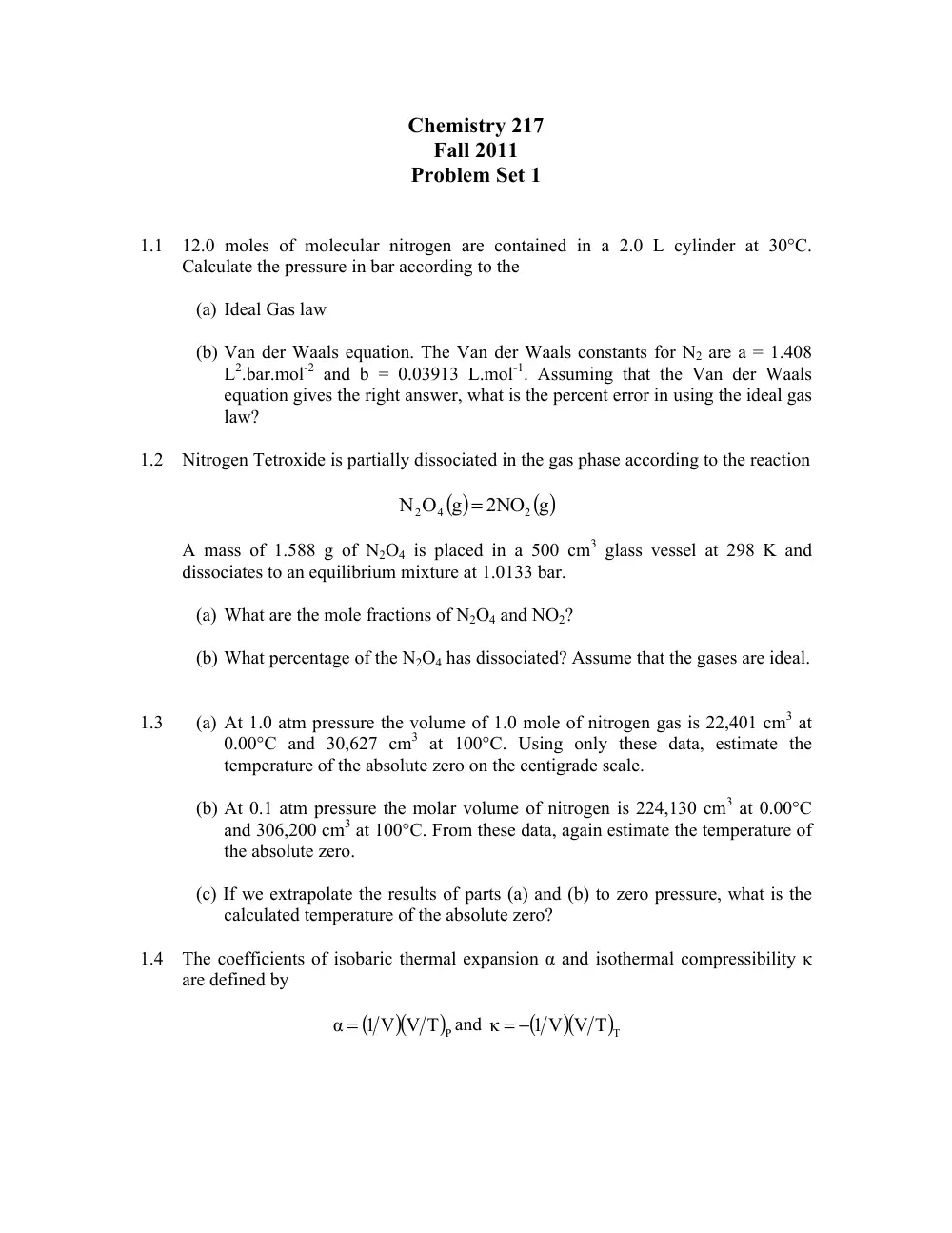
Chemistry 217
Fall 2011
Problem Set 1
1.1 12.0 moles of molecular nitrogen are contained in a 2.0 L cylinder at 30°C.
Calculate the pressure in bar according to the
(a) Ideal Gas law
(b) Van der Waals equation. The Van der Waals constants for N2 are a = 1.408
L2.bar.mol-2 and b = 0.03913 L.mol-1. Assuming that the Van der Waals
equation gives the right answer, what is the percent error in using the ideal gas
law?
1.2 Nitrogen Tetroxide is partially dissociated in the gas phase according to the reaction
( )
( )
2NO g
N O g
2
4
2
=
A mass of 1.588 g of N2O4 is placed in a 500 cm3 glass vessel at 298 K and
dissociates to an equilibrium mixture at 1.0133 bar.
(a) What are the mole fractions of N2O4 and NO2?
(b) What percentage of the N2O4 has dissociated? Assume that the gases are ideal.
1.3
(a) At 1.0 atm pressure the volume of 1.0 mole of nitrogen gas is 22,401 cm3 at
0.00°C and 30,627 cm3 at 100°C. Using only these data, estimate the
temperature of the absolute zero on the centigrade scale.
(b) At 0.1 atm pressure the molar volume of nitrogen is 224,130 cm3 at 0.00°C
and 306,200 cm3 at 100°C. From these data, again estimate the temperature of
the absolute zero.
(c) If we extrapolate the results of parts (a) and (b) to zero pressure, what is the
calculated temperature of the absolute zero?
1.4 The coefficients of isobaric thermal expansion α and isothermal compressibility κ
are defined by
(
)(
α = 1 V V T)P
and
(
)(
1 V V T)T
κ
= −
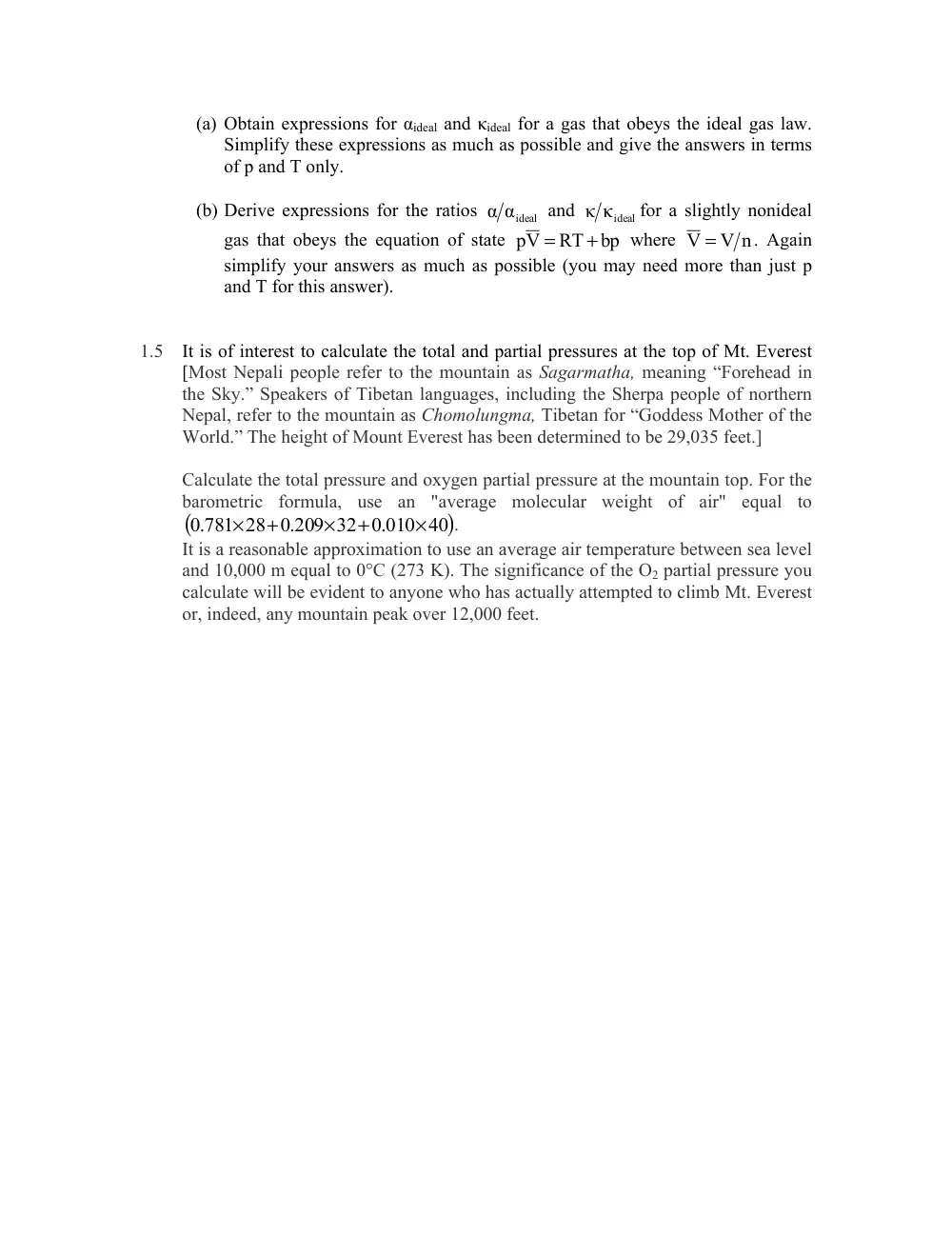
(a) Obtain expressions for αideal and κideal for a gas that obeys the ideal gas law.
Simplify these expressions as much as possible and give the answers in terms
of p and T only.
(b) Derive expressions for the ratios
α αideal
and
κ κideal
for a slightly nonideal
gas that obeys the equation of state
bp
RT
pV
+
=
where
V = V n
. Again
simplify your answers as much as possible (you may need more than just p
and T for this answer).
1.5 It is of interest to calculate the total and partial pressures at the top of Mt. Everest
[Most Nepali people refer to the mountain as Sagarmatha, meaning “Forehead in
the Sky.” Speakers of Tibetan languages, including the Sherpa people of northern
Nepal, refer to the mountain as Chomolungma, Tibetan for “Goddess Mother of the
World.” The height of Mount Everest has been determined to be 29,035 feet.]
Calculate the total pressure and oxygen partial pressure at the mountain top. For the
barometric formula, use an "average molecular weight of air" equal to
(
.0 010 40)
.0 209 32
.0 781 28
×
+
×
+
×
.
It is a reasonable approximation to use an average air temperature between sea level
and 10,000 m equal to 0°C (273 K). The significance of the O2 partial pressure you
calculate will be evident to anyone who has actually attempted to climb Mt. Everest
or, indeed, any mountain peak over 12,000 feet.