
CHEM 217 Problems Set 2, Fall 2011
American University of Beirut · Thermodynamics and Chemical Dynamics · 2 pages
More CHEM 217 files
- Problems Problem Quiz 2 · Fall 2017ProblemsView
- Problems Set 1 · Fall 2011ProblemsView
- Problems Set 1 Solution · Fall 2011Problems · with solutionView
- Problems Set 5 Solution · Fall 2011Problems · with solutionView
- Problems Set 7 · Fall 2011ProblemsView
- Exam 1 with Solution · Fall 2011Exam · with solutionView
- Exam 2 with Solution · Fall 2011Exam · with solutionView
- Exam 3 with Solution · Fall 2011Exam · with solutionView
Show the text of this problems
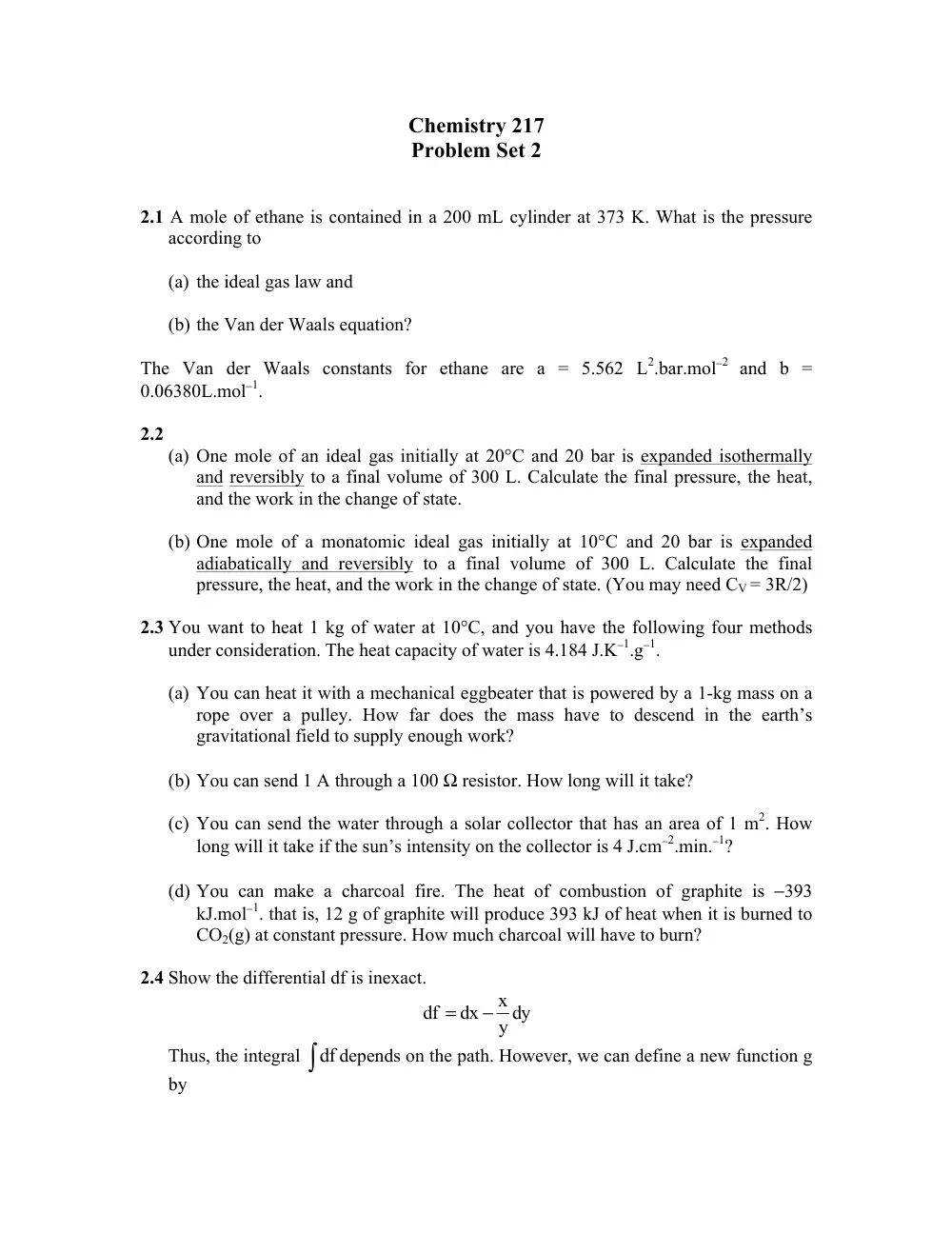
Chemistry 217
Problem Set 2
2.1 A mole of ethane is contained in a 200 mL cylinder at 373 K. What is the pressure
according to
(a) the ideal gas law and
(b) the Van der Waals equation?
The Van der Waals constants for ethane are a = 5.562 L2.bar.mol−2 and b =
0.06380L.mol−1.
2.2
(a) One mole of an ideal gas initially at 20°C and 20 bar is expanded isothermally
and reversibly to a final volume of 300 L. Calculate the final pressure, the heat,
and the work in the change of state.
(b) One mole of a monatomic ideal gas initially at 10°C and 20 bar is expanded
adiabatically and reversibly to a final volume of 300 L. Calculate the final
pressure, the heat, and the work in the change of state. (You may need CV = 3R/2)
2.3 You want to heat 1 kg of water at 10°C, and you have the following four methods
under consideration. The heat capacity of water is 4.184 J.K−1.g−1.
(a) You can heat it with a mechanical eggbeater that is powered by a 1-kg mass on a
rope over a pulley. How far does the mass have to descend in the earth’s
gravitational field to supply enough work?
(b) You can send 1 A through a 100 Ω resistor. How long will it take?
(c) You can send the water through a solar collector that has an area of 1 m2. How
long will it take if the sun’s intensity on the collector is 4 J.cm−2.min.−1?
(d) You can make a charcoal fire. The heat of combustion of graphite is −393
kJ.mol−1. that is, 12 g of graphite will produce 393 kJ of heat when it is burned to
CO2(g) at constant pressure. How much charcoal will have to burn?
2.4 Show the differential df is inexact.
y dy
x
dx
df
−
=
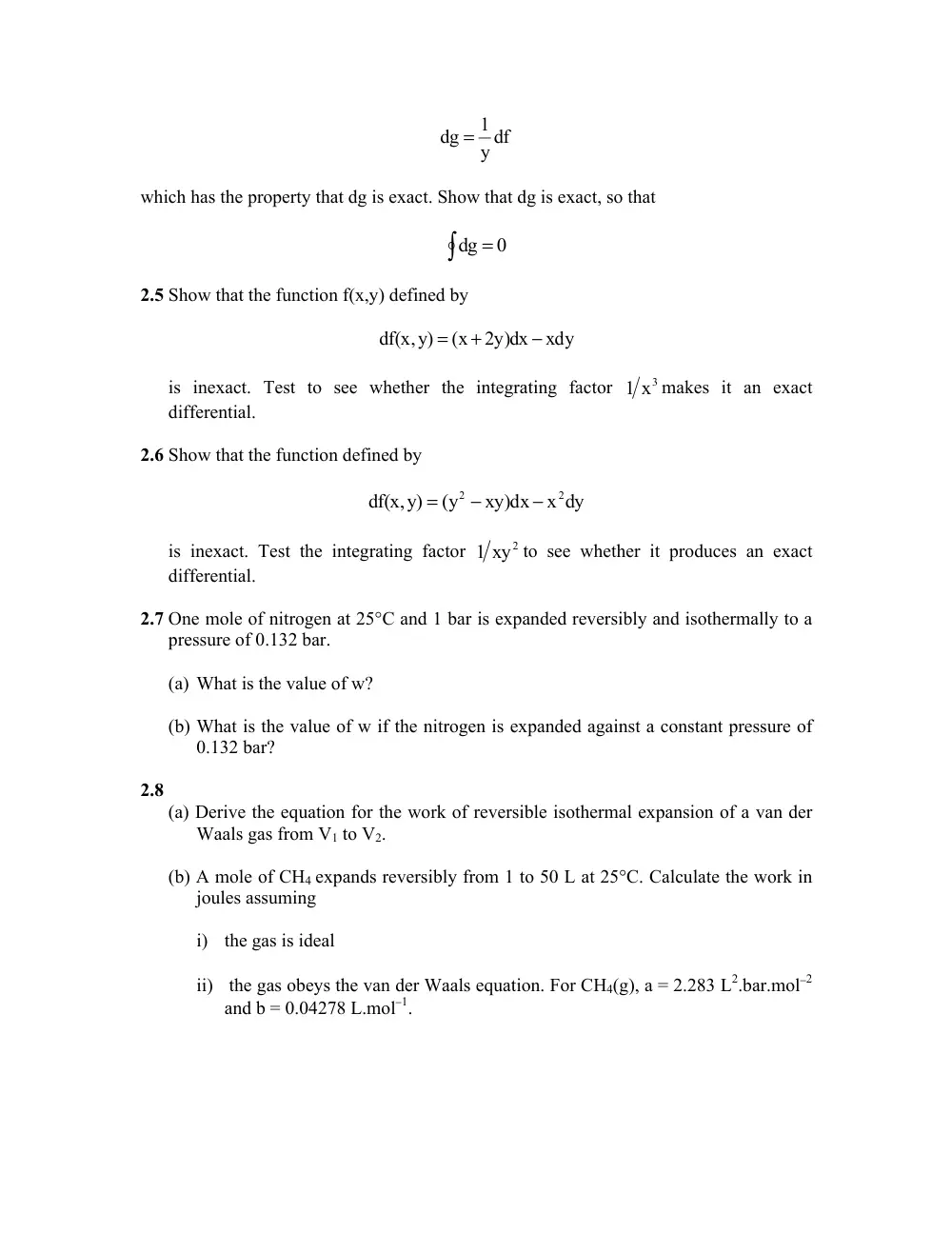
Thus, the integral ∫df depends on the path. However, we can define a new function g
by
y df
dg = 1
which has the property that dg is exact. Show that dg is exact, so that
∫
dg = 0
2.5 Show that the function f(x,y) defined by
xdy
2y)dx
(x
df(x,y)
−
+
=
is inexact. Test to see whether the integrating factor
1 x3
makes it an exact
differential.
2.6 Show that the function defined by
x dy
xy)dx
(y
df(x,y)
2
2
−
−
=
is inexact. Test the integrating factor
1 xy2
to see whether it produces an exact
differential.
2.7 One mole of nitrogen at 25°C and 1 bar is expanded reversibly and isothermally to a
pressure of 0.132 bar.
(a) What is the value of w?
(b) What is the value of w if the nitrogen is expanded against a constant pressure of
0.132 bar?
2.8
(a) Derive the equation for the work of reversible isothermal expansion of a van der
Waals gas from V1 to V2.
(b) A mole of CH4 expands reversibly from 1 to 50 L at 25°C. Calculate the work in
joules assuming
i) the gas is ideal
ii) the gas obeys the van der Waals equation. For CH4(g), a = 2.283 L2.bar.mol−2
and b = 0.04278 L.mol−1.