
CIVE 450 Midterm, Spring 2011
American University of Beirut · Water and Wastewater Treatment and Laboratory · 2 pages

More CIVE 450 files
- Midterm · Spring 2014ExamView
- Homework Problems · Fall 2015HomeworkView
- Lab Report 1 · Spring 2014LabView
- Problems Page 1 · Spring 2014ProblemsView
- Problems Page 2 · Spring 2014ProblemsView
- Problems Page 3 · Spring 2014ProblemsView
- Problems Page 4 · Spring 2014ProblemsView
- Problems Page 5 · Spring 2014ProblemsView
Show the text of this exam
Prof. G.M.Ayoub FACULTY OF ENGINEERING & ARCHITECTURE Class of 2011
AMERICAN UNIVERSITY oF BEIRUT
CIVE 450 April 9,2010 NAME: GYNalwek Water « Wastewater Treatment
eee
CLOSED BOOK (90 MIN.)
~ NO PROGRAMMABLE CALCULATORS OR CELL PHONES ARE ALLOWED
~ READ YOUR QUESTIONS CAREFULLY BEFORE YOU ANSWER
~- RETURN YOUR QUESTION SHEETS WITH YOUR ANSWER BOOKS
~ WHERE APPLICABLE ANSWERS NOT SUPPORTED BY CALCULATIONS WILL NOT BE
CONSIDERED
YOUR ANSWERS SHOULD BE BRIEF, TO THE POINT, AND CONCISE
1.20% A river water supply is treated by the sequence of unit operations and chemical
<e additions in the following list, State in a few words the purpose or purposes of each unit
process and chemical application.
(a) pre-sedimentation with polymer addition
> (b) mixing and flocculation with the addition of alum and polymer
Sv (c) addition of activated carbon
Ve (d) sedimentation we
ley (e) granular media filtration
(f) post chlorination
ra VA 2.20% a. Design a rectangular settling tank/s for a flow of 20, 000 m? ‘day The detention period
p.......___ is 4 hours, and the water depth 3m. The ratio of length to width is to be 4:1.
fe, ke 10 m. Determine the SOR m/d ana Séitliig Velocity of the design particle in mm/s. -
SS b. If one of the tanks goes out of operation and you are to divert the flow to the other
~ L:W ratio with a detention petiod of not Jess than 4 hrs at normal flow. What would the
detention period be at peak flow and will it be acceptable?
3. 10% a. Primary sedimentation of turbid water reduces suspended solids from 1000m;
200mg/L. How many kilograms of dry solids are removed by treating 4000 m?.
b. If the concentration in the settled sludge withdrawn from the clarifier is 8% solids
and the specific gravity of the sludge is 1.03, what will be the sludge volume
resulting from the treatment of 4000m? of the tiver water.
to
4. 20%a. What are the process reactions that take place when a coagulant is
added to water. An example for each is a plus.
b. If you want to determine the type of coagulant and the optimal coagulant dose
to use , what would you do and how would you do it.
¢. To achieve flocculation, mixing is required. This in tum would require power
input. By what terms is this power input expressed. How would you calculate
oN
a
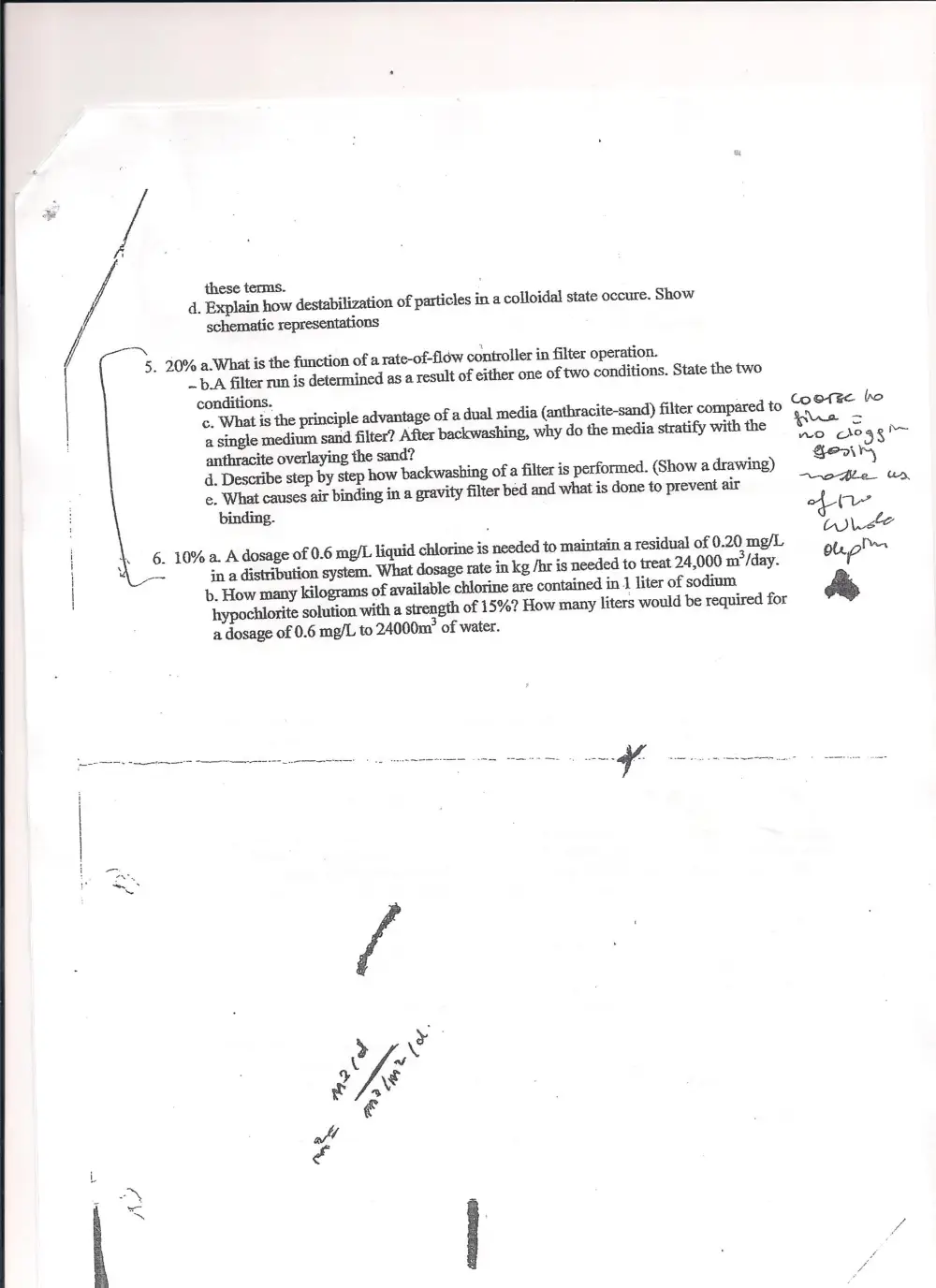
these terms.
d. Explain how destabilization of
particles in a colloidal state occure. Show
/ schematic representations
5. 20% a.What is the function of a rate-of-fléw controller in filter operation.
_b.A filter run is determined as a result of either one of two conditions. State the two
conditions.
c. What is the principle advantage of a dual media (anthracite-sand) filter compared to ri eee ho
a single medium sand filter? Afier backwashing, why do the media stratify with the mo 838 he
anthracite overlaying the sand?
kwashing of a filter is performed. (Show a drawing)
nHodiie Ur
d. Describe step by step how bac!
e. What causes air binding in a gravity filter bed and what is done to prevent air
(1
binding.
Wt
6. 10% a. A dosage of 0.6 mg/L liquid chlorine is needed to maintain a residual of 0.20 mg/L oor
|
' -—~ in a distribution system. What dosage rate in kg /hr is needed to treat 24,000 m?/day.
b. How many kilograms of available chlorine are contained in 1 liter of sodium &
hypochlorite solution with a strength of 15%? How many liters would be required for
a dosage of 0.6 mg/L to 24000m? of water.