
CIVE 646 Homework 2 Optimization, Fall 2011
American University of Beirut · Water Resources Systems Planning and Management · 10 pages


More CIVE 646 files
- Homework 1 (handout) · Fall 2011HomeworkView
- Homework 1 Solution · Fall 2011Homework · with solutionView
- Homework 2 Optimization (handout) · Fall 2011HomeworkView
- Homework 3 Multicriteria Decision Analysis · Fall 2011HomeworkView
- Homework 3 Solution · Fall 2011Homework · with solutionView
- Homework 4 Fuzzy Logic · Fall 2011HomeworkView
- Problems · Fall 2011ProblemsView
Show the text of this homework
AUB-FEA-CEE
CIVE646- Water Resources Systems: Planning and Management
Fall 2011-12
Homework # 2 - Solution
CIVE 646 - Water Resources Systems: Planning and Management
(Fall 2011-12)
4-24 An industrial firm makes two products, A and B. These products require water and other resources.
Water is the scarce resource-they have plenty of other needed resources. The products they make are unique,
and hence they can set the unit price of each product at any value they want to. However experience tells them
that the higher the unit price for a product, the less amount of that product they will sell. The relationship
between unit price and quantity that can be sold is given by the following two demand functions:
P0(A) = 8 – A
P0(B) = 6 – 1.5B
(a) What are the amounts of A and B, and their unit prices, that maximize the total revenue that can be
obtained? Formulate the problem and use optimization tool of Matlab to solve it.
(b) Suppose the total amount of A and B could not exceed some amount Tmax. What are the amounts of A and B,
and their unit prices, that maximize total revenue, if:
i)
Tmax = 10
ii)
Tmax = 5
Formulate the problem and use optimization tool of Matlab to solve it.
Water is needed to make each unit of A and B. The production functions relating the amount of water XA needed
to make A, and the amount of water XB needed to make B are A = 0.5 XA, and B = 0.25 XB, respectively.
(c) Find the amounts of A and B and their unit prices that maximize total revenue assuming the total amount of
water available is 10 units. Formulate the problem and use optimization tool of Matlab to solve it.
Solution:
(a) Total Revenue Functions:
TRA = (8 - A)A = 8A - A2
TRB = (6 - 1.5B)B = 6B – 1.5B2
Maximize TR = TRA + TRA
Optimization tool of Matlab:
function f = objfun(x)
a = x(1); b = x(2);
f = -8*a + a^2 - 6*b + 1.5*b^2;
Quantity of product A
Quantity of product B
Po
Unit
price
Po
Unit
Price
8 – A
6 – 1.5B
AUB-FEA-CEE
CIVE646- Water Resources Systems: Planning and Management
Fall 2011-12
A = 4, P0(A) = 4
B = 2, P0(B) = 3
TR = 4*4 + 2*3 = 22
b) In this case:
A + B Tmax. 10
The solution for A and B would be same as (a) since A + B = 6 10
A + B Tmax. 5
function f = objfun(x)
a = x(1); b = x(2);
f = -8*a + a^2 - 6*b + 1.5*b^2;
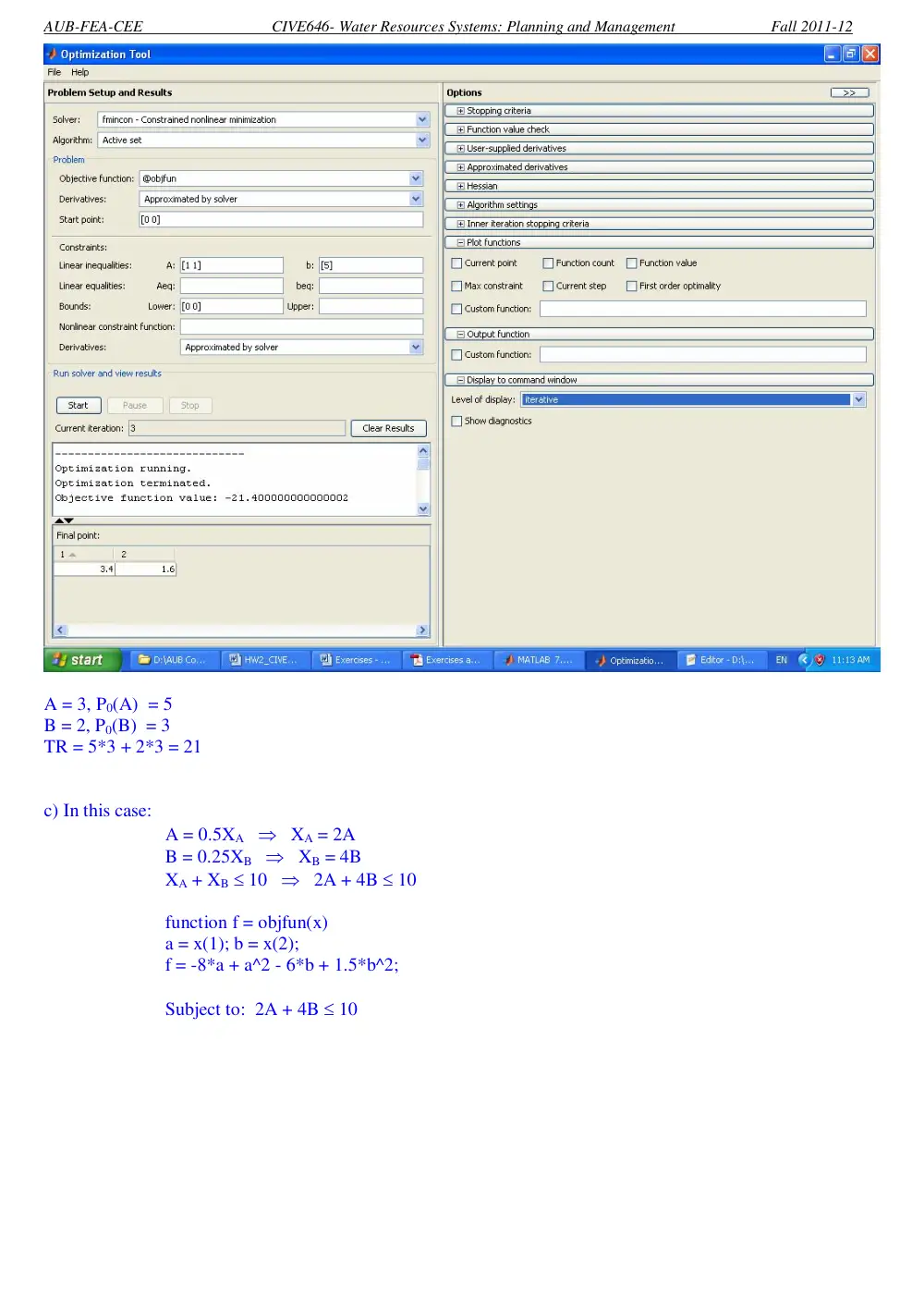
Subject to A + B 5
AUB-FEA-CEE
CIVE646- Water Resources Systems: Planning and Management
Fall 2011-12
A = 3, P0(A) = 5
B = 2, P0(B) = 3
TR = 5*3 + 2*3 = 21
c) In this case:
A = 0.5XA XA = 2A
B = 0.25XB XB = 4B
XA + XB 10 2A + 4B 10
function f = objfun(x)
a = x(1); b = x(2);
f = -8*a + a^2 - 6*b + 1.5*b^2;
Subject to: 2A + 4B 10
AUB-FEA-CEE
CIVE646- Water Resources Systems: Planning and Management
Fall 2011-12
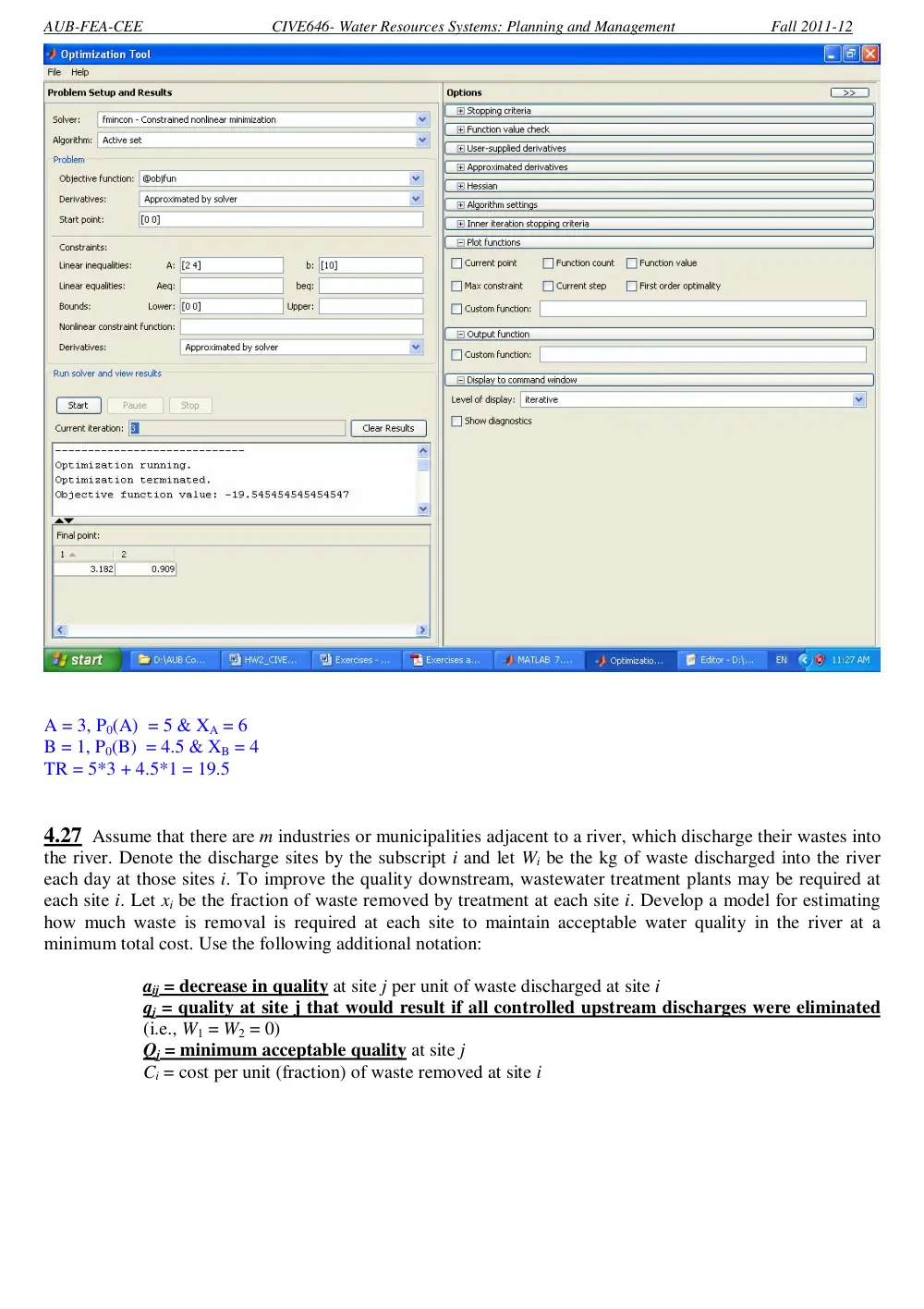
A = 3, P0(A) = 5 & XA = 6
B = 1, P0(B) = 4.5 & XB = 4
TR = 5*3 + 4.5*1 = 19.5
4.27 Assume that there are m industries or municipalities adjacent to a river, which discharge their wastes into
the river. Denote the discharge sites by the subscript i and let Wi be the kg of waste discharged into the river
each day at those sites i. To improve the quality downstream, wastewater treatment plants may be required at
each site i. Let xi be the fraction of waste removed by treatment at each site i. Develop a model for estimating
how much waste is removal is required at each site to maintain acceptable water quality in the river at a
minimum total cost. Use the following additional notation:
aij = decrease in quality at site j per unit of waste discharged at site i
qj = quality at site j that would result if all controlled upstream discharges were eliminated
(i.e., W1 = W2 = 0)
Qj = minimum acceptable quality at site j
Ci = cost per unit (fraction) of waste removed at site i
AUB-FEA-CEE
CIVE646- Water Resources Systems: Planning and Management
Fall 2011-12
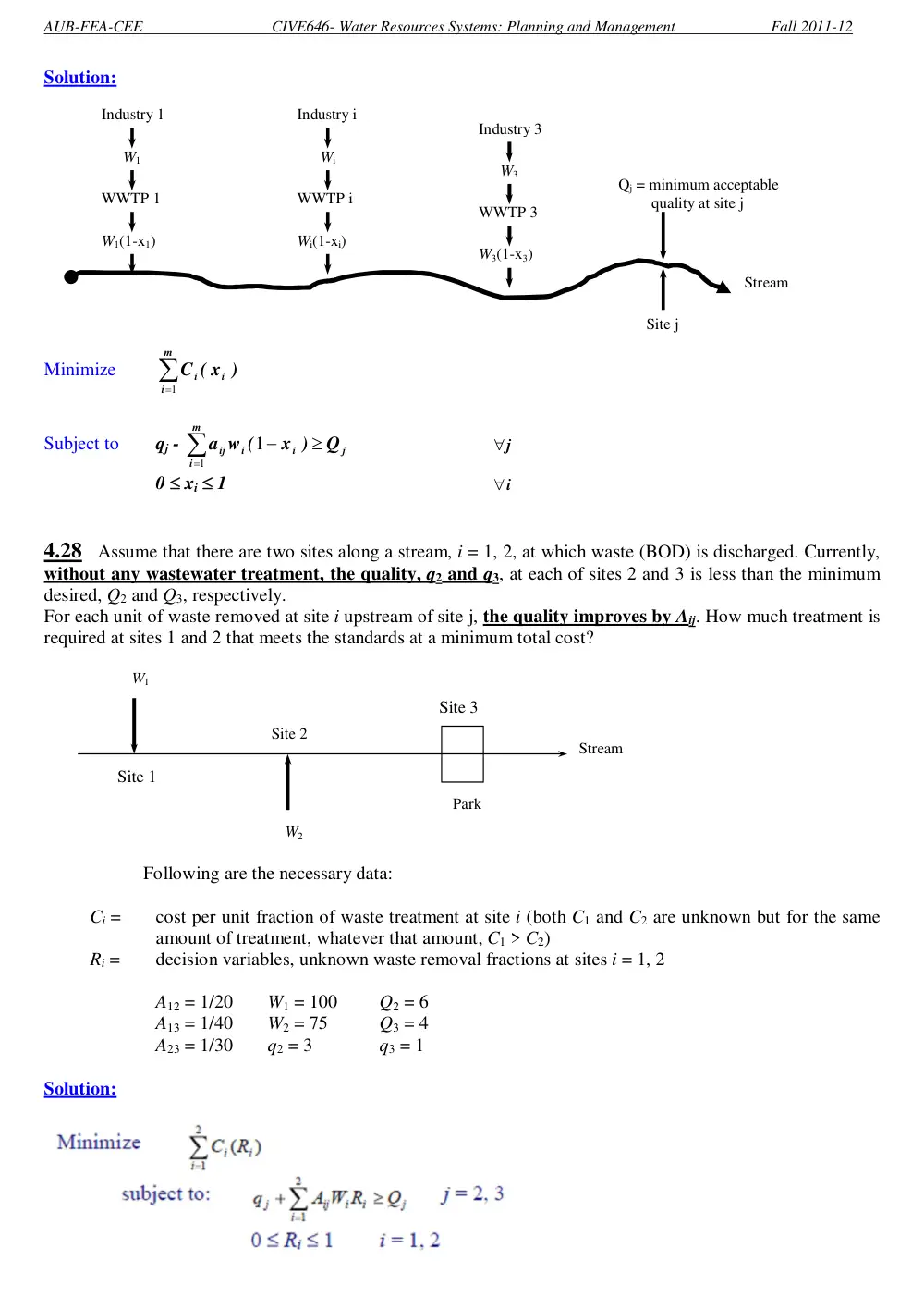
Solution:
Minimize
( x )
C
m
i
i
i
1
Subject to
qj -
j
i
i
m
i
ij
Q
x )
a w (
1
1
j
0 xi 1
i
4.28 Assume that there are two sites along a stream, i = 1, 2, at which waste (BOD) is discharged. Currently,
without any wastewater treatment, the quality, q2 and q3, at each of sites 2 and 3 is less than the minimum
desired, Q2 and Q3, respectively.
For each unit of waste removed at site i upstream of site j, the quality improves by Aij. How much treatment is
required at sites 1 and 2 that meets the standards at a minimum total cost?
Following are the necessary data:
Ci =
cost per unit fraction of waste treatment at site i (both C1 and C2 are unknown but for the same
amount of treatment, whatever that amount, C1 > C2)
Ri =
decision variables, unknown waste removal fractions at sites i = 1, 2
A12 = 1/20
W1 = 100
Q2 = 6
A13 = 1/40
W2 = 75
Q3 = 4
A23 = 1/30
q2 = 3
q3 = 1
Solution:
Site 1
Site 2
Site 3
Park
W1
W2
Stream
W1
W1(1-x1)
Industry 1
WWTP 1
Stream
Wi
Wi(1-xi)
Industry i
WWTP i
W3
W3(1-x3)
Industry 3
WWTP 3
Qj = minimum acceptable
quality at site j
Site j
AUB-FEA-CEE
CIVE646- Water Resources Systems: Planning and Management
Fall 2011-12
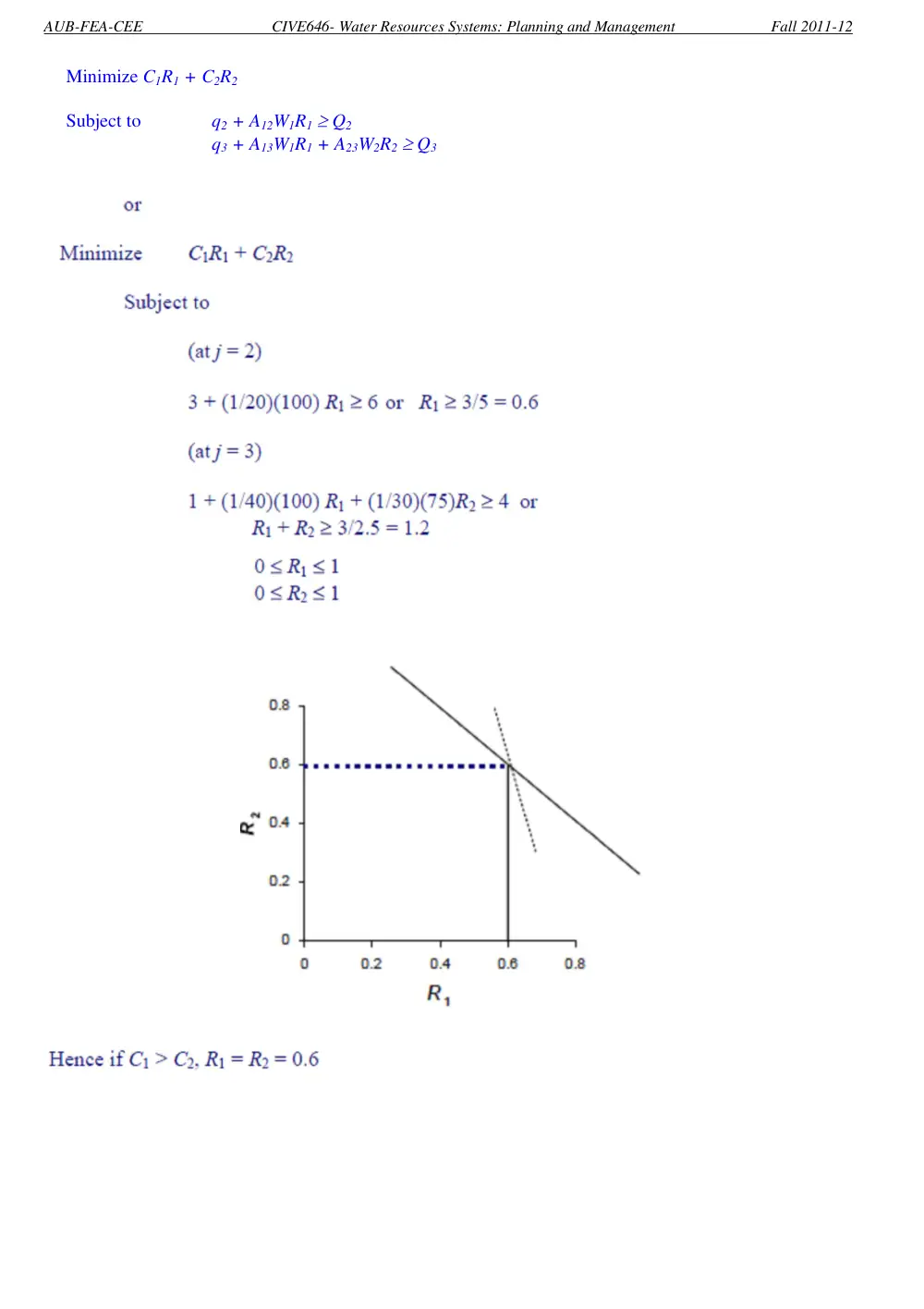
Minimize C1R1 + C2R2
Subject to
q2 + A12W1R1 Q2
q3 + A13W1R1 + A23W2R2 Q3
AUB-FEA-CEE
CIVE646- Water Resources Systems: Planning and Management
Fall 2011-12
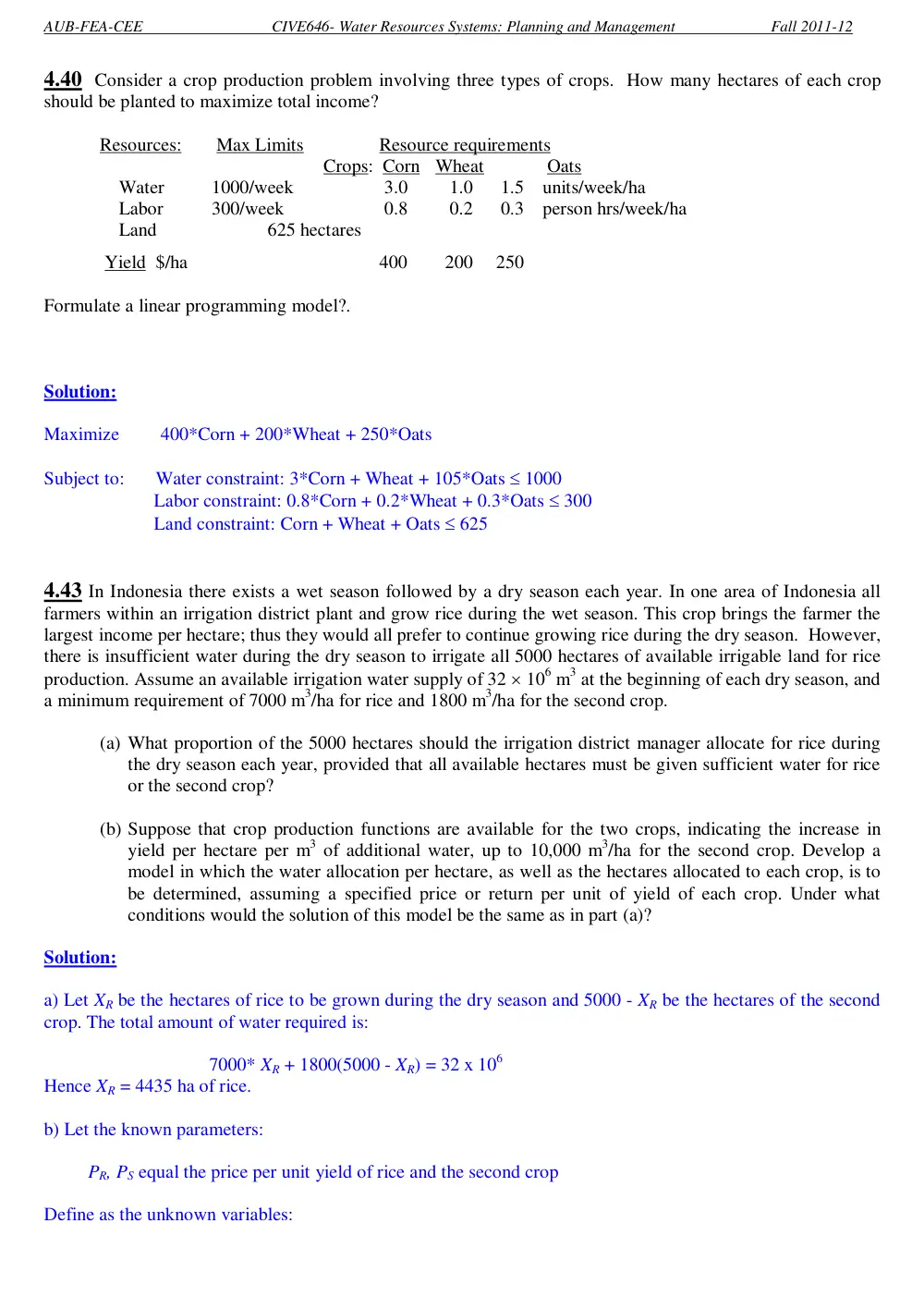
4.40 Consider a crop production problem involving three types of crops. How many hectares of each crop
should be planted to maximize total income?
Resources:
Max Limits
Resource requirements
Crops: Corn Wheat
Oats
Water 1000/week
3.0
1.0 1.5 units/week/ha
Labor
300/week
0.8
0.2 0.3 person hrs/week/ha
Land
625 hectares
Yield $/ha
400
200 250
Formulate a linear programming model?.
Solution:
Maximize
400*Corn + 200*Wheat + 250*Oats
Subject to:
Water constraint: 3*Corn + Wheat + 105*Oats 1000
Labor constraint: 0.8*Corn + 0.2*Wheat + 0.3*Oats 300
Land constraint: Corn + Wheat + Oats 625
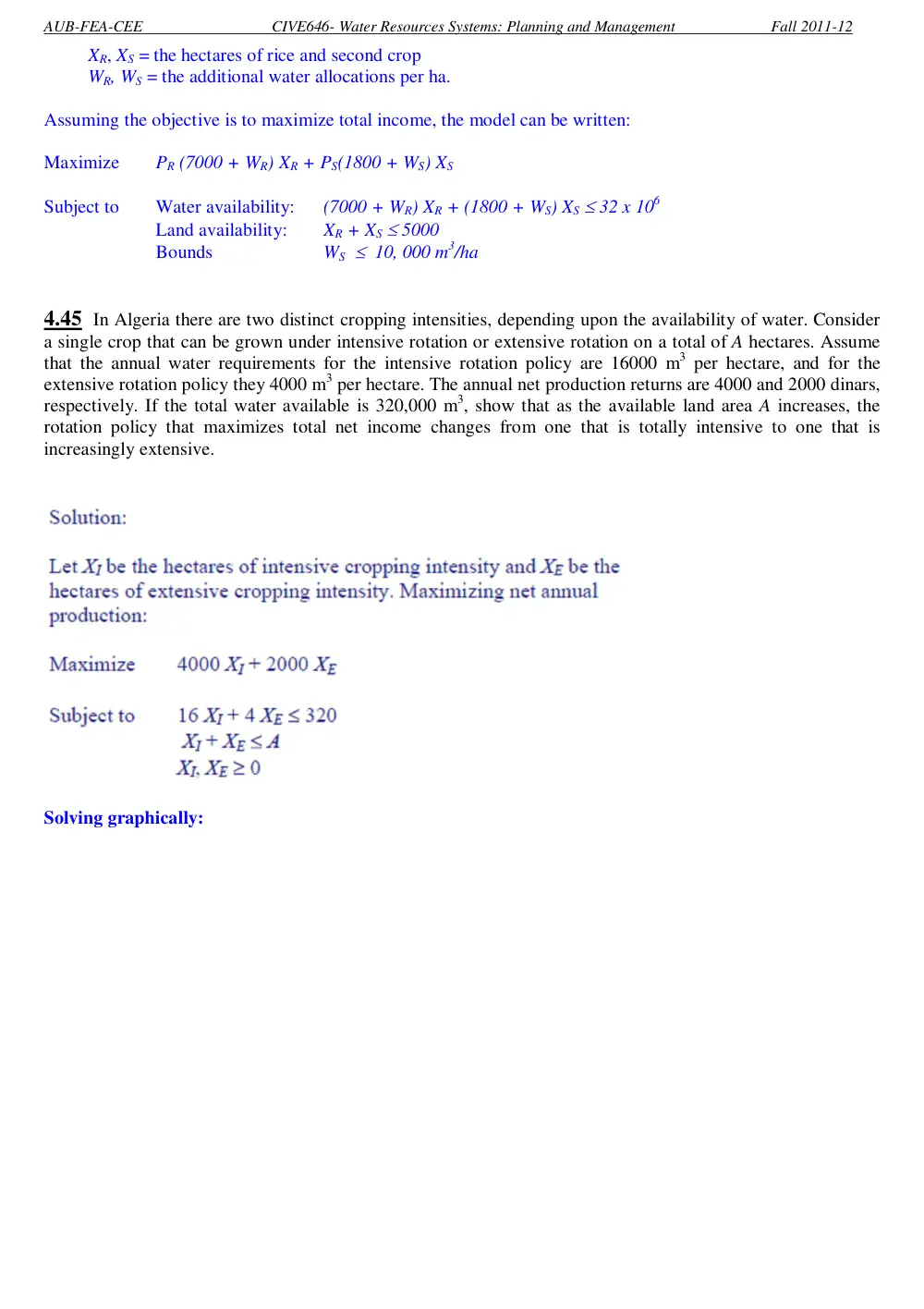
4.43 In Indonesia there exists a wet season followed by a dry season each year. In one area of Indonesia all
farmers within an irrigation district plant and grow rice during the wet season. This crop brings the farmer the
largest income per hectare; thus they would all prefer to continue growing rice during the dry season. However,
there is insufficient water during the dry season to irrigate all 5000 hectares of available irrigable land for rice
production. Assume an available irrigation water supply of 32 106 m3 at the beginning of each dry season, and
a minimum requirement of 7000 m3/ha for rice and 1800 m3/ha for the second crop.
(a) What proportion of the 5000 hectares should the irrigation district manager allocate for rice during
the dry season each year, provided that all available hectares must be given sufficient water for rice
or the second crop?
(b) Suppose that crop production functions are available for the two crops, indicating the increase in
yield per hectare per m3 of additional water, up to 10,000 m3/ha for the second crop. Develop a
model in which the water allocation per hectare, as well as the hectares allocated to each crop, is to
be determined, assuming a specified price or return per unit of yield of each crop. Under what
conditions would the solution of this model be the same as in part (a)?
Solution:
a) Let XR be the hectares of rice to be grown during the dry season and 5000 - XR be the hectares of the second
crop. The total amount of water required is:
7000* XR + 1800(5000 - XR) = 32 x 106
Hence XR = 4435 ha of rice.
b) Let the known parameters:
PR, PS equal the price per unit yield of rice and the second crop
Define as the unknown variables:
AUB-FEA-CEE
CIVE646- Water Resources Systems: Planning and Management
Fall 2011-12
XR, XS = the hectares of rice and second crop
WR, WS = the additional water allocations per ha.
Assuming the objective is to maximize total income, the model can be written:
Maximize
PR (7000 + WR) XR + PS(1800 + WS) XS
Subject to
Water availability:
(7000 + WR) XR + (1800 + WS) XS 32 x 106
Land availability:
XR + XS 5000
Bounds
WS 10, 000 m3/ha
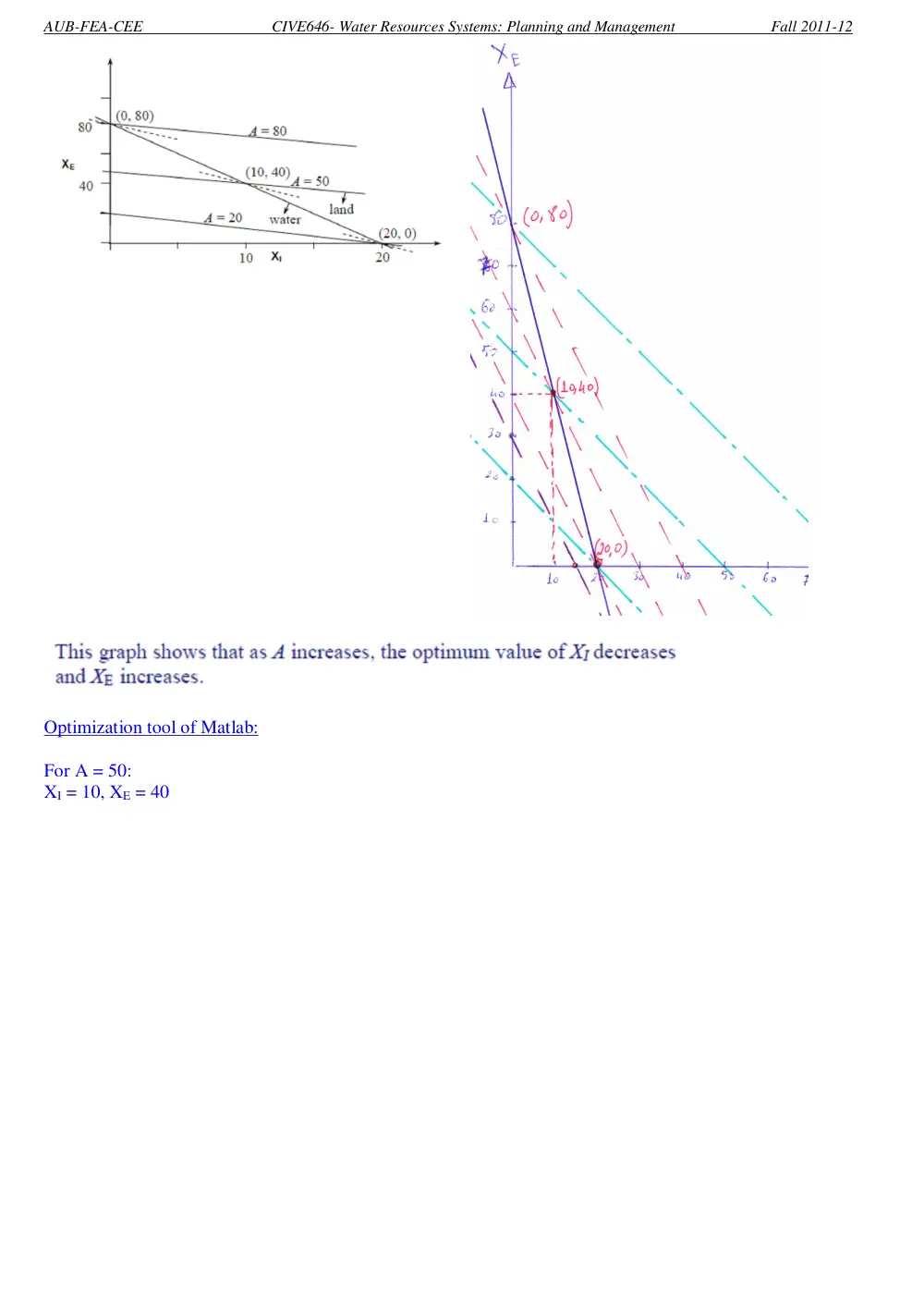
4.45 In Algeria there are two distinct cropping intensities, depending upon the availability of water. Consider
a single crop that can be grown under intensive rotation or extensive rotation on a total of A hectares. Assume
that the annual water requirements for the intensive rotation policy are 16000 m3 per hectare, and for the
extensive rotation policy they 4000 m3 per hectare. The annual net production returns are 4000 and 2000 dinars,
respectively. If the total water available is 320,000 m3, show that as the available land area A increases, the
rotation policy that maximizes total net income changes from one that is totally intensive to one that is
increasingly extensive.
Solving graphically:
AUB-FEA-CEE
CIVE646- Water Resources Systems: Planning and Management
Fall 2011-12
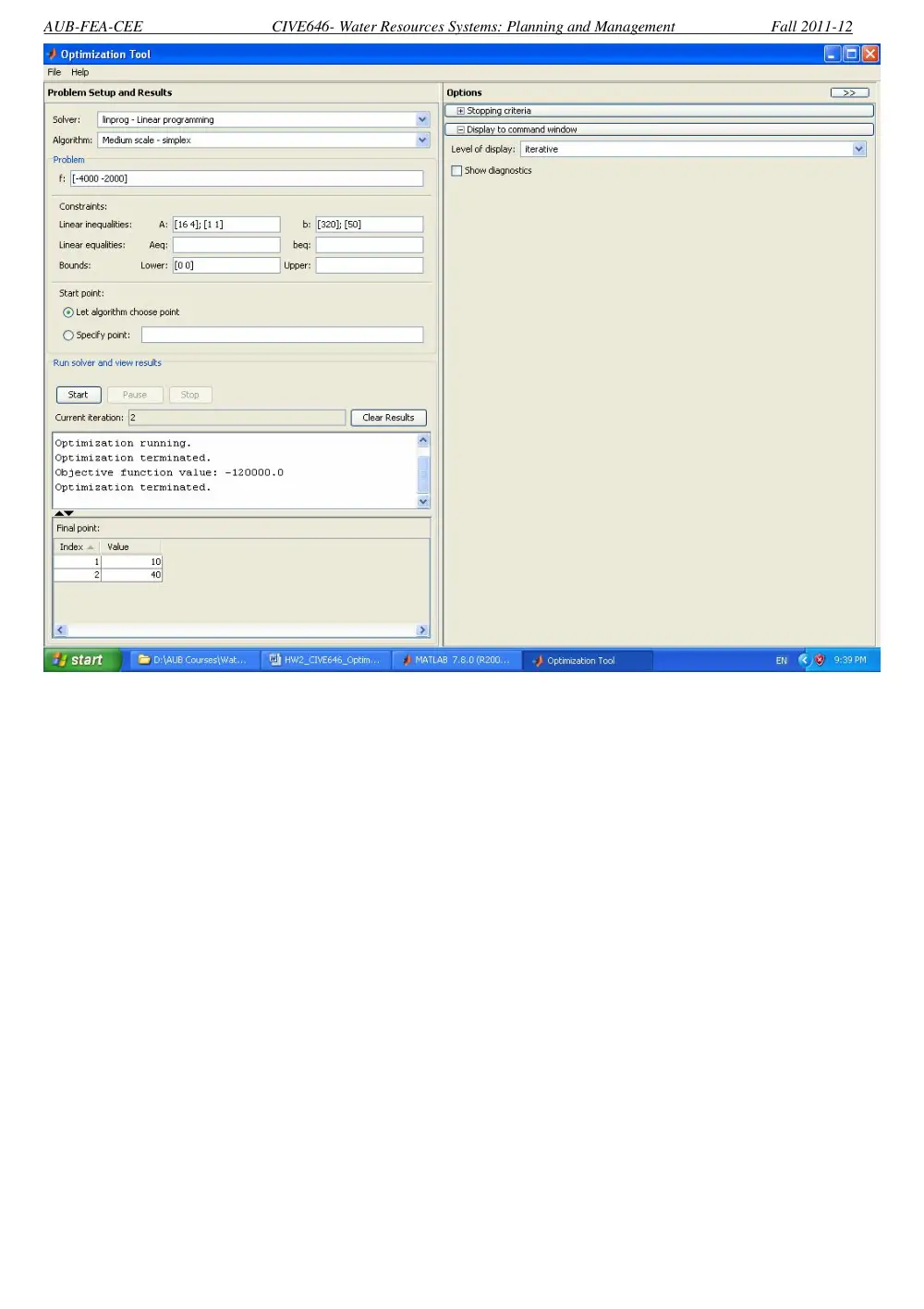
Optimization tool of Matlab:
For A = 50:
XI = 10, XE = 40
AUB-FEA-CEE
CIVE646- Water Resources Systems: Planning and Management
Fall 2011-12