
CIVE 646 Problems, Fall 2011
American University of Beirut · Water Resources Systems Planning and Management · 69 pages

Showing the first 10 of 69 pages. Download the PDF to see all of it.
More CIVE 646 files
- Homework 1 (handout) · Fall 2011HomeworkView
- Homework 1 Solution · Fall 2011Homework · with solutionView
- Homework 2 Optimization · Fall 2011HomeworkView
- Homework 2 Optimization (handout) · Fall 2011HomeworkView
- Homework 3 Multicriteria Decision Analysis · Fall 2011HomeworkView
- Homework 3 Solution · Fall 2011Homework · with solutionView
- Homework 4 Fuzzy Logic · Fall 2011HomeworkView
Show the text of this problems
Water Resource Systems Planning and Management
Daniel P. Loucks & Eelco van Beek
Exercises
Content
Chapter 1 Water Resources Planning and Management: an overview..........................1
Chapter 2 Water Resource Systems Modelling: its role in planning and management 2
Chapter 3 Modelling methods for Evaluating Alternatives ..........................................3
Chapter 4 Optimization Methods..................................................................................7
Chapter 5 Fuzzy Optimization....................................................................................23
Chapter 6 Data-Based Models ....................................................................................24
Chapter 7 Concepts in Probability, Statistics and Stochastic Modelling....................26
Chapter 8 Modelling Uncertainty ...............................................................................42
Chapter 9 Model Sensitivity and Uncertainty Analysis..............................................44
Chapter 10 Performance Criteria ................................................................................45
Chapter 11 River Basin Planning Models...................................................................49
Chapter 12 Water Quality Modelling and Prediction .................................................60
Chapter 13 Urban Water Systems...............................................................................65
Chapter 14 A Synopsis................................................................................................67
Water Resources Systems Planning and Management
Exercises
Daniel P. Loucks & Eelco van Beek
1
Chapter 1 Water Resources Planning and Management: an
overview
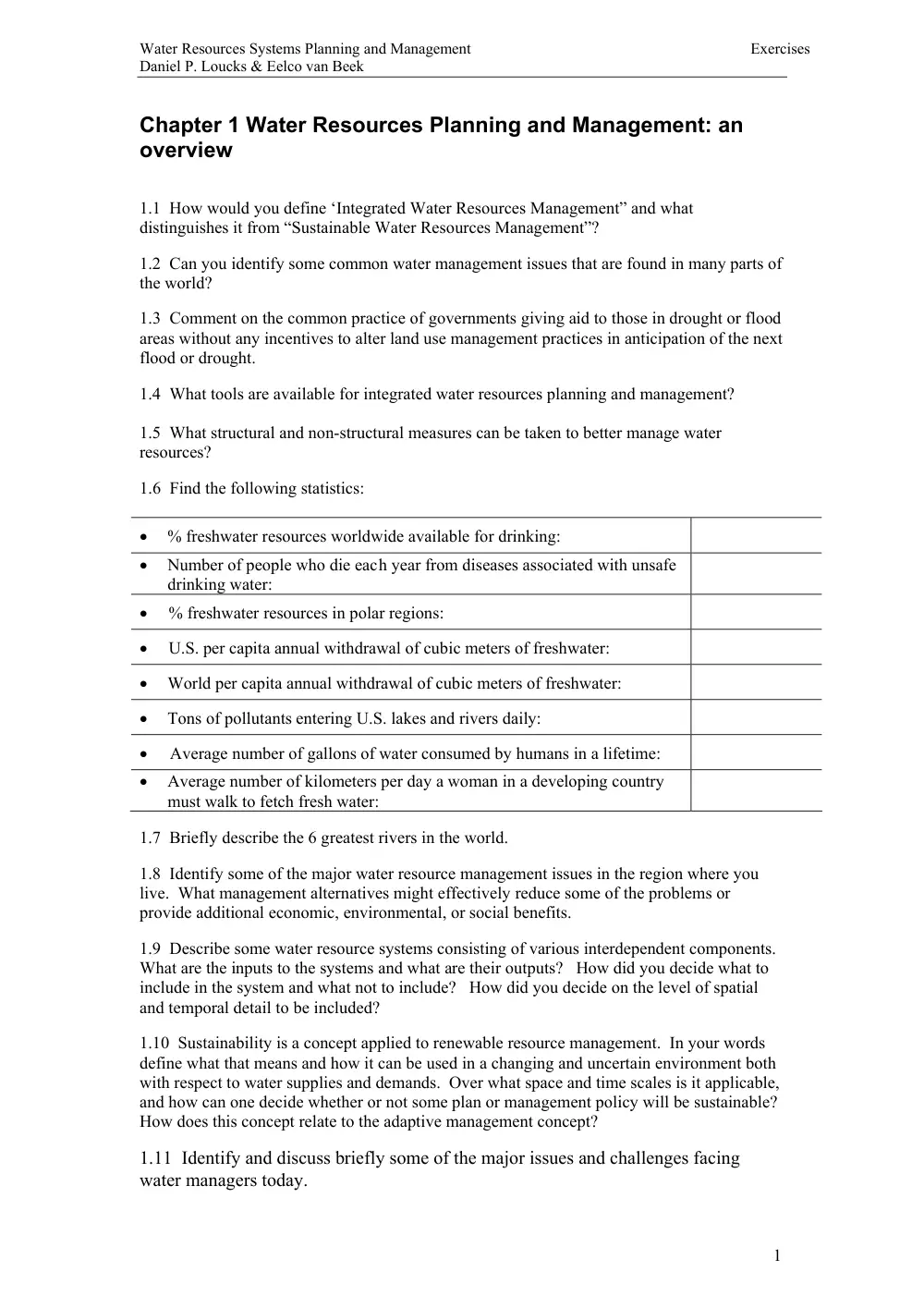
1.1 How would you define ‘Integrated Water Resources Management” and what
distinguishes it from “Sustainable Water Resources Management”?
1.2 Can you identify some common water management issues that are found in many parts of
the world?
1.3 Comment on the common practice of governments giving aid to those in drought or flood
areas without any incentives to alter land use management practices in anticipation of the next
flood or drought.
1.4 What tools are available for integrated water resources planning and management?
1.5 What structural and non-structural measures can be taken to better manage water
resources?
1.6 Find the following statistics:
·
% freshwater resources worldwide available for drinking:
·
Number of people who die each year from diseases associated with unsafe
drinking water:
·
% freshwater resources in polar regions:
·
U.S. per capita annual withdrawal of cubic meters of freshwater:
·
World per capita annual withdrawal of cubic meters of freshwater:
·
Tons of pollutants entering U.S. lakes and rivers daily:
·
Average number of gallons of water consumed by humans in a lifetime:
·
Average number of kilometers per day a woman in a developing country
must walk to fetch fresh water:
1.7 Briefly describe the 6 greatest rivers in the world.
1.8 Identify some of the major water resource management issues in the region where you
live. What management alternatives might effectively reduce some of the problems or
provide additional economic, environmental, or social benefits.
1.9 Describe some water resource systems consisting of various interdependent components.
What are the inputs to the systems and what are their outputs? How did you decide what to
include in the system and what not to include? How did you decide on the level of spatial
and temporal detail to be included?
1.10 Sustainability is a concept applied to renewable resource management. In your words
define what that means and how it can be used in a changing and uncertain environment both
with respect to water supplies and demands. Over what space and time scales is it applicable,
and how can one decide whether or not some plan or management policy will be sustainable?
How does this concept relate to the adaptive management concept?
1.11 Identify and discuss briefly some of the major issues and challenges facing
water managers today.
Water Resources Systems Planning and Management
Exercises
Daniel P. Loucks & Eelco van Beek
2
Chapter 2 Water Resource Systems Modelling: its role in
planning and management
2.1 What is a system?
2.2 What is systems analysis?
2.3 What is a mathematical model?
2.4 Why develop and use models?
2.5 What is a decision support system?
2.6 What is shared vision modeling and planning?
2.7 What characteristics of water resources planning or management problems make them
suitable for analysis using quantitative systems analysis techniques?
2.8 Identify some specific water resource systems planning problems and for each problem
specify in words possible objectives, the unknown decision variables whose values need to be
determined, and the constraints or that must be met by any solution of the problem.
2.9 From a review of the recent issues of various journals pertaining to water resources and
the appropriate areas of engineering, economics, planning and operations research, identify
those journals that contain articles on water resources systems planning and analysis, and the
topics or problems currently being discussed.
2.10 Many water resource systems planning problems involve considerations that are very
difficult if not impossible to quantify, and hence they cannot easily be incorporated into any
mathematical model for defining and evaluating various alternative solutions. Briefly discuss
what value these admittedly incomplete quantitative models may have in the planning process
when non-quantifiable aspects are also important. Can you identify some planning problems
that have such intangible objectives?
2.11 Define integrated water management and what that entails as distinct from just water
management.
2.12 Water resource systems serve many purposes and can satisfy many objectives. What is
the difference between purposes and objectives?
2.13 How would you characterize the steps of a planning process aimed at solving a
particular problem?
2.14 Suppose you live in an area where the only source of water (at a reasonable cost) is from
an aquifer that receives no recharge. Briefly discuss how you might develop a plan for its use
over time.
Water Resources Systems Planning and Management
Exercises
Daniel P. Loucks & Eelco van Beek
3
Chapter 3 Modelling methods for Evaluating Alternatives
3.1 Briefly outline why multiple disciplines are needed to efficiently and effectively manage
water resources in major river basins, or even in local watersheds.
3.2 Describe in a page or two what some of the issues are in the region where you live.
3.3 Define adaptive management, shared vision modeling, and sustainability.
3.4 Distinguish what a manager does from what an analyst (modeler) does.
3.5 Identify some typical or common water resources planning or management problems that
are suitable for analysis using quantitative systems analysis techniques.
3.6 Consider the following five alternatives for the production of energy (103 kwh/day) and
irrigation supplies (106 m3/month):
Alternative
Energy Production
Irrigation Supply
A
22
20
B
10
35
C
20
32
D
12
21
E
6
25
Which alternative would be the best in your opinion and why? Why might a decision maker
select alternative E even realizing other alternatives exist that can give more hydropower
energy and irrigation supply?
3.7 Define a model similar to Equations 3.1 to 3.3 for finding the dimensions of a cylindrical
tank that minimizes the total cost of storing a specified volume of water. What are the
unknown decision variables? What are the model parameters? Develop an iterative
approach for solving this model.
3.8 Briefly distinguish between simulation and optimization.
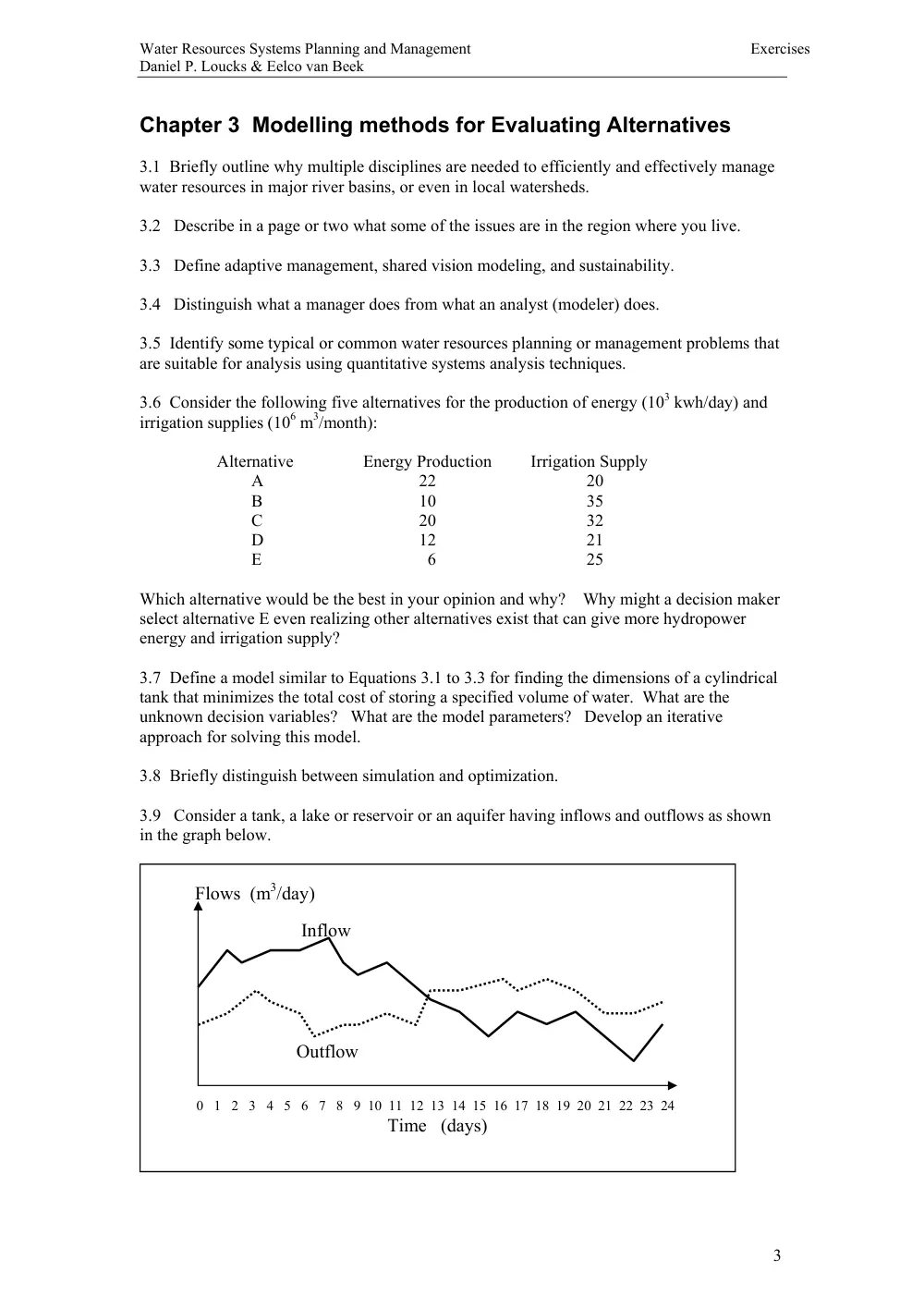
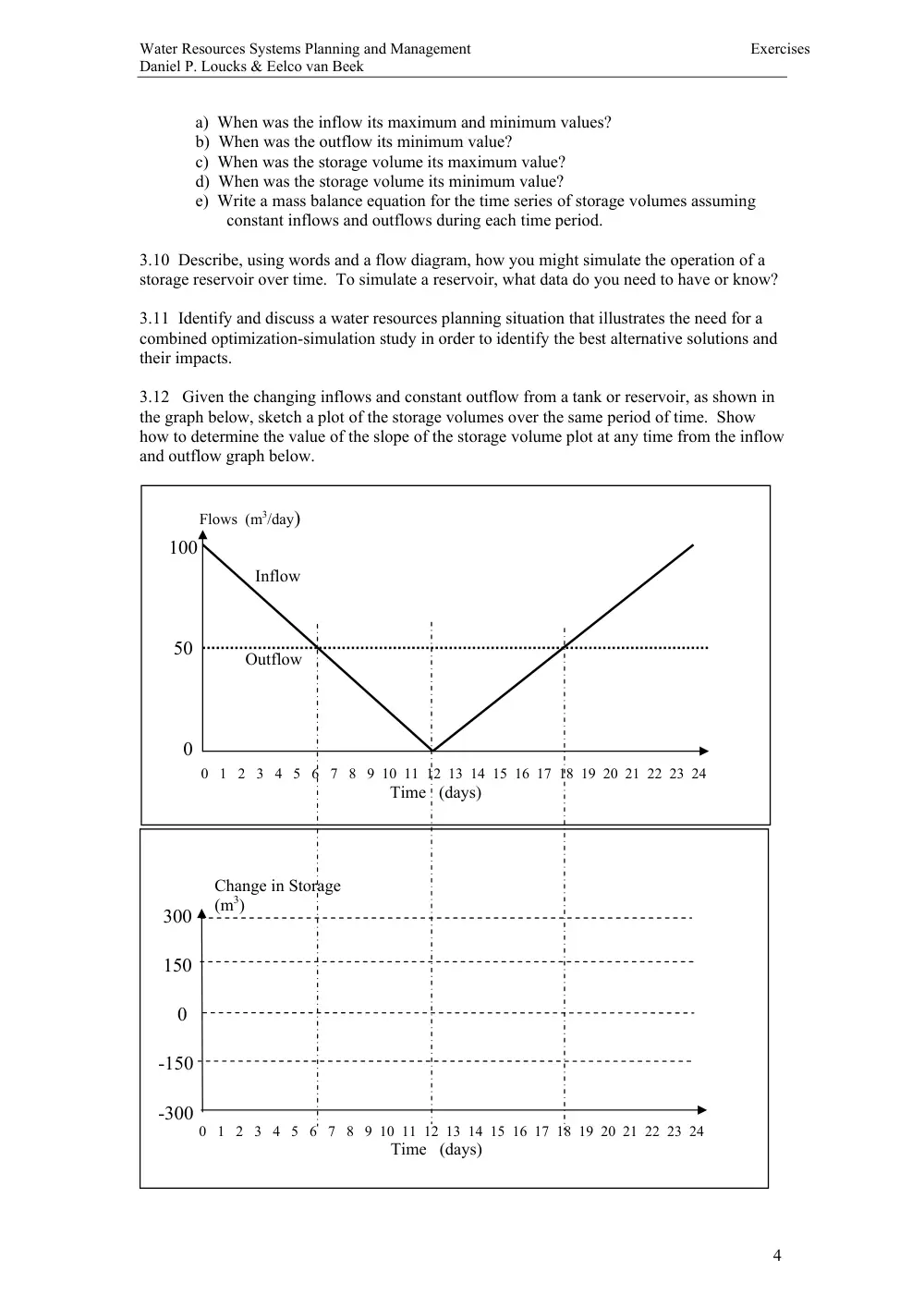
3.9 Consider a tank, a lake or reservoir or an aquifer having inflows and outflows as shown
in the graph below.
0 1 2 3 4 5 6 7 8 9 10 11 12 13 14 15 16 17 18 19 20 21 22 23 24
Time (days)
Inflow
Outflow
Flows (m3/day)
Water Resources Systems Planning and Management
Exercises
Daniel P. Loucks & Eelco van Beek
4
a) When was the inflow its maximum and minimum values?
b) When was the outflow its minimum value?
c) When was the storage volume its maximum value?
d) When was the storage volume its minimum value?
e) Write a mass balance equation for the time series of storage volumes assuming
constant inflows and outflows during each time period.
3.10 Describe, using words and a flow diagram, how you might simulate the operation of a
storage reservoir over time. To simulate a reservoir, what data do you need to have or know?
3.11 Identify and discuss a water resources planning situation that illustrates the need for a
combined optimization-simulation study in order to identify the best alternative solutions and
their impacts.
3.12 Given the changing inflows and constant outflow from a tank or reservoir, as shown in
the graph below, sketch a plot of the storage volumes over the same period of time. Show
how to determine the value of the slope of the storage volume plot at any time from the inflow
and outflow graph below.
0 1 2 3 4 5 6 7 8 9 10 11 12 13 14 15 16 17 18 19 20 21 22 23 24
Time (days)
Flows (m3/day)
100
50
0
Inflow
Outflow
Change in Storage
(m3)
300
150
0
-150
-300
0 1 2 3 4 5 6 7 8 9 10 11 12 13 14 15 16 17 18 19 20 21 22 23 24
Time (days)
Water Resources Systems Planning and Management
Exercises
Daniel P. Loucks & Eelco van Beek
5
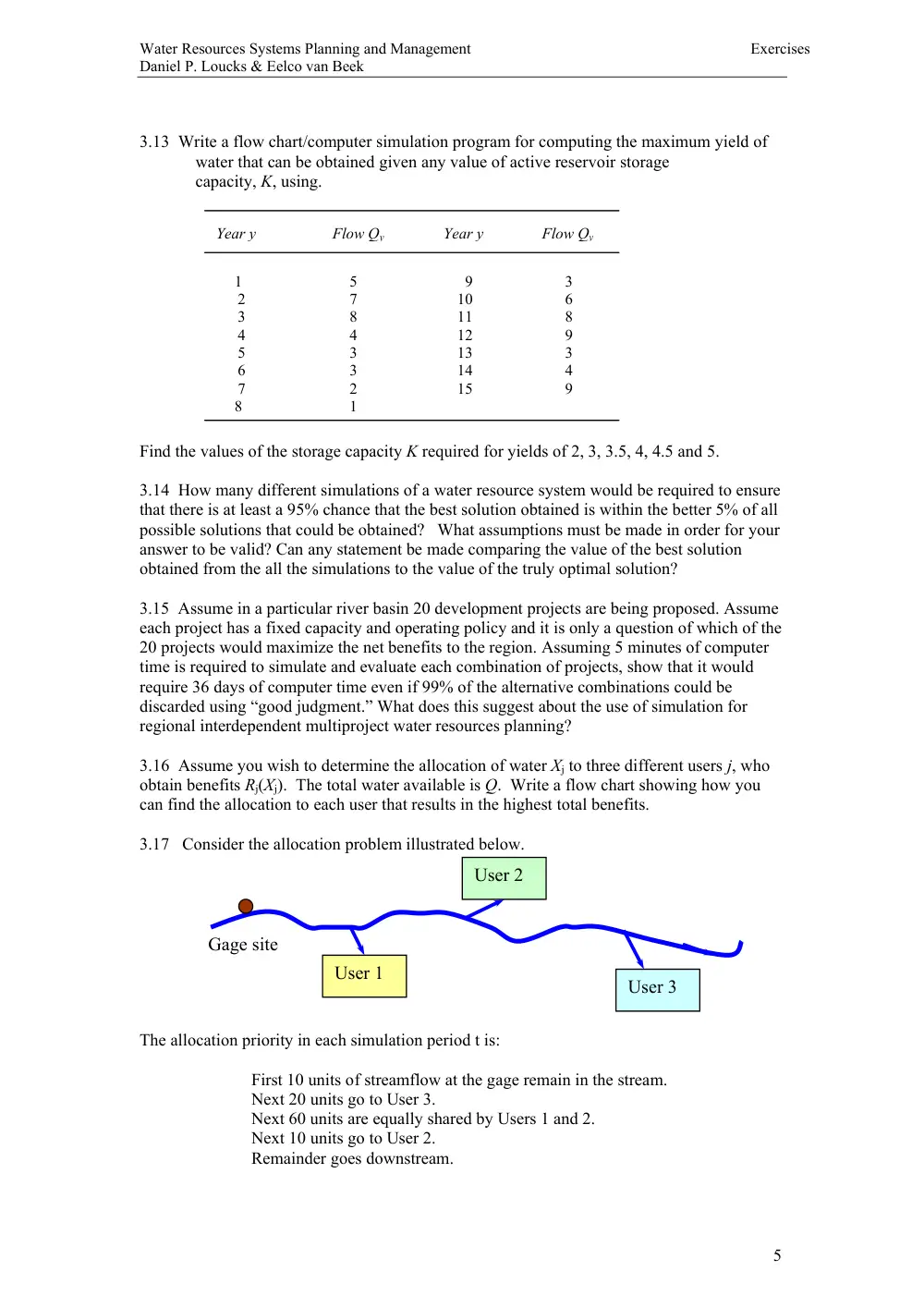
3.13 Write a flow chart/computer simulation program for computing the maximum yield of
water that can be obtained given any value of active reservoir storage
capacity, K, using.
Find the values of the storage capacity K required for yields of 2, 3, 3.5, 4, 4.5 and 5.
3.14 How many different simulations of a water resource system would be required to ensure
that there is at least a 95% chance that the best solution obtained is within the better 5% of all
possible solutions that could be obtained? What assumptions must be made in order for your
answer to be valid? Can any statement be made comparing the value of the best solution
obtained from the all the simulations to the value of the truly optimal solution?
3.15 Assume in a particular river basin 20 development projects are being proposed. Assume
each project has a fixed capacity and operating policy and it is only a question of which of the
20 projects would maximize the net benefits to the region. Assuming 5 minutes of computer
time is required to simulate and evaluate each combination of projects, show that it would
require 36 days of computer time even if 99% of the alternative combinations could be
discarded using “good judgment.” What does this suggest about the use of simulation for
regional interdependent multiproject water resources planning?
3.16 Assume you wish to determine the allocation of water Xj to three different users j, who
obtain benefits Rj(Xj). The total water available is Q. Write a flow chart showing how you
can find the allocation to each user that results in the highest total benefits.
3.17 Consider the allocation problem illustrated below.
The allocation priority in each simulation period t is:
First 10 units of streamflow at the gage remain in the stream.
Next 20 units go to User 3.
Next 60 units are equally shared by Users 1 and 2.
Next 10 units go to User 2.
Remainder goes downstream.
Year y
Flow Qy
Year y
Flow Qy
1
5
9 3
2
7
10 6
3
8
11 8
4
4
12 9
5
3
13 3
6
3
14 4
7
2
15 9
8
1
User 1
User 2
User 3
Gage site
Water Resources Systems Planning and Management
Exercises
Daniel P. Loucks & Eelco van Beek
6
a) Assume no incremental flow along the stream and no return flow from users. Define the
allocation policy at each site. This will be a graph of allocation as a function of the flow at
the allocation site.
b) Simulate this allocation policy using any river basin simulation model such as RIBASIM,
WEAP, Modsim, or other selected model (see CD) for any specified inflow series ranging
from 0 to 130 units.
Water Resources Systems Planning and Management
Exercises
Daniel P. Loucks & Eelco van Beek
7
Chapter 4 Optimization Methods
Engineering economics:
4.1 Consider two alternative water resource projects, A and B. Project A will cost
$2,533,000 and will return $1,000,000 at the end of 5 years and $4,000,000 at the end of 10
years. Project B will cost $4,000,000 and will return $2,000,000 at the end of 5 and 15 years,
and another $3,000,000 at the end of 10 years. Project A has a life of 10 years, and B has a
life of 15 years. Assuming an interest rate of 0.1 (10%) per year:
(a) What is the present value of each project?
(b) What is each project’s annual net benefit?
(c) Would the preferred project differ if the interest rates were 0.05?
(d) Assuming that each of these projects would be replaced with a similar project
having the same time stream of costs and returns, show that by extending each
series of projects to a common terminal year (e.g., 30 years), the annual net
benefits of each series of projects would be will be same as found in part (b).
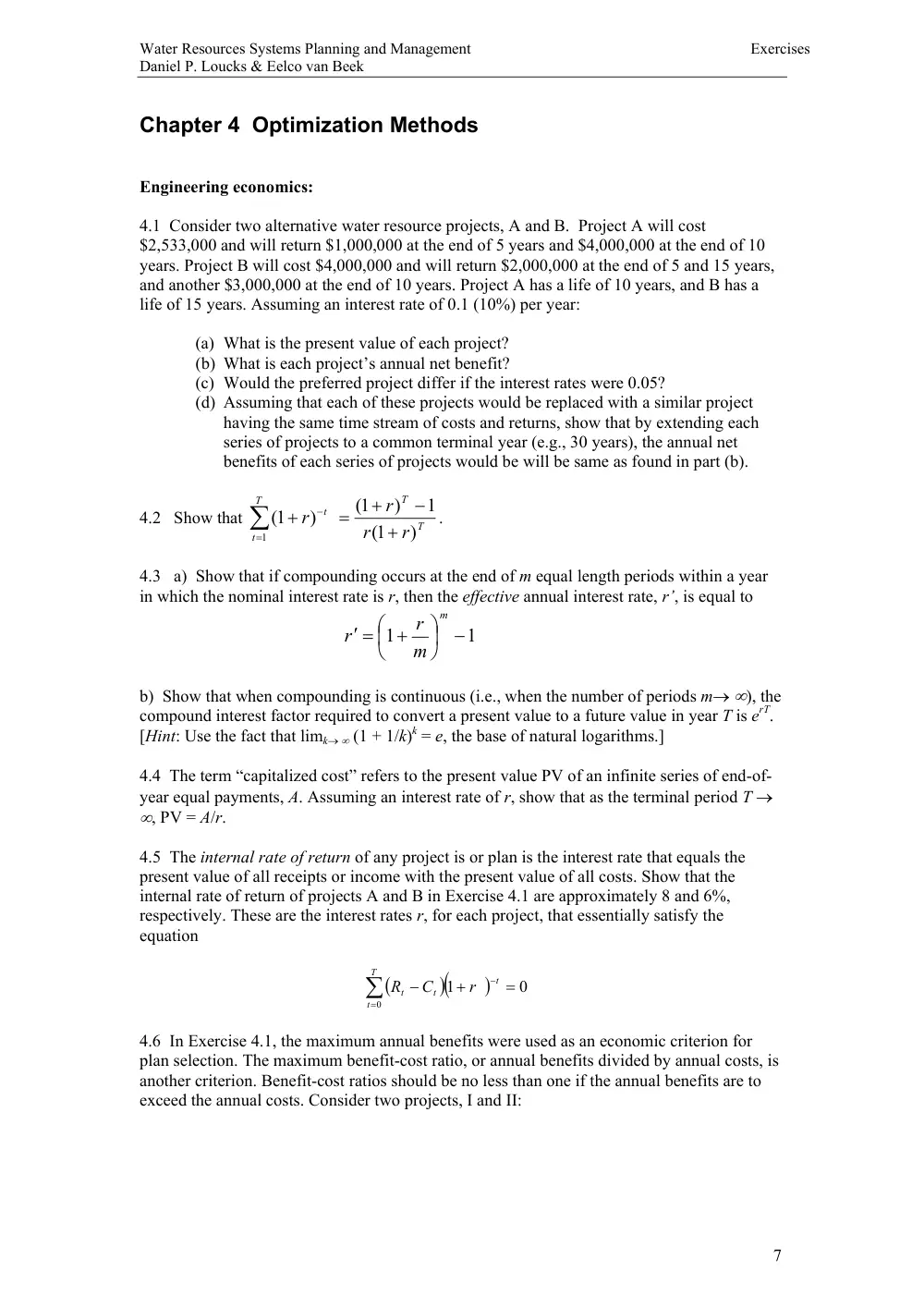
4.2 Show that
1
(1
)
T
t
t
r -
=
+
å
T
T
r
r
r
)
1(
1
)
1(
+
-
+
=
.
4.3 a) Show that if compounding occurs at the end of m equal length periods within a year
in which the nominal interest rate is r, then the effective annual interest rate, r’, is equal to
1
1
-
÷
ø
ö
ç
è
= æ +
¢
m
m
r
r
b) Show that when compounding is continuous (i.e., when the number of periods m® ¥), the
compound interest factor required to convert a present value to a future value in year T is erT.
[Hint: Use the fact that limk® ¥ (1 + 1/k)k = e, the base of natural logarithms.]
4.4 The term “capitalized cost” refers to the present value PV of an infinite series of end-of-
year equal payments, A. Assuming an interest rate of r, show that as the terminal period T ®
¥, PV = A/r.
4.5 The internal rate of return of any project is or plan is the interest rate that equals the
present value of all receipts or income with the present value of all costs. Show that the
internal rate of return of projects A and B in Exercise 4.1 are approximately 8 and 6%,
respectively. These are the interest rates r, for each project, that essentially satisfy the
equation
(
)
)
(
0
1
0
=
+
-
-
=å
t
T
t
t
t
r
C
R
4.6 In Exercise 4.1, the maximum annual benefits were used as an economic criterion for
plan selection. The maximum benefit-cost ratio, or annual benefits divided by annual costs, is
another criterion. Benefit-cost ratios should be no less than one if the annual benefits are to
exceed the annual costs. Consider two projects, I and II:
Water Resources Systems Planning and Management
Exercises
Daniel P. Loucks & Eelco van Beek
8
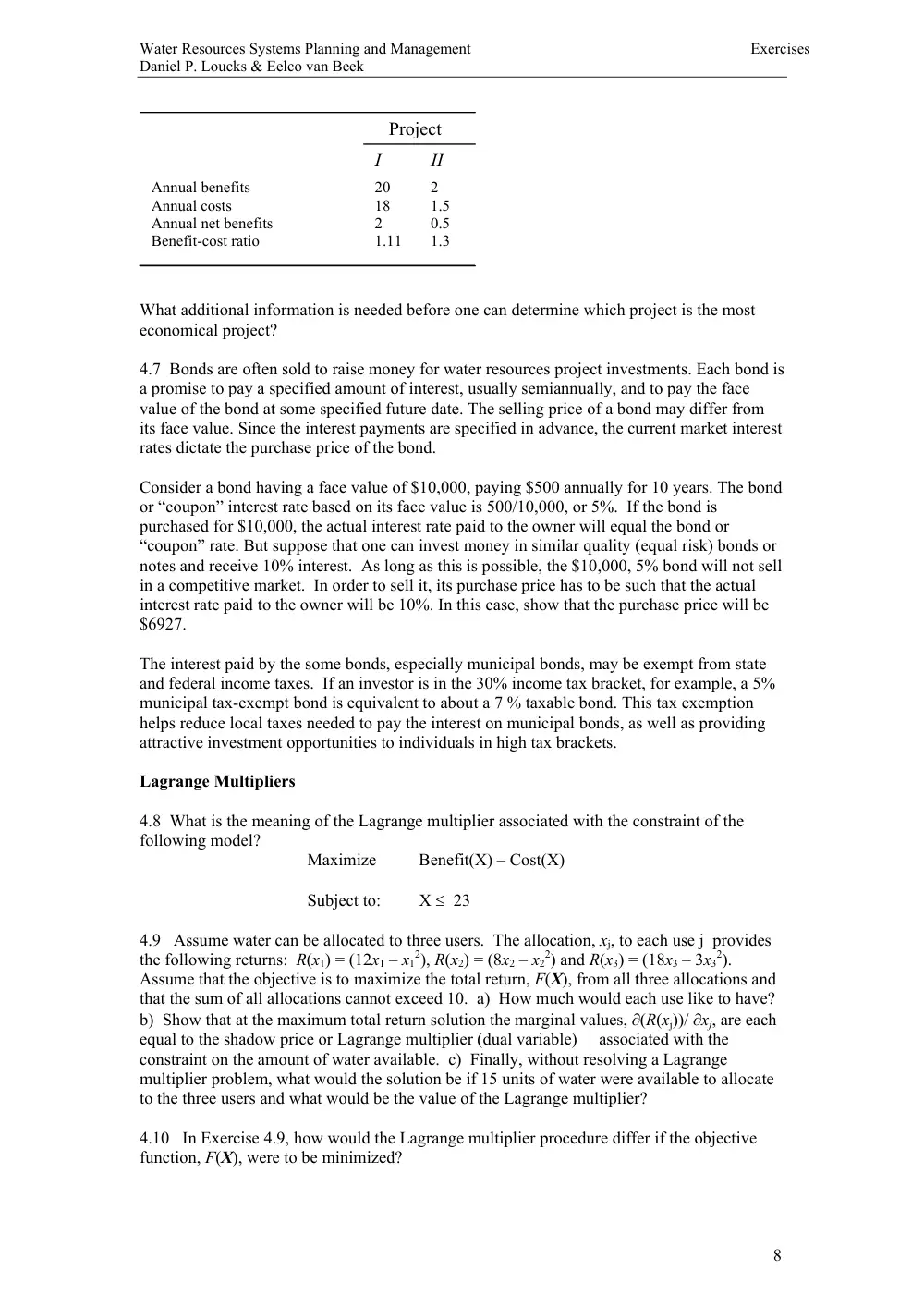
What additional information is needed before one can determine which project is the most
economical project?
4.7 Bonds are often sold to raise money for water resources project investments. Each bond is
a promise to pay a specified amount of interest, usually semiannually, and to pay the face
value of the bond at some specified future date. The selling price of a bond may differ from
its face value. Since the interest payments are specified in advance, the current market interest
rates dictate the purchase price of the bond.
Consider a bond having a face value of $10,000, paying $500 annually for 10 years. The bond
or “coupon” interest rate based on its face value is 500/10,000, or 5%. If the bond is
purchased for $10,000, the actual interest rate paid to the owner will equal the bond or
“coupon” rate. But suppose that one can invest money in similar quality (equal risk) bonds or
notes and receive 10% interest. As long as this is possible, the $10,000, 5% bond will not sell
in a competitive market. In order to sell it, its purchase price has to be such that the actual
interest rate paid to the owner will be 10%. In this case, show that the purchase price will be
$6927.
The interest paid by the some bonds, especially municipal bonds, may be exempt from state
and federal income taxes. If an investor is in the 30% income tax bracket, for example, a 5%
municipal tax-exempt bond is equivalent to about a 7 % taxable bond. This tax exemption
helps reduce local taxes needed to pay the interest on municipal bonds, as well as providing
attractive investment opportunities to individuals in high tax brackets.
Lagrange Multipliers
4.8 What is the meaning of the Lagrange multiplier associated with the constraint of the
following model?
Maximize
Benefit(X) – Cost(X)
Subject to:
X £ 23
4.9 Assume water can be allocated to three users. The allocation, xj, to each use j provides
the following returns: R(x1) = (12x1 – x1
2), R(x2) = (8x2 – x2
2) and R(x3) = (18x3 – 3x3
2).
Assume that the objective is to maximize the total return, F(X), from all three allocations and
that the sum of all allocations cannot exceed 10. a) How much would each use like to have?
b) Show that at the maximum total return solution the marginal values, ¶(R(xj))/ ¶xj, are each
equal to the shadow price or Lagrange multiplier (dual variable)
associated with the
constraint on the amount of water available. c) Finally, without resolving a Lagrange
multiplier problem, what would the solution be if 15 units of water were available to allocate
to the three users and what would be the value of the Lagrange multiplier?
4.10 In Exercise 4.9, how would the Lagrange multiplier procedure differ if the objective
function, F(X), were to be minimized?
Project
I
II
Annual benefits
20
2
Annual costs
18
1.5
Annual net benefits
2
0.5
Benefit-cost ratio
1.11
1.3
Water Resources Systems Planning and Management
Exercises
Daniel P. Loucks & Eelco van Beek
9
4.11 Assume that the objective was to minimize the sum of squared deviations of the actual
allocations xj from some desired or known target allocations Tj. Given a supply of water Q
less than the sum of all target allocations Tj, structure a planning model and its corresponding
Lagrangian. Will a global minimum be obtained from solving the partial differential equations
derived from the Lagrangian? Why?
4.12 Using Lagrange multipliers, prove that the least-cost design of a cylindrical storage tank
of any volume V > 0 has one-third of its cost in its base and top and two-thirds of its cost in its
side, regardless of the cost per unit area of its base or side. (It is these types of rules that end
up in handbooks in engineering design.)
4.13 An industrial firm makes two products, A and B. These products require water and other
resources. Water is the scarce resource-they have plenty of other needed resources. The
products they make are unique, and hence they can set the unit price of each product at any
value they want to. However experience tells them that the higher the unit price for a product,
the less amount of that product they will sell. The relationship between unit price and
quantity that can be sold is given by the following two demand functions.
(a) What are the amounts of A and B, and their unit prices, that maximize the total
revenue obtained?
(b) Suppose the total amount of A and B could not exceed some amount Tmax.
What are the amounts of A and B, and their unit prices, that maximize total
revenue, if
i)
Tmax = 10
ii)
Tmax = 5
Water is needed to make each unit of A and B. The production functions relating the
amount of water XA needed to make A, and the amount of water XB needed to make B
are A = 0.5 XA, and B = 0.25 XB, respectively.
(c) Find the amounts of A and B and their unit prices that maximize total revenue
assuming the total amount of water available is 10 units.
(d) What is the value of the dual variable, or shadow price, associated with the 10
units of available water?
Dynamic programming
4.14 Solve for the optimal integer allocations x1, x2, and x3 for the problem defined by
Exercise 4.9 assuming the total available water is 3 and 4. Also solve for the optimal
allocation policy if the total water available is 7 and each xj must not exceed 4.
Quantity of product A
Quantity of product B
Po
Unit
price
Po
Unit
Price
8 – A
6 – 1.5B
Water Resources Systems Planning and Management
Exercises
Daniel P. Loucks & Eelco van Beek
10
4.15 Consider a three-season reservoir operation problem. The inflows are 10, 50 and 20 in
seasons 1, 2 and 3 respectively. Find the operating policy that minimizes the sum of total
squared deviations from a constant storage target of 20 and a constant release target of 25 in
each of the three seasons. Develop a discrete dynamic programming model that considers
only 4 discrete storage values: 0, 10, 20 and 30. Assume the releases cannot be less than 10
or greater than 40. Show how the model’s recursive equations change depending on whether
the decisions are the releases or the final storage volumes. Verify the optimal operating
policy is the same regardless of whether the decision variables are the releases or the final
storage volumes in each period. Which model do you think is easier to solve? How would
each model change if more importance were given to the desired releases than to the desired
storage volumes?
4.16 Show that the constraint limiting a reservoir release, rt, to be no greater than the initial
storage volume, st, plus inflow, it, is redundant to the continuity equation
st + it – rt = st+1.
4.17 Develop a general recursive equation for a forward-moving dynamic programming
solution procedure for a single reservoir operating problem. Define all variables and functions
used. Why is this not a very useful approach to finding a reservoir operating policy?
4.18 The following table provides estimates for the recent values of the costs of additional
wastewater treatment plant capacity needed at the end of each 5-year period for the next 20
years. Find the capacity expansion schedule that minimizes the present values of the total
future costs. If there is more than one least cost solution, indicate which one you think is
better, and why?
The cost in each period t must be paid at the beginning of the period. What was the discount
factor used to convert the costs at the beginning of each period t to present value costs shown
above. In other words how would a cost at the beginning of period t be discounted to the
beginning of period 1, given an annual interest rate of r? (Only the algebraic expression of the
discount factor is asked, not the numerical value of r.)
4.19 Consider a wastewater treatment plant in which it is possible to include five different
treatment processes in series. These treatment processes must together remove at least 90% of
the 100 units of influent waste. Assuming the Ri is the amount of waste removed by process i,
the following conditions must hold:
20 £ R1 £ 30
0 £ R2 £ 30
0 £ R3 £ 10
0 £ R4 £ 20
0 £ R5 £ 30
DISCOUNTED COST OF
ADDITIONAL CAPACITY:
UNITS OF ADDITIONAL CAPACITY
Period Years
2
4
6
8
10
1
1-5
12
15
18
23
26
2
2
6-10
8
11
13
15
6
3
11-15
6
8
8
4
16-20
4
10
Additional Required
Capacity at
End of Perioda
aThis is the total required capacity that must exist at the end of period.
Water Resources Systems Planning and Management
Exercises
Daniel P. Loucks & Eelco van Beek
11
(a) Write the constrained optimization-planning model for finding the least-cost
combination of the removals Ri that together will remove 90% of the influent
waste. The cost of the various discrete sizes of each unit process i depend upon
the waste entering the process i as well as the amount of waste removed, as
indicated in the table below.
(b) Draw the dynamic programming network and solve this problem by dynamic
programming. Indicate on the network the calculations required to find the least-
cost path from state 100 at stage 1 to state 10 at stage 6 using both forward- and
backward-moving dynamic programming solution procedures.
(c) Could the following conditions be included in the original dynamic programming
model and still be solved without requiring R4 to be 0 in the first case and R3 to
be 0 in the second case?
(i)
R4 = 0 if R3 = 0, or
(ii)
R3 = 0 if R2 £ 20.
4.20 The city of Eutro Falls is under a court order to reduce the amount of phosphorus that
which it discharges in its sewage to Lake Algae. The city presently has three wastewater
treatment plants. Each plant i currently discharges Pt kg/day of phosphorus into the lake.
Some or all plants must reduce their discharges so that the total for the three plants does not
exceed P kg/day.
Let Xt be the percent of the phosphorus by additional treatment at plant i, and the Ci(Xi) the
cost of such treatment ($/year) at each plant i.
a) Structure a planning model to determine the least cost (i.e., a cost effective)
treatment plant for the city.
PROCESS i:
Influent, Removal,
Ii
Ri
100
20
5
100
30
10
1
2
3
4
5
Annual Cost = Ci(Ii, Ri)
80
10
3
3
1
80
20
9
2
80
30
13
70
10
4
5
2
70
20
10
3
70
30
15
60
10
6
2
3
60
20
4
6
60
30
9
50
10
7
3
4
50
20
5
8
50
30
10
40
10
8
5
5
40
20
7
12
40
30
18
30
10
8
8
30
20
10
12
20
10
8
Water Resources Systems Planning and Management
Exercises
Daniel P. Loucks & Eelco van Beek
12
b) Restructure the model for the solution by dynamic programming. Define the
stages, states, decision variables, and the recursive equation for each stage.
c) Now assume P1 = 20; P2 = 15; P3 = 25; and P = 20. Make up some cost data and
check the model if it works.
4.21 Find (draw) a rule curve for operating a single reservoir that maximizes the sum of the
benefits for flood control, recreation, water supply and hydropower. Assume the average
inflows in four seasons of a year are 40, 80 60, 20, and the active reservoir capacity is 100.
For an average storage S and for a release of R in a season, the hydropower benefits are 2
times the square root of the product of S and R, 2(S R)0.5 and the water supply benefits are
3R0.7 in each season. The recreation benefits are 40-(70-S)2 in the third season. The flood
control benefits are 20 – (40 – S)2 in the second season. Specify the dynamic programming
recursion equations you are using to solve the problem.
4.22 How would the model defined in Exercise 4.21 change if there were a water user
upstream of this reservoir and you were to find the best water allocation policy for that user,
assuming known benefits associated with these allocations that are to be included in the
overall maximum benefits objective function?
4.23 Suppose there are four water users along a river who benefit from receiving water. Each
has a water target, i.e., each expects and plans for a specified amount. These known water
targets are W(1), W(2), W(3), and W(4) for the four users respectively. Show how dynamic
programming can be used to find two allocation policies. One is to be based on minimizing
the maximum deficit deviation from any target allocation. The other is to be based on
minimizing the maximum percentage deficit from any target allocation.
4-24 An industrial firm makes two products, A and B. These products require water and
other resources. Water is the scarce resource-they have plenty of other needed resources. The
products they make are unique, and hence they can set the unit price of each product at any
value they want to. However experience tells them that the higher the unit price for a product,
the less amount of that product they will sell. The relationship between unit price and
quantity that can be sold is given by the following two demand functions.
(a) What are the amounts of A and B, and their unit prices, that maximize the total
revenue that can be obtained? (You can use calculus to solve this problem if you
wish.)
(b) Suppose the total amount of A and B could not exceed some amount Tmax.
What are the amounts of A and B, and their unit prices, that maximize total
revenue, if
iii)
Tmax = 10
iv)
Tmax = 5
Quantity of product A
Quantity of product B
Po
Unit
price
Po
Unit
Price
8 – A
6 – 1.5B
Water Resources Systems Planning and Management
Exercises
Daniel P. Loucks & Eelco van Beek
13
Water is needed to make each unit of A and B. The production functions relating the
amount of water XA needed to make A, and the amount of water XB needed to make B
are A = 0.5 XA, and B = 0.25 XB, respectively.
(c) Find the amounts of A and B and their unit prices that maximize total revenue
assuming the total amount of water available is 10 units. Use discrete dynamic
programming, both forward- and backward-moving algorithms. You can assume
integer values of each water allocation X for this exercise. Show your work on a
network. For the backward moving algorithm, also show your work using tables
showing the state, Si, the possible decision variables XA and XB and their values, the
best decision, and the best value, Fi(Si), associated with the best decision.
Gradient “Hill-climbing” methods
4.25
Solve Exercise 4.24(b) using hill-climbing techniques and assuming discrete integer
values and Tmax = 5. For example, which product would you produce if you could make only
1 unit of either A or B? If you could make another unit of A or B, which would you make?
Continue this process up to 5 units of products A and/or B.
Linear and non-linear programming
4.26 Consider the industrial firm that makes two products A and B as described in Exercise
4.24(b). Using Lingo (or any other program you wish):
(a) Find the amounts of A and B and their unit prices that maximize total revenue
assuming the total amount of water available is 10 units.
(b) What is the value of the dual variable, or shadow price, associated with the 10
units of available water?
(c) Suppose the demand functions are not really certain. How sensitive are the
allocations of water to the parameter values in those functions? How sensitive
are the allocations to the parameter values 0.5 and 0.25 in the production
functions?
4.27 Assume that there are m industries or municipalities adjacent to a river, which discharge
their wastes into the river. Denote the discharge sites by the subscript i and let Wi be the kg of
waste discharged into the river each day at those sites i. To improve the quality downstream,
wastewater treatment plants may be required at each site i. Let xi be the fraction of waste
removed by treatment at each site i. Deve