
CMPS 200 Homework Assignment 11, Fall 2011
American University of Beirut · Introduction to Programming · 12 pages






Showing the first 10 of 12 pages. Download the PDF to see all of it.
More CMPS 200 files
- Homework 11 · Fall 2018HomeworkView
- Homework Last Assignment · Fall 2018HomeworkView
- Homework Asst10 · Fall 2017HomeworkView
- Homework 9 · Spring 2017HomeworkView
- Homework Assignment 2 · Fall 2016HomeworkView
- Homework Assignment 5 · Fall 2016HomeworkView
- Homework Assignment 6 · Fall 2016HomeworkView
- Homework 1 · Spring 2016HomeworkView
Show the text of this homework
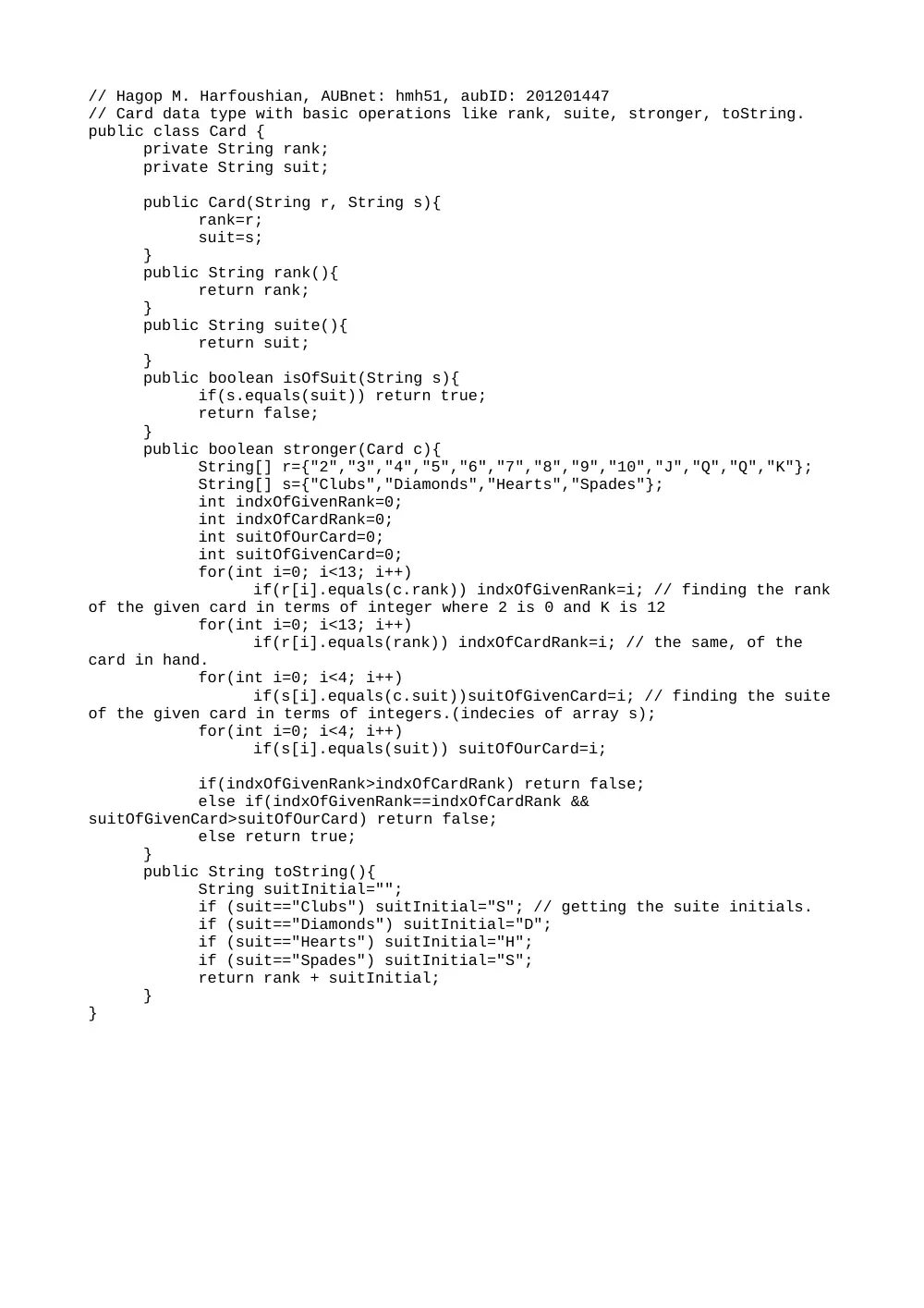
// Hagop M. Harfoushian, AUBnet: hmh51, aubID: 201201447
// Card data type with basic operations like rank, suite, stronger, toString.
public class Card {
private String rank;
private String suit;
public Card(String r, String s){
rank=r;
suit=s;
}
public String rank(){
return rank;
}
public String suite(){
return suit;
}
public boolean isOfSuit(String s){
if(s.equals(suit)) return true;
return false;
}
public boolean stronger(Card c){
String[] r={"2","3","4","5","6","7","8","9","10","J","Q","Q","K"};
String[] s={"Clubs","Diamonds","Hearts","Spades"};
int indxOfGivenRank=0;
int indxOfCardRank=0;
int suitOfOurCard=0;
int suitOfGivenCard=0;
for(int i=0; i<13; i++)
if(r[i].equals(c.rank)) indxOfGivenRank=i; // finding the rank
of the given card in terms of integer where 2 is 0 and K is 12
for(int i=0; i<13; i++)
if(r[i].equals(rank)) indxOfCardRank=i; // the same, of the
card in hand.
for(int i=0; i<4; i++)
if(s[i].equals(c.suit))suitOfGivenCard=i; // finding the suite
of the given card in terms of integers.(indecies of array s);
for(int i=0; i<4; i++)
if(s[i].equals(suit)) suitOfOurCard=i;
if(indxOfGivenRank>indxOfCardRank) return false;
else if(indxOfGivenRank==indxOfCardRank &&
suitOfGivenCard>suitOfOurCard) return false;
else return true;
}
public String toString(){
String suitInitial="";
if (suit=="Clubs") suitInitial="S"; // getting the suite initials.
if (suit=="Diamonds") suitInitial="D";
if (suit=="Hearts") suitInitial="H";
if (suit=="Spades") suitInitial="S";
return rank + suitInitial;
}
}
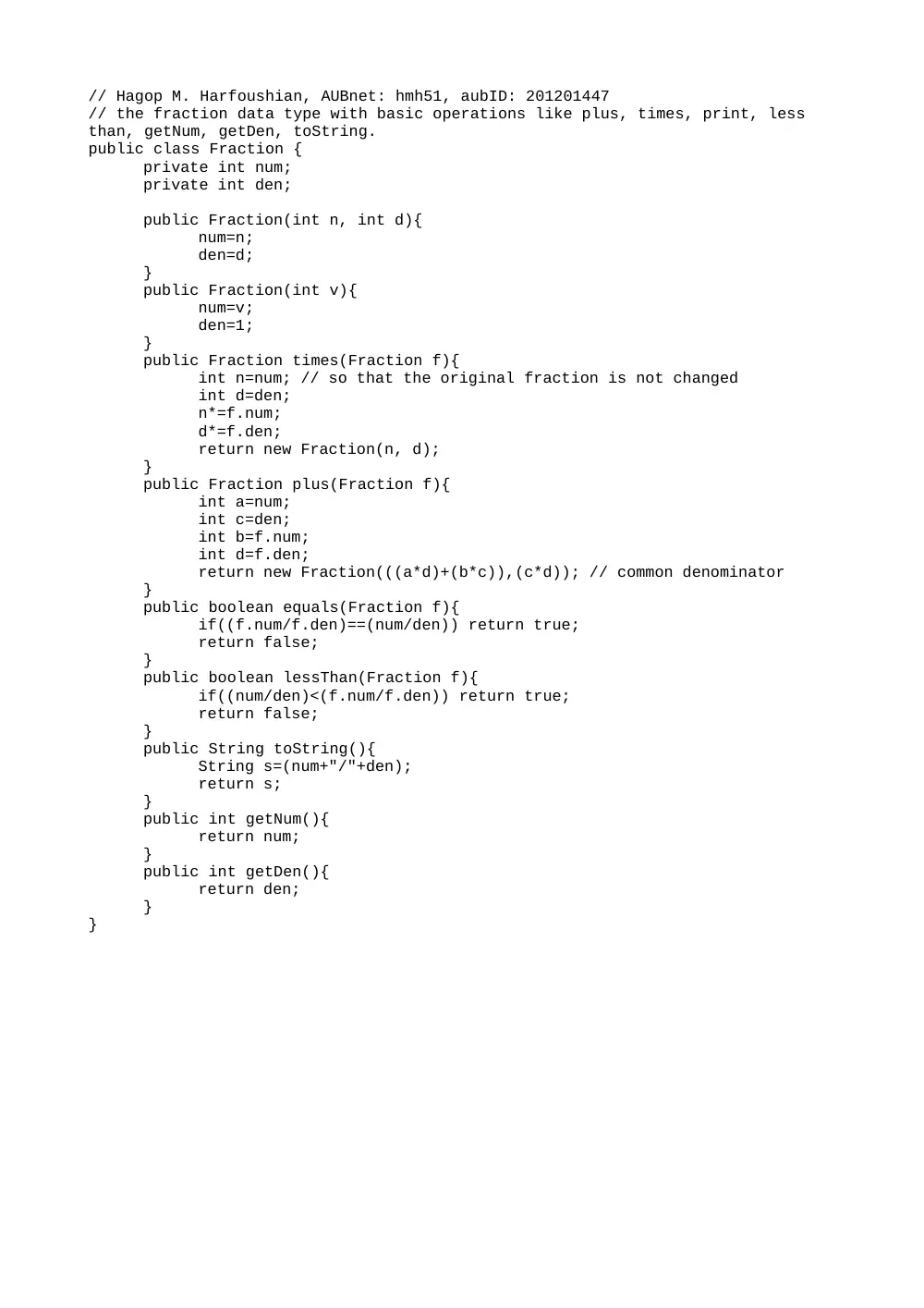
// Hagop M. Harfoushian, AUBnet: hmh51, aubID: 201201447
// the fraction data type with basic operations like plus, times, print, less
than, getNum, getDen, toString.
public class Fraction {
private int num;
private int den;
public Fraction(int n, int d){
num=n;
den=d;
}
public Fraction(int v){
num=v;
den=1;
}
public Fraction times(Fraction f){
int n=num; // so that the original fraction is not changed
int d=den;
n*=f.num;
d*=f.den;
return new Fraction(n, d);
}
public Fraction plus(Fraction f){
int a=num;
int c=den;
int b=f.num;
int d=f.den;
return new Fraction(((a*d)+(b*c)),(c*d)); // common denominator
}
public boolean equals(Fraction f){
if((f.num/f.den)==(num/den)) return true;
return false;
}
public boolean lessThan(Fraction f){
if((num/den)<(f.num/f.den)) return true;
return false;
}
public String toString(){
String s=(num+"/"+den);
return s;
}
public int getNum(){
return num;
}
public int getDen(){
return den;
}
}
public class Point {
private double x;
private double y;
public Point(double x0,double y0){
x=x0;
y=y0;
}
public double getX(){
return x;
}
public double getY(){
return y;
}
public String toString(){
return "("+ x + ", "+ y + ")";
}
}
// Hagop M. Harfoushian, AUBnet: hmh51, aubID: 201201447
// This is the rectangle data Type whose API and description is in the book.
// a rectangle is defined as a given point, and two "vectors" drawn perp. from
it, called hight and width.
public class Rectangle {
private int x;
private int y;
private int width;
private int height;
private Point p;
public Rectangle(int initialX, int initialY, int initialWidth, int
initialHeight){
x = initialX;
y = initialY;
width = initialWidth;
height = initialHeight;
if(height <= 0 || width <= 0) System.out.println("Error");
}
public int getHeight(){
return height;
}
public int getWidth(){
return width;
}
public int getX(){
return x;
}
public int getY(){
return y;
}
public String toString(){
String s = "Rectangle[x="+x+", y="+y+", width=" + width +",
height="+height+"]";
return s;
}
public Rectangle(Point p2, int initialWidth, int initialHeight){
x = (int)p2.getX();
y = (int)p2.getY();
width=initialWidth;
height= initialHeight;
p=p2;
}
public Point getPoint(){
Point p2 = new Point(p.getX(),p.getY());
return p2;
}
public boolean contains(int initialX, int initialY){
if(initialX<=x && initialY<=y)
return true;
else
return false;
}
public boolean contains(Point p){
int a = (int)p.getX();
int b = (int)p.getY();
if(a>=x && b>=y && a<=x+width && b<=y+height)return true;
else return false;
}
public Rectangle union(Rectangle r)
{
int x2 = r.getX();
int y2 = r.getY();
int w2 = r.getWidth();
int h2 = r.getHeight();
int union_X = Math.min(x,x2); // the upper most left point (taking
the origin in the buttom left)
int union_Y = Math.min(y, y2);
int union_W = Math.max(width+x, w2+x2)-union_X; // max width from
the 1st rectangle to the second.
int union_H = Math.max(height+y,h2+y2)-union_Y;// max height from
the 1st rectangle to the second.
Rectangle union = new Rectangle (union_X,union_Y,union_W,union_H);
return union;
}
public Rectangle intersection(Rectangle rect)
{
int w2 = rect.getWidth();
int x2 = rect.getX();
int h2 = rect.getHeight();
int y2 = rect.getY();
int inter_X = Math.max(x,x2);// x intersection
int inter_Y = Math.max(y,y2);// y intersection
int inter_Width = Math.min(width+x, w2+x2)-inter_X;// min width from
the 1st rectangle to the second.
int inter_Height = Math.min(height+y, h2+y2)-inter_Y;// min height
from the 1st rectangle to the second.
Rectangle intersection = new Rectangle
(inter_X,inter_Y,inter_Width,inter_Height);
return intersection;
}
}
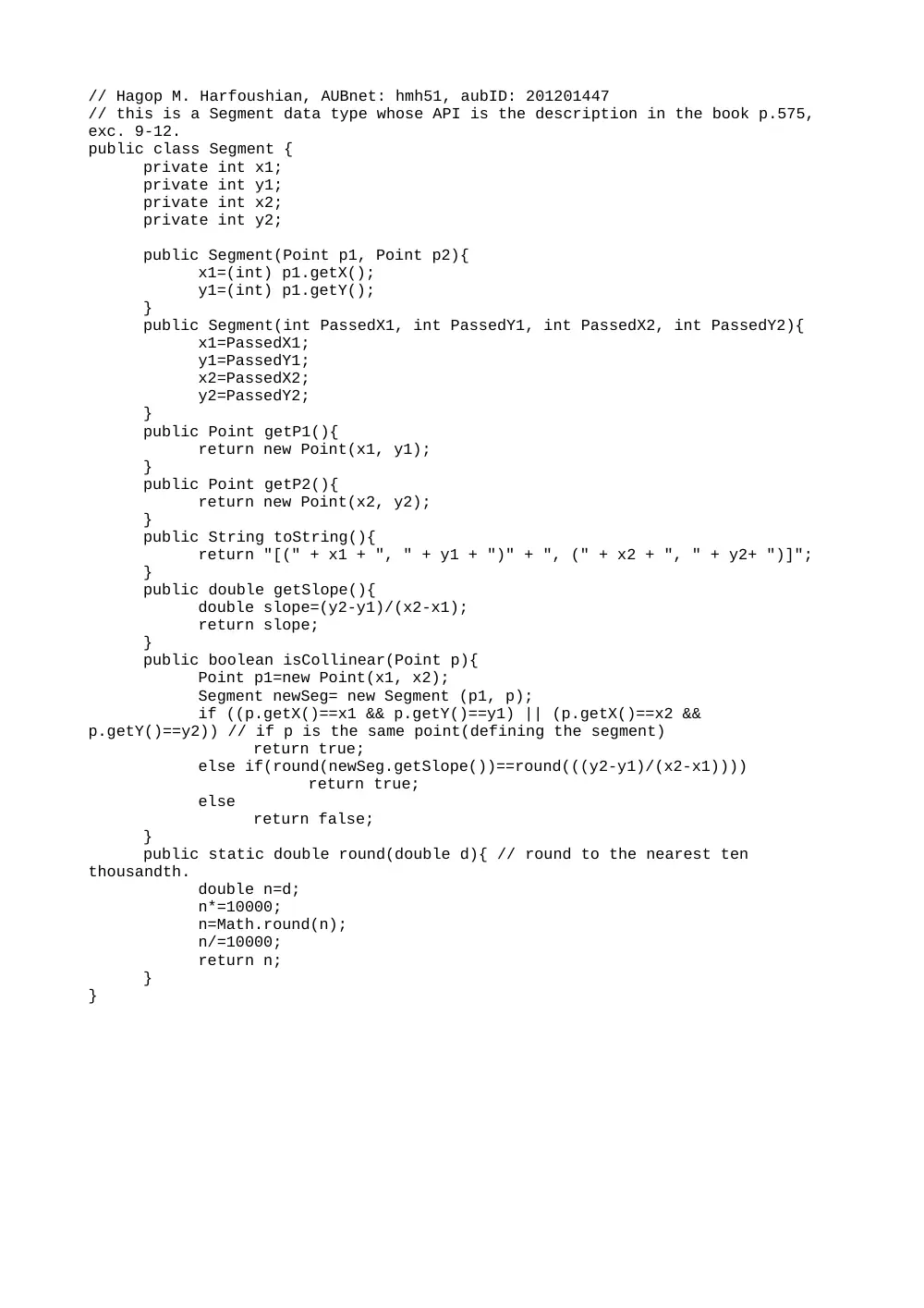
// Hagop M. Harfoushian, AUBnet: hmh51, aubID: 201201447
// this is a Segment data type whose API is the description in the book p.575,
exc. 9-12.
public class Segment {
private int x1;
private int y1;
private int x2;
private int y2;
public Segment(Point p1, Point p2){
x1=(int) p1.getX();
y1=(int) p1.getY();
}
public Segment(int PassedX1, int PassedY1, int PassedX2, int PassedY2){
x1=PassedX1;
y1=PassedY1;
x2=PassedX2;
y2=PassedY2;
}
public Point getP1(){
return new Point(x1, y1);
}
public Point getP2(){
return new Point(x2, y2);
}
public String toString(){
return "[(" + x1 + ", " + y1 + ")" + ", (" + x2 + ", " + y2+ ")]";
}
public double getSlope(){
double slope=(y2-y1)/(x2-x1);
return slope;
}
public boolean isCollinear(Point p){
Point p1=new Point(x1, x2);
Segment newSeg= new Segment (p1, p);
if ((p.getX()==x1 && p.getY()==y1) || (p.getX()==x2 &&
p.getY()==y2)) // if p is the same point(defining the segment)
return true;
else if(round(newSeg.getSlope())==round(((y2-y1)/(x2-x1))))
return true;
else
return false;
}
public static double round(double d){ // round to the nearest ten
thousandth.
double n=d;
n*=10000;
n=Math.round(n);
n/=10000;
return n;
}
}
public class TestCards {
public static void main(String[] args) {
Card c1 = new Card("10", "Hearts");
Card c2 = new Card("Q", "Spades");
System.out.println(c1);
System.out.println(c2);
System.out.println(c1.isOfSuit("Hearts")); // should print
true
System.out.println(c2.isOfSuit("Hearts")); // should print
false
System.out.println(c1.stronger(c2)); // should print
false
}
}
public class TestFraction {
public static void main(String[] args) {
Fraction x = new Fraction(1, 2);
Fraction y = new Fraction(1, 4);
Fraction z = x.times(y);
Fraction w = x.plus(y);
System.out.println(x + " * " + y + " = " + z);
System.out.println(x + " + " + y + " = " + w);
}
}
public class TestRectangle {
public static void main(String[] args){
Rectangle r=new Rectangle(2,5,20,10);
System.out.println(r.getHeight());
System.out.println(r.getWidth());
System.out.println(r.intersection(new Rectangle(2,5,3,4)));
System.out.println(r.union(new Rectangle(5,4,3,2)));
}
}
public class TestSegment {
public static void main(String[] args){
Point p=new Point(22,2);
Segment s=new Segment(2,4,3,6);
System.out.println(s);
System.out.println(s.getP1());
System.out.println(s.isCollinear(p));
System.out.println(s.getSlope());
}
}
Segment:
public static void main(String[] args){
Point p=new Point(22,2);
Segment s=new Segment(2,4,3,6);
System.out.println(s);
System.out.println(s.getP1());
System.out.println(s.isCollinear(p));
System.out.println(s.getSlope());
}
=======================
[(2, 4), (3, 6)]
(2.0, 4.0)
false
2.0
Fraction:
public static void main(String[] args) {
Fraction x = new Fraction(1, 2);
Fraction y = new Fraction(1, 4);
Fraction z = x.times(y);
Fraction w = x.plus(y);
System.out.println(x + " * " + y + " = " + z);
System.out.println(x + " + " + y + " = " + w);
}
===================
1/2 * 1/4 = 1/8
1/2 + 1/4 = 6/8
Cards:
public static void main(String[] args) {
Card c1 = new Card("10", "Hearts");
Card c2 = new Card("Q", "Spades");
System.out.println(c1);
System.out.println(c2);
System.out.println(c1.isOfSuit("Hearts")); // should print
true
System.out.println(c2.isOfSuit("Hearts")); // should print
false
System.out.println(c1.stronger(c2)); // should print
false
}
=========================
10H
QS
true
false
false
Rectangle:
public static void main(String[] args){
Rectangle r=new Rectangle(2,5,20,10);
System.out.println(r.getHeight());
System.out.println(r.getWidth());
System.out.println(r.intersection(new Rectangle(2,5,3,4)));
System.out.println(r.union(new Rectangle(5,4,3,2)));
}
========================
10
20
Rectangle[x=2, y=5, width=3, height=4]
Rectangle[x=2, y=4, width=20, height=11]