
CMPS 200 Homework Assignment 11, Fall 2012
American University of Beirut · Introduction to Programming · 2 pages
More CMPS 200 files
- Homework 11 · Fall 2018HomeworkView
- Homework Last Assignment · Fall 2018HomeworkView
- Homework Asst10 · Fall 2017HomeworkView
- Homework 9 · Spring 2017HomeworkView
- Homework Assignment 2 · Fall 2016HomeworkView
- Homework Assignment 5 · Fall 2016HomeworkView
- Homework Assignment 6 · Fall 2016HomeworkView
- Homework 1 · Spring 2016HomeworkView
Show the text of this homework
Faculty of Arts & Sciences
Department of Computer Science
CMPS 200—Introduction to Programming
Assignment 11 – Due Monday Dec 10, 2012
Notes and Announcements
Reading material:
Chapter 8 of the text
In addition, p. 286-290 show an example describing the use of the throw construct for raising
exceptions. P. 184, 287, 351, and 463 show examples of Exceptions thrown in various contexts.
Exercises
1. Line Segment Data Type
Exercises 9-12 on page 575 of your textbook describe the API of a data type that represents line segments
in the plane Implement the data type as a Java class, and write a client program to test your
implementation. Note: You will be graded on the client test program you write, and not just on your
implementation of the Line data type.
2. Rectangle Data Type
Exercises 13-17 on page 576 of your textbook describe the API of a data type that represents rectangles.
Implement the data type as a Java class, and write a client program to test your implementation. Note: You
will be graded on the client test program you write, and not just on your implementation of the
Rectangle data type.
3. Card Data Type
A card from a standard 52-card deck of playing cards has two elements:
a rank ("2", "3", "4", "5", "6", "7", "8", "9", "10", "J", "Q", "K", "A"); and
a suit ("Clubs", "Diamonds", "Hearts", "Spades")
Write a class Card that implements the methods whose signatures are shown below. The class should
have 2 private data members: rank and suit (both of type String).
public Card (String r, String s) // constructor
public String rank()
public String suit()
public boolean isOfSuit(String s) // checks if card is of given suit
public boolean stronger(Card c) // true if card is stronger than c
public String toString() // returns a printed representation
// in the form "8S", "10D", "KC",...
A card is stronger than another if its rank is higher. In case of equal rank, the suit determines the relative
strength: Spades beat Hearts which beat Diamonds which beat Clubs.
Your code should be in a file Card.java. The file should also include a main() method to test the methods
of the Card class. Use the main() below and augment it with a few additional tests.
public static void main(String[] args) {
Card c1 = new Card("10", "Hearts");
Card c2 = new Card("Q", "Spades");
System.out.println(c1);
System.out.println(c2);
System.out.println(c1.isOfSuit("Hearts")); // should print true
System.out.println(c2.isOfSuit("Hearts")); // should print false
System.out.ptintln(c1.stronger(c2)); // should print false
}
Introduction to Computer Programming (CMPS 200)
Fall 2012
2 of 2
4. Fraction (Revisited)
The data type Fraction you wrote in the previous assignment had a deficiency in that it returned
fractions that were not simplified (e.g., 24/48, 128/32, etc.). Fix this problem by writing a private instance
method simplify() that gets called as needed. Hint: the simplify() method will call another private
method gcd() that computes the greatest common divisor.
You can find the greatest common divisor (gcd) of two integers x and y using Euclid's algorithm, which is an
iterative computation based on the following observation: If x > y, then if y divides x, the gcd of x and y is y;
otherwise the gcd of x and y is the same as the gcd of y and x % y.
Test your enhanced implementation of the Fraction data type. Create test data to test all the methods
of the class. Write a client program that reads a set of fractions (pairs of integers) from standard input and
computes their cumulative sum and product.
5. Turtle
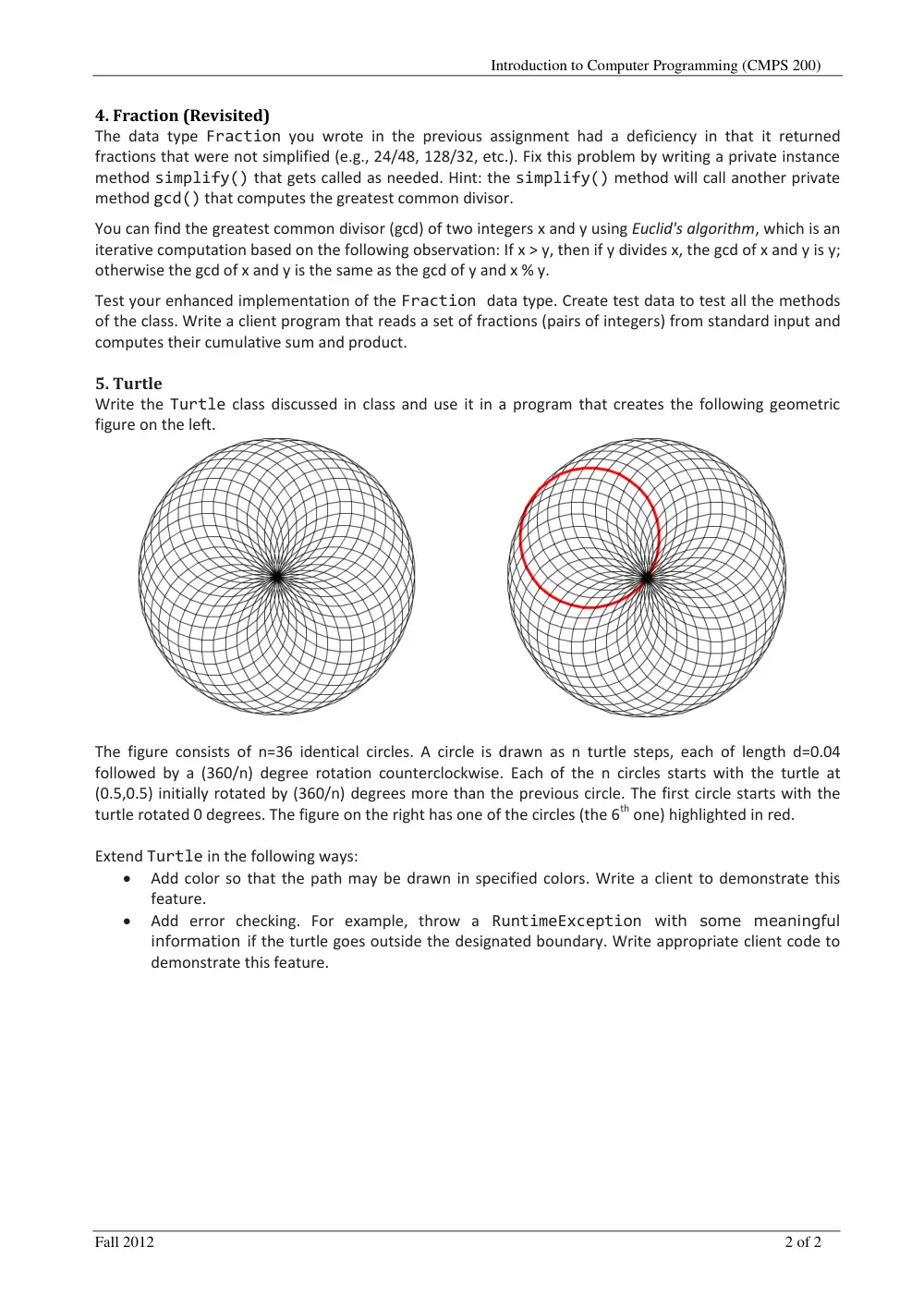
Write the Turtle class discussed in class and use it in a program that creates the following geometric
figure on the left.
The figure consists of n=36 identical circles. A circle is drawn as n turtle steps, each of length d=0.04
followed by a (360/n) degree rotation counterclockwise. Each of the n circles starts with the turtle at
(0.5,0.5) initially rotated by (360/n) degrees more than the previous circle. The first circle starts with the
turtle rotated 0 degrees. The figure on the right has one of the circles (the 6th one) highlighted in red.
Extend Turtle in the following ways:
Add color so that the path may be drawn in specified colors. Write a client to demonstrate this
feature.
Add error checking. For example, throw a RuntimeException with some meaningful
information if the turtle goes outside the designated boundary. Write appropriate client code to
demonstrate this feature.