
CMPS 200 Homework Assignment 12, Fall 2012
American University of Beirut · Introduction to Programming · 2 pages
More CMPS 200 files
- Homework 11 · Fall 2018HomeworkView
- Homework Last Assignment · Fall 2018HomeworkView
- Homework Asst10 · Fall 2017HomeworkView
- Homework 9 · Spring 2017HomeworkView
- Homework Assignment 2 · Fall 2016HomeworkView
- Homework Assignment 5 · Fall 2016HomeworkView
- Homework Assignment 6 · Fall 2016HomeworkView
- Homework 1 · Spring 2016HomeworkView
Show the text of this homework
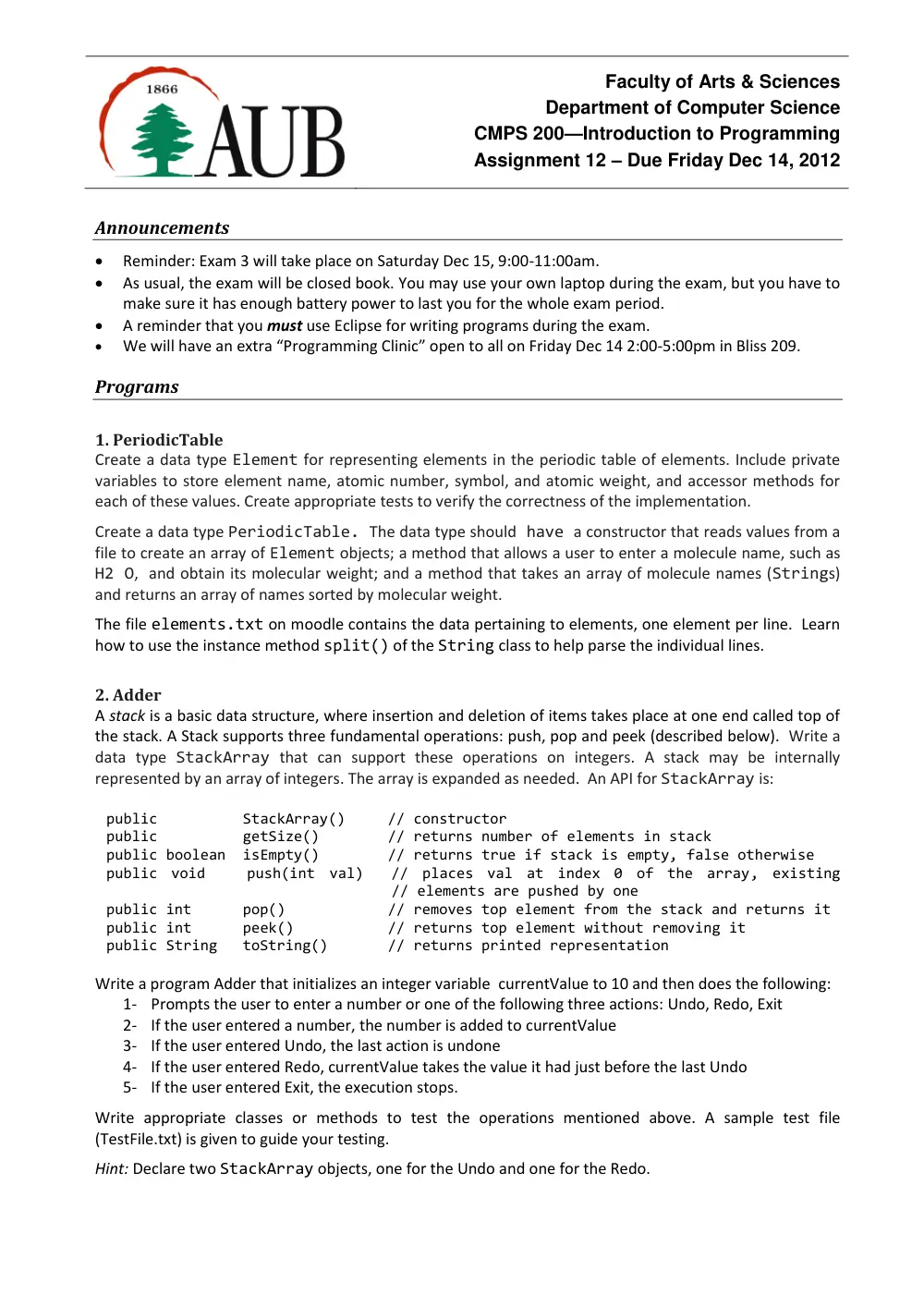
Faculty of Arts & Sciences
Department of Computer Science
CMPS 200—Introduction to Programming
Assignment 12 – Due Friday Dec 14, 2012
Announcements
Reminder: Exam 3 will take place on Saturday Dec 15, 9:00-11:00am.
As usual, the exam will be closed book. You may use your own laptop during the exam, but you have to
make sure it has enough battery power to last you for the whole exam period.
A reminder that you must use Eclipse for writing programs during the exam.
We will have an extra “Programming Clinic” open to all on Friday Dec 14 2:00-5:00pm in Bliss 209.
Programs
1. PeriodicTable
Create a data type Element for representing elements in the periodic table of elements. Include private
variables to store element name, atomic number, symbol, and atomic weight, and accessor methods for
each of these values. Create appropriate tests to verify the correctness of the implementation.
Create a data type PeriodicTable. The data type should have a constructor that reads values from a
file to create an array of Element objects; a method that allows a user to enter a molecule name, such as
H2 O, and obtain its molecular weight; and a method that takes an array of molecule names (Strings)
and returns an array of names sorted by molecular weight.
The file elements.txt on moodle contains the data pertaining to elements, one element per line. Learn
how to use the instance method split() of the String class to help parse the individual lines.
2. Adder
A stack is a basic data structure, where insertion and deletion of items takes place at one end called top of
the stack. A Stack supports three fundamental operations: push, pop and peek (described below). Write a
data type StackArray that can support these operations on integers. A stack may be internally
represented by an array of integers. The array is expanded as needed. An API for StackArray is:
public StackArray() // constructor
public getSize() // returns number of elements in stack
public boolean isEmpty() // returns true if stack is empty, false otherwise
public void push(int val) // places val at index 0 of the array, existing
// elements are pushed by one
public int pop() // removes top element from the stack and returns it
public int peek() // returns top element without removing it
public String toString() // returns printed representation
Write a program Adder that initializes an integer variable currentValue to 10 and then does the following:
1- Prompts the user to enter a number or one of the following three actions: Undo, Redo, Exit
2- If the user entered a number, the number is added to currentValue
3- If the user entered Undo, the last action is undone
4- If the user entered Redo, currentValue takes the value it had just before the last Undo
5- If the user entered Exit, the execution stops.
Write appropriate classes or methods to test the operations mentioned above. A sample test file
(TestFile.txt) is given to guide your testing.
Hint: Declare two StackArray objects, one for the Undo and one for the Redo.
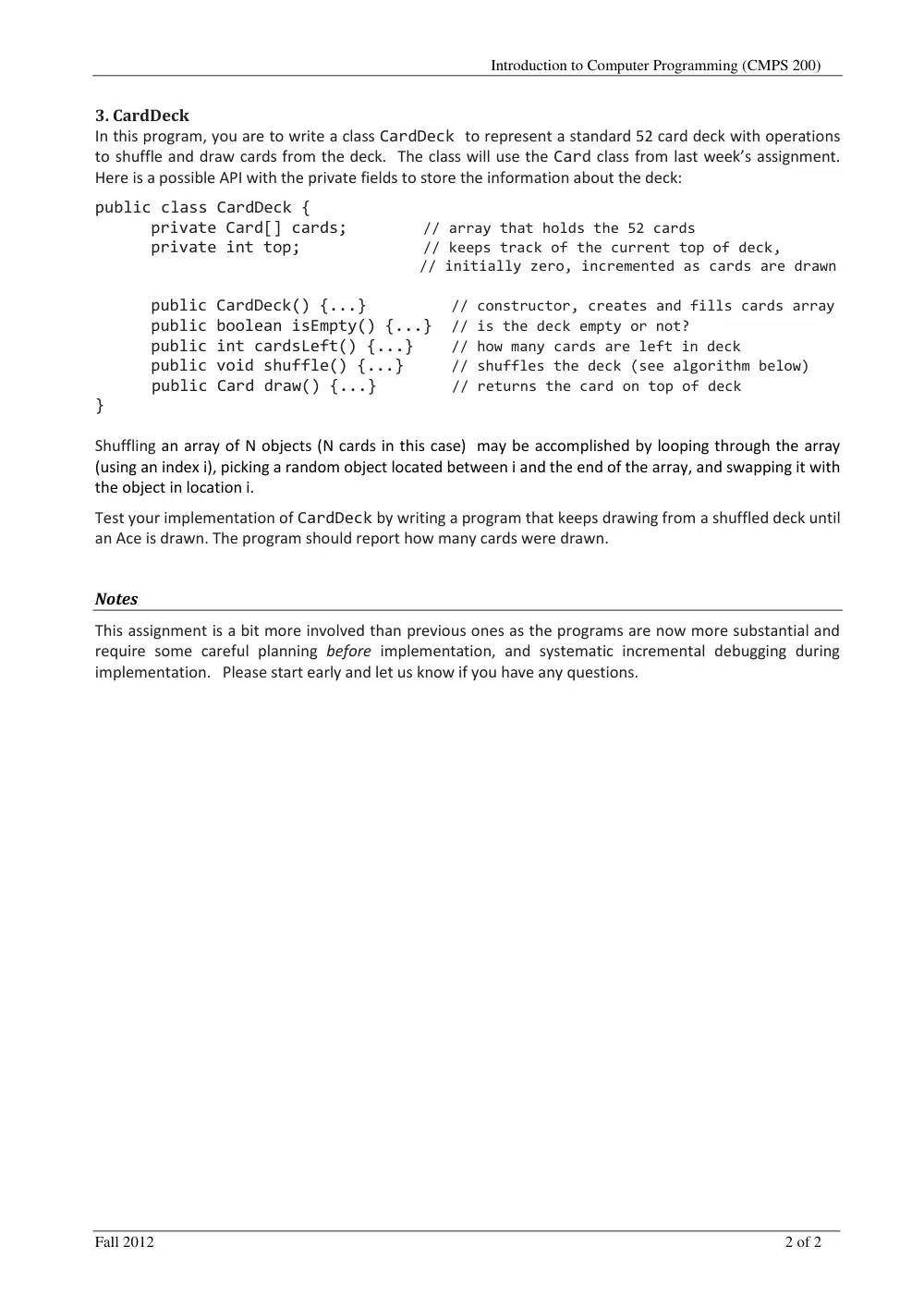
Introduction to Computer Programming (CMPS 200)
Fall 2012
2 of 2
3. CardDeck
In this program, you are to write a class CardDeck to represent a standard 52 card deck with operations
to shuffle and draw cards from the deck. The class will use the Card class from last week’s assignment.
Here is a possible API with the private fields to store the information about the deck:
public class CardDeck {
private Card[] cards; // array that holds the 52 cards
private int top; // keeps track of the current top of deck,
// initially zero, incremented as cards are drawn
public CardDeck() {...} // constructor, creates and fills cards array
public boolean isEmpty() {...} // is the deck empty or not?
public int cardsLeft() {...} // how many cards are left in deck
public void shuffle() {...} // shuffles the deck (see algorithm below)
public Card draw() {...} // returns the card on top of deck
}
Shuffling an array of N objects (N cards in this case) may be accomplished by looping through the array
(using an index i), picking a random object located between i and the end of the array, and swapping it with
the object in location i.
Test your implementation of CardDeck by writing a program that keeps drawing from a shuffled deck until
an Ace is drawn. The program should report how many cards were drawn.
Notes
This assignment is a bit more involved than previous ones as the programs are now more substantial and
require some careful planning before implementation, and systematic incremental debugging during
implementation. Please start early and let us know if you have any questions.