
CMPS 200 Homework Assignment 13, Fall 2012
American University of Beirut · Introduction to Programming · 4 pages

More CMPS 200 files
- Homework 11 · Fall 2018HomeworkView
- Homework Last Assignment · Fall 2018HomeworkView
- Homework Asst10 · Fall 2017HomeworkView
- Homework 9 · Spring 2017HomeworkView
- Homework Assignment 2 · Fall 2016HomeworkView
- Homework Assignment 5 · Fall 2016HomeworkView
- Homework Assignment 6 · Fall 2016HomeworkView
- Homework 1 · Spring 2016HomeworkView
Show the text of this homework
Faculty of Arts & Sciences
Department of Computer Science
CMPS 200—Introduction to Programming
Assignment 13 – Due Friday Jan 4, 2013
Reading
Material
Chapter
6.
The
chapter
covers
the
built-‐in
Java
I/O
datatypes
including
the
File,
Scanner,
and
PrintStream
datatypes.
In
this
assignment,
all
I/O
must
be
done
with
the
standard
Java
I/O
APIs
i.e.
File,
Scanner
and
PrintStream.
You
may
not
use
the
In/Out
classes
we
used
in
previous
assignments.
Exercises
1.
Courses.
The
goal
of
this
simple
exercise
is
to
illustrate
how
to
handle
data
types
whose
instance
variables
are
of
object
type.
The
Course
data
type
below
whose
variables
include
TextBook
and
Instructor.
Write
the
classes
and
answer
the
question
below
with
an
appropriate
diagram.
public
class
TextBook
private
String
title,
author,
publisher;
//
instance
variables
public
TextBook(String
titl,
String
auth,
String
pub)
//
basic
constructor
public
TextBook(TextBook
t)
//
copy
constructor
public
void
set(String
title,
String
author,
String
publisher)
//
mutator
method
public
String
toString()
//
string
representation
of
textbook
public
class
Instructor
private
String
lastname,
firstname,
office;
public
Instructor(String
lname,
String
fname,
String
office)
//
basic
constructor
public
Instructor(Instructor
inst)
//
copy
constructor
public
void
set(String
lname,
String
fname,
String
office)
public
String
toString()
//
string
representation
of
textbook
public
class
Course
private
String
title;
private
Instructor
instr;
private
TextBook
text;
public
Course(String
name,
Instructor
ins,
TextBook
txt)
//
basic
constructor
public
String
getName()
//
accessor
method
public
Instructor
getInstructor()
//
accessor
method
public
TextBook
getTextBook()
//
accessor
method
public
String
toString()
//
string
representation
of
course
public
class
CourseTest
{
public
static
void
main(String[]
args)
{
//
Create
Instructor
objects
Instructor
instructor1
=
new
Instructor("Turkiyyah",
"George",
"Bliss
116");
Instructor
instructor2
=
new
Instructor("Jaber",
"Mohamad",
"Bliss
309");
//
Create
TextBook
objects
TextBook
text1
=
new
TextBook("Building
Java
Programs",
"Stepp",
"Pearson");
//
Create
Course
objects
Course
course1
=
new
Course("CMPS
200",
instructor1,
text1);
Course
course2
=
new
Course("CMPS
200",
instructor2,
text1);
//
Display
the
courses
information.
System.out.println(course1);
System.out.println(course2);
}
Question:
Explain
what
problems
might
occur
if
the
constructor
of
the
Course
class
does
not
call
the
copy
constructors
for
its
instructor
and
textbook
instance
variables.
Draw
appropriate
diagrams.
Introduction to Computer Programming (CMPS 200)
Fall 2012
2 of 4
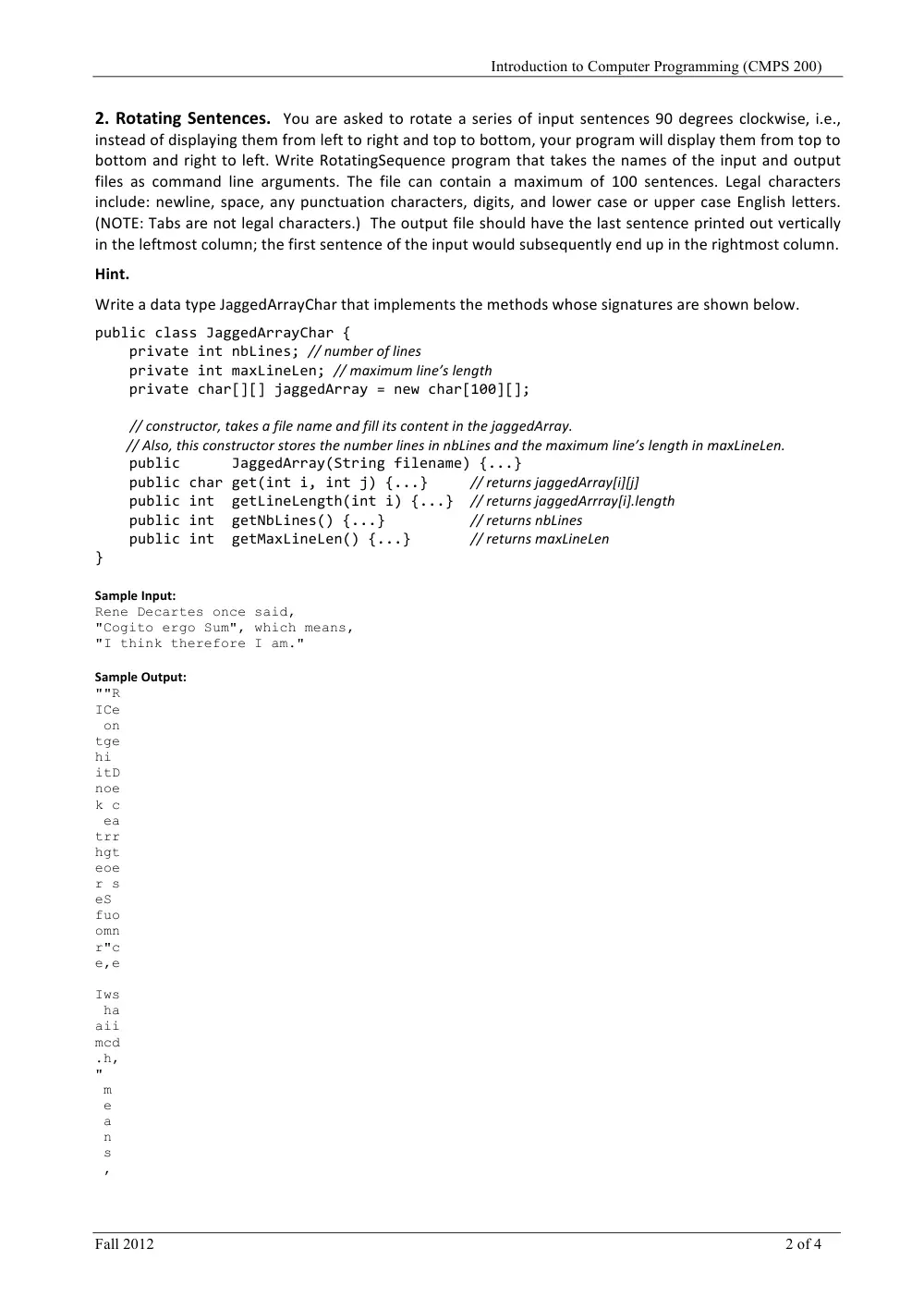
2.
Rotating
Sentences.
You
are
asked
to
rotate
a
series
of
input
sentences
90
degrees
clockwise,
i.e.,
instead
of
displaying
them
from
left
to
right
and
top
to
bottom,
your
program
will
display
them
from
top
to
bottom
and
right
to
left.
Write
RotatingSequence
program
that
takes
the
names
of
the
input
and
output
files
as
command
line
arguments.
The
file
can
contain
a
maximum
of
100
sentences.
Legal
characters
include:
newline,
space,
any
punctuation
characters,
digits,
and
lower
case
or
upper
case
English
letters.
(NOTE:
Tabs
are
not
legal
characters.)
The
output
file
should
have
the
last
sentence
printed
out
vertically
in
the
leftmost
column;
the
first
sentence
of
the
input
would
subsequently
end
up
in
the
rightmost
column.
Hint.
Write
a
data
type
JaggedArrayChar
that
implements
the
methods
whose
signatures
are
shown
below.
public
class
JaggedArrayChar
{
private
int
nbLines;
//
number
of
lines
private
int
maxLineLen;
//
maximum
line’s
length
private
char[][]
jaggedArray
=
new
char[100][];
//
constructor,
takes
a
file
name
and
fill
its
content
in
the
jaggedArray.
//
Also,
this
constructor
stores
the
number
lines
in
nbLines
and
the
maximum
line’s
length
in
maxLineLen.
public
JaggedArray(String
filename)
{...}
public
char
get(int
i,
int
j)
{...}
//
returns
jaggedArray[i][j]
public
int
getLineLength(int
i)
{...}
//
returns
jaggedArrray[i].length
public
int
getNbLines()
{...}
//
returns
nbLines
public
int
getMaxLineLen()
{...}
//
returns
maxLineLen
}
Sample
Input:
Rene Decartes once said,
"Cogito ergo Sum", which means,
"I think therefore I am."
Sample
Output:
""R
ICe
on
tge
hi
itD
noe
k c
ea
trr
hgt
eoe
r s
eS
fuo
omn
r"c
e,e
Iws
ha
aii
mcd
.h,
"
m
e
a
n
s
,
Introduction to Computer Programming (CMPS 200)
Fall 2012
3 of 4
3.
Dice
In
this
problem,
you
are
going
to
perform
some
experiments
that
result
from
rolling
two
six-‐sided
dice.
You
will
start
by
creating
two
classes
Die
and
DicePair
that
will
be
used
to
answer
follow-‐up
questions.
Die
and
DicePair
are
given
as
follows:
public
class
Die
{
public
Die()
//
basic
constructor
public
Die(int
face,
int
n)
//
Constructs
a
die
where
a
given
face
is
“loaded,
i.e.,
//
is
n
times
more
likely
to
occur
than
the
others
public
int
roll()
//
returns
a
random
integer
between
1
and
6
}
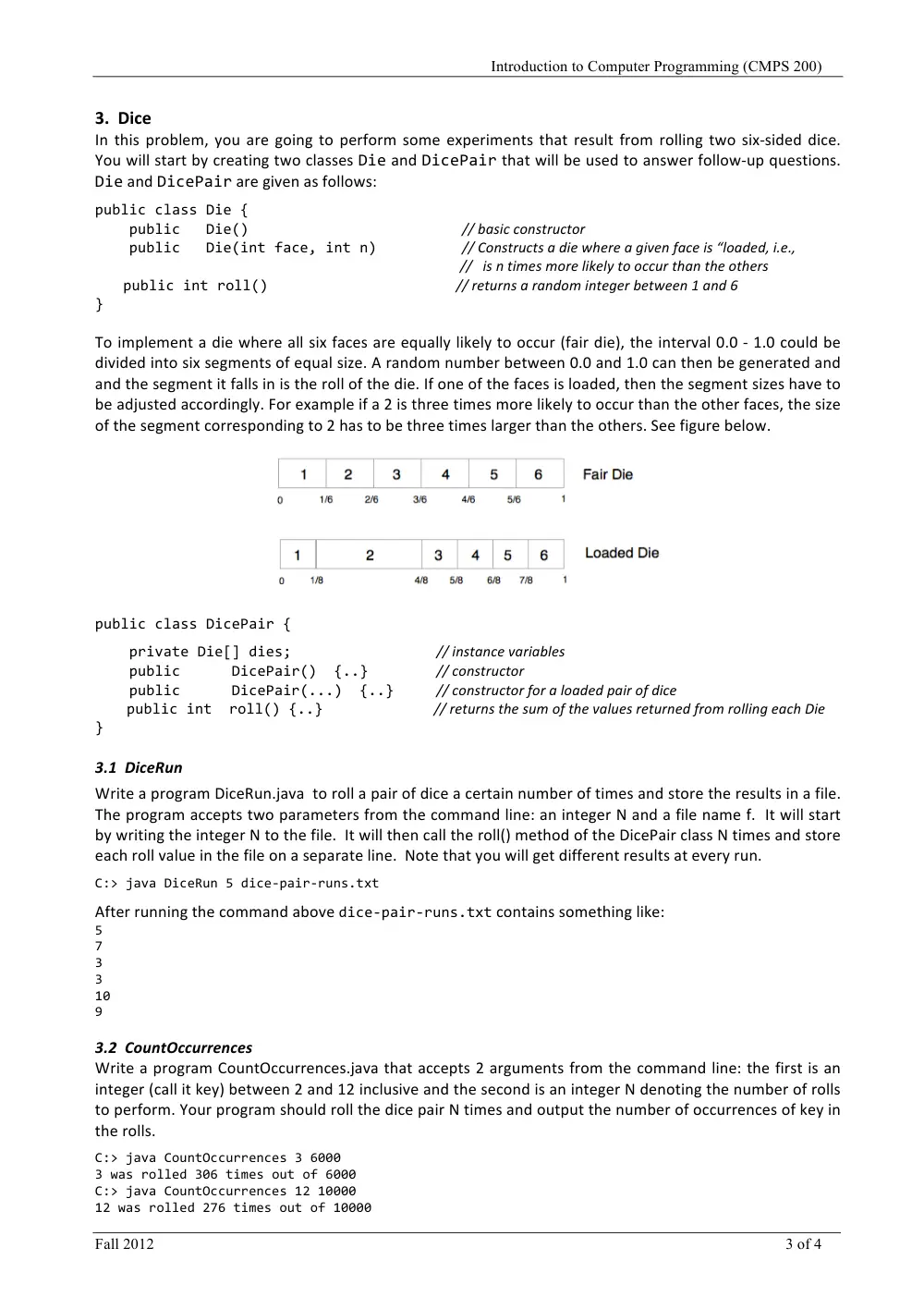
To
implement
a
die
where
all
six
faces
are
equally
likely
to
occur
(fair
die),
the
interval
0.0
-‐
1.0
could
be
divided
into
six
segments
of
equal
size.
A
random
number
between
0.0
and
1.0
can
then
be
generated
and
and
the
segment
it
falls
in
is
the
roll
of
the
die.
If
one
of
the
faces
is
loaded,
then
the
segment
sizes
have
to
be
adjusted
accordingly.
For
example
if
a
2
is
three
times
more
likely
to
occur
than
the
other
faces,
the
size
of
the
segment
corresponding
to
2
has
to
be
three
times
larger
than
the
others.
See
figure
below.
public
class
DicePair
{
private
Die[]
dies;
//
instance
variables
public
DicePair()
{..}
//
constructor
public
DicePair(...)
{..}
//
constructor
for
a
loaded
pair
of
dice
public
int
roll()
{..}
//
returns
the
sum
of
the
values
returned
from
rolling
each
Die
}
3.1
DiceRun
Write
a
program
DiceRun.java
to
roll
a
pair
of
dice
a
certain
number
of
times
and
store
the
results
in
a
file.
The
program
accepts
two
parameters
from
the
command
line:
an
integer
N
and
a
file
name
f.
It
will
start
by
writing
the
integer
N
to
the
file.
It
will
then
call
the
roll()
method
of
the
DicePair
class
N
times
and
store
each
roll
value
in
the
file
on
a
separate
line.
Note
that
you
will
get
different
results
at
every
run.
C:>
java
DiceRun
5
dice-‐pair-‐runs.txt
After
running
the
command
above
dice-‐pair-‐runs.txt
contains
something
like:
5
7
3
3
10
9
3.2
CountOccurrences
Write
a
program
CountOccurrences.java
that
accepts
2
arguments
from
the
command
line:
the
first
is
an
integer
(call
it
key)
between
2
and
12
inclusive
and
the
second
is
an
integer
N
denoting
the
number
of
rolls
to
perform.
Your
program
should
roll
the
dice
pair
N
times
and
output
the
number
of
occurrences
of
key
in
the
rolls.
C:>
java
CountOccurrences
3
6000
3
was
rolled
306
times
out
of
6000
C:>
java
CountOccurrences
12
10000
12
was
rolled
276
times
out
of
10000
Introduction to Computer Programming (CMPS 200)
Fall 2012
4 of 4
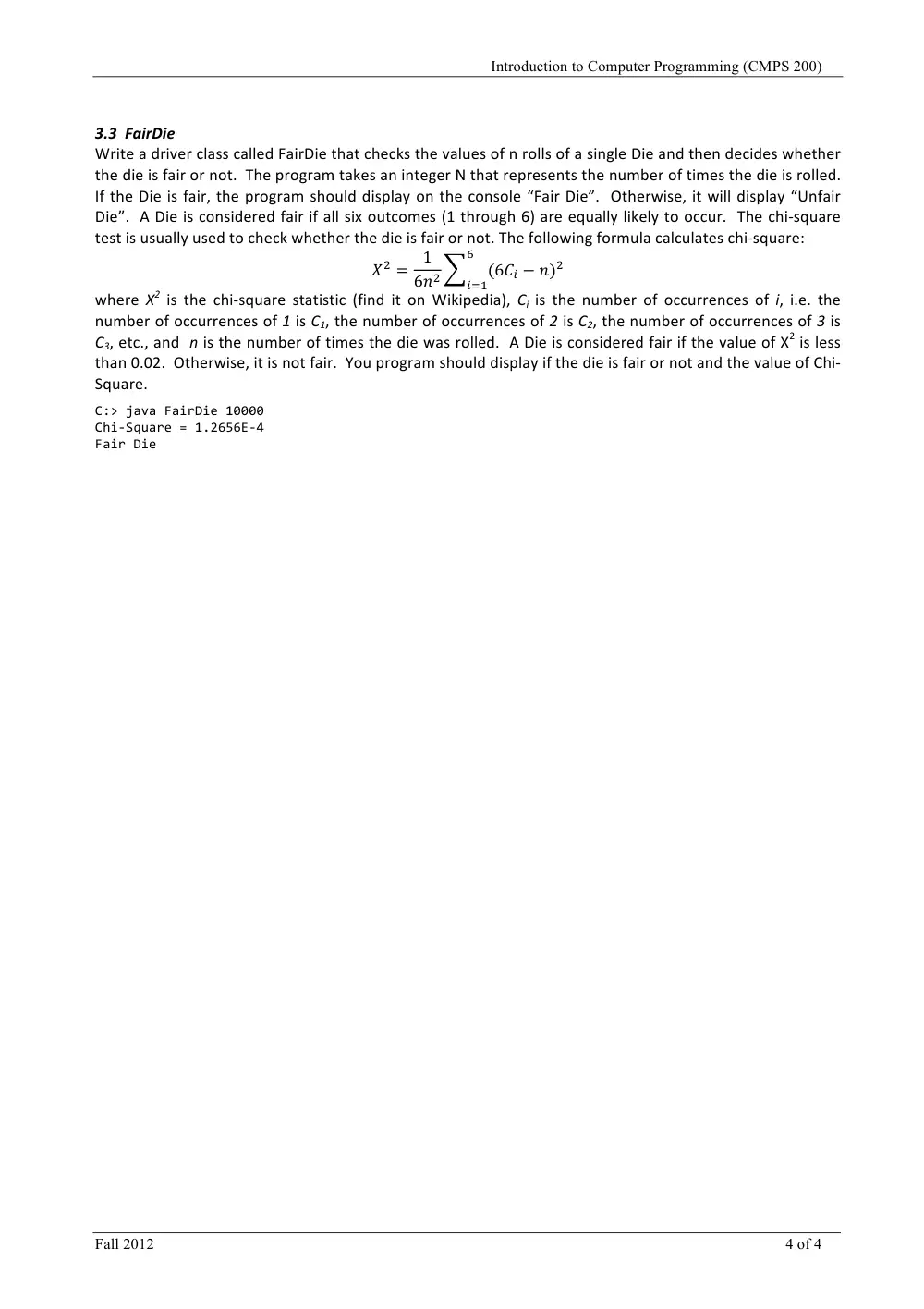
3.3
FairDie
Write
a
driver
class
called
FairDie
that
checks
the
values
of
n
rolls
of
a
single
Die
and
then
decides
whether
the
die
is
fair
or
not.
The
program
takes
an
integer
N
that
represents
the
number
of
times
the
die
is
rolled.
If
the
Die
is
fair,
the
program
should
display
on
the
console
“Fair
Die”.
Otherwise,
it
will
display
“Unfair
Die”.
A
Die
is
considered
fair
if
all
six
outcomes
(1
through
6)
are
equally
likely
to
occur.
The
chi-‐square
test
is
usually
used
to
check
whether
the
die
is
fair
or
not.
The
following
formula
calculates
chi-‐square:
𝑋! =
1
6𝑛!
(6𝐶! − 𝑛)!
!
!!!
where
Χ2
is
the
chi-‐square
statistic
(find
it
on
Wikipedia),
Ci
is
the
number
of
occurrences
of
i,
i.e.
the
number
of
occurrences
of
1
is
C1,
the
number
of
occurrences
of
2
is
C2,
the
number
of
occurrences
of
3
is
C3,
etc.,
and
n
is
the
number
of
times
the
die
was
rolled.
A
Die
is
considered
fair
if
the
value
of
Χ2
is
less
than
0.02.
Otherwise,
it
is
not
fair.
You
program
should
display
if
the
die
is
fair
or
not
and
the
value
of
Chi-‐
Square.
C:>
java
FairDie
10000
Chi-‐Square
=
1.2656E-‐4
Fair
Die