
CMPS 200 Homework Assignment 2, Fall 2012
American University of Beirut · Introduction to Programming · 2 pages
More CMPS 200 files
- Homework 11 · Fall 2018HomeworkView
- Homework Last Assignment · Fall 2018HomeworkView
- Homework Asst10 · Fall 2017HomeworkView
- Homework 9 · Spring 2017HomeworkView
- Homework Assignment 2 · Fall 2016HomeworkView
- Homework Assignment 5 · Fall 2016HomeworkView
- Homework Assignment 6 · Fall 2016HomeworkView
- Homework 1 · Spring 2016HomeworkView
Show the text of this homework
Faculty of Arts & Sciences
Department of Computer Science
CMPS 200—Introduction to Programming
Assignment 2 – Due Monday Oct 8, 2012
Reading Material
Nested for loops: pp 119-136 of the text.
Methods that take arguments and return values: sections 3.1 and 3.2, pp 156-179.
Exercises
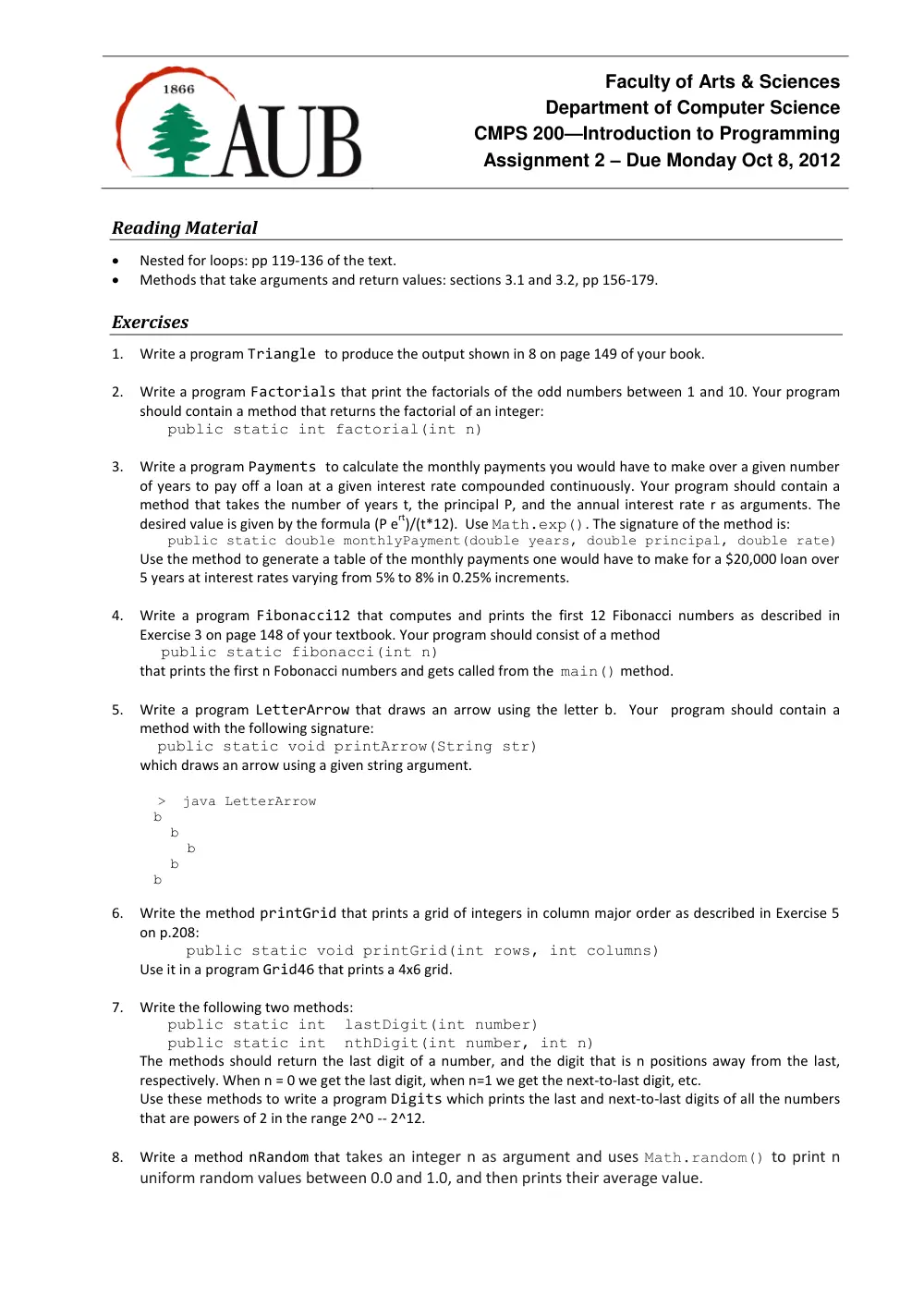
1. Write a program Triangle to produce the output shown in 8 on page 149 of your book.
2. Write a program Factorials that print the factorials of the odd numbers between 1 and 10. Your program
should contain a method that returns the factorial of an integer:
public static int factorial(int n)
3. Write a program Payments to calculate the monthly payments you would have to make over a given number
of years to pay off a loan at a given interest rate compounded continuously. Your program should contain a
method that takes the number of years t, the principal P, and the annual interest rate r as arguments. The
desired value is given by the formula (P ert)/(t*12). Use Math.exp(). The signature of the method is:
public static double monthlyPayment(double years, double principal, double rate)
Use the method to generate a table of the monthly payments one would have to make for a $20,000 loan over
5 years at interest rates varying from 5% to 8% in 0.25% increments.
4. Write a program Fibonacci12 that computes and prints the first 12 Fibonacci numbers as described in
Exercise 3 on page 148 of your textbook. Your program should consist of a method
public static fibonacci(int n)
that prints the first n Fobonacci numbers and gets called from the main() method.
5. Write a program LetterArrow that draws an arrow using the letter b. Your program should contain a
method with the following signature:
public static void printArrow(String str)
which draws an arrow using a given string argument.
> java LetterArrow
b
b
b
b
b
6. Write the method printGrid that prints a grid of integers in column major order as described in Exercise 5
on p.208:
public static void printGrid(int rows, int columns)
Use it in a program Grid46 that prints a 4x6 grid.
7. Write the following two methods:
public static int lastDigit(int number)
public static int nthDigit(int number, int n)
The methods should return the last digit of a number, and the digit that is n positions away from the last,
respectively. When n = 0 we get the last digit, when n=1 we get the next-to-last digit, etc.
Use these methods to write a program Digits which prints the last and next-to-last digits of all the numbers
that are powers of 2 in the range 2^0 -- 2^12.
8. Write a method nRandom that takes an integer n as argument and uses Math.random() to print n
uniform random values between 0.0 and 1.0, and then prints their average value.
Introduction to Computer Programming (CMPS 200)
Fall 2012
2 of 2
Submission Instructions and Notes
As usual, submit your commented source code and sample runs in a zip file to Moodle by the deadline.
Important: We have changed the naming convention for your submitted files so it has a prefix indicating your
section number. Your zip submissions should be named s#_asst2_netid, where # is your section number
(between 1 and 9) and netid stands for your AUBnet user name. For example, if your AUBnetid is abc65 and
you are in section 4, you should call your submission s4_asst2_abc65. The zip files will be processed
automatically so please make sure you use this naming convention.
For those of you using Windows, we will start using notepad++ to edit java programs. Please download from
Moodle and install the proper version for your OS (32- or 64-bit). We will continue to use textedit on Mac OS.