
CMPS 209 Problems Chapter 11, Fall 2015
American University of Beirut · Computers and Programming for the Sciences · 22 pages





Showing the first 10 of 22 pages. Download the PDF to see all of it.
More CMPS 209 files
- Lab Sample Lab Quiz Data File · Fall 2017LabView
- Lab Sample Quiz · Fall 2017LabView
- Syllabus · Spring 2016LabView
- Syllabus · Spring 2016LabView
- Homework Assignment 5 Solution · Spring 2015Homework · with solutionView
- Homework Assignmnet 3 · Fall 2015HomeworkView
- Homework Assignmnet 5 · Fall 2015HomeworkView
- Final · Fall 2015Final examView
Show the text of this chapter
1
Copyright © 2008 Prentice-Hall. All rights reserved.
CHAPTER 11:
BEHIND THE SCENES: DATABASES AND INFORMATION
SYSTEMS
Multiple Choice:
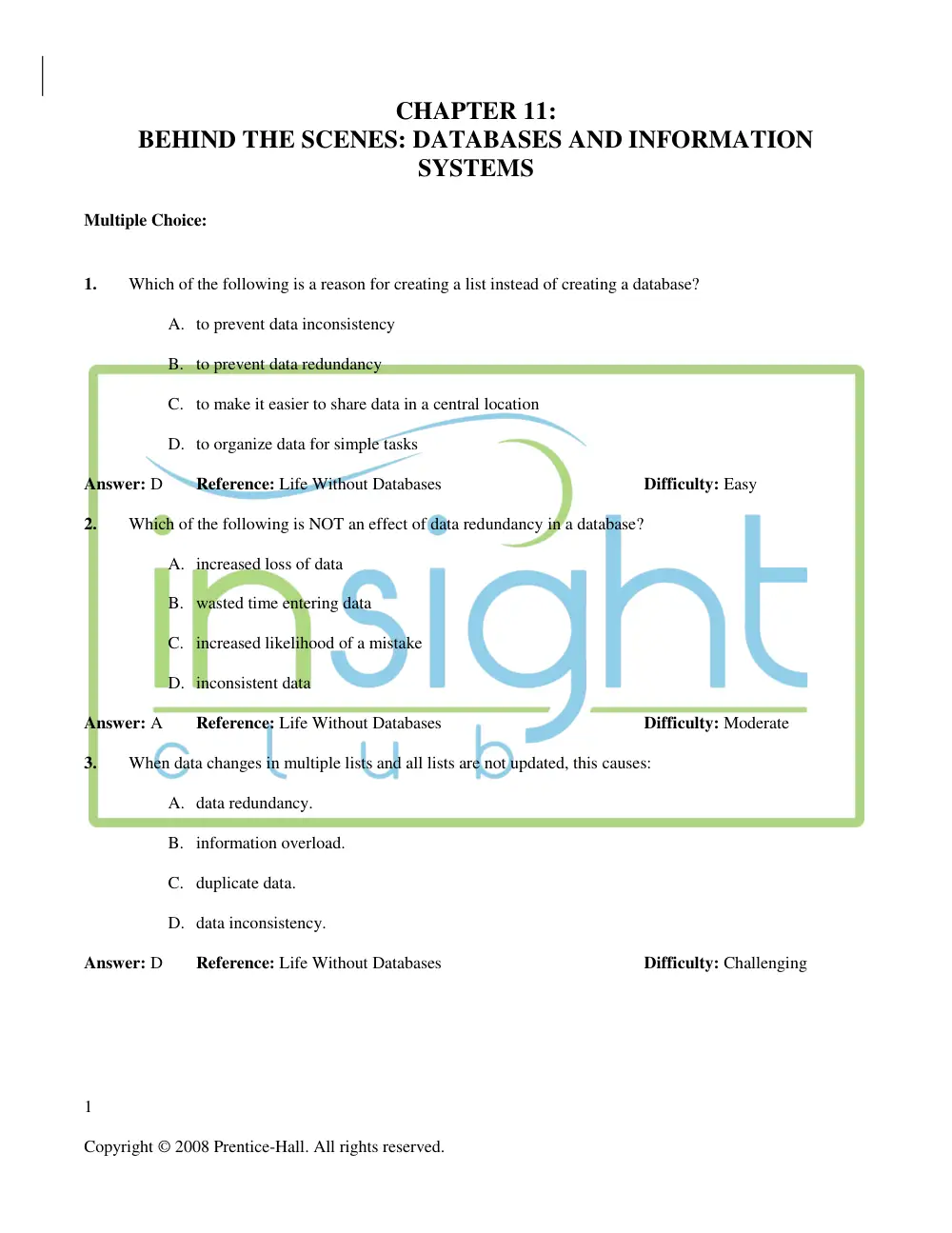
1.
Which of the following is a reason for creating a list instead of creating a database?
A. to prevent data inconsistency
B. to prevent data redundancy
C. to make it easier to share data in a central location
D. to organize data for simple tasks
Answer: D
Reference: Life Without Databases
Difficulty: Easy
2.
Which of the following is NOT an effect of data redundancy in a database?
A. increased loss of data
B. wasted time entering data
C. increased likelihood of a mistake
D. inconsistent data
Answer: A
Reference: Life Without Databases
Difficulty: Moderate
3.
When data changes in multiple lists and all lists are not updated, this causes:
A. data redundancy.
B. information overload.
C. duplicate data.
D. data inconsistency.
Answer: D
Reference: Life Without Databases
Difficulty: Challenging
Chapter 11: Behind the Scenes: Databases and Information Systems
2
Copyright © 2008 Prentice-Hall. All rights reserved.
4.
____________ means that the data contained in a database is accurate and reliable.
A. Data redundancy
B. Data integrity
C. Data reliability
D. Data consistency
Answer: B
Reference: Advantages of Using Databases
Difficulty: Moderate
5.
All of the following are advantages of using a database, EXCEPT:
A. data redundancy.
B. data integrity.
C. flexible use of data.
D. information sharing.
Answer: A
Reference: Advantages of Using Databases
Difficulty: Easy
6.
In a database, a field is a:
A. label.
B. table of information.
C. group of related records.
D. category of information.
Answer: D
Reference: Fields
Difficulty: Moderate
7.
Each field in a database is identified by a:
A. field name.
B. key name.
C. field type.
D. field code.
Answer: A
Reference: Fields
Difficulty: Easy
Chapter 11: Behind the Scenes: Databases and Information Systems
3
Copyright © 2008 Prentice-Hall. All rights reserved.
8.
In a database, ____________ fields store numbers used to perform calculations.
A. next
B. numeric
C. key
D. alphanumeric
Answer: B
Reference: Fields
Difficulty: Easy
9.
A telephone number would be stored in a____________ field in a database.
A. text
B. memo
C. computed
D. date
Answer: A
Reference: Bits And Bytes: When a Number Isn’t Really a Number
Difficulty: Moderate
10.
A picture would be stored in a(n)____________ field in a database.
A. text
B. memo
C. object
D. hyperlink
Answer: C
Reference: Fields
Difficulty: Moderate
11.
To record a person’s last name, use a(n) ____________ field in a database.
A. memo
B. object
C. name
D. text
Answer: D
Reference: Fields
Difficulty: Easy
Chapter 11: Behind the Scenes: Databases and Information Systems
4
Copyright © 2008 Prentice-Hall. All rights reserved.
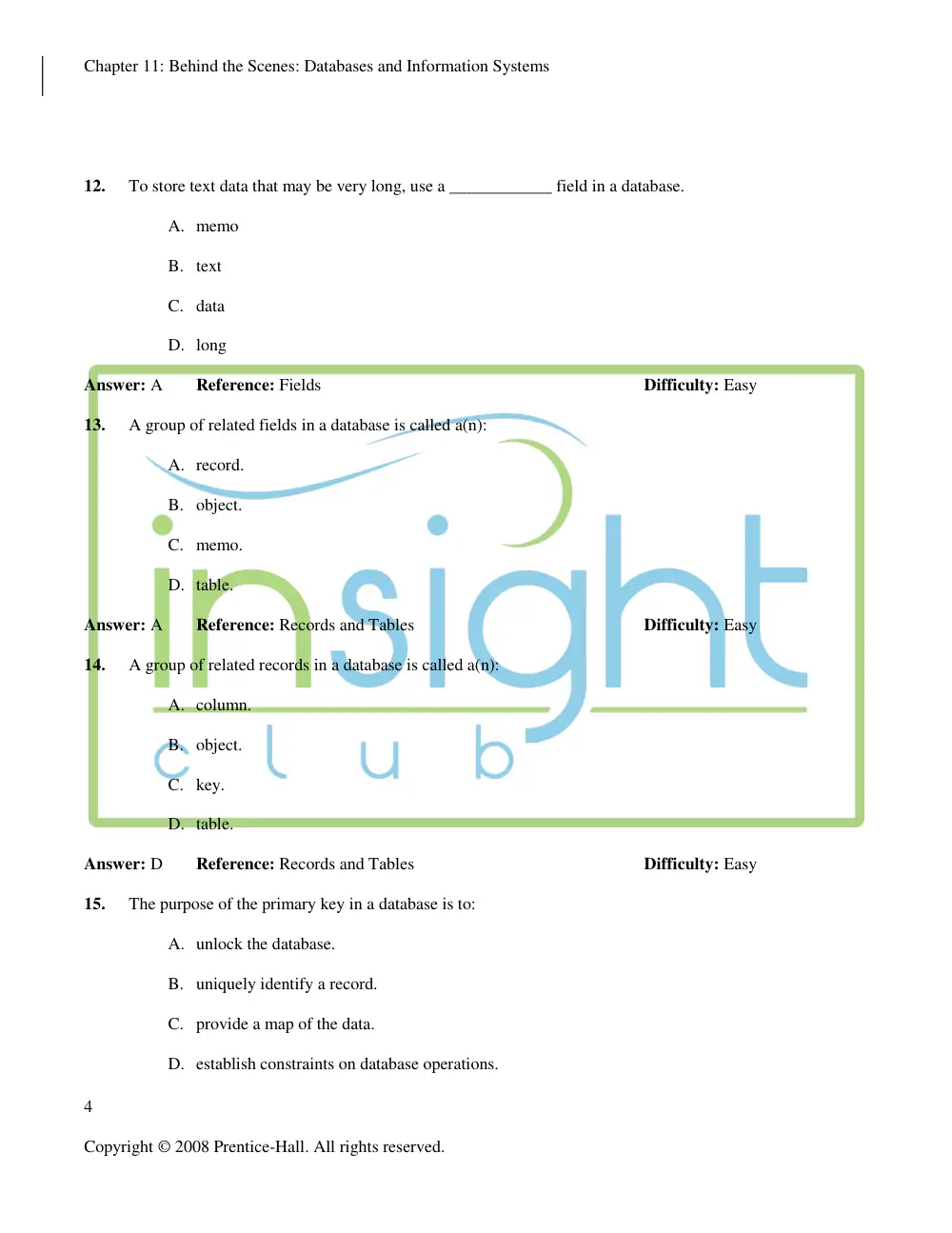
12.
To store text data that may be very long, use a ____________ field in a database.
A. memo
B. text
C. data
D. long
Answer: A
Reference: Fields
Difficulty: Easy
13.
A group of related fields in a database is called a(n):
A. record.
B. object.
C. memo.
D. table.
Answer: A
Reference: Records and Tables
Difficulty: Easy
14.
A group of related records in a database is called a(n):
A. column.
B. object.
C. key.
D. table.
Answer: D
Reference: Records and Tables
Difficulty: Easy
15.
The purpose of the primary key in a database is to:
A. unlock the database.
B. uniquely identify a record.
C. provide a map of the data.
D. establish constraints on database operations.
Chapter 11: Behind the Scenes: Databases and Information Systems
5
Copyright © 2008 Prentice-Hall. All rights reserved.
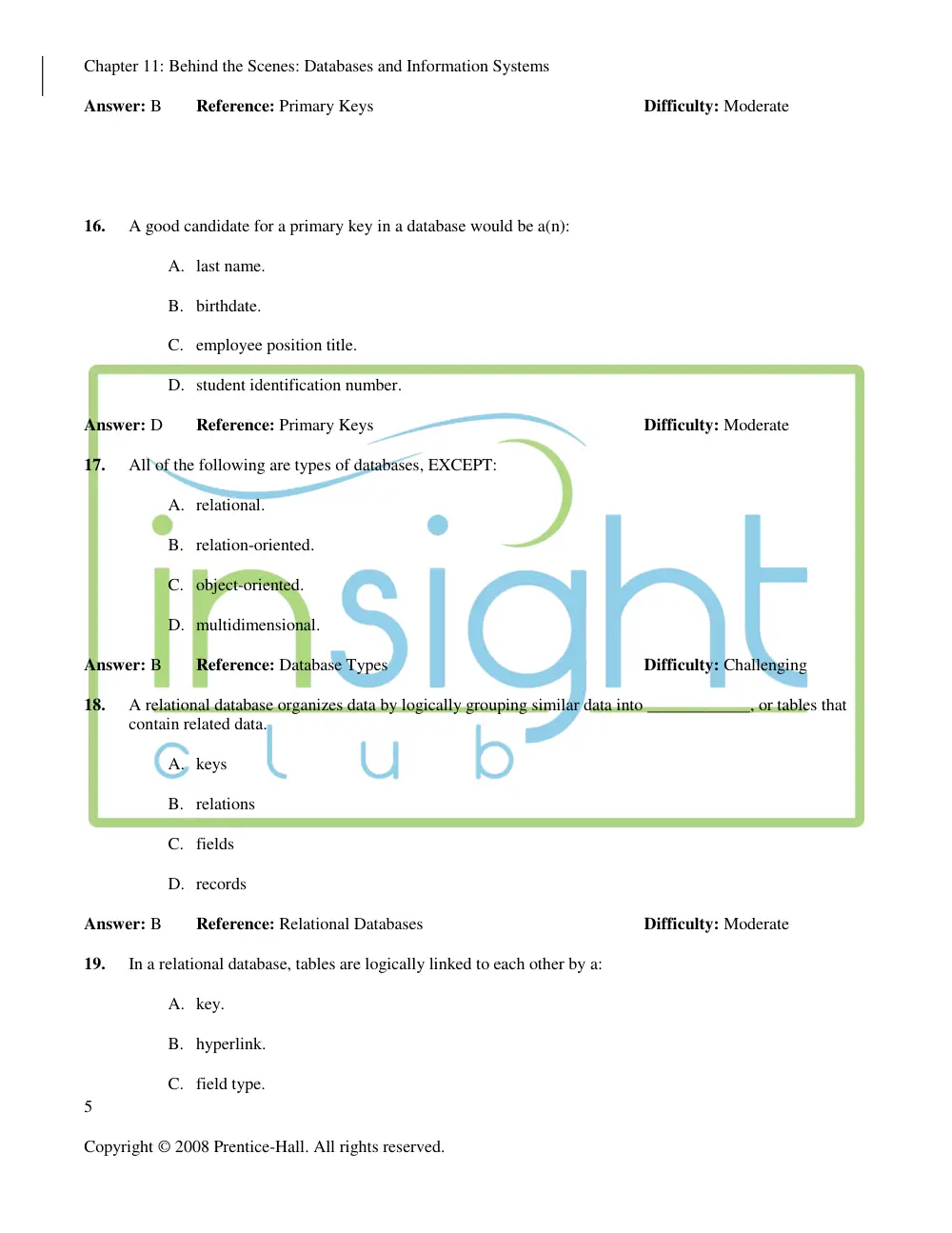
Answer: B
Reference: Primary Keys
Difficulty: Moderate
16.
A good candidate for a primary key in a database would be a(n):
A. last name.
B. birthdate.
C. employee position title.
D. student identification number.
Answer: D
Reference: Primary Keys
Difficulty: Moderate
17.
All of the following are types of databases, EXCEPT:
A. relational.
B. relation-oriented.
C. object-oriented.
D. multidimensional.
Answer: B
Reference: Database Types
Difficulty: Challenging
18.
A relational database organizes data by logically grouping similar data into ____________, or tables that
contain related data.
A. keys
B. relations
C. fields
D. records
Answer: B
Reference: Relational Databases
Difficulty: Moderate
19.
In a relational database, tables are logically linked to each other by a:
A. key.
B. hyperlink.
C. field type.
Chapter 11: Behind the Scenes: Databases and Information Systems
6
Copyright © 2008 Prentice-Hall. All rights reserved.
D. field size.
Answer: A
Reference: Relational Databases
Difficulty: Moderate
Chapter 11: Behind the Scenes: Databases and Information Systems
7
Copyright © 2008 Prentice-Hall. All rights reserved.
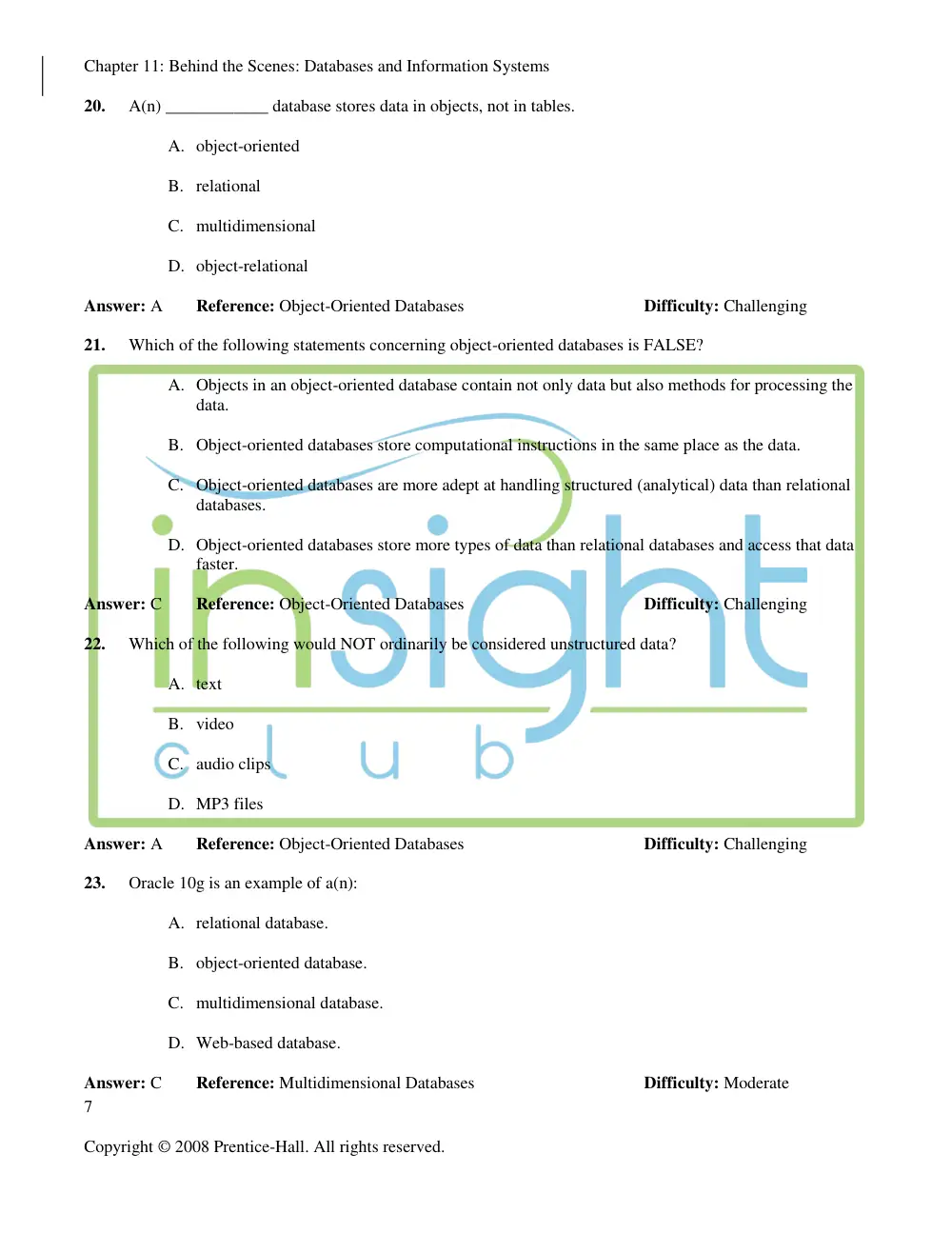
20.
A(n) ____________ database stores data in objects, not in tables.
A. object-oriented
B. relational
C. multidimensional
D. object-relational
Answer: A
Reference: Object-Oriented Databases
Difficulty: Challenging
21.
Which of the following statements concerning object-oriented databases is FALSE?
A. Objects in an object-oriented database contain not only data but also methods for processing the
data.
B. Object-oriented databases store computational instructions in the same place as the data.
C. Object-oriented databases are more adept at handling structured (analytical) data than relational
databases.
D. Object-oriented databases store more types of data than relational databases and access that data
faster.
Answer: C
Reference: Object-Oriented Databases
Difficulty: Challenging
22.
Which of the following would NOT ordinarily be considered unstructured data?
A. text
B. video
C. audio clips
D. MP3 files
Answer: A
Reference: Object-Oriented Databases
Difficulty: Challenging
23.
Oracle 10g is an example of a(n):
A. relational database.
B. object-oriented database.
C. multidimensional database.
D. Web-based database.
Answer: C
Reference: Multidimensional Databases
Difficulty: Moderate
Chapter 11: Behind the Scenes: Databases and Information Systems
8
Copyright © 2008 Prentice-Hall. All rights reserved.
24.
Which of the following is NOT one of the four main functions of a database management system (DBMS)?
A. creating databases and entering data
B. viewing and indexing data
C. querying data
D. programming data
Answer: D
Reference: Database Management Systems: Basic Operations
Difficulty: Moderate
25.
The ____________ contains data descriptions and defines the name, data type, and length of each field in
the database.
A. data dictionary
B. data table
C. data record
D. data field
Answer: A
Reference: Creating Databases and Entering Data
Difficulty: Moderate
26.
Another name for the data dictionary in a database is the:
A. validation data.
B. relational data.
C. database management system.
D. database schema.
Answer: D
Reference: Creating Databases and Entering Data
Difficulty: Challenging
27.
Field attributes (such as data type and field size) in a database are also known as:
A. metadata.
B. default values.
C. field names.
D. primary keys.
Answer: A
Reference: Creating Databases and Entering Data
Difficulty: Moderate
Chapter 11: Behind the Scenes: Databases and Information Systems
9
Copyright © 2008 Prentice-Hall. All rights reserved.
28.
When entering data, violations of ____________ usually result in error messages.
A. data entry
B. validation rules
C. arithmetic operators
D. computation
Answer: B
Reference: Data Validation
Difficulty: Moderate
29.
____________ are the values the database will automatically use for the field unless the user enters another
value.
A. Data types
B. Default values
C. Validated data
D. Metadata
Answer: B
Reference: Creating Databases and Entering Data
Difficulty: Moderate
30.
Common types of validation checks include all of the following, EXCEPT:
A. range.
B. completeness.
C. redundancy.
D. consistency.
Answer: A
Reference: Data Validation
Difficulty: Challenging
31.
Range checks ensure that the data entered falls within the set ____________, which are properties that must
be satisfied for an entry to be accepted into a field.
A. field constraints
B. default values
C. validations
Chapter 11: Behind the Scenes: Databases and Information Systems
10
Copyright © 2008 Prentice-Hall. All rights reserved.
D. descriptions
Answer: B
Reference: Data Validation
Difficulty: Challenging
32.
In addition to keying data directly into the database, data entry can be done from a(n):
A. input form.
B. table.
C. field.
D. data dictionary.
Answer: A
Reference: Input Forms
Difficulty: Easy
33.
____________ is the process within the database design of ensuring that data entered into a database meets
validation rules.
A. Proofreading
B. Authorization
C. Validation
D. Computation
Answer: C
Reference: Data Validation
Difficulty: Moderate
34.
The phrase “>5.50 And <20” is an example of a(n) ____________ check to validate data in a database.
A. requirements
B. completeness
C. range
D. insurance
Answer: C
Reference: Data Validation
Difficulty: Moderate
35.
A(n) ____________ check confirms that only text characters are entered in a field.
A. alphabetic
B. numeric
C. completeness
Chapter 11: Behind the Scenes: Databases and Information Systems
11
Copyright © 2008 Prentice-Hall. All rights reserved.
D. range
Answer: A
Reference: Data Validation
Difficulty: Easy
36.
A(n) ____________ check ensures that all fields in a database defined as “required” have data entered into
them.
A. requirements
B. completeness
C. consistency
D. alphabetic and numeric
Answer: B
Reference: Data Validation
Difficulty: Moderate
37.
A ____________ check compares the values of data in two or more fields to see if these values are
reasonable.
A. constraint
B. completeness
C. consistency
D. range
Answer: C
Reference: Data Validation
Difficulty: Moderate
38.
Making a field ____________ means that it cannot be left blank.
A. numeric
B. required
C. calculated
D. validated
Answer: B
Reference: Data Validation
Difficulty: Easy
39.
____________ organizes a database into the order you need.
A. Browsing
Chapter 11: Behind the Scenes: Databases and Information Systems
12
Copyright © 2008 Prentice-Hall. All rights reserved.
B. Scrolling
C. Sorting
D. Querying
Answer: C
Reference: Viewing and Sorting Data
Difficulty: Easy
40.
SQL is based on a branch of mathematics called:
A. structured algebra.
B. data-driven calculus.
C. artificial intelligence.
D. relational algebra.
Answer: D
Reference: Dig Deeper: Structured Query Language (SQL)
Difficulty: Challenging
41.
A(n) ____________ query displays a subset of data from one table based on specified criteria.
A. select
B. variable
C. operational
D. join
Answer: A
Reference: Dig Deeper: Structured Query Language (SQL)
Difficulty: Moderate
42.
A ____________ query displays a subset of data from two or more tables using a common field.
A. select
B. complex
C. table
D. join
Answer: D
Reference: Dig Deeper: Structured Query Language (SQL)
Difficulty: Moderate
43.
A(n) ____________ enables users to have the database select and display records that match a certain
criteria.
A. query
Chapter 11: Behind the Scenes: Databases and Information Systems
13
Copyright © 2008 Prentice-Hall. All rights reserved.
B. sort
C. operation
D. join
Answer: A
Reference: Extracting or Querying Data
Difficulty: Moderate
44.
The process of reducing redundancy in a database is called:
A. a consistency check.
B. normalization.
C. metadata.
D. schema.
Answer: B
Reference: Normalization of Data
Difficulty: Moderate
45.
The primary key must be a(n) ____________ field.
A. numeric
B. object
C. unique
D. related
Answer: C
Reference: Normalization of Data
Difficulty: Easy
46.
A ____________ is a large-scale electronic repository of data that is time-variant.
A. data warehouse
B. data mine
C. knowledge-based system
D. decision support system
Answer: A
Reference: Data Warehouses
Difficulty: Moderate
47.
The premise behind a relational database is that ____________ are established among the tables.
Chapter 11: Behind the Scenes: Databases and Information Systems
14
Copyright © 2008 Prentice-Hall. All rights reserved.
A. relationships
B. schema
C. consistencies
D. normalizations
Answer: A
Reference: Normalization of Data
Difficulty: Moderate
48.
____________ is the term used for extracting data from source databases, transforming or reformatting the
data, and storing it in the data warehouse.
A. Data staging
B. Validation
C. Normalization
D. Clickstream data
Answer: A
Reference: Data Staging
Difficulty: Challenging
49.
All of the following are types of reports generated by a management information system, EXCEPT:
A. summary
B. detail
C. exception
D. validation
Answer: D
Reference: Management Information Systems
Difficulty: Easy
50.
Which of the following items is NOT a major component of a decision support system (DSS)?
A. internal and external data sources
B. data warehousing
C. model management systems
D. knowledge-based systems
Answer: B
Reference: Decision Support Systems
Difficulty: Challenging
Chapter 11: Behind the Scenes: Databases and Information Systems
15
Copyright © 2008 Prentice-Hall. All rights reserved.
Fill in the Blank:
51.
In a database, a category of information is stored in a(n) ____________.
Answer: field
Reference: Fields
Difficulty: Moderate
52.
In a database, ____________ fields are numeric fields that store the contents of a calculation.
Answer: computational (or computed)
Reference: Fields
Difficulty: Challenging
53.
In a database, field ____________ include text, numeric, date, memo, object, and hyperlink.
Answer: types
Reference: Fields
Difficulty: Easy
54.
____________ are electronic collections of related data that can be easily stored, sorted, organized, and
queried.
Answer: Databases
Reference: Life Without Databases
Difficulty: Easy
55.
Each record in a database should have one field that has a value unique to that record, and this is called a(n)
____________.
Answer: primary key
Reference: Primary Keys
Difficulty: Moderate
56.
A(n)____________ stores data in multiple dimensions as opposed to relational databases, which store data
in two-dimensional tables.
Answer: multidimensional database
Reference: Multidimensional Databases
Difficulty: Moderate
57.
A group of related records in a database is called a file or a(n) ____________.
Answer: table
Reference: Records and Tables
Difficulty: Easy
58.
In ____________ databases, tables are logically linked to each other by including their primary keys in
other tables with related information.
Answer: relational
Reference: Relational Databases
Difficulty: Easy
59.
All modern ____________ contain a query language that the software uses to retrieve and display records.
Answer: database management systems (DBMS) Reference: Extracting or Querying Data Difficulty: Easy
60.
____________ databases are more adept at handling unstructured data such as audio clips, video clips, and
pictures.
Answer: Object-oriented
Reference: Object-Oriented Databases
Difficulty: Moderate
Chapter 11: Behind the Scenes: Databases and Information Systems
16
Copyright © 2008 Prentice-Hall. All rights reserved.
61.
SQL is based on relational algebra, which, like algebraic equations, uses ____________ and
____________.
Answer: variables, operations Reference: Dig Deeper: Structured Query Language (SQL)
Difficulty: Moderate
62.
Because they store the instructions for doing computations in the same place as the data, ____________
databases can usually process requests for information faster than relational databases.
Answer: object-oriented
Reference: Object-Oriented Databases
Difficulty: Challenging
63.
Small slices of a data warehouse are known as ____________.
Answer: data marts
Reference: Data Marts
Difficulty: Easy
64.
The data dictionary is also known as the ____________.
Answer: database schema
Reference: Creating Databases and Entering Data
Difficulty: Moderate
65.
Data describing other data in a database is called ____________.
Answer: metadata
Reference: Creating Databases and Entering Data
Difficulty: Challenging
66.
Besides using data entry forms or keying data directly into the database, users can ____________data
electronically from other application files.
Answer: import
Reference: Input Forms
Difficulty: Moderate
67.
A(n) ____________ check is used to restrict fields in a database to numbers only.
Answer: numeric
Reference: Data Validation
Difficulty: Moderate
68.
Another name for sorting is ____________.
Answer: indexing
Reference: Viewing and Sorting Data
Difficulty: Easy
69.
The predominant query language for modern-day databases is ____________.
Answer: SQL (structured query language) Reference: Extracting or Querying Data
Difficulty: Easy
70.
A(n) ____________ query displays a subset of data from a table based on the criteria you specify.
Answer: select
Reference: Dig Deeper: Structured Query Language (SQL)
Difficulty: Challenging
71.
When creating a query, the ____________ include directions such as select, from, and where.
Answer: operations
Reference: Dig Deeper: Structured Query Language (SQL) Difficulty: Challenging
Chapter 11: Behind the Scenes: Databases and Information Systems
17
Copyright © 2008 Prentice-Hall. All rights reserved.
72.
The two most common queries used to extract data are select queries and ____________ queries.
Answer: join
Reference: Dig Deeper: Structured Query Language (SQL)
Difficulty: Moderate
73.
A(n) ____________ is a question or inquiry you ask the database so that it provides you with records you
wish to view.
Answer: query
Reference: Extracting or Querying Data
Difficulty: Easy
74.
The process of outputting the contents of a database in a file format recognizable by other applications is
called ____________.
Answer: exporting
Reference: Outputting Data
Difficulty: Easy
75.
The ____________ of data is the process of achieving the goal of reducing data redundancy by recording
data only once.
Answer: normalization
Reference: Normalization of Data
Difficulty: Moderate
True and False:
76.
Referential integrity means that for each value in the foreign key of one table, there is a corresponding
value in the primary key of the related table.
Answer: True
Reference: Normalization of Data
Difficulty: Challenging
77.
A data warehouse includes data that pertains to one period in time.
Answer: False
Reference: Data Warehouses
Difficulty: Moderate
78.
Real-time processing means that transactions are accumulated, then a number of transactions are processed
at once.
Answer: False (Batch)
Reference: Transaction Processing Systems
Difficulty: Easy
79.
The most pressing problems of lists are the inability of the data to be shared and data redundancy.
Answer: True
Reference: Life Without Databases
Difficulty: Moderate
80.
Online transaction processing (OLTP) works with real-time processing to ensure that the data is as up to
date as possible.
Answer: True
Reference: Transaction Processing Systems
Difficulty: Easy
81.
A join query displays a subset of data from a table based on the criteria you specify.
Answer: False (select) Reference: Dig Deeper: Structured Query Language (SQL)
Difficulty: Moderate
Chapter 11: Behind the Scenes: Databases and Information Systems
18
Copyright © 2008 Prentice-Hall. All rights reserved.
82.
Management information systems (MIS) help managers develop solutions for specific problems.
Answer: False (decision support systems-DDS) Reference: Decision Support Systems Difficulty: Challenging
83.
External data sources include any source not owned by the company that owns the DDS, such as
demographic data purchased from third parties, mailing lists, and statistics compiled by the federal
government.
Answer: True
Reference: Internal and External Data Sources
Difficulty: Easy
84.
A portal is a Web site where many types of data services or applications can be accessed at one time.
Answer: True Reference: Trends in IT: Emerging Technologies: Web Portal…
Difficulty: Easy
85.
Data warehousing is the process by which great amounts of data are analyzed and investigated with the
purpose of spotting significant patterns or trends.
Answer: False (Data mining)
Reference: Data Mining
Difficulty: Moderate
86.
Knowledge-based systems support normal logic that enables the interjection of experiential learning into
the equation by considering possibilities.
Answer: False (fuzzy logic)
Reference: Knowledge-Based Systems
Difficulty: Challenging
87.
Reducing data redundancy by recording data only once is called normalization of data.
Answer: True
Reference: Normalization of Data
Difficulty: Moderate
88.
In a relational database, when two tables have a common field, the link between the tables is known as a
relationship.
Answer: True
Reference: Relational Database Operations
Difficulty: Easy
89.
Sorting a database in alphabetical order means you are sorting in descending order.
Answer: False (ascending)
Reference: Viewing and Sorting Data
Difficulty: Easy
90.
Summary reports provide a consolidated picture of detailed data.
Answer: True
Reference: Management Information Systems
Difficulty: Moderate
Matching:
Chapter 11: Behind the Scenes: Databases and Information Systems
19
Copyright © 2008 Prentice-Hall. All rights reserved.
91.
Match the following
terms to their functions:
I.
normalization
A. alerts managers of need for immediate attention
II. exception report
B. contains historical data
III. data warehouse
C. reduces data redundancy in a database
IV. data dictionary
D. enforces match of primary to foreign keys
V. referential integrity E. contains metadata describing database structure
Answer: C, A, B, E, D
Reference: Multiple locations in chapter
Difficulty: Challenging
92.
Match the following
acronyms to their descriptions:
I.
OQL
A. processes everyday business transactions
II. SQL
B. query language similar to SQL
III. OLAP
C. uses databases and models for assisting complex decision processes
IV. TPS
D. assists users with analyzing and finding trends in data warehouses
V. DSS
E. consists of commands and syntax for querying relational databases
Answer: B, E, D, A, C
Reference: Multiple locations in chapter
Difficulty: Moderate
93.
Match the following
SQL terms to their meanings:
I.
join
A. another term for directions
II. select
B. a query that uses keywords to specify fields to display from a table
III. variables
C. table names, field names, or selection criteria
Chapter 11: Behind the Scenes: Databases and Information Systems
20
Copyright © 2008 Prentice-Hall. All rights reserved.
IV. select, from, where D. a query that displays related data from multiple tables
V. operations
E. examples of operations
Answer: D, B, C, E, A Reference: DIG DEEPER: Structured Query Language (SQL)
Difficulty: Moderate
94.
Match the following
terms to their meanings:
I.
object-oriented database
A. SQL is based on this form of mathematics
II. knowledge-based system
B. combines data and methods for processing
III. data mart
C. smaller-scale version of a data warehouse
IV. memo field
D. can include artificial intelligence and uses fuzzy logic
V. relational algebra
E. contains variable-length text data
Answer: B, D, C, E, A
Reference: Multiple locations in chapter
Difficulty: Moderate
95.
Match the following
terms to their meanings:
I.
data mining
A. finding patterns and trends in a data warehouse
II. multidimensional database
B. updating transactions all at one time
III. batch processing
C. loading data into a database from external sources
IV. real-time processing
D. stores data in multiple dimensions
V. importing
E. updating the database as a transaction occurs
Answer: A, D, B, E, C
Reference: Multiple locations in chapter
Difficulty: Easy
96.
Match the following
acronyms to their definitions:
Chapter 11: Behind the Scenes: Databases and Information Systems
21
Copyright © 2008 Prentice-Hall. All rights reserved.
I.
BLOB
A. a branch of computer science that is attempting to create computers that think
like humans
II. MIS
B. unstructured data encoded in binary form
III. NLP
C. a system that assists employees in accomplishing routine tasks
IV. AI
D. users communicate with computers using a natural spoken or written language
as opposed to programming languages
V. OSS
E. information that enables managers to make critical business decisions
Answer: B, E, D, A, C
Reference: Multiple locations in chapter
Difficulty: Moderate
97.
Match the following
terms to their meanings:
I.
database
A. electronic collection of related data that can be easily
stored, sorted, organized, and queried
II. fuzzy logic
B. ensures that data in the TPS is as up to date as possible
III. online transaction processing (OLTP)
C. tries to replicate human decision-making processes
IV. model management system
D. interjects experiential learning into the equation
V. expert system
E. assists in building management models in DSSs
Answer: A, D, B, E, C
Reference: Multiple locations in chapter
Difficulty: Moderate
98.
Match the following
terms to their meanings:
I.
detailed report
A. another name for the data dictionary
II. data redundancy
B. a list of transactions that occurred during a certain time period
III. unstructured data
C. non-traditional data such as audio clips, video clips, and
pictures
IV. table
D. another name for a file, it is usually organized by a common
object
V. database schema
E. entering data multiple times
Chapter 11: Behind the Scenes: Databases and Information Systems
22
Copyright © 2008 Prentice-Hall. All rights reserved.
Answer: B, E, C, D, A
Reference: Multiple locations in chapter
Difficulty: Moderate
99.
Match the following
terms to their functions:
I.
object fields
A. a unique field that ensures that records are not duplicated
II. computational fields
B. contain items such as pictures or video clips
III. relations
C. store the contents of a calculation
IV. record
D. tables that contain related data in a relational database
V. primary key
E. a group of related fields
Answer: B, C, D, E, A
Reference: Multiple locations in chapter
Difficulty: Moderate
100.
Match the following
terms to their meanings:
I.
file
A. software-based solution used to gather and analyze information
II. metadata
B. includes range, completeness, consistency, alphabetic, and
numeric
III. information system
C. also known as a table
IV. relational database
D. data describing data
V. validation check
E. organizes data in tables that are logically linked to each other
by primary keys
Answer: C, D, A, E, B
Reference: Multiple locations in chapter
Difficulty: Moderate