
CMPS 211 Homework 3 with Solution, Spring 2016
American University of Beirut · Discrete Structures · 10 pages · with solution
More CMPS 211 files
- Homework 6 with Solution · Spring 2016Homework · with solutionView
- Homework 4 with Solution · Spring 2016Homework · with solutionView
- Homework 1 with Solution · Spring 2016Homework · with solutionView
- Homework 5 with Solution · Spring 2016Homework · with solutionView
- Homework 5 · Fall 2015HomeworkView
- Homework 1 · Fall 2015HomeworkView
- Homework 3 · Fall 2015HomeworkView
- Homework 1 Solution · Fall 2015Homework · with solutionView
Show the text of this homework
American University of Beirut
Department of Computer Science
CMPS 211 - Spring 2015-16
Assignment 3 - Solution Key
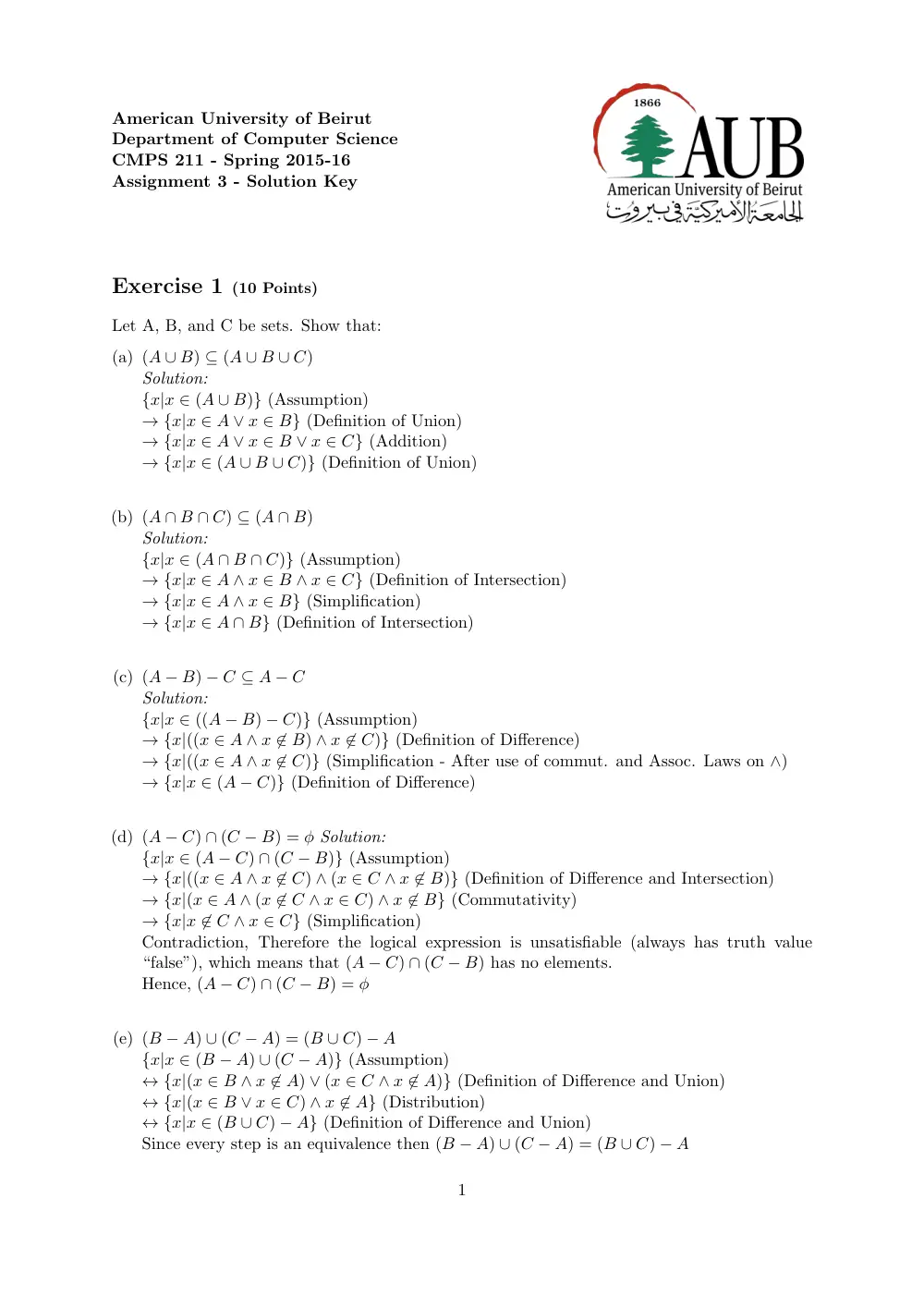
Exercise 1 (10 Points)
Let A, B, and C be sets. Show that:
(a) (A ∪ B) ⊆ (A ∪ B ∪ C)
Solution:
{x|x ∈ (A ∪ B)} (Assumption)
→ {x|x ∈ A ∨ x ∈ B} (Definition of Union)
→ {x|x ∈ A ∨ x ∈ B ∨ x ∈ C} (Addition)
→ {x|x ∈ (A ∪ B ∪ C)} (Definition of Union)
(b) (A ∩ B ∩ C) ⊆ (A ∩ B)
Solution:
{x|x ∈ (A ∩ B ∩ C)} (Assumption)
→ {x|x ∈ A ∧ x ∈ B ∧ x ∈ C} (Definition of Intersection)
→ {x|x ∈ A ∧ x ∈ B} (Simplification)
→ {x|x ∈ A ∩ B} (Definition of Intersection)
(c) (A − B) − C ⊆ A − C
Solution:
{x|x ∈ ((A − B) − C)} (Assumption)
→ {x|((x ∈ A ∧ x ̸∈ B) ∧ x ̸∈ C)} (Definition of Difference)
→ {x|((x ∈ A ∧ x ̸∈ C)} (Simplification - After use of commut. and Assoc. Laws on ∧)
→ {x|x ∈ (A − C)} (Definition of Difference)
(d) (A − C) ∩ (C − B) = φ Solution:
{x|x ∈ (A − C) ∩ (C − B)} (Assumption)
→ {x|((x ∈ A ∧ x ̸∈ C) ∧ (x ∈ C ∧ x ̸∈ B)} (Definition of Difference and Intersection)
→ {x|(x ∈ A ∧ (x ̸∈ C ∧ x ∈ C) ∧ x ̸∈ B} (Commutativity)
→ {x|x ̸∈ C ∧ x ∈ C} (Simplification)
Contradiction, Therefore the logical expression is unsatisfiable (always has truth value
“false”), which means that (A − C) ∩ (C − B) has no elements.
Hence, (A − C) ∩ (C − B) = φ
(e) (B − A) ∪ (C − A) = (B ∪ C) − A
{x|x ∈ (B − A) ∪ (C − A)} (Assumption)
↔ {x|(x ∈ B ∧ x ̸∈ A) ∨ (x ∈ C ∧ x ̸∈ A)} (Definition of Difference and Union)
↔ {x|(x ∈ B ∨ x ∈ C) ∧ x ̸∈ A} (Distribution)
↔ {x|x ∈ (B ∪ C) − A} (Definition of Difference and Union)
Since every step is an equivalence then (B − A) ∪ (C − A) = (B ∪ C) − A
1
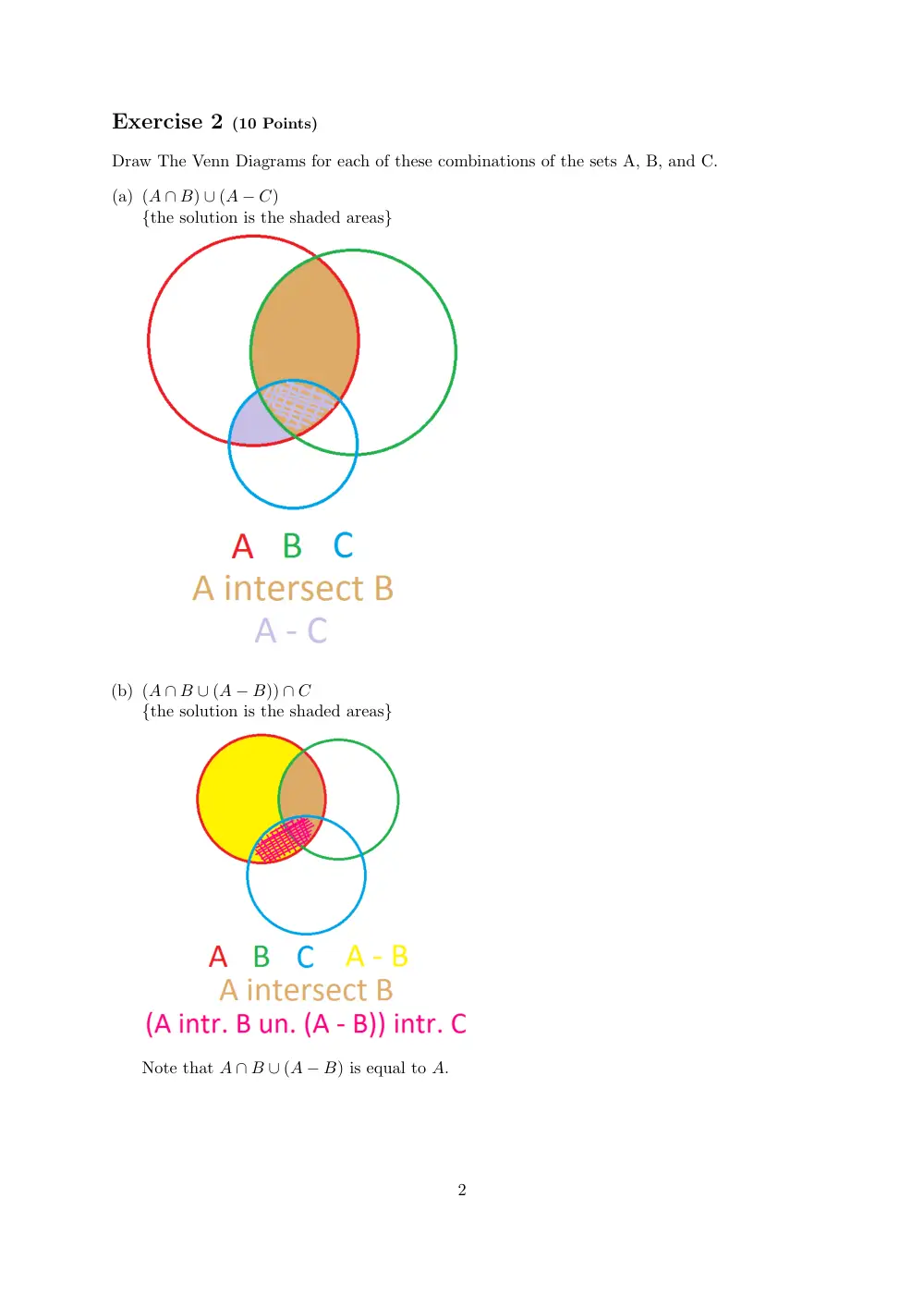
Exercise 2 (10 Points)
Draw The Venn Diagrams for each of these combinations of the sets A, B, and C.
(a) (A ∩ B) ∪ (A − C)
{the solution is the shaded areas}
(b) (A ∩ B ∪ (A − B)) ∩ C
{the solution is the shaded areas}
Note that A ∩ B ∪ (A − B) is equal to A.
2
Exercise 3 (15 Points)
Give an example of two uncountable sets A and B such that A − B is:
(a) Finite A = IR, B = IR − {0}. A − B = {0}(Finite)
(b) Countable infinite A = IR, B = IR − IN. A − B = IN(CountablyInfinite)
(c) Uncountable infinite A = IR, B = IR − [0, 1]. A − B = [0, 1](Uncountable)
Exercise 4 (15 Points)
Prove that if A is uncountable and A ⊆ B, then B is uncountable.
Solution 1: Proof by contradiction
Assume A is uncountable and A ⊆ B. For the sake of contradiction, assume B is countable.
if B is countable then there exists a bijection (one-to-one and onto) (f) between B and IN.
f : B → IN
Construct the function f|A by restricting the domain of f to A ⊆ B, i.e:
f|A : A → IN : f|A (x) = f(x)
f|A is defined the same was as f but with a smaller domain. Since f is injective (one-to-one),
then f|A is also one-to-one (note that f|A may no longer be onto).
However, since A is uncountable, then there does not exist any injective function from it to IN.
Contradiction, B must be uncountable.
Solution 2:
Assume that B is countable. Then the elements of B can be listed as b1, b2, b3 Because A is a
subset of B, taking the subsequence of {bn} that contains the terms that are in A only gives a
listing of the elements of A. Because A is uncountable, this is impossible, and therefore B can’t
be countable
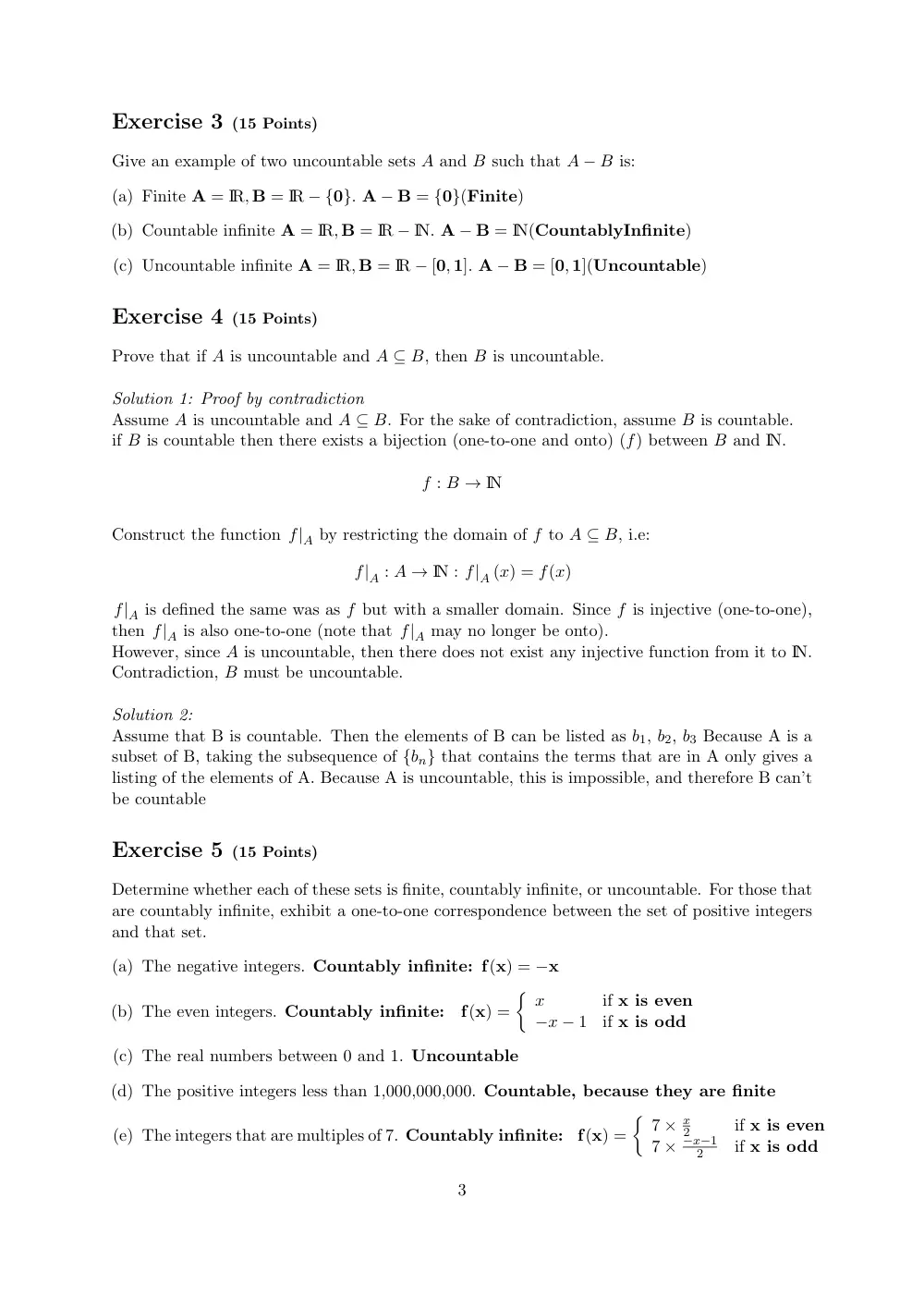
Exercise 5 (15 Points)
Determine whether each of these sets is finite, countably infinite, or uncountable. For those that
are countably infinite, exhibit a one-to-one correspondence between the set of positive integers
and that set.
(a) The negative integers. Countably infinite: f(x) = −x
(b) The even integers. Countably infinite:
f(x) =
� x
if x is even
−x − 1
if x is odd
(c) The real numbers between 0 and 1. Uncountable
(d) The positive integers less than 1,000,000,000. Countable, because they are finite
(e) The integers that are multiples of 7. Countably infinite:
f(x) =
� 7 × x
2
if x is even
7 × −x−1
2
if x is odd
3
(f) The odd negative integers. Countably infinite: f(x) = −2x + 1
(g) The integers with absolute value less than 1,000,000.
Countable, because they are
finite
(h) The set A × Z+ where A = 2, 3. Countably infinite:
f(x) =
� (2, x
2)
if x is even
(3, x+1
2 )
if x is odd
(i) All bit strings not containing the bit 0. Countable: for any integer n, the corresponding
bit string would be a string formed of n 0s
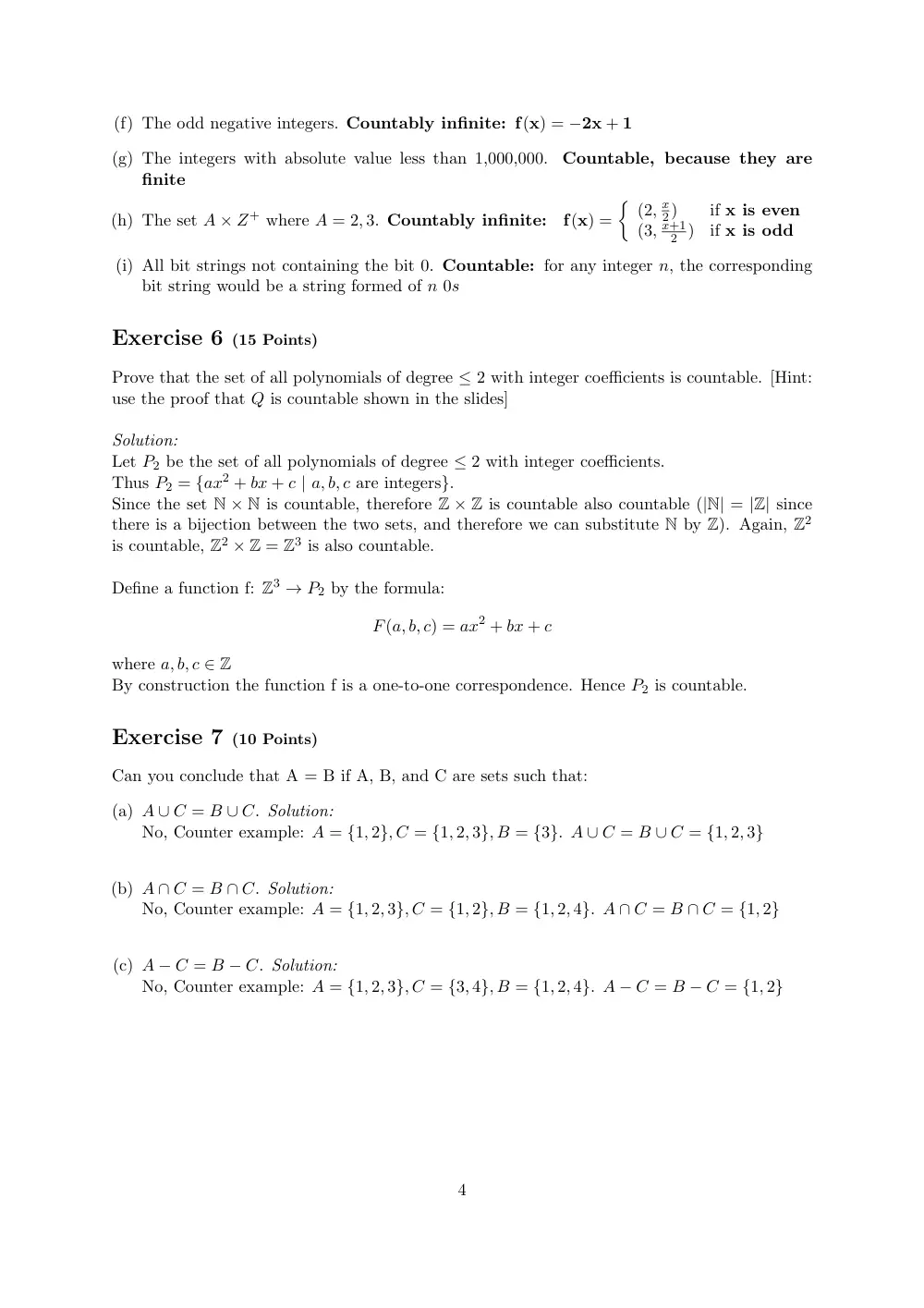
Exercise 6 (15 Points)
Prove that the set of all polynomials of degree ≤ 2 with integer coefficients is countable. [Hint:
use the proof that Q is countable shown in the slides]
Solution:
Let P2 be the set of all polynomials of degree ≤ 2 with integer coefficients.
Thus P2 = {ax2 + bx + c | a, b, c are integers}.
Since the set N × N is countable, therefore Z × Z is countable also countable (|N| = |Z| since
there is a bijection between the two sets, and therefore we can substitute N by Z). Again, Z2
is countable, Z2 × Z = Z3 is also countable.
Define a function f: Z3 → P2 by the formula:
F(a, b, c) = ax2 + bx + c
where a, b, c ∈ Z
By construction the function f is a one-to-one correspondence. Hence P2 is countable.
Exercise 7 (10 Points)
Can you conclude that A = B if A, B, and C are sets such that:
(a) A ∪ C = B ∪ C. Solution:
No, Counter example: A = {1, 2}, C = {1, 2, 3}, B = {3}. A ∪ C = B ∪ C = {1, 2, 3}
(b) A ∩ C = B ∩ C. Solution:
No, Counter example: A = {1, 2, 3}, C = {1, 2}, B = {1, 2, 4}. A ∩ C = B ∩ C = {1, 2}
(c) A − C = B − C. Solution:
No, Counter example: A = {1, 2, 3}, C = {3, 4}, B = {1, 2, 4}. A − C = B − C = {1, 2}
4
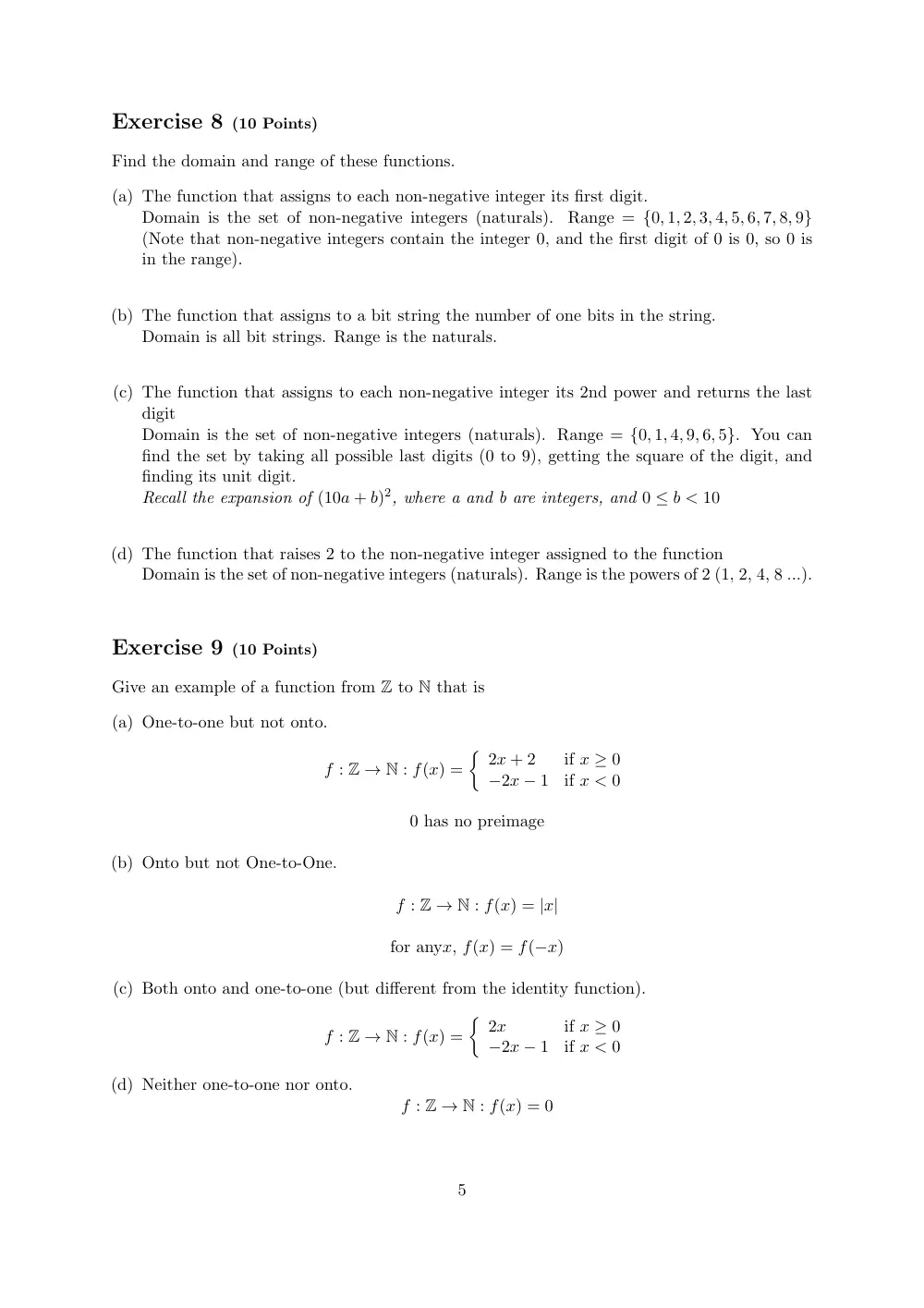
Exercise 8 (10 Points)
Find the domain and range of these functions.
(a) The function that assigns to each non-negative integer its first digit.
Domain is the set of non-negative integers (naturals).
Range = {0, 1, 2, 3, 4, 5, 6, 7, 8, 9}
(Note that non-negative integers contain the integer 0, and the first digit of 0 is 0, so 0 is
in the range).
(b) The function that assigns to a bit string the number of one bits in the string.
Domain is all bit strings. Range is the naturals.
(c) The function that assigns to each non-negative integer its 2nd power and returns the last
digit
Domain is the set of non-negative integers (naturals). Range = {0, 1, 4, 9, 6, 5}. You can
find the set by taking all possible last digits (0 to 9), getting the square of the digit, and
finding its unit digit.
Recall the expansion of (10a + b)2, where a and b are integers, and 0 ≤ b < 10
(d) The function that raises 2 to the non-negative integer assigned to the function
Domain is the set of non-negative integers (naturals). Range is the powers of 2 (1, 2, 4, 8 ...).
Exercise 9 (10 Points)
Give an example of a function from Z to N that is
(a) One-to-one but not onto.
f : Z → N : f(x) =
� 2x + 2
if x ≥ 0
−2x − 1
if x < 0
0 has no preimage
(b) Onto but not One-to-One.
f : Z → N : f(x) = |x|
for anyx, f(x) = f(−x)
(c) Both onto and one-to-one (but different from the identity function).
f : Z → N : f(x) =
� 2x
if x ≥ 0
−2x − 1
if x < 0
(d) Neither one-to-one nor onto.
f : Z → N : f(x) = 0
5
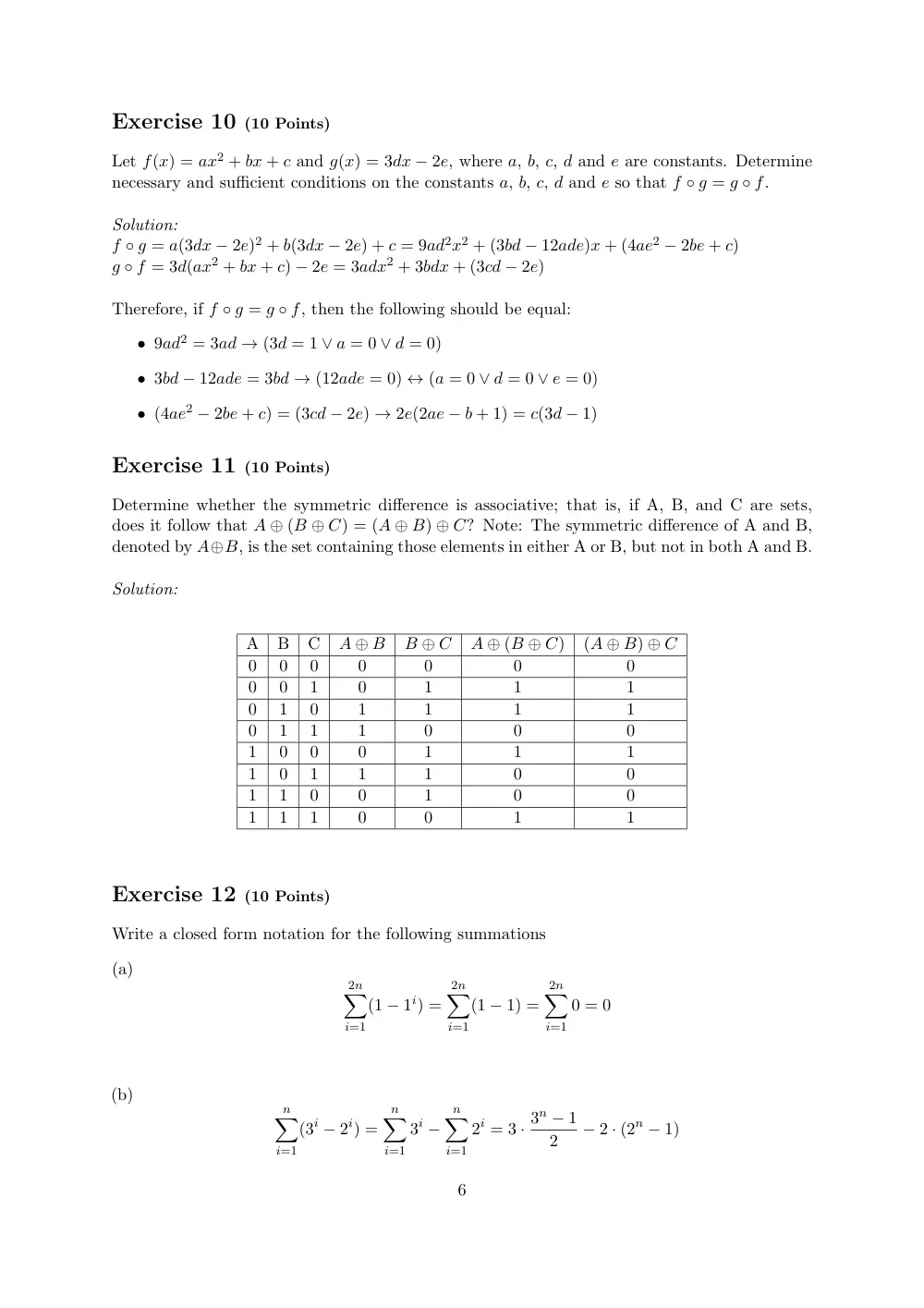
Exercise 10 (10 Points)
Let f(x) = ax2 + bx + c and g(x) = 3dx − 2e, where a, b, c, d and e are constants. Determine
necessary and sufficient conditions on the constants a, b, c, d and e so that f ◦ g = g ◦ f.
Solution:
f ◦ g = a(3dx − 2e)2 + b(3dx − 2e) + c = 9ad2x2 + (3bd − 12ade)x + (4ae2 − 2be + c)
g ◦ f = 3d(ax2 + bx + c) − 2e = 3adx2 + 3bdx + (3cd − 2e)
Therefore, if f ◦ g = g ◦ f, then the following should be equal:
• 9ad2 = 3ad → (3d = 1 ∨ a = 0 ∨ d = 0)
• 3bd − 12ade = 3bd → (12ade = 0) ↔ (a = 0 ∨ d = 0 ∨ e = 0)
• (4ae2 − 2be + c) = (3cd − 2e) → 2e(2ae − b + 1) = c(3d − 1)
Exercise 11 (10 Points)
Determine whether the symmetric difference is associative; that is, if A, B, and C are sets,
does it follow that A ⊕ (B ⊕ C) = (A ⊕ B) ⊕ C? Note: The symmetric difference of A and B,
denoted by A⊕B, is the set containing those elements in either A or B, but not in both A and B.
Solution:
A
B
C
A ⊕ B
B ⊕ C
A ⊕ (B ⊕ C)
(A ⊕ B) ⊕ C
0
0
0
0
0
0
0
0
0
1
0
1
1
1
0
1
0
1
1
1
1
0
1
1
1
0
0
0
1
0
0
0
1
1
1
1
0
1
1
1
0
0
1
1
0
0
1
0
0
1
1
1
0
0
1
1
Exercise 12 (10 Points)
Write a closed form notation for the following summations
(a)
2n
�
i=1
(1 − 1i) =
2n
�
i=1
(1 − 1) =
2n
�
i=1
0 = 0
(b)
n
�
i=1
(3i − 2i) =
n
�
i=1
3i −
n
�
i=1
2i = 3 · 3n − 1
2
− 2 · (2n − 1)
6
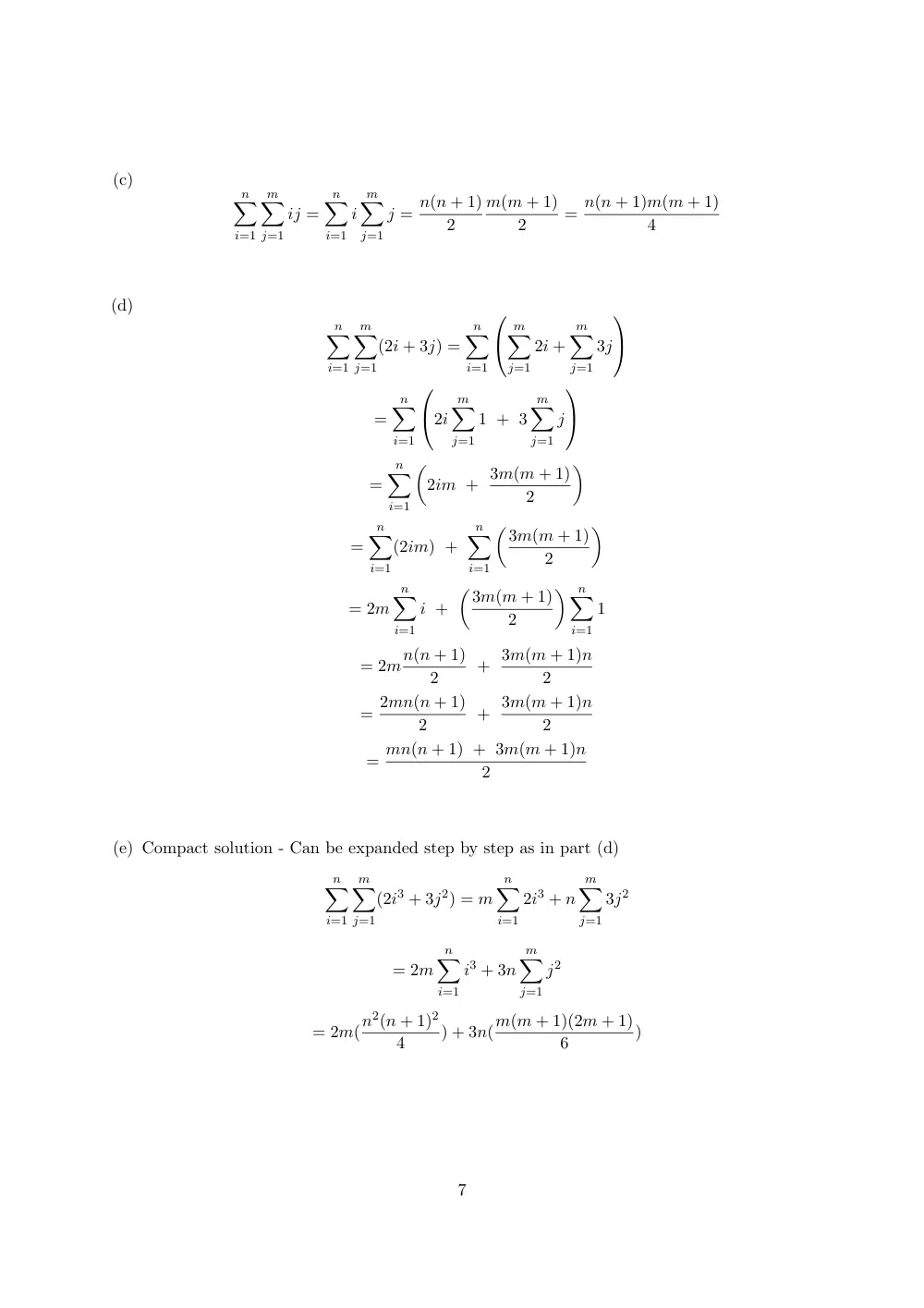
(c)
n
�
i=1
m
�
j=1
ij =
n
�
i=1
i
m
�
j=1
j = n(n + 1)
2
m(m + 1)
2
= n(n + 1)m(m + 1)
4
(d)
n
�
i=1
m
�
j=1
(2i + 3j) =
n
�
i=1
m
�
j=1
2i +
m
�
j=1
3j
=
n
�
i=1
2i
m
�
j=1
1 + 3
m
�
j=1
j
=
n
�
i=1
�
2im + 3m(m + 1)
2
�
=
n
�
i=1
(2im) +
n
�
i=1
�3m(m + 1)
2
�
= 2m
n
�
i=1
i +
�3m(m + 1)
2
�
n
�
i=1
1
= 2mn(n + 1)
2
+ 3m(m + 1)n
2
= 2mn(n + 1)
2
+ 3m(m + 1)n
2
= mn(n + 1) + 3m(m + 1)n
2
(e) Compact solution - Can be expanded step by step as in part (d)
n
�
i=1
m
�
j=1
(2i3 + 3j2) = m
n
�
i=1
2i3 + n
m
�
j=1
3j2
= 2m
n
�
i=1
i3 + 3n
m
�
j=1
j2
= 2m(n2(n + 1)2
4
) + 3n(m(m + 1)(2m + 1)
6
)
7
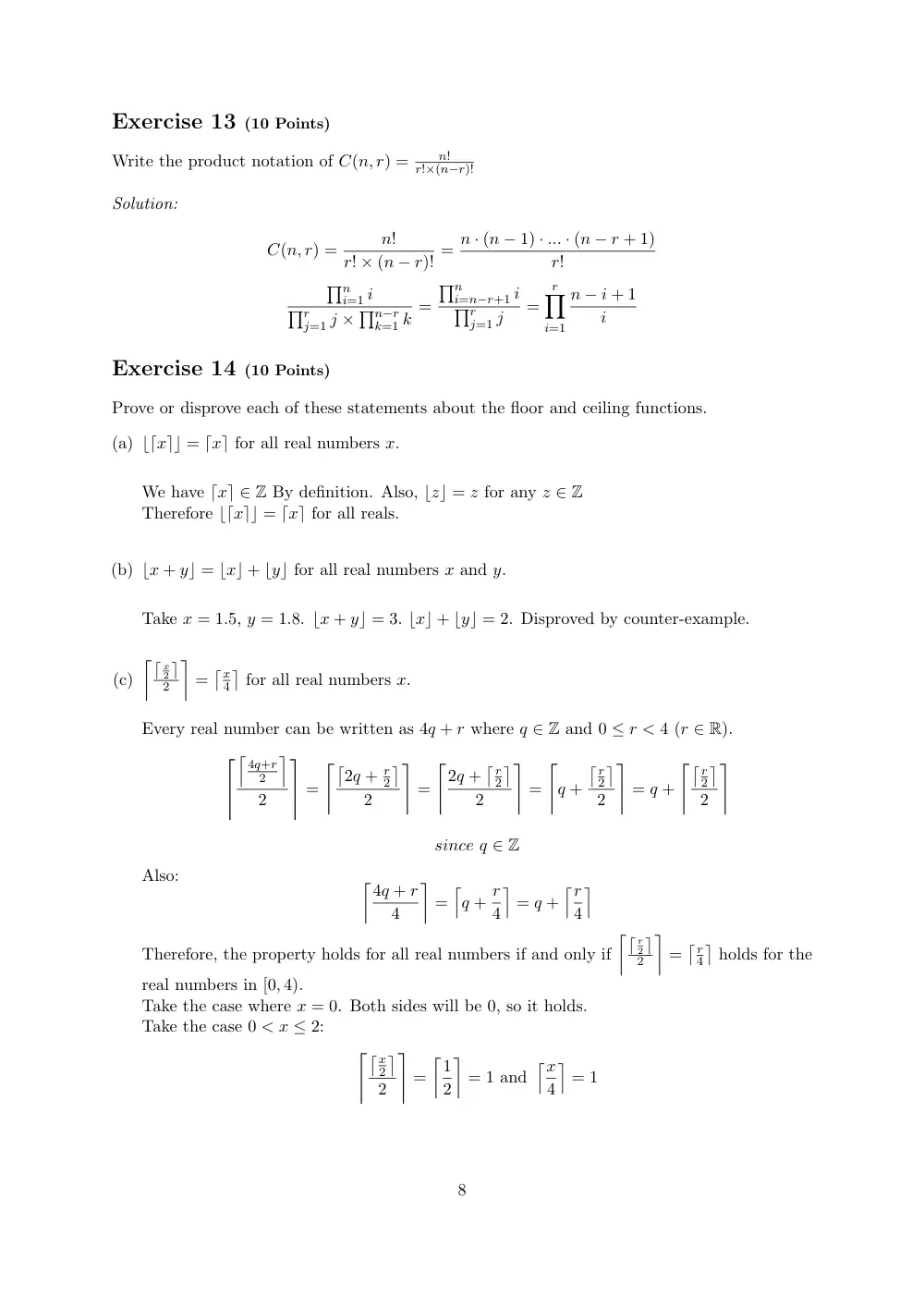
Exercise 13 (10 Points)
Write the product notation of C(n, r) =
n!
r!×(n−r)!
Solution:
C(n, r) =
n!
r! × (n − r)! = n · (n − 1) · ... · (n − r + 1)
r!
�n
i=1 i
�r
j=1 j × �n−r
k=1 k =
�n
i=n−r+1 i
�r
j=1 j
=
r
�
i=1
n − i + 1
i
Exercise 14 (10 Points)
Prove or disprove each of these statements about the floor and ceiling functions.
(a) ⌊⌈x⌉⌋ = ⌈x⌉ for all real numbers x.
We have ⌈x⌉ ∈ Z By definition. Also, ⌊z⌋ = z for any z ∈ Z
Therefore ⌊⌈x⌉⌋ = ⌈x⌉ for all reals.
(b) ⌊x + y⌋ = ⌊x⌋ + ⌊y⌋ for all real numbers x and y.
Take x = 1.5, y = 1.8. ⌊x + y⌋ = 3. ⌊x⌋ + ⌊y⌋ = 2. Disproved by counter-example.
(c)
�
⌈ x
2⌉
2
�
=
� x
4
�
for all real numbers x.
Every real number can be written as 4q + r where q ∈ Z and 0 ≤ r < 4 (r ∈ R).
�
4q+r
2
�
2
=
��
2q + r
2
�
2
�
=
�
2q +
� r
2
�
2
�
=
�
q +
� r
2
�
2
�
= q +
�� r
2
�
2
�
since q ∈ Z
Also:
�4q + r
4
�
=
�
q + r
4
�
= q +
�r
4
�
Therefore, the property holds for all real numbers if and only if
�
⌈ r
2⌉
2
�
=
� r
4
�
holds for the
real numbers in [0, 4).
Take the case where x = 0. Both sides will be 0, so it holds.
Take the case 0 < x ≤ 2:
�� x
2
�
2
�
=
�1
2
�
= 1 and
�x
4
�
= 1
8
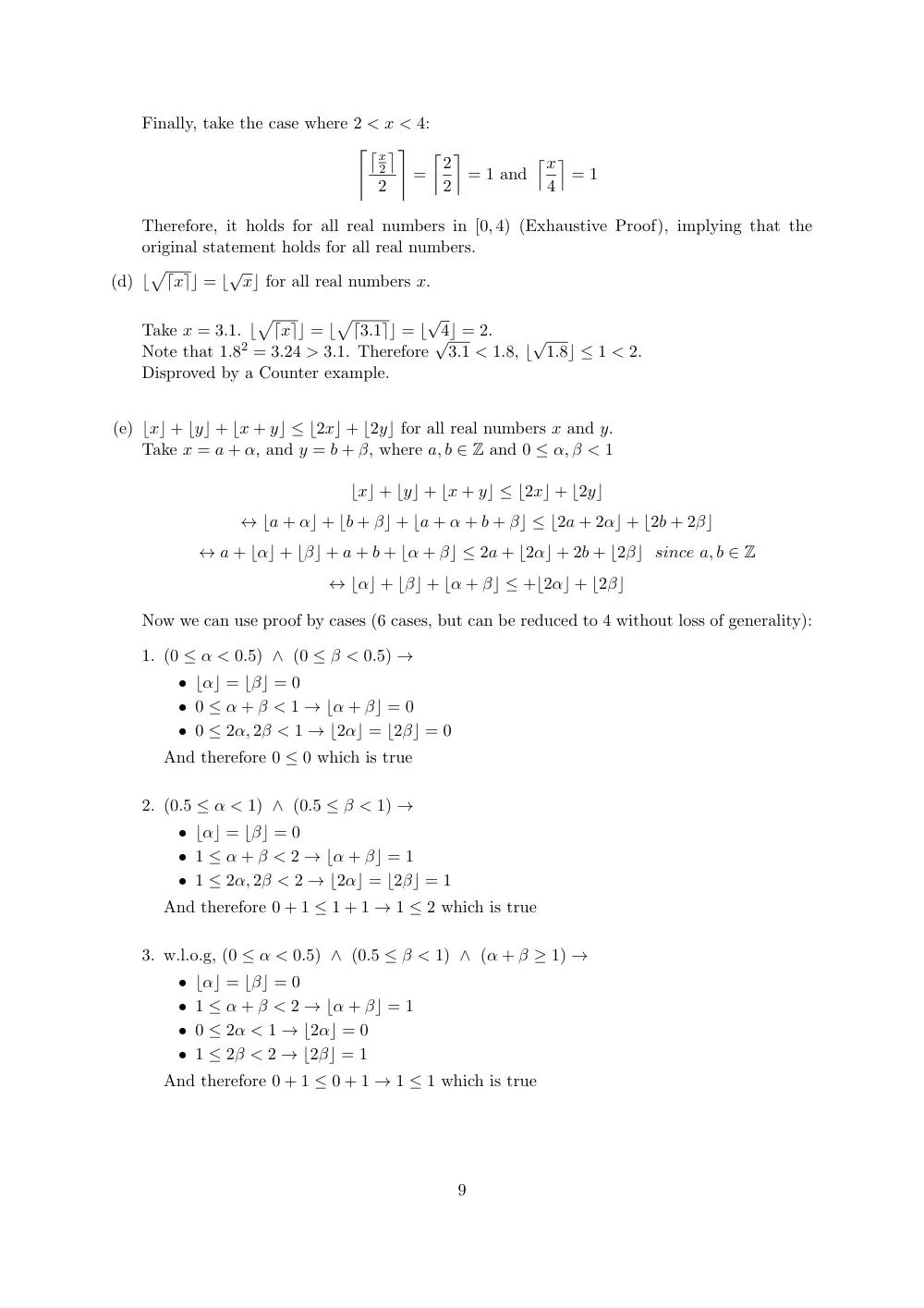
Finally, take the case where 2 < x < 4:
�� x
2
�
2
�
=
�2
2
�
= 1 and
�x
4
�
= 1
Therefore, it holds for all real numbers in [0, 4) (Exhaustive Proof), implying that the
original statement holds for all real numbers.
(d) ⌊
�
⌈x⌉⌋ = ⌊√x⌋ for all real numbers x.
Take x = 3.1. ⌊
�
⌈x⌉⌋ = ⌊
�
⌈3.1⌉⌋ = ⌊
√
4⌋ = 2.
Note that 1.82 = 3.24 > 3.1. Therefore
√
3.1 < 1.8, ⌊
√
1.8⌋ ≤ 1 < 2.
Disproved by a Counter example.
(e) ⌊x⌋ + ⌊y⌋ + ⌊x + y⌋ ≤ ⌊2x⌋ + ⌊2y⌋ for all real numbers x and y.
Take x = a + α, and y = b + β, where a, b ∈ Z and 0 ≤ α, β < 1
⌊x⌋ + ⌊y⌋ + ⌊x + y⌋ ≤ ⌊2x⌋ + ⌊2y⌋
↔ ⌊a + α⌋ + ⌊b + β⌋ + ⌊a + α + b + β⌋ ≤ ⌊2a + 2α⌋ + ⌊2b + 2β⌋
↔ a + ⌊α⌋ + ⌊β⌋ + a + b + ⌊α + β⌋ ≤ 2a + ⌊2α⌋ + 2b + ⌊2β⌋ since a, b ∈ Z
↔ ⌊α⌋ + ⌊β⌋ + ⌊α + β⌋ ≤ +⌊2α⌋ + ⌊2β⌋
Now we can use proof by cases (6 cases, but can be reduced to 4 without loss of generality):
1. (0 ≤ α < 0.5) ∧ (0 ≤ β < 0.5) →
• ⌊α⌋ = ⌊β⌋ = 0
• 0 ≤ α + β < 1 → ⌊α + β⌋ = 0
• 0 ≤ 2α, 2β < 1 → ⌊2α⌋ = ⌊2β⌋ = 0
And therefore 0 ≤ 0 which is true
2. (0.5 ≤ α < 1) ∧ (0.5 ≤ β < 1) →
• ⌊α⌋ = ⌊β⌋ = 0
• 1 ≤ α + β < 2 → ⌊α + β⌋ = 1
• 1 ≤ 2α, 2β < 2 → ⌊2α⌋ = ⌊2β⌋ = 1
And therefore 0 + 1 ≤ 1 + 1 → 1 ≤ 2 which is true
3. w.l.o.g, (0 ≤ α < 0.5) ∧ (0.5 ≤ β < 1) ∧ (α + β ≥ 1) →
• ⌊α⌋ = ⌊β⌋ = 0
• 1 ≤ α + β < 2 → ⌊α + β⌋ = 1
• 0 ≤ 2α < 1 → ⌊2α⌋ = 0
• 1 ≤ 2β < 2 → ⌊2β⌋ = 1
And therefore 0 + 1 ≤ 0 + 1 → 1 ≤ 1 which is true
9
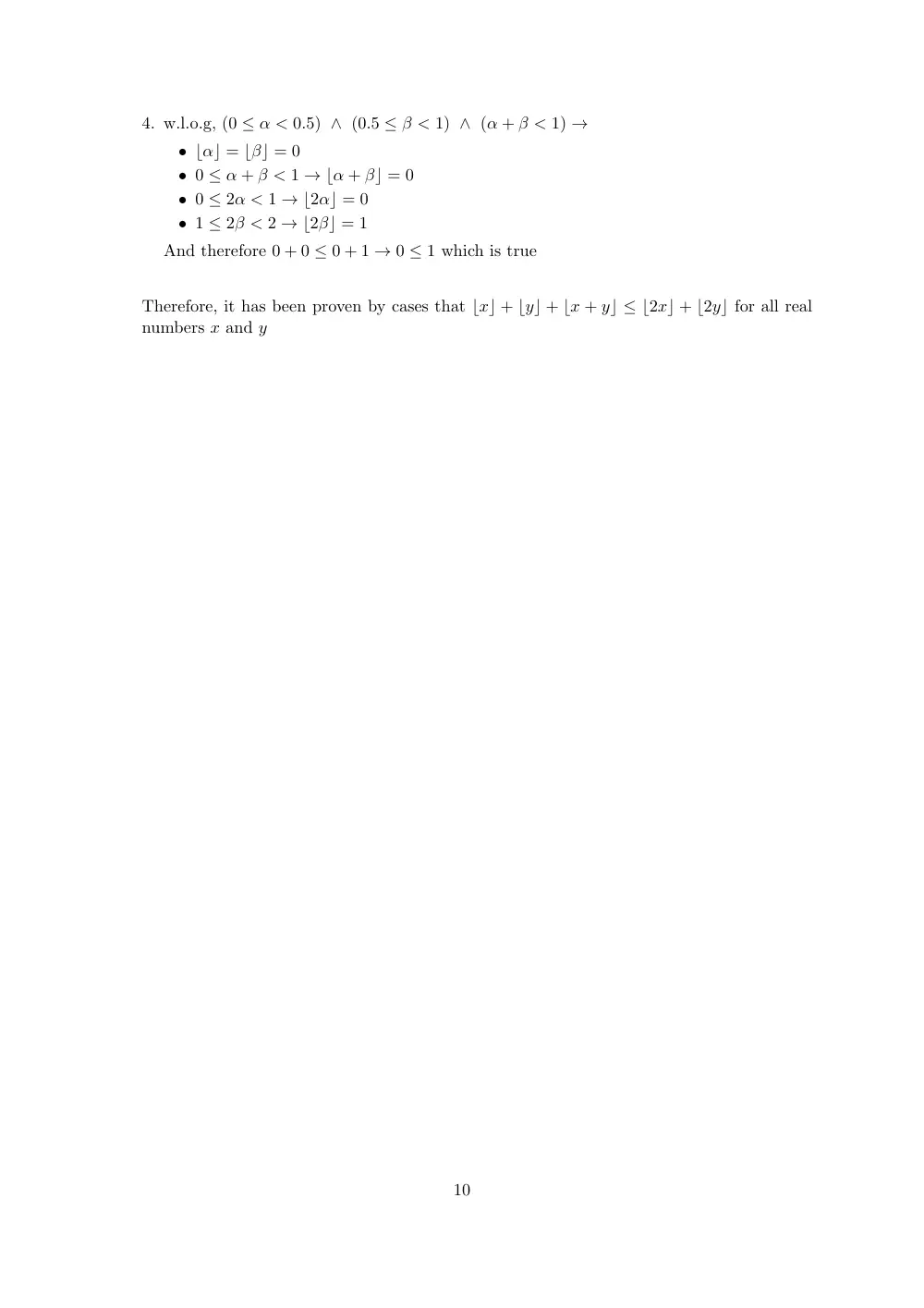
4. w.l.o.g, (0 ≤ α < 0.5) ∧ (0.5 ≤ β < 1) ∧ (α + β < 1) →
• ⌊α⌋ = ⌊β⌋ = 0
• 0 ≤ α + β < 1 → ⌊α + β⌋ = 0
• 0 ≤ 2α < 1 → ⌊2α⌋ = 0
• 1 ≤ 2β < 2 → ⌊2β⌋ = 1
And therefore 0 + 0 ≤ 0 + 1 → 0 ≤ 1 which is true
Therefore, it has been proven by cases that ⌊x⌋ + ⌊y⌋ + ⌊x + y⌋ ≤ ⌊2x⌋ + ⌊2y⌋ for all real
numbers x and y
10