
CMPS 211 Homework 6 with Solution, Spring 2016
American University of Beirut · Discrete Structures · 10 pages · with solution



More CMPS 211 files
- Homework 3 with Solution · Spring 2016Homework · with solutionView
- Homework 1 with Solution · Spring 2016Homework · with solutionView
- Homework 4 with Solution · Spring 2016Homework · with solutionView
- Homework 5 with Solution · Spring 2016Homework · with solutionView
- Homework 1 · Fall 2015HomeworkView
- Homework 2 · Fall 2015HomeworkView
- Homework 3 · Fall 2015HomeworkView
- Homework 1 Solution · Fall 2015Homework · with solutionView
Show the text of this homework
American University of Beirut
Department of Computer Science
CMPS 211 - Spring 2015-16
Assignment 6
Maximum Grade is 120
The following exercises are to be completed by Monday 2nd of May. Late
submissions will not be accepted.
You are expected to submit to moodle and another printed copy during class.
Only typed submissions will be accepted from now on, and those who submit
in LATEX will get extra credits.
Exercise 1 (15 Points)
Prove that among any 7 points placed on the circumference of any circle, there is always
a pair of points that form an arc of angle ≤ 60 degrees?
Solution
Split the circle into 6 arcs each of an angle of 60 degrees. Now, we have transformed the
problem into a pigeonhole problem having k=6 pigeon holes (6 arcs), and N=7 pigeons
(the 7 points). By the pigeon hole principle, at least two points fall into the same arc.
Since all arcs are of size 60 degrees, then angle between the two points which fall in the
same arc is at most 60 degrees.
Therefore, among any 7 points placed on the circumference of any circle, there is always
a pair of points that form an arc of angle ≤ 60 degrees.
Exercise 2 (15 Points)
A coin is flipped 10 times, where each flip comes up either heads or tails. How many
possible outcomes do we have in these cases:
1. In total?
Solution:We have 10 flips, each flip has two possible outcomes, therefore the product
rule applies: 210.
2. Contain exactly two heads?
Solution:We have 10 flips, 2 of them must be head, the rest is automatically chosen
to be tails. Since the faces of the coins are identical then ordering the heads doesn’t
matter (i.e. H1H2T1... is equivalent to H2H1T1...). Therefore the total number of
outcomes is equal to 10C2. We can see it as follows: We have 2 Heads which we
want to pick 2 position out of 2. The position order doesn’t matter; therefore pick
2 out of 10 order doesn’t matter & without replacement, then 10C2.
1
3. Contain at most three tails?
Solution:This is equal to the sum of outcomes containing exactly no Tails, exactly
one Tail, exactly two Tails, and exactly three Tails (same logic as in part b): 10C0+
10C1 + 10C2 + 10C3.
4. Contain the same number of heads and tails?
Solution:This is equivalent to saying exactly 5 heads (or exactly 5 tails). Again, we
can apply the same logic as in part b, so 10C5.
Exercise 3 (15 Points)
How many bit strings of length 20 contain:
1. Exactly 4 ones?
Solution:This is similar to problem 2-2, in fact if we consider 1 to be tail and 0 to
be heads it will be exactly mappable to it. In this case we want 4 ones so it is 20C4
2. At most 4 ones?
Solution:Also similar to problem 2-3 Sum of exactly 0 ones, exactly 1 one, exactly 2
ones, exactly 3 ones, and exactly 4 ones... Therefore 20C0+20C1+20C2+20C3+
20C4
3. At least 4 ones?
Solution:This can be computed in many ways, we can apply the sum rule directly
and get �20
n=4 20Cn, or we can think about it as if it is saying at most 16 ones and
apply the sum rule then �16
n=0 20Cn. Or we can think about it as the complement
of having at most 3 ones and thus we get 220 − (20C0 + 20C1 + 20C2 + 20C3).
4. An equal number of zeros and ones?
Solution:In other word exactly 10 zeros (or exactly 10 ones): 20C10.
5. Either 10 consecutive zeros or 10 consecutive ones?
Solution: First we count the number of bit strings of length 20 that contain 10
consecutive 0s. We will base the count on where the string of 10 or more consecutive
0s starts. If it starts in the first bit, then the first 10 bits are all 0s, but there is free
choice for the last 10 bits; therefore there are 210 such strings. If it starts in the
second bit, then the first bit must be a 1, the next 10 bits are all 0s, but there is free
choice for the last 9 bits; therefore there are 29 such strings. If it starts in the third
bit, then the second bit must be a 1 but the first bit and the last 8 bits are arbitrary;
therefore there are 29 such strings. Similarly, there are 29 such strings that have
the consecutive 0s starting in each of positions four, five, ... and eleven. This gives
us a total of 210 + 10 ∗ 29 strings that contain 10 consecutive 0s. Symmetrically,
there are 210 + 10 ∗ 29 strings that contain 10 consecutive 1s.
Clearly the two
strings 00000000001111111111 and 11111111110000000000 are counted twice, and
therefore should be deducted. Therefore the answer is 2 ∗ (210 + 10 ∗ 29) − 2
2
Exercise 4 (15 Points)
How many string of six lowercase letter from the English alphabet contain:
1. The letter a?
Solution:The easiest way to do this is counting the strings not containing a, and
take that out all possible strings: 266−256. Choosing a position for a then counting
can be tricky and cause overcounting for the cases where we have two consecutive
letters a.
2. The letters a and b?
Solution:In a similar way we count the number of string not containing b (256), and
the strings not containing a (256), and the strings not containing neither a nor b
(244). We notice that the strings not containing a include the strings not containing
neither a nor b, and those not containing b also contain the ones without a and
b; and therefore the strings not containing a or b are overcounted, and should be
subtracted : 256 + 256 − 246
The total number of strings with both a and b is the total number of strings
that can formed from the alphabets minus those without a and b, and therefore:
266 − (256 + 256 − 246).
3. The letters a and b in consecutive positions, with a preceding b, with all the letters
distinct?
Solution:In other words we want the string to contain ”ab”, and the string has
distinct letters (no need to worry about double counting).
This leave 4 free letters to pick out of 24, since we can’t pick a nor b, and their
order matters), so we get 4P24 = 24 ∗ 23 ∗ 22 ∗ 21 different such strings. We then
multiply this number by 5 which is the number of positions we can insert “ab” into,
overall we get 5 ∗ 4P24.
4. The letters a and b, where a is somewhere to the left of b in the string, with all the
letters distinct?
Solution:We have 4 free letters similar to the previous part (24P4 possible permu-
tation of those letters), we can place a anywhere (5 possibilities), however we can
place b only to the right of a (number of possibilities depends on position of a).
When a is placed in the beginning, b can be placed any where after it (5 positions),
When a is placed at the end, b can only be placed at the end of the string after a
(1 position). So we get 5 + 4 + 3 + 2 + 1 = 15 different ways of placing a and b
inside the string.
This gives us overall 15 ∗ 24P4.
3
Exercise 5 (15 Points)
What is the minimum number of students required in a discrete mathematics class to be
sure that at least six will receive the same grade, if there are five possible grades, A, B,
C, D, and F?
Solution
We have 5 possible grades, and we need to guarantee at least 6 students take same grade,
therefore we want to find N such that
� N
5
�
= 6 by pigeon hole principle; therefore we
know that 5 ∗ (6 − 1) + 1 ≤ N ≤ 5 ∗ 6, and hence the minimum N to satisfy the equation
is 5*(6-1) + 1 = 26 students.
4
Exercise 6 (20 Points)
You are given an array of n elements. Devise a divide and conquer algorithm to remove
all duplicates in array. Prove the correctness of your algorithm. Then write and solve a
recurrence for the algorithm’s run-time.
Algorithm 1 merge − sort − no − dups(a0, ..., an, lower, upper)
1: if lower == upper then
2:
return alower
3: else if lower < upper then
4:
left = merge-sort-no-dups(a0, ..., an, lower, upper+lower
2
)
5:
right = merge-sort-no-dups(a0, ..., an, upper+lower
2
, upper)
6:
return merge-no-dups(left, right)
7: end if
Algorithm 2 merge − no − dups(l0, ..., lm, r0, ..., rk)
1: result = empty list
2: i = 0 j = 0
3: while i ≤ m ∧ j ≤ k do
4:
if li = rj then
5:
add li to end of result
6:
i = i + 1
7:
j = j + 1.
8:
else if li < rj then
9:
add li to end of result
10:
i = i + 1
11:
else if li > rj then
12:
add rj to end of result
13:
j = j + 1
14:
end if
15: end while
16: while i ≤ m do
17:
add li to end of result
18:
i = i + 1
19: end while
20: while j ≤ k do
21:
add rj to end of result
22:
j = j + 1
23: end while
24: return result
5
Correctness
We want to show the following: merge-sort-no-dups(a0, ..., an, lower, upper) return a
sorted duplicate-free copy of the segment alower, ..., aupper. call this statement P(lower, upper).
We will proceed by induction, first we show that P is true in the base case, i.e. when
lower = upper. This is clearly the case since the algorithm will return a single element.
For the inductive step we will look at P(lower, upper) for some upper > lower, here
we notice that the algorithm makes two recursive calls, on the first and last half of
alower, ..., aupper, these calls are assumed to be correct by induction hypothesis, therefore
we know that both left, and right are sorted duplicate free segments of the first and last
half of alower, ..., aupper.
Therefore the correctness depends on the correctness of merge-no-dups. We
need to show that merge-no-dups merges left and right into a sorted duplicates free array.
For this purpose we suggest the following loop invariant: inv = “At iteraton (i, j) result
is sorted and duplicate free of the segments l0, ..., li−1 and r0, ..., rj−1”. Where l and r are
the same as left and right previously discussed.
Initialization
At the start of the loop, i = j = 0 and result is empty, so the invariant holds trivially.
Maintenance
At the start of the (i, j) iteration, we assume that the invariant holds, we want to show
that it holds after the end of the iteration. We have three cases:
• li = rj: in this case we add only one of the two numbers, leaving the other out, then
we proceed by increasing i and j. since l, r are sorted and duplicate free, as well
as result (by hypothesis), then li = ri > t ∀t ∈ result. Therefore result remains
sorted and duplicate free and now includes li, rj.
• li < rj: in this case we add li and move i forward, since l is sorted, therefore
li > lk ∀0 ≤ k < i, also r and result are sorted and duplicate free, therefore
li > t ∀t ∈ result. Therefore result remains sorted and duplicate free and now
includes li.
• li > rj: in this case we add rj and move j forward, since r is sorted, therefore
rj > rk ∀0 ≤ k < j, also l and result are sorted and duplicate free, therefore
rj > t ∀t ∈ result. Therefore result remains sorted and duplicate free and now
includes rj.
Termination
The loop clearly terminates when either i or j exceeds the size of l or r. The two con-
secutive loops clearly wont change the invariant, since both list are sorted and duplicate,
the remaining segment in either of them, is guaranteed to be strictly greater than the
previous segment.
6
Therefore, merge-no-dups returns a sorted duplicate free copy of l merged with r, and
thus our algorithm is correct.
Run-time
T(n) = 2T(n
2) + O(n)
T(1) = O(1)
By Master theorem we can find that run-time is O(nlgn).
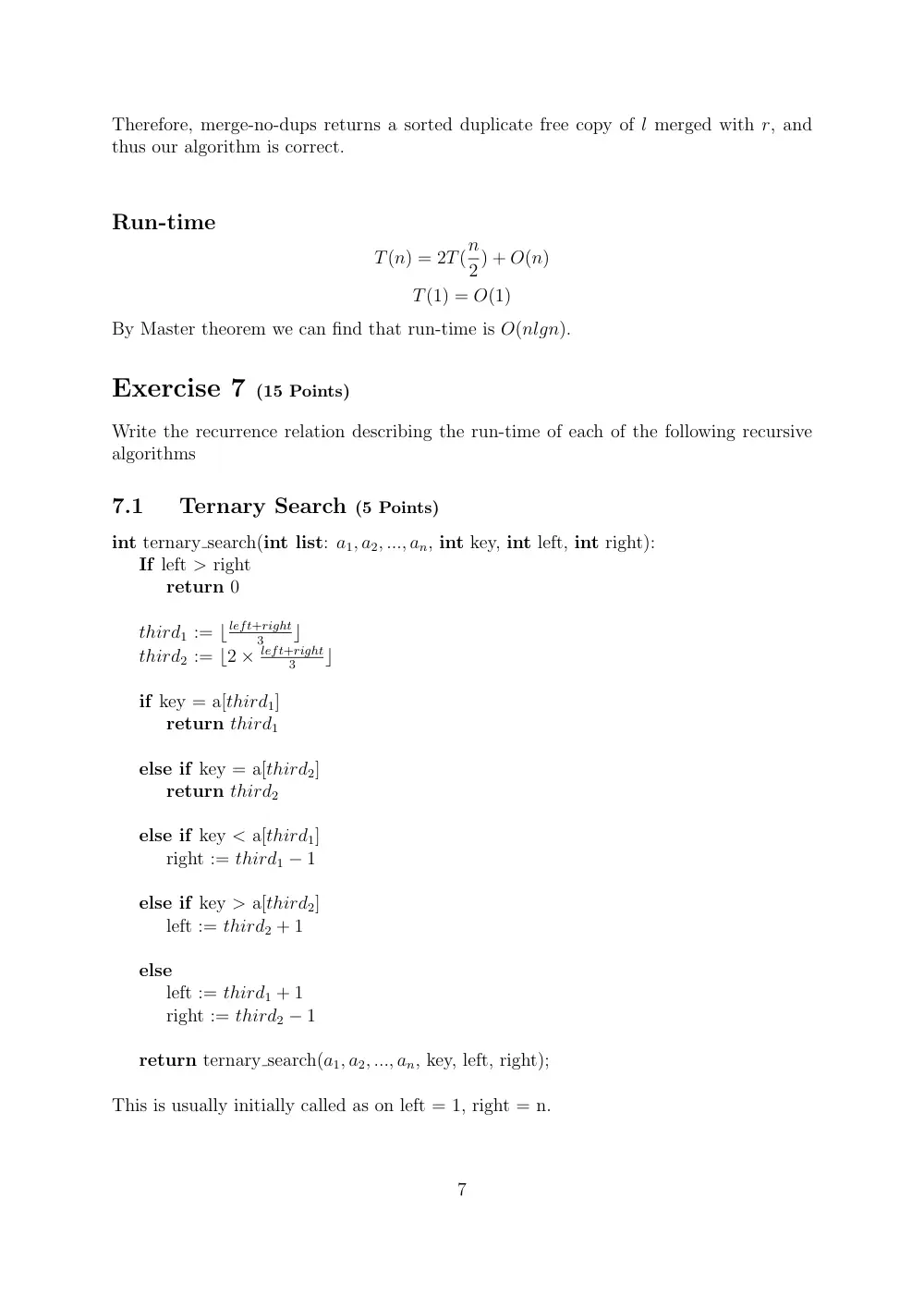
Exercise 7 (15 Points)
Write the recurrence relation describing the run-time of each of the following recursive
algorithms
7.1
Ternary Search (5 Points)
int ternary search(int list: a1, a2, ..., an, int key, int left, int right):
If left > right
return 0
third1 := ⌊ left+right
3
⌋
third2 := ⌊2 × left+right
3
⌋
if key = a[third1]
return third1
else if key = a[third2]
return third2
else if key < a[third1]
right := third1 − 1
else if key > a[third2]
left := third2 + 1
else
left := third1 + 1
right := third2 − 1
return ternary search(a1, a2, ..., an, key, left, right);
This is usually initially called as on left = 1, right = n.
7
7.1
Run-time
T(n) = T(n
3) + O(1)
T(1) = C
∈ Θ(log3(n))
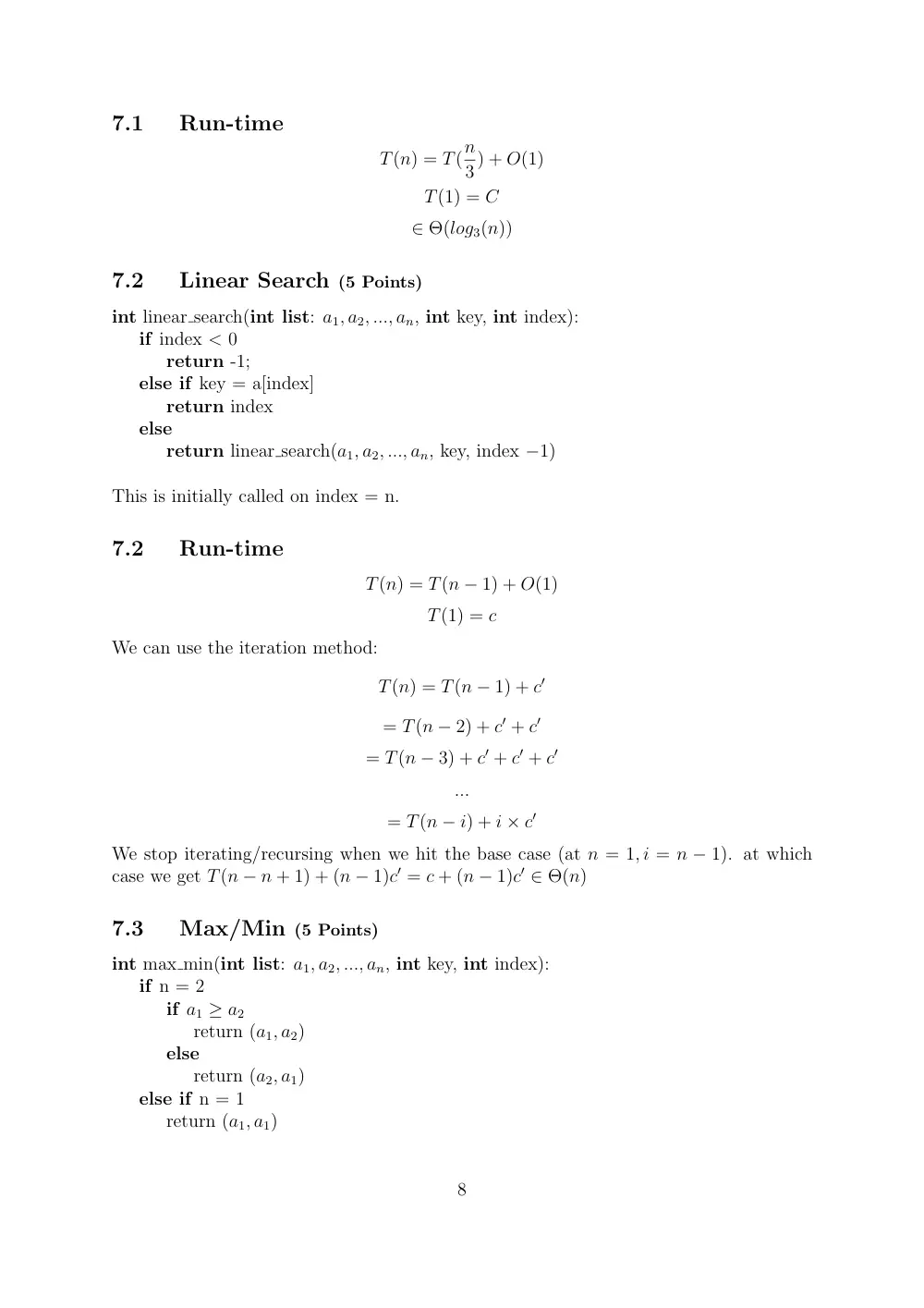
7.2
Linear Search (5 Points)
int linear search(int list: a1, a2, ..., an, int key, int index):
if index < 0
return -1;
else if key = a[index]
return index
else
return linear search(a1, a2, ..., an, key, index −1)
This is initially called on index = n.
7.2
Run-time
T(n) = T(n − 1) + O(1)
T(1) = c
We can use the iteration method:
T(n) = T(n − 1) + c′
= T(n − 2) + c′ + c′
= T(n − 3) + c′ + c′ + c′
...
= T(n − i) + i × c′
We stop iterating/recursing when we hit the base case (at n = 1, i = n − 1). at which
case we get T(n − n + 1) + (n − 1)c′ = c + (n − 1)c′ ∈ Θ(n)
7.3
Max/Min (5 Points)
int max min(int list: a1, a2, ..., an, int key, int index):
if n = 2
if a1 ≥ a2
return (a1, a2)
else
return (a2, a1)
else if n = 1
return (a1, a1)
8
S1 := {a1, a2, ..., a n
4 }
S2 := {a n
4 +1, a n
4 +2, ..., a n
2 }
S3 := {a n
2 +1, a n
2 +2, ..., a3× n
4 }
S4 := {a3× n
4 +1, a3× n
4 +2, ..., an}
(max1, min1) := max min(S1)
(max2, min2) := max min(S2)
(max3, min3) := max min(S3)
(max4, min4) := max min(S4)
maxs = [max1, max2, max3, max4]
mins = [min1, min2, min3, min4]
(max,
) := max min(maxs)
#
means value is ignored
( , min) := max min(mins)
return (max, min)
7.3
Run-time
Notice that max min(maxs) and max min(mins) run on arrays of fixed constant size (4),
therefore they are considered to run in constant time O(1).
T(n) = 4T(n
4) + O(1)
T(1) = c
∈ Θ(n)
Exercise 8 (10 Points)
Use Masters theorem to run-time of each of the following recurrences:
1. T(n) = 2T( n
2) + O(n2).
logb(a) = log2(2) = 1. clearly n2 ∈ Ω(n1+ϵ) (ϵ < 1).
Also 2f( n2
2 ) ≤ 2n2 for all n (Regularity condition holds).
Therefore T(n) ∈ Θ(n2)
2. T(n) = T( n
2) + O(1).
logb(a) = log2(1) = 0. Notice that nlogb(a) = n0 = 1 Constant.
Therefore f(n) ∈ Θ(nlogb(a)).
Therefore T(n) ∈ Θ(nlogb(a)log(n)) ∈ Θ(log(n))
3. T(n) = 2T( n
2) + O(1).
logb(a) = log2(2) = 1. Notice that f(n) is constant,
9
Therefore it is in O(nlogb(a)−ϵ) (ϵ < 1).
Therefore T(n) ∈ Θ(nlogb(a)) ∈ Θ(n)
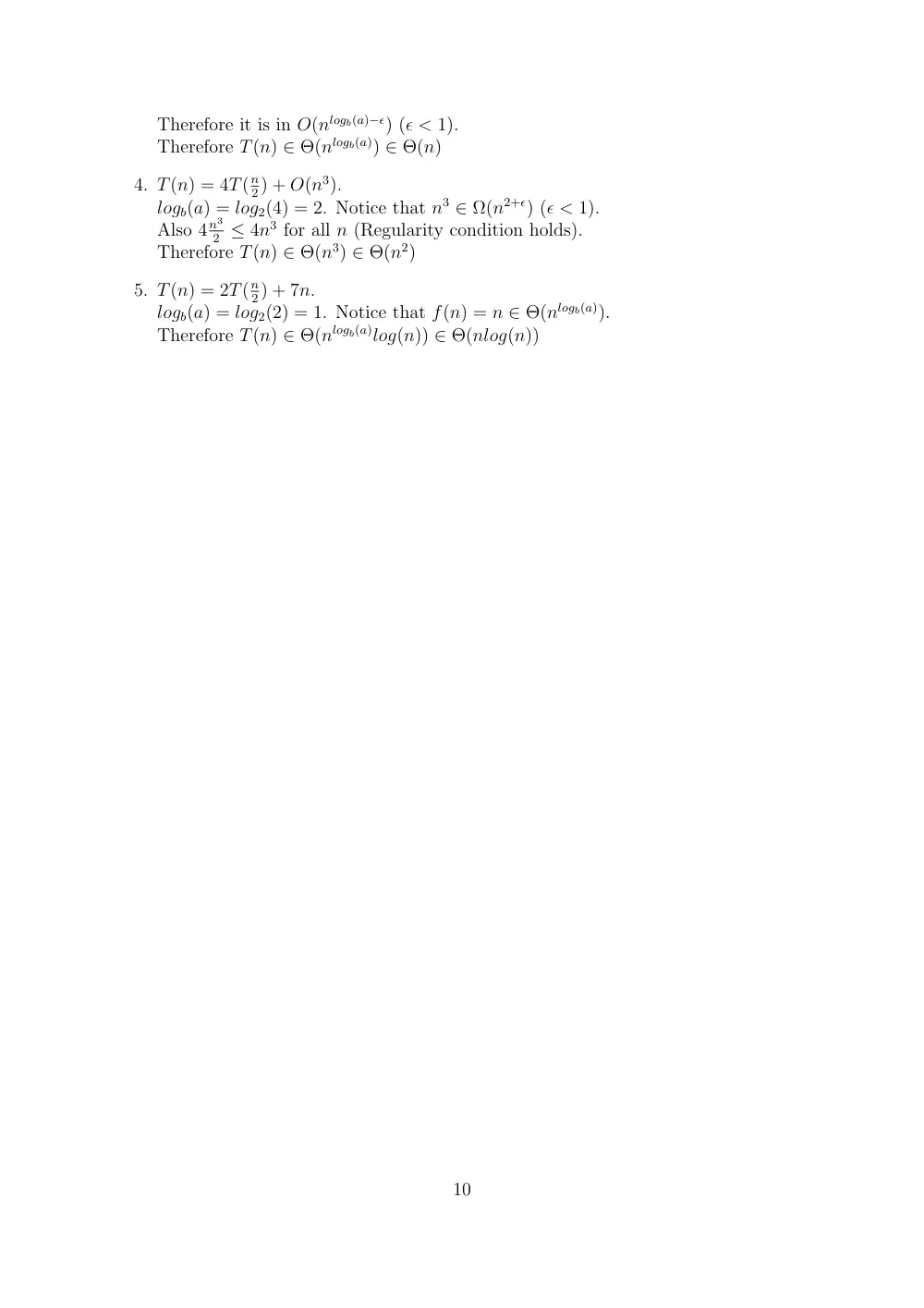
4. T(n) = 4T( n
2) + O(n3).
logb(a) = log2(4) = 2. Notice that n3 ∈ Ω(n2+ϵ) (ϵ < 1).
Also 4 n3
2 ≤ 4n3 for all n (Regularity condition holds).
Therefore T(n) ∈ Θ(n3) ∈ Θ(n2)
5. T(n) = 2T( n
2) + 7n.
logb(a) = log2(2) = 1. Notice that f(n) = n ∈ Θ(nlogb(a)).
Therefore T(n) ∈ Θ(nlogb(a)log(n)) ∈ Θ(nlog(n))
10