
CMPS 253 Final, Fall 2010
American University of Beirut · Professional Practice · 3 pages

More CMPS 253 files
Show the text of this final exam
CMPS 253: SOFTWARE ENGINEERING, Fall 2010 – 2011
Final Examination
Saturday January 29, 8:00 – 10:00 a.m., Nicely 415
Instructions.
• Please leave the first page blank: write only your name and section number.
• Please draw a horizontal line across the page between the answers to each question.
• You may refer to the following during the exam: the course textbook, the course lecture
notes, your homework solutions, any notes that you have taken in class. If you wish to
use existing results, please cite them properly, e.g., use a page number for results in the
course textbook, or a lecture title and page number for results in the course notes.
• You may not refer to any other materials.
Good luck!
1. (40 points) Consider the following procedure:
public static int values(int[] a)
//REQUIRES: a is not null
//EFFECTS: returns the number of distinct values in a, i.e., returns
//
| { v : (exists i : 0 <= i < a.length : v = a[i]) } |
1a. (20 points) Provide an implementation (code) for values that satisfies the following con-
ditions:
1. It contains at most one while loop
2. It calls a single helper procedure
1b. (10 points) Provide a specification for the helper, i.e., REQUIRES and EFFECTS clauses.
1c. (10 points) Provide an implementation for the helper. The implementation of the helper
must contain at most one while loop.
Sample solution:
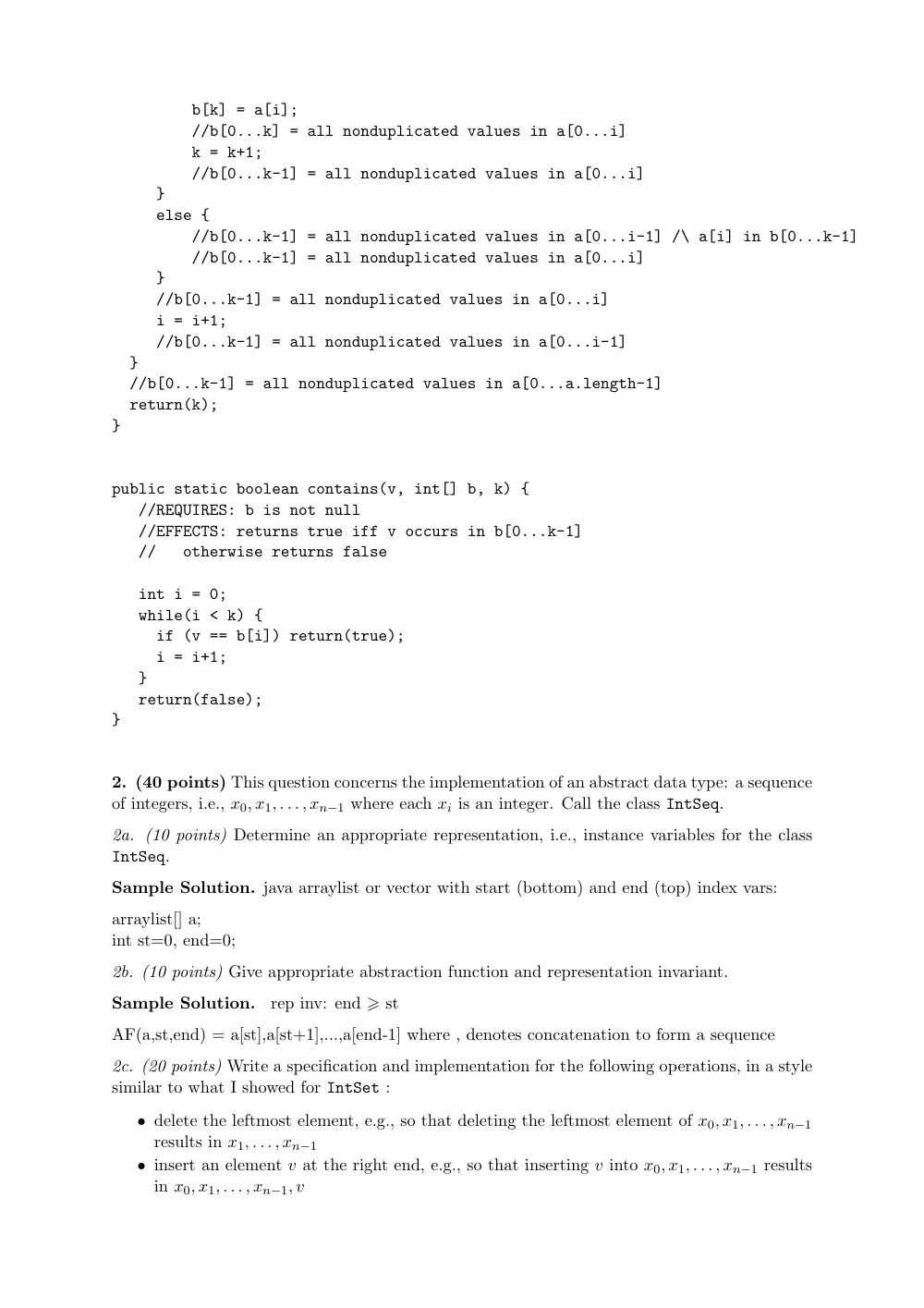
public static int values(int[] a) {
//REQUIRES: a is not null
//EFFECTS: returns the number of distinct values in a, i.e., returns
//
vals(a, a.length) where
//
vals(a, i) = | { v : (exists j : 0 <= j < i : v = a[j]) } |
int i = 0;
//loop counter
int[] b = new int[a.length];
int k=0;[
//index into b; b[0...k-1], which contains all
//nonduplicated values in a[0...i-1]
//invariant: b[0...k-1] = all nonduplicated values in a[0...i-1]
while(i < a.length) {
//b[0...k-1] = all nonduplicated values in a[0...i-1]
if (!contains(a[i],b,k)) {
//b[0...k-1] = all nonduplicated values in a[0...i-1] /\ a[i] notin b[0...k-1]
b[k] = a[i];
//b[0...k] = all nonduplicated values in a[0...i]
k = k+1;
//b[0...k-1] = all nonduplicated values in a[0...i]
}
else {
//b[0...k-1] = all nonduplicated values in a[0...i-1] /\ a[i] in b[0...k-1]
//b[0...k-1] = all nonduplicated values in a[0...i]
}
//b[0...k-1] = all nonduplicated values in a[0...i]
i = i+1;
//b[0...k-1] = all nonduplicated values in a[0...i-1]
}
//b[0...k-1] = all nonduplicated values in a[0...a.length-1]
return(k);
}
public static boolean contains(v, int[] b, k) {
//REQUIRES: b is not null
//EFFECTS: returns true iff v occurs in b[0...k-1]
//
otherwise returns false
int i = 0;
while(i < k) {
if (v == b[i]) return(true);
i = i+1;
}
return(false);
}
2. (40 points) This question concerns the implementation of an abstract data type: a sequence
of integers, i.e., x0, x1, . . . , xn−1 where each xi is an integer. Call the class IntSeq.
2a. (10 points) Determine an appropriate representation, i.e., instance variables for the class
IntSeq.
Sample Solution. java arraylist or vector with start (bottom) and end (top) index vars:
arraylist[] a;
int st=0, end=0;
2b. (10 points) Give appropriate abstraction function and representation invariant.
Sample Solution.
rep inv: end ⩾ st
AF(a,st,end) = a[st],a[st+1],...,a[end-1] where , denotes concatenation to form a sequence
2c. (20 points) Write a specification and implementation for the following operations, in a style
similar to what I showed for IntSet :
• delete the leftmost element, e.g., so that deleting the leftmost element of x0, x1, . . . , xn−1
results in x1, . . . , xn−1
• insert an element v at the right end, e.g., so that inserting v into x0, x1, . . . , xn−1 results
in x0, x1, . . . , xn−1, v
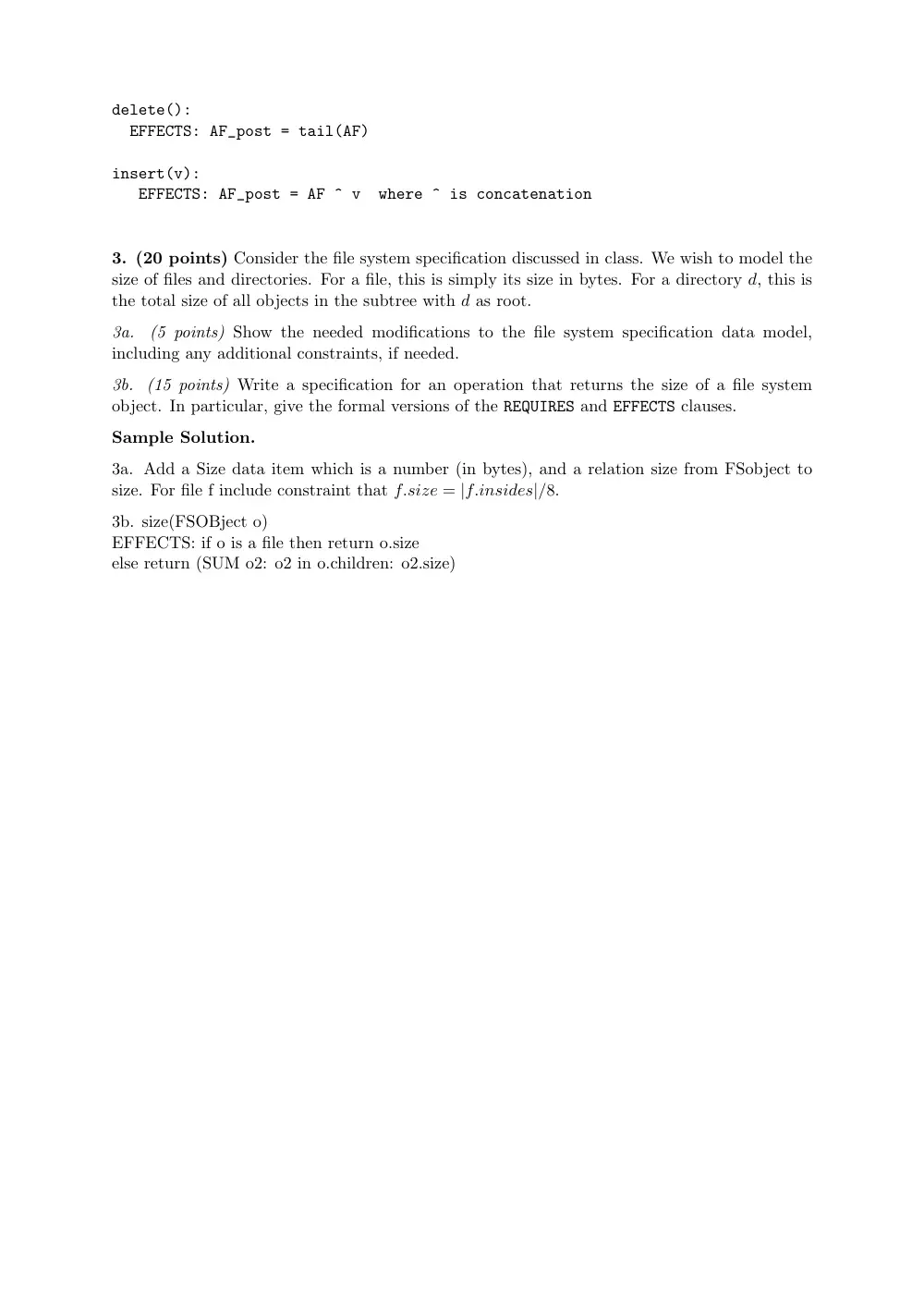
delete():
EFFECTS: AF_post = tail(AF)
insert(v):
EFFECTS: AF_post = AF ^ v
where ^ is concatenation
3. (20 points) Consider the file system specification discussed in class. We wish to model the
size of files and directories. For a file, this is simply its size in bytes. For a directory d, this is
the total size of all objects in the subtree with d as root.
3a.
(5 points) Show the needed modifications to the file system specification data model,
including any additional constraints, if needed.
3b. (15 points) Write a specification for an operation that returns the size of a file system
object. In particular, give the formal versions of the REQUIRES and EFFECTS clauses.
Sample Solution.
3a. Add a Size data item which is a number (in bytes), and a relation size from FSobject to
size. For file f include constraint that f.size = |f.insides|/8.
3b. size(FSOBject o)
EFFECTS: if o is a file then return o.size
else return (SUM o2: o2 in o.children: o2.size)