
CMPS 253 Midterm, Fall 2010
American University of Beirut · Professional Practice · 2 pages
More CMPS 253 files
Show the text of this exam
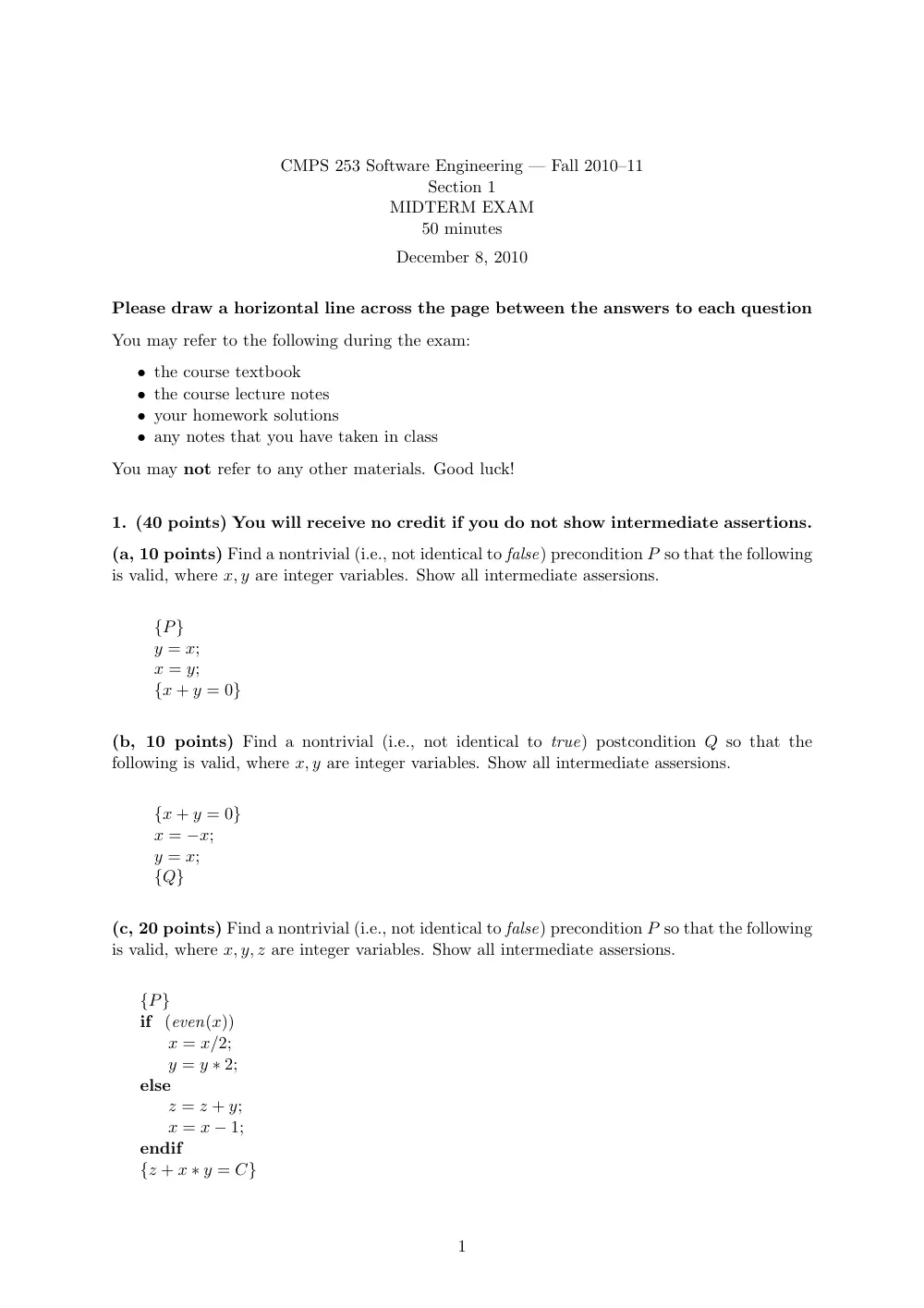
CMPS 253 Software Engineering — Fall 2010–11
Section 1
MIDTERM EXAM
50 minutes
December 8, 2010
Please draw a horizontal line across the page between the answers to each question
You may refer to the following during the exam:
• the course textbook
• the course lecture notes
• your homework solutions
• any notes that you have taken in class
You may not refer to any other materials. Good luck!
1. (40 points) You will receive no credit if you do not show intermediate assertions.
(a, 10 points) Find a nontrivial (i.e., not identical to false) precondition P so that the following
is valid, where x, y are integer variables. Show all intermediate assersions.
{P}
y = x;
x = y;
{x + y = 0}
(b, 10 points) Find a nontrivial (i.e., not identical to true) postcondition Q so that the
following is valid, where x, y are integer variables. Show all intermediate assersions.
{x + y = 0}
x = −x;
y = x;
{Q}
(c, 20 points) Find a nontrivial (i.e., not identical to false) precondition P so that the following
is valid, where x, y, z are integer variables. Show all intermediate assersions.
{P}
if (even(x))
x = x/2;
y = y ∗ 2;
else
z = z + y;
x = x − 1;
endif
{z + x ∗ y = C}
1
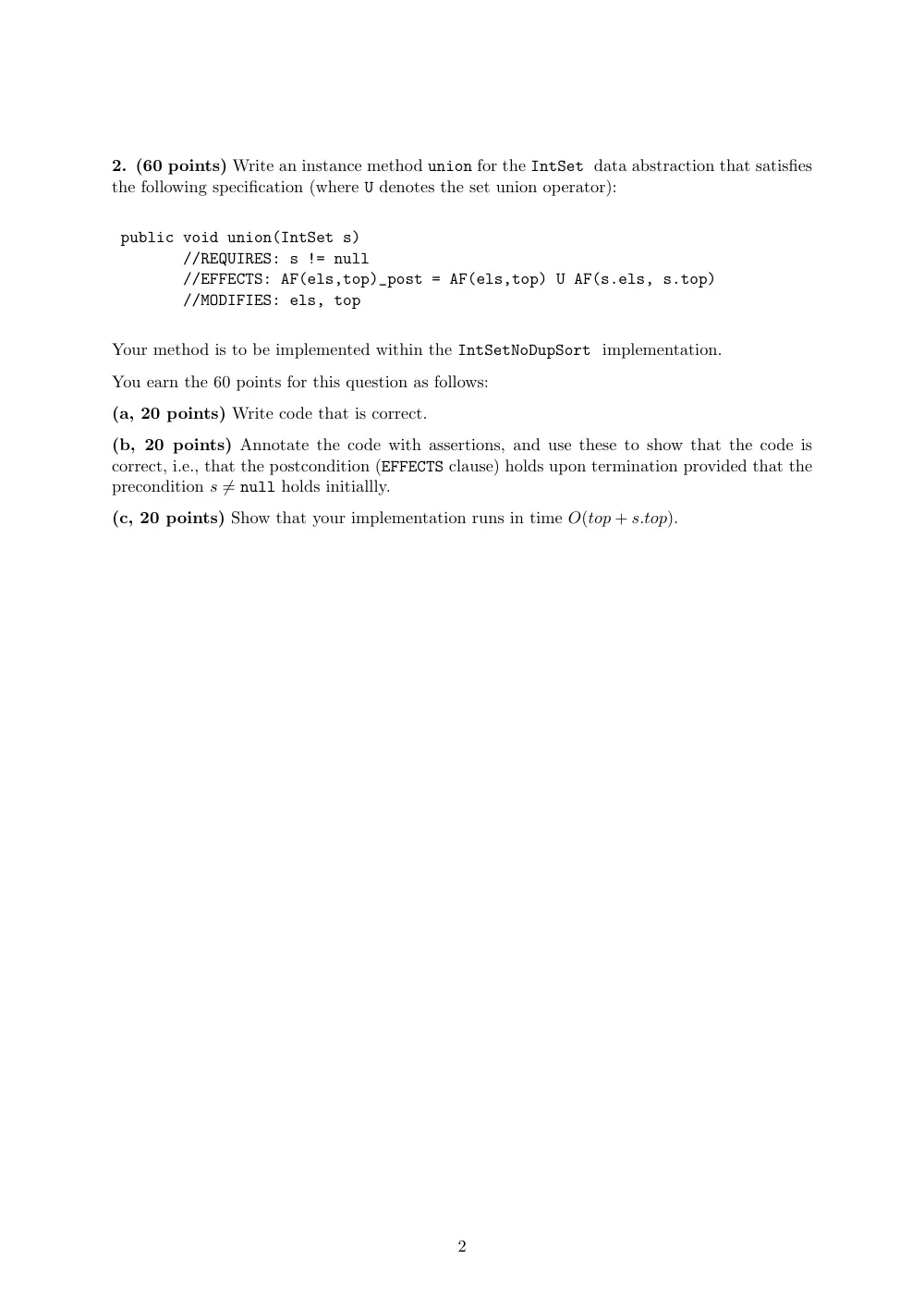
2. (60 points) Write an instance method union for the IntSet data abstraction that satisfies
the following specification (where U denotes the set union operator):
public void union(IntSet s)
//REQUIRES: s != null
//EFFECTS: AF(els,top)_post = AF(els,top) U AF(s.els, s.top)
//MODIFIES: els, top
Your method is to be implemented within the IntSetNoDupSort implementation.
You earn the 60 points for this question as follows:
(a, 20 points) Write code that is correct.
(b, 20 points) Annotate the code with assertions, and use these to show that the code is
correct, i.e., that the postcondition (EFFECTS clause) holds upon termination provided that the
precondition s ̸= null holds initiallly.
(c, 20 points) Show that your implementation runs in time O(top + s.top).
2