
CMPS 258 Final, Fall 2005
American University of Beirut · Programming Languages · 9 pages
More CMPS 258 files
Show the text of this final exam
American University of Beirut
CMPS 258
Programming Languages
Fall 2005-06
Final Exam
Date: Jan. 28th 3:00 – 5:00pm.
Name: -------------------------
Instructor: Chiraz Ben Abdelkader
• This exam is closed-book and closed notes. You are allowed to bring 2 A4 papers of notes,
front and back.
• There are 9 pages and 4 sets of questions, for a total of 100 points.
• The questions are broken down into four main parts as shown below; plan your time wisely
based on the distribution of points and difficulty of the questions.
• Write as legibly as you can, otherwise I might NOT mark your answer!
Subprograms ……………………………….………… / 20 points
Functional Programming ……………………………/ 25 points
Object-oriented programming ………………………/ 30 points
Miscellaneous …………………………………………/ 25 points
Total……………………………………………………/100 points
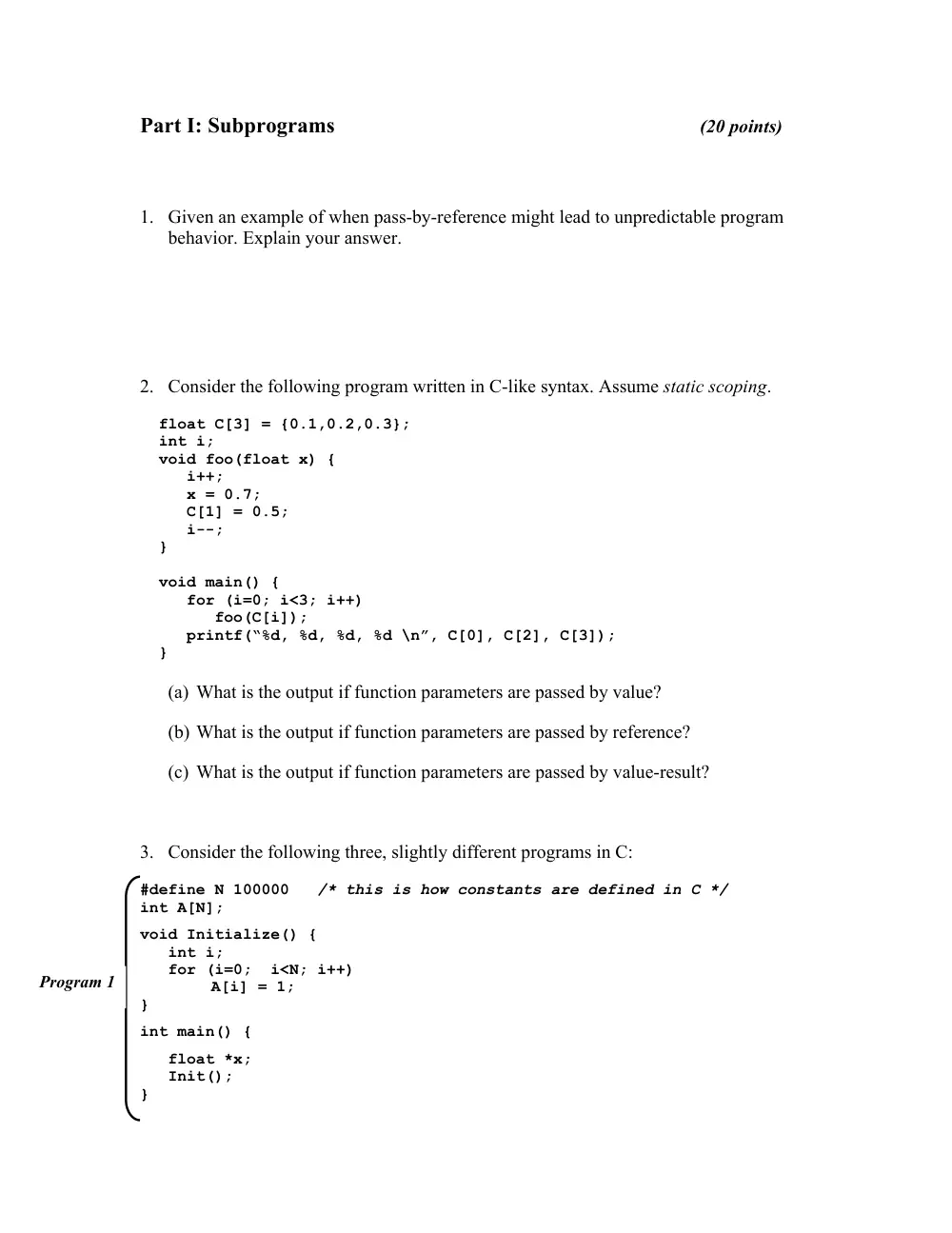
Part I: Subprograms
(20 points)
1. Given an example of when pass-by-reference might lead to unpredictable program
behavior. Explain your answer.
2. Consider the following program written in C-like syntax. Assume static scoping.
float C[3] = {0.1,0.2,0.3};
int i;
void foo(float x) {
i++;
x = 0.7;
C[1] = 0.5;
i--;
}
void main() {
for (i=0; i<3; i++)
foo(C[i]);
printf(“%d, %d, %d, %d \n”, C[0], C[2], C[3]);
}
(a) What is the output if function parameters are passed by value?
(b) What is the output if function parameters are passed by reference?
(c) What is the output if function parameters are passed by value-result?
3. Consider the following three, slightly different programs in C:
#define N 100000 /* this is how constants are defined in C */
int A[N];
void Initialize() {
int i;
for (i=0; i<N; i++)
A[i] = 1;
}
int main() {
float *x;
Init();
}
Program 1
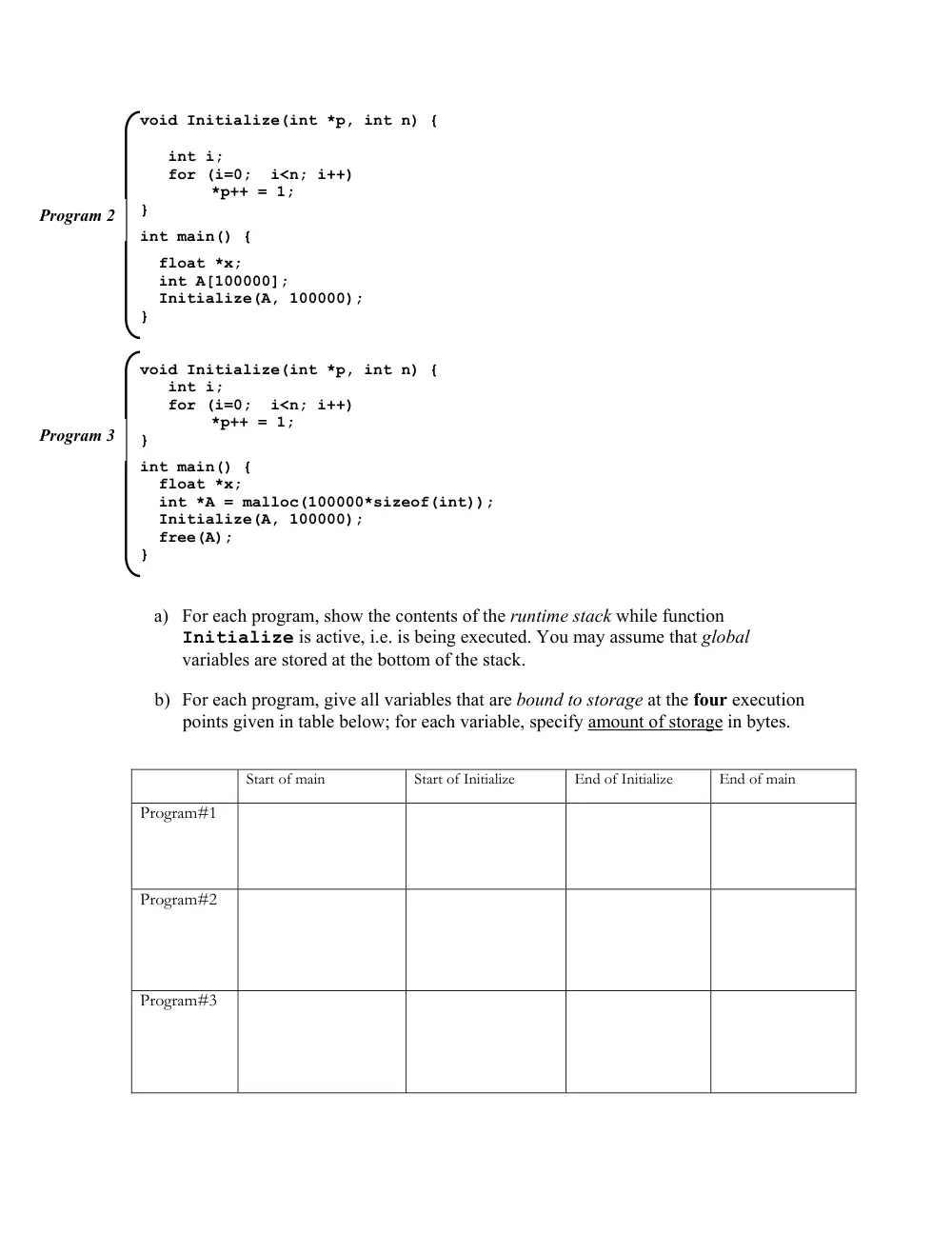
void Initialize(int *p, int n) {
int i;
for (i=0; i<n; i++)
*p++ = 1;
}
int main() {
float *x;
int A[100000];
Initialize(A, 100000);
}
void Initialize(int *p, int n) {
int i;
for (i=0; i<n; i++)
*p++ = 1;
}
int main() {
float *x;
int *A = malloc(100000*sizeof(int));
Initialize(A, 100000);
free(A);
}
a) For each program, show the contents of the runtime stack while function
Initialize is active, i.e. is being executed. You may assume that global
variables are stored at the bottom of the stack.
b) For each program, give all variables that are bound to storage at the four execution
points given in table below; for each variable, specify amount of storage in bytes.
Start of main
Start of Initialize
End of Initialize
End of main
Program#1
Program#2
Program#3
Program 2
Program 3
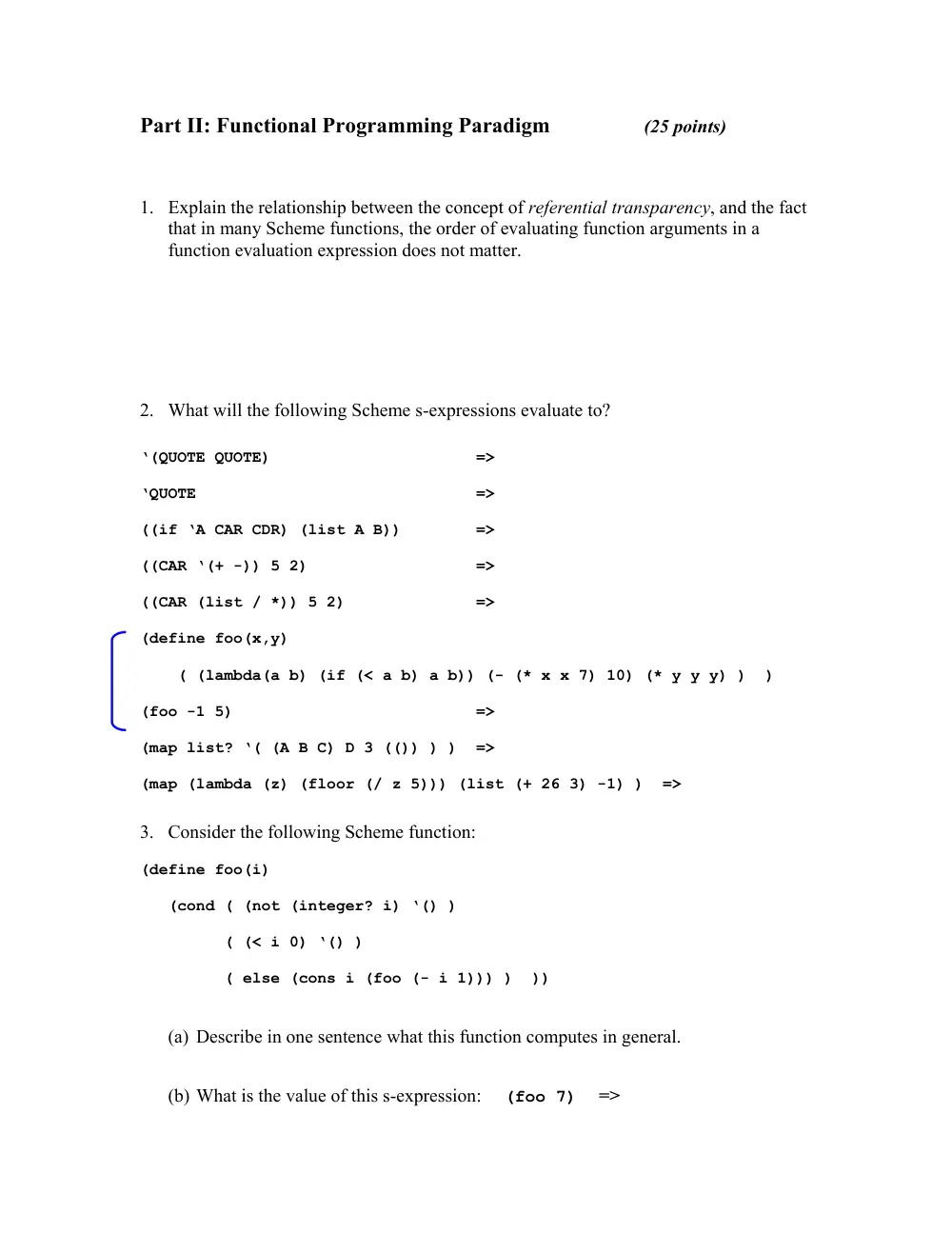
Part II: Functional Programming Paradigm
(25 points)
1. Explain the relationship between the concept of referential transparency, and the fact
that in many Scheme functions, the order of evaluating function arguments in a
function evaluation expression does not matter.
2. What will the following Scheme s-expressions evaluate to?
‘(QUOTE QUOTE)
=>
‘QUOTE
=>
((if ‘A CAR CDR) (list A B))
=>
((CAR ‘(+ -)) 5 2)
=>
((CAR (list / *)) 5 2)
=>
(define foo(x,y)
( (lambda(a b) (if (< a b) a b)) (- (* x x 7) 10) (* y y y) ) )
(foo -1 5)
=>
(map list? ‘( (A B C) D 3 (()) ) ) =>
(map (lambda (z) (floor (/ z 5))) (list (+ 26 3) -1) ) =>
3. Consider the following Scheme function:
(define foo(i)
(cond ( (not (integer? i) ‘() )
( (< i 0) ‘() )
( else (cons i (foo (- i 1))) ) ))
(a) Describe in one sentence what this function computes in general.
(b) What is the value of this s-expression: (foo 7) =>
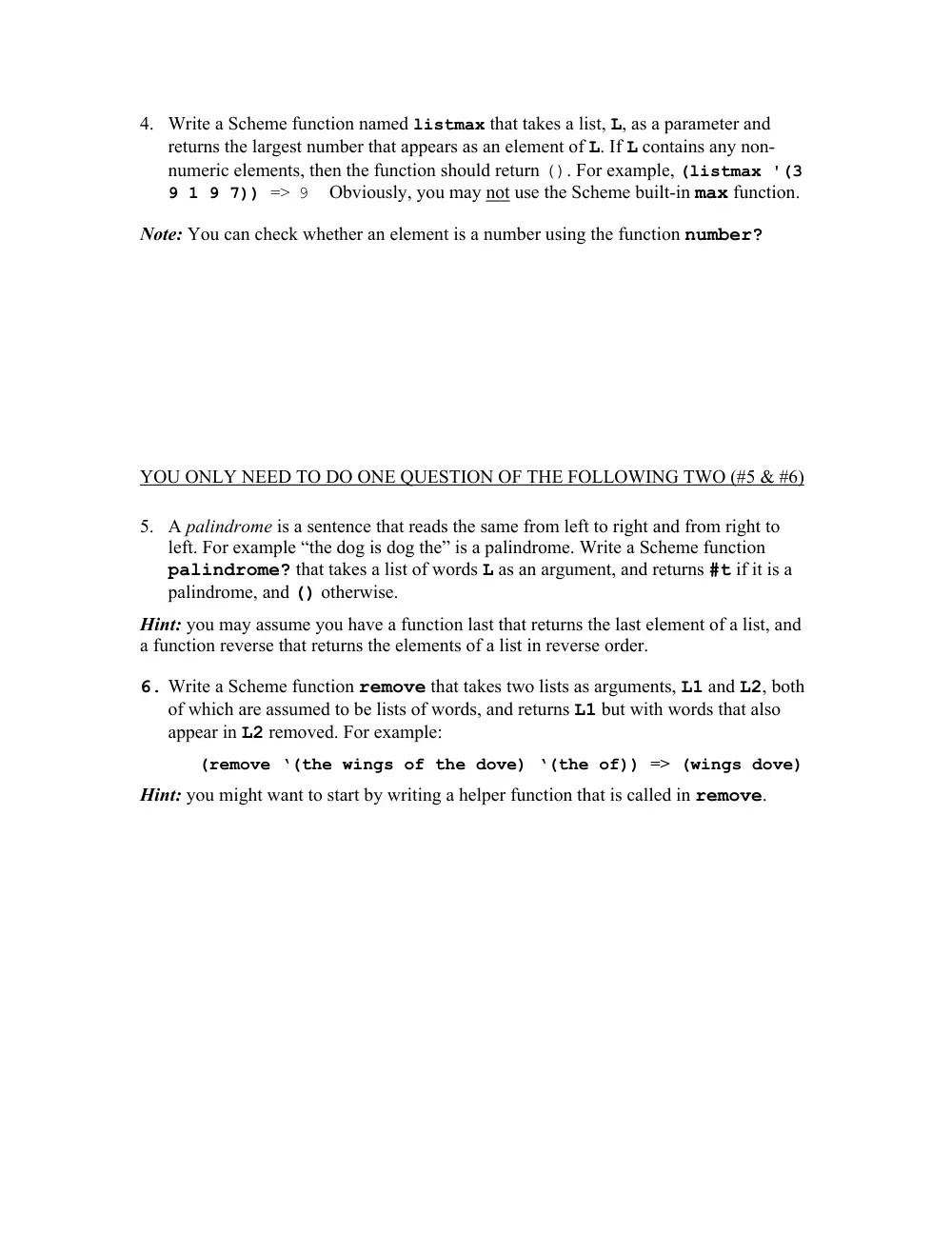
4. Write a Scheme function named listmax that takes a list, L, as a parameter and
returns the largest number that appears as an element of L. If L contains any non-
numeric elements, then the function should return (). For example, (listmax '(3
9 1 9 7)) => 9 Obviously, you may not use the Scheme built-in max function.
Note: You can check whether an element is a number using the function number?
YOU ONLY NEED TO DO ONE QUESTION OF THE FOLLOWING TWO (#5 & #6)
5. A palindrome is a sentence that reads the same from left to right and from right to
left. For example “the dog is dog the” is a palindrome. Write a Scheme function
palindrome? that takes a list of words L as an argument, and returns #t if it is a
palindrome, and () otherwise.
Hint: you may assume you have a function last that returns the last element of a list, and
a function reverse that returns the elements of a list in reverse order.
6. Write a Scheme function remove that takes two lists as arguments, L1 and L2, both
of which are assumed to be lists of words, and returns L1 but with words that also
appear in L2 removed. For example:
(remove ‘(the wings of the dove) ‘(the of)) => (wings dove)
Hint: you might want to start by writing a helper function that is called in remove.
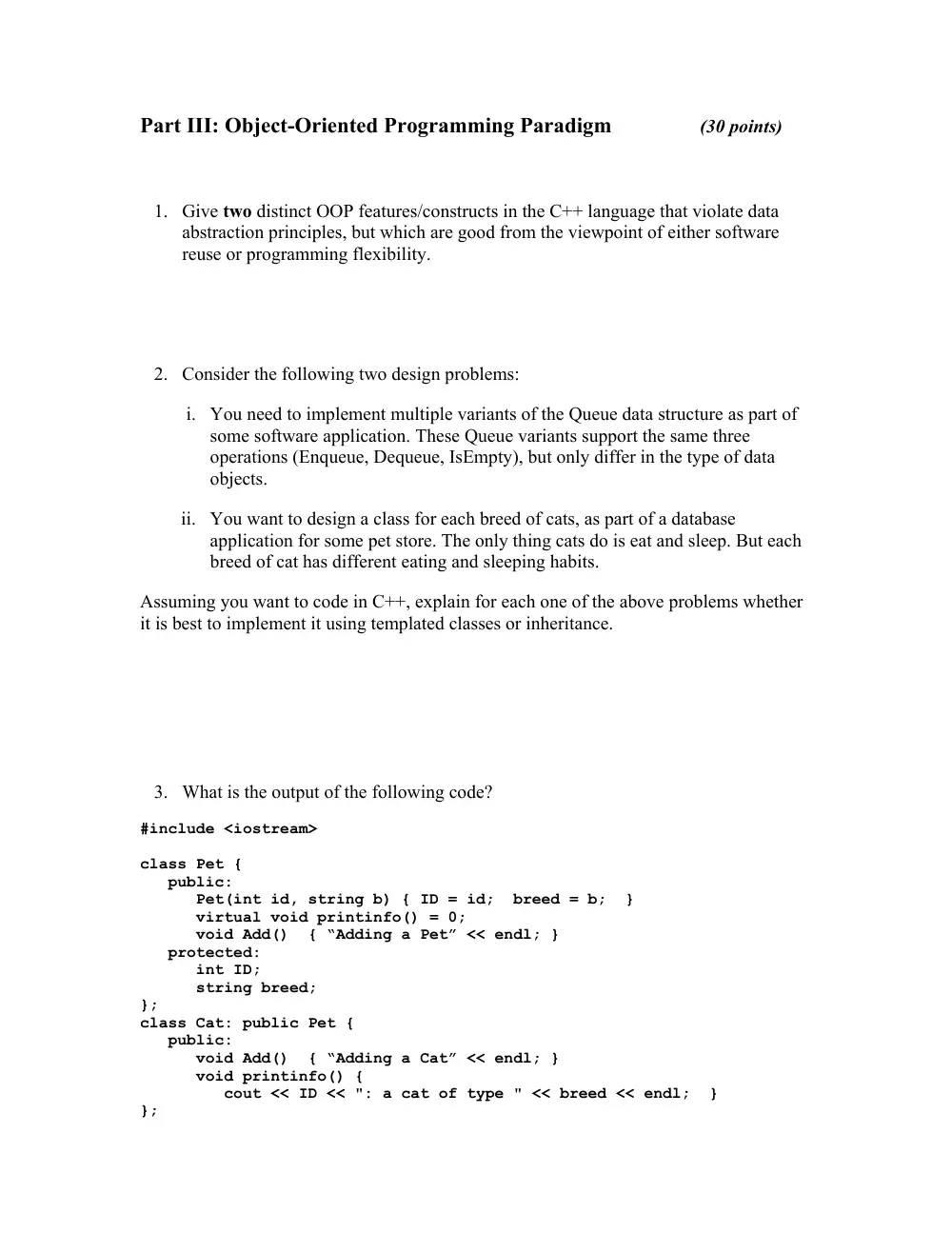
Part III: Object-Oriented Programming Paradigm
(30 points)
1. Give two distinct OOP features/constructs in the C++ language that violate data
abstraction principles, but which are good from the viewpoint of either software
reuse or programming flexibility.
2. Consider the following two design problems:
i. You need to implement multiple variants of the Queue data structure as part of
some software application. These Queue variants support the same three
operations (Enqueue, Dequeue, IsEmpty), but only differ in the type of data
objects.
ii. You want to design a class for each breed of cats, as part of a database
application for some pet store. The only thing cats do is eat and sleep. But each
breed of cat has different eating and sleeping habits.
Assuming you want to code in C++, explain for each one of the above problems whether
it is best to implement it using templated classes or inheritance.
3. What is the output of the following code?
#include <iostream>
class Pet {
public:
Pet(int id, string b) { ID = id; breed = b; }
virtual void printinfo() = 0;
void Add() { “Adding a Pet” << endl; }
protected:
int ID;
string breed;
};
class Cat: public Pet {
public:
void Add() { “Adding a Cat” << endl; }
void printinfo() {
cout << ID << ": a cat of type " << breed << endl; }
};
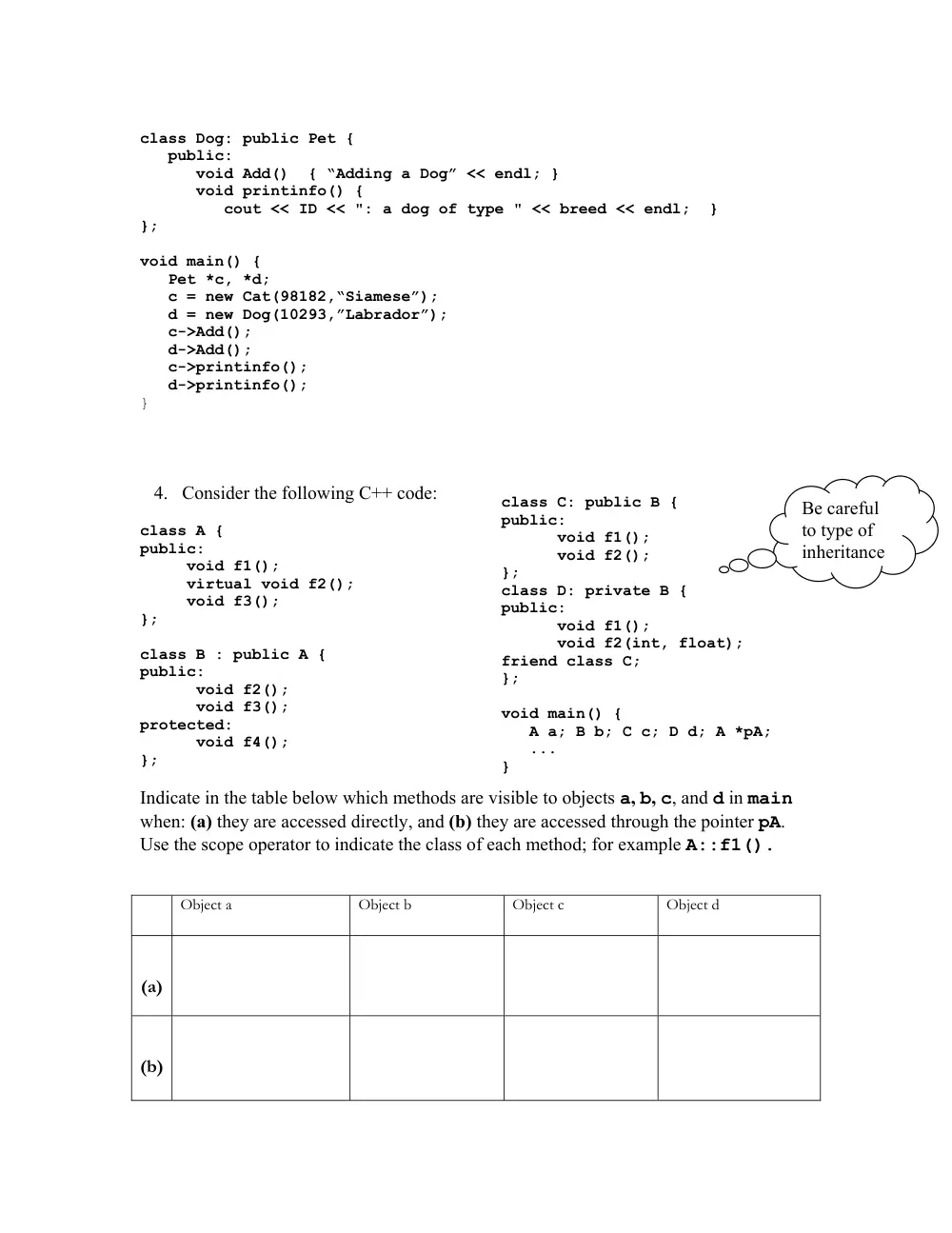
class Dog: public Pet {
public:
void Add() { “Adding a Dog” << endl; }
void printinfo() {
cout << ID << ": a dog of type " << breed << endl; }
};
void main() {
Pet *c, *d;
c = new Cat(98182,“Siamese”);
d = new Dog(10293,”Labrador”);
c->Add();
d->Add();
c->printinfo();
d->printinfo();
}
4. Consider the following C++ code:
class A {
public:
void f1();
virtual void f2();
void f3();
};
class B : public A {
public:
void f2();
void f3();
protected:
void f4();
};
Indicate in the table below which methods are visible to objects a, b, c, and d in main
when: (a) they are accessed directly, and (b) they are accessed through the pointer pA.
Use the scope operator to indicate the class of each method; for example A::f1().
Object a
Object b
Object c
Object d
(a)
(b)
class C: public B {
public:
void f1();
void f2();
};
class D: private B {
public:
void f1();
void f2(int, float);
friend class C;
};
void main() {
A a; B b; C c; D d; A *pA;
...
}
Be careful
to type of
inheritance
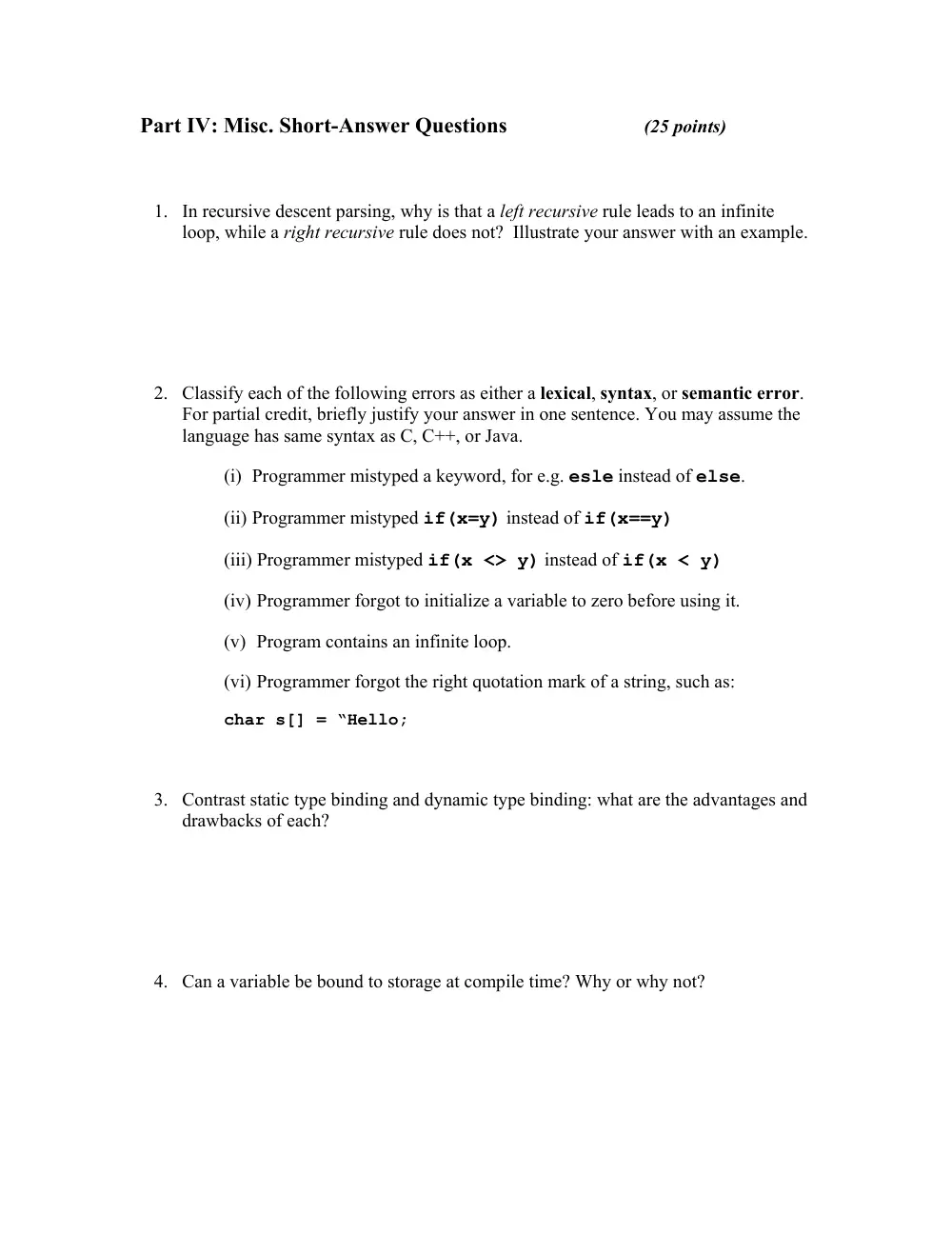
Part IV: Misc. Short-Answer Questions
(25 points)
1. In recursive descent parsing, why is that a left recursive rule leads to an infinite
loop, while a right recursive rule does not? Illustrate your answer with an example.
2. Classify each of the following errors as either a lexical, syntax, or semantic error.
For partial credit, briefly justify your answer in one sentence. You may assume the
language has same syntax as C, C++, or Java.
(i) Programmer mistyped a keyword, for e.g. esle instead of else.
(ii) Programmer mistyped if(x=y) instead of if(x==y)
(iii) Programmer mistyped if(x <> y) instead of if(x < y)
(iv) Programmer forgot to initialize a variable to zero before using it.
(v) Program contains an infinite loop.
(vi) Programmer forgot the right quotation mark of a string, such as:
char s[] = “Hello;
3. Contrast static type binding and dynamic type binding: what are the advantages and
drawbacks of each?
4. Can a variable be bound to storage at compile time? Why or why not?
5. Give two reasons why the compiler needs to maintain/store descriptors for all
variables in a program (during compilation)?
6. Why is array access via subscripting potentially slower than array access via
pointers?
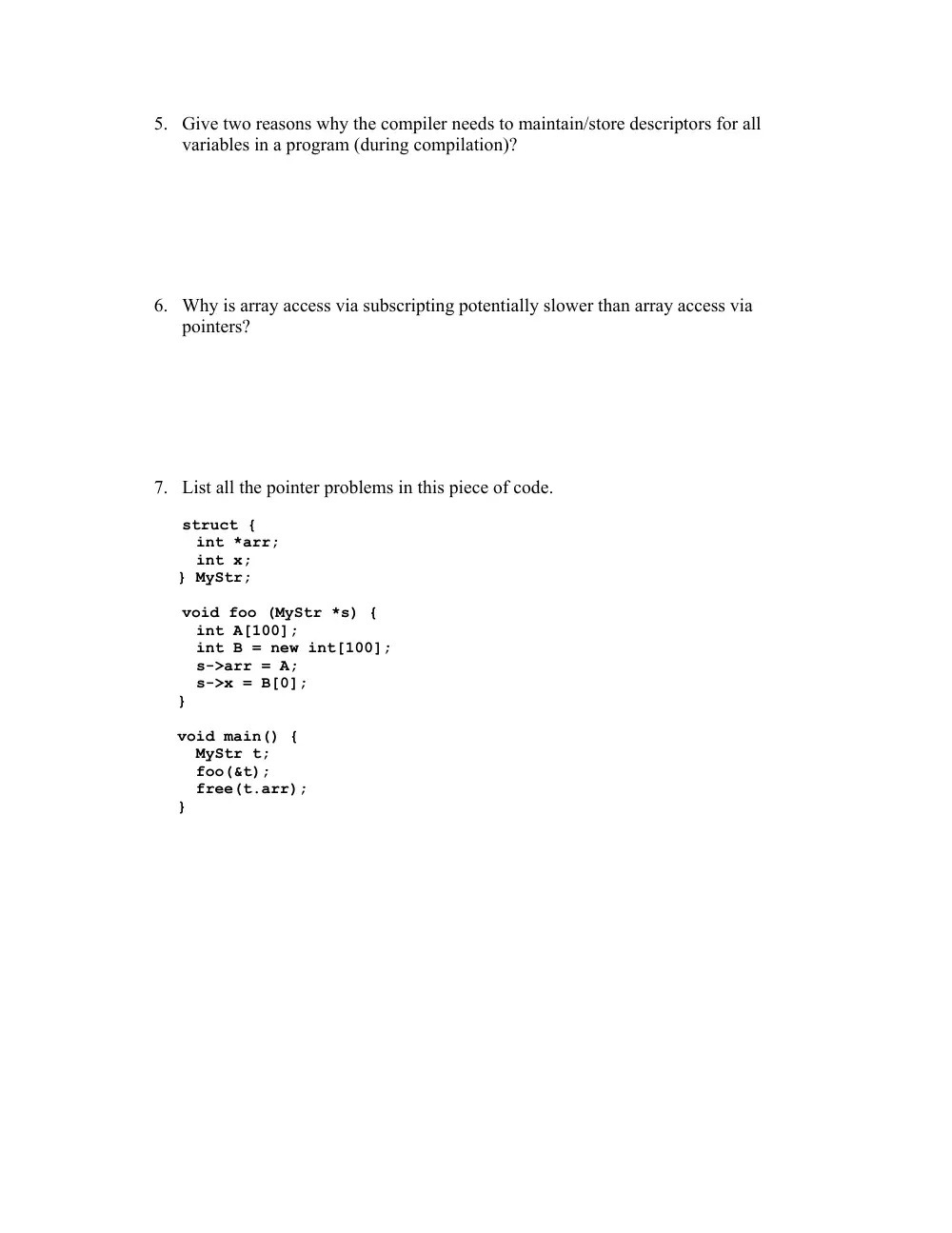
7. List all the pointer problems in this piece of code.
struct {
int *arr;
int x;
} MyStr;
void foo (MyStr *s) {
int A[100];
int B = new int[100];
s->arr = A;
s->x = B[0];
}
void main() {
MyStr t;
foo(&t);
free(t.arr);
}