
CMPS 258 Final, Spring 2005
American University of Beirut · Programming Languages · 15 pages




Showing the first 10 of 15 pages. Download the PDF to see all of it.
More CMPS 258 files
Show the text of this final exam
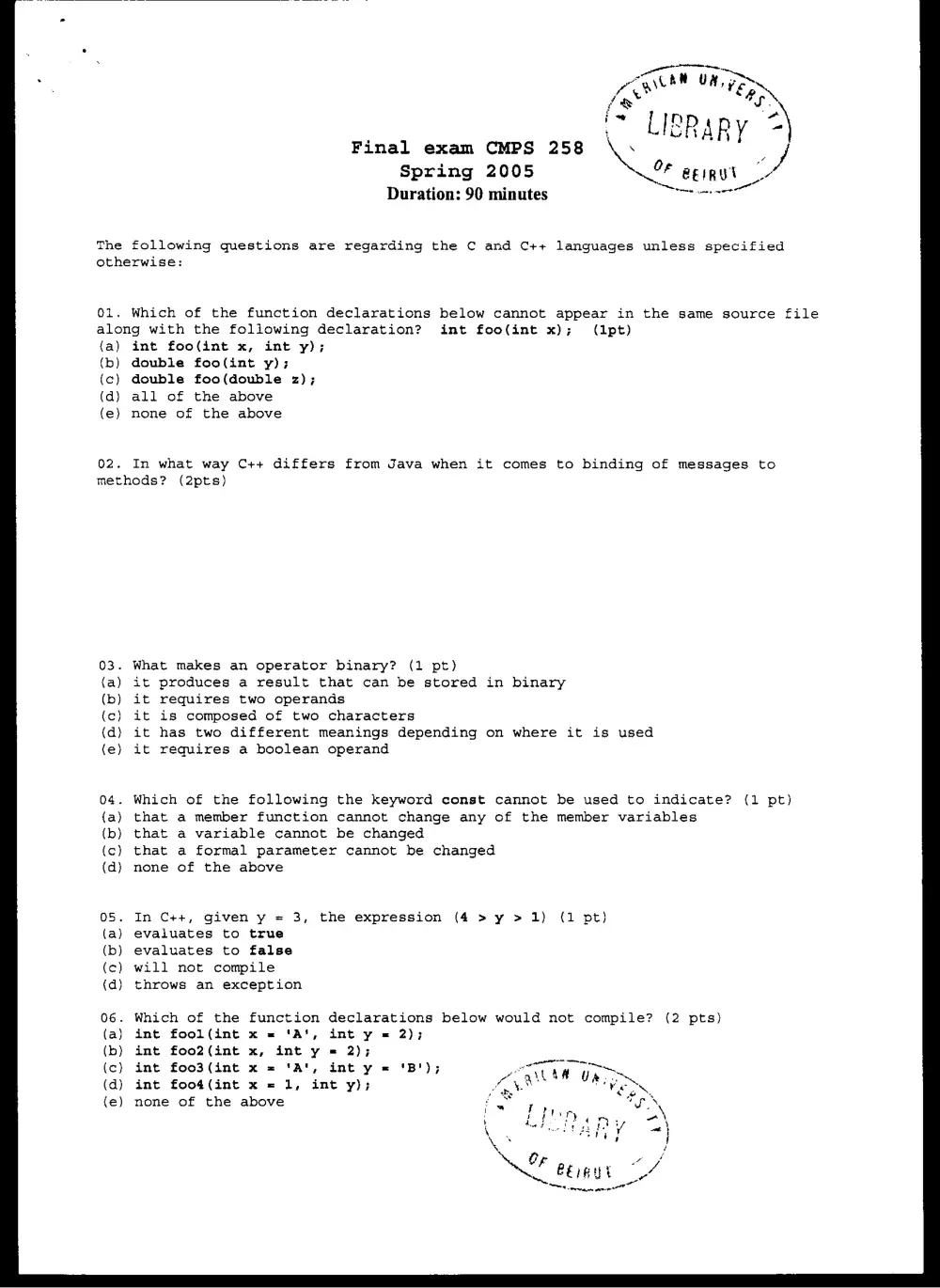
Final exam CMPS 258 \ .
Spring 2005 OF aeiRyt
Duration: 90 minutes etl
The following questions are regarding the C and C++ languages unless specified
otherwise:
01. Which of the function declarations below cannot appear in the same source file
along with the following declaration? int foo(int x); (l1pt)
{a) int foo(int x, int y);
(b) double foo(int y);
(c) double foo(double z);
(d) all of the above
(e) none of the above
02.
In what way C++ differs from Java when it comes to binding of messages to
methods? (2pts)
03.
(a)
(b)
(c)
(d)
(e)
04.
{a)
(b)
(c)
(da)
os.
(a)
(b)
(¢)
(d)
06.
(a)
(b)
(c}
(d)
{e)
What makes an operator binary? (1 pt)
it produces a result that can be stored in binary
it requires two operands
it is composed of two characters
it has two different meanings depending on where it is used
it requires a boolean operand
Which of the following the keyword const cannot be used to indicate? (1 pt)
that a member function cannot change any of the member variables
that a variable cannot be changed
that a formal parameter cannot be changed
none of the above
In C++, given y = 3, the expression (4 > y > 1) (1 pt)
evaluates to true
evaluates to false
will not compile
throws an exception
Which of the function declarations below would not compile? (2 pts)
int fool(int x = 'A', int y = 2);
int foo2(int x, int y = 2);
int foo3(int x = 'A', int y = 'B');
int food(int x = 1, int y);
none of the above
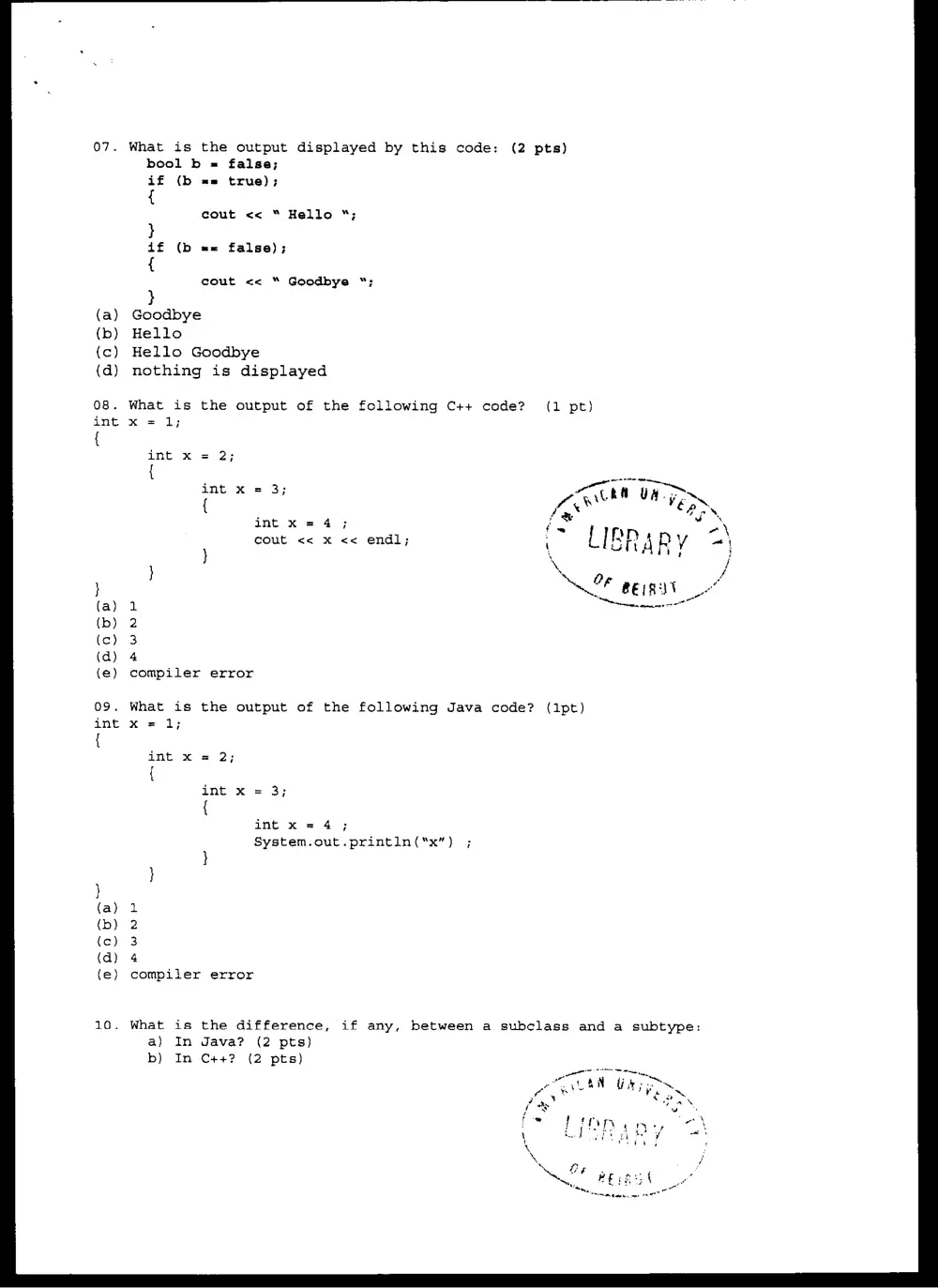
07. What is the output displayed by this code: (2 pts)
bool b = falsa;
if (b == true);
{
}
if (b «= false);
{
}
Goodbye
Hello
Hello Goodbye
nothing is displayed
cout << “ Hello *;
cout << “ Goodbye “;
. What is the output of the following C++ code? (1 pt)
x= 1;
int x 2;
{ aoneeme
int x 3; oe a
{ fo YA gEN.
int x = 4; fe
! v
cout << x << endl; :~ LIBRARY a\
4 t
{
H
\ }
‘, vA
} “SPP ne
f L
(a) acne
(b)
(c)
(d)
(@) compiler error
09. What is the output of the following Java code? (1pt)
int x = 1;
{
int x = 2;
{
int x = 3;
{
int x = 4;
System.out.println ("x") ;
(c)
1
2
3
4
{e) compiler error
10. What is the difference, if any, between a subclass and a subtype:
a) In Java? (2 pts)
b) In C++? (2 pts)
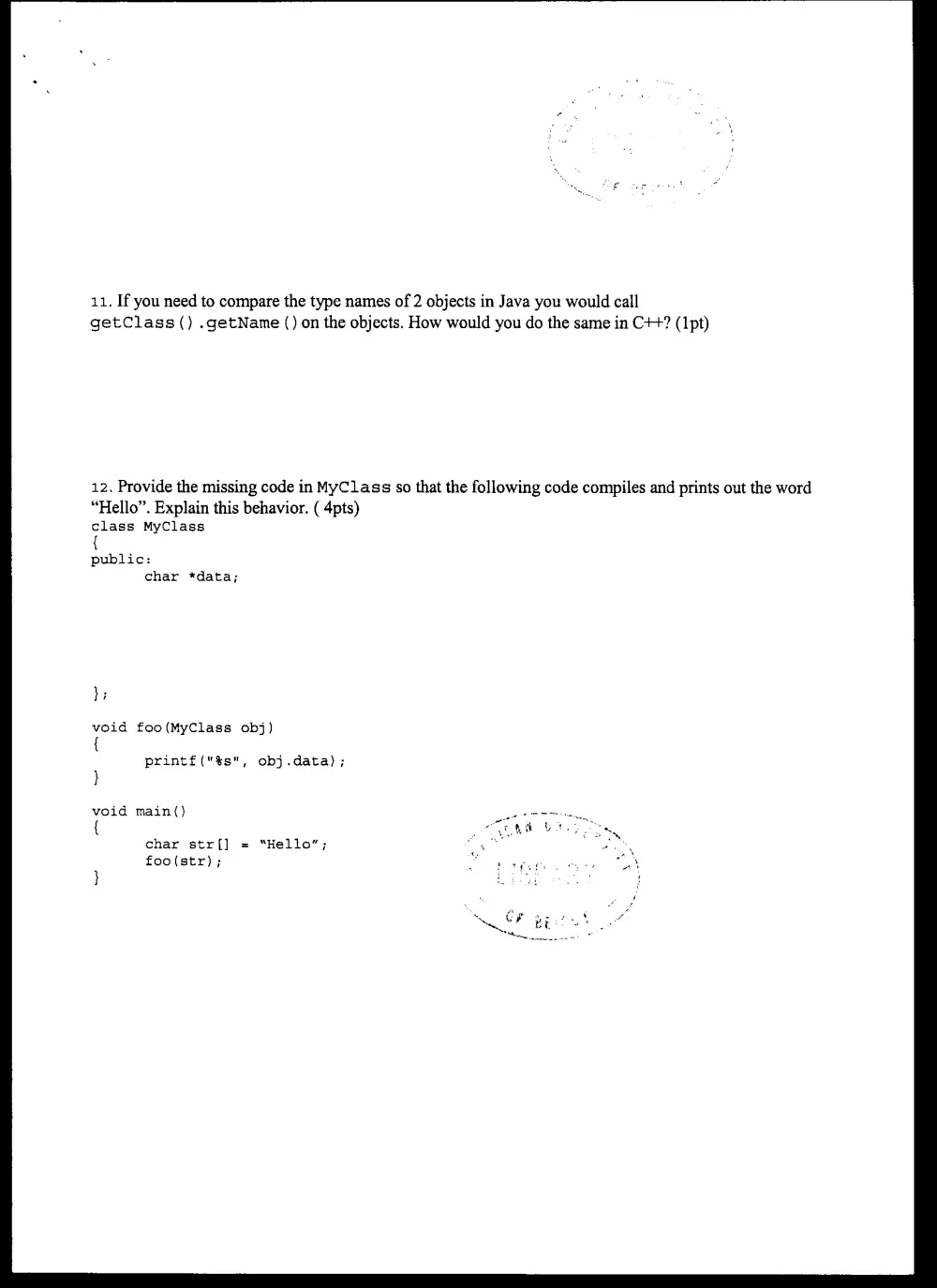
11. If you need to compare the type names of 2 objects in Java you would call
getClass () .getName () on the objects. How would you do the same in C++? (1pt)
12. Provide the missing code in MyClass so that the following code compiles and prints out the word
“Hello”. Explain this behavior. ( 4pts)
class MyClass
{
public:
char *data;
};
void foo(MyClass obj)
{
printf ("%s", obj.data);
}
void main()
{
char strf{] = “Hello”;
foo(str) ; spe eee AY
13. The function foo does not compile. Explain why, clearly. (3pts)
class MyClass
{
public:
int x;
const int foo() const {
K++;
return x;
}
}i
14, Given the following code: (3pts) Pati
pee MyClass awn ee
ey ” \
public: {3 ip rye us}
MyClass() { x = 1; } LIB tA R ! !
int x; . Jf
int & bar() OF agignt
{ ene
return x;
}
};
void main{)
{
MyClass obj;
obj.bar() = 2;
a) At the end of main, the value of x is 1
b) At the end of main, the value of x is 2
c) At the end of main, the value of x is ‘junk’
d) The code does not compile
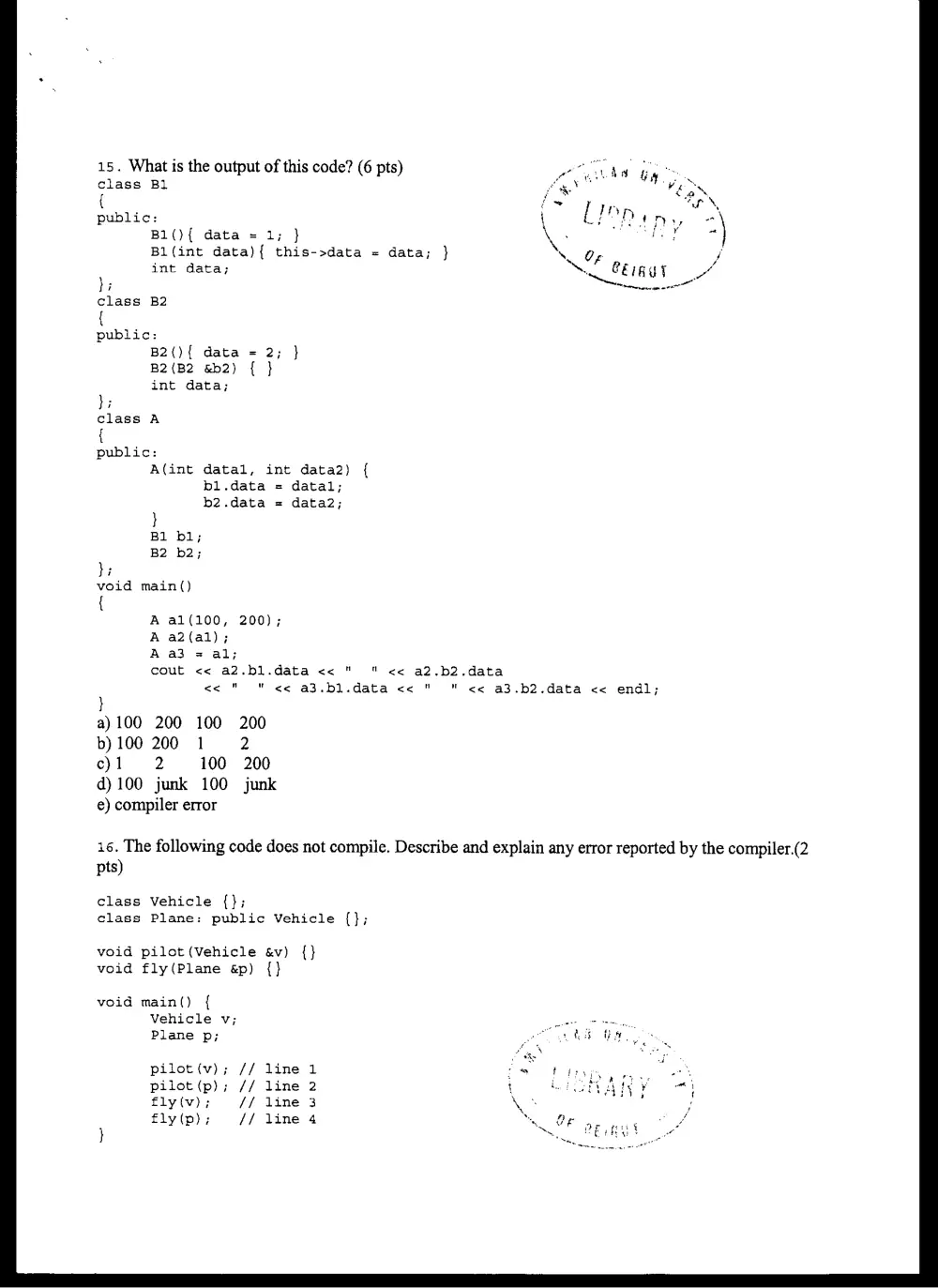
15. What is the output of this code? (6 pts) an
class Bl OR
{ i ;
public: [yp Ay,
B1l(){ data = 1; } . a
Bl(int data){ this->data = data; } No /
f yf
int data; NL Chimt
he eens
class B2
{
public:
B2(){ data = 2; }
B2(B2 &b2) { }
int data;
}e
class A
{
public:
A(int datal, int data2) {
bl.data = datal;
b2.data = data2;
}
Bl bl;
B2 b2;
hi
void main()
{
A al(100, 200);
A a2(al);
A a3 = al;
cout << a2.bl.data << " " «<< a2.b2.data
<< " " «< a3.bl.data << " " << a3.b2.data << endl;
}
a) 100 200 100 200
b) 100 200 1 2
c) 1 2 100 200
d) 100 junk 100 junk
e) compiler error
16. The following code does not compile. Describe and explain any error reported by the compiler.(2
pts)
class Vehicle {};
class Plane: public Vehicle {};
void pilot (Vehicle av) {}
void fly(Plane sp) {}
void main() {
Vehicle v;
Plane p;
pilot(v); // line
pilot(p); // line
fly(v); // line
fly(p); // line
PWN
17. The following code does not compile. Describe and explain any error reported by the compiler. (2
pts)
class Vehicle {};
class Plane: private Vehicle {};
void pilot (Vehicle &v) {}
void fly(Plane &p) {}
void main() {
Vehicle v;
Plane p;
pilot(v); // line
pilot(p); // line
fly(v); // line
fly(p); // line
BwWNe
18. When an object gets deleted in C++, its destructor gets called. Is there an equivalent concept in Java?
Expand. (2 pts)
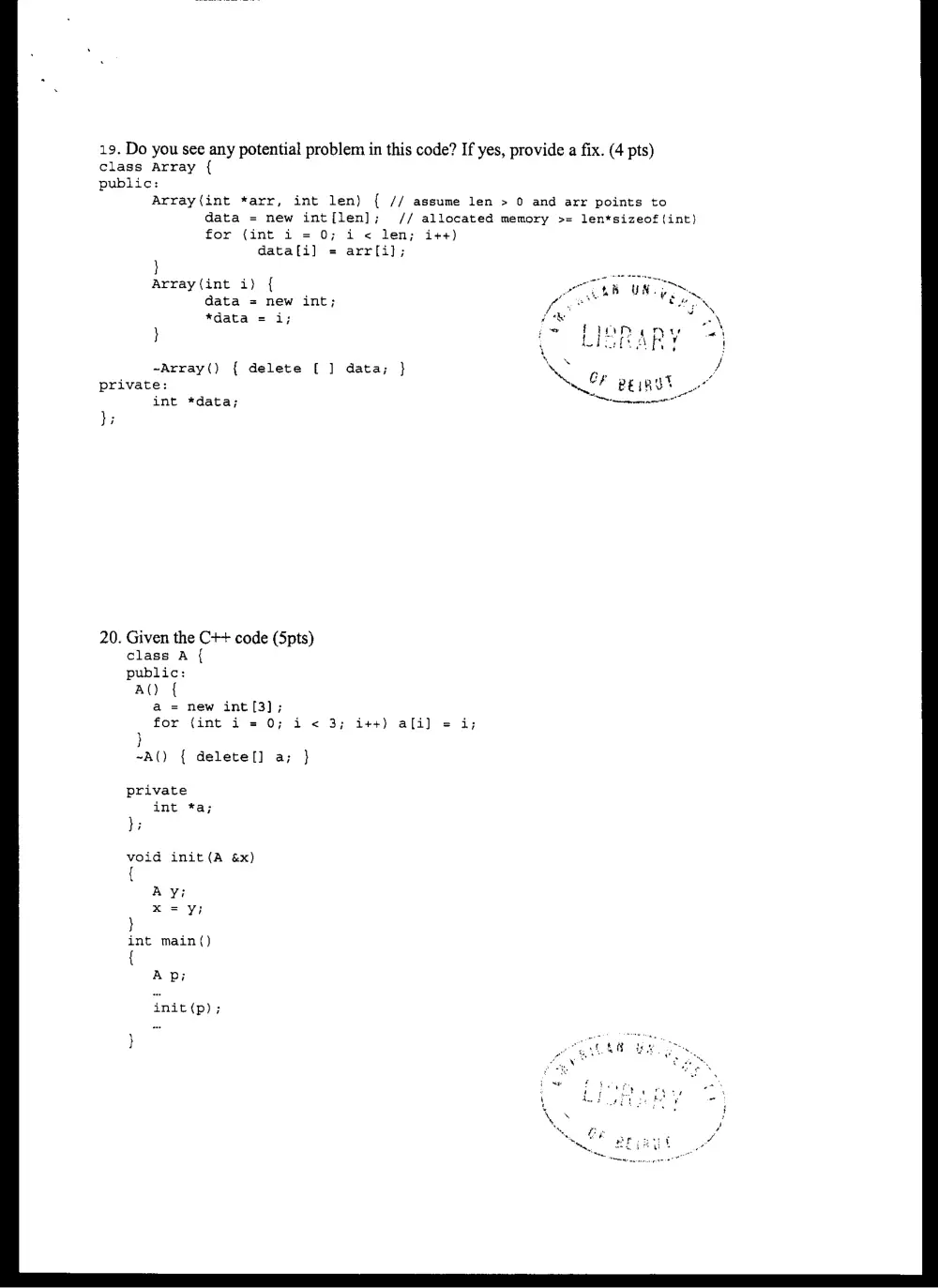
19. Do you see any potential problem in this code? If yes, provide a fix. (4 pts)
class Array {
public:
Array(int *arr, int len) { // assume len > 0 and arr points to
data = new int[len]; // allocated memory >= len*sizeof (int)
for (int i = 0; i < len; i++)
datafi] = arrfil;
}
Array(int i) {
data = new int;
*data = i;
}
~Array() { delete [ ] data; }
private:
int *data;
};
20. Given the C++ code (5pts)
class A {
public:
A() {
a = new int [3];
for {(imt i = 0; i < 3; i++) a[i]
}
~A() { delete[] a; }
"
He
private
int *a;
void init(A &x)
{
Ay:
x = yi
}
int main()
{
AD;
init(p);
you might notice that as the program runs following the call init (p), the values stored in p.a start
changing unpredictably.
a) What might be happening?
b) Explain how to fix this problem and provide a modified code.
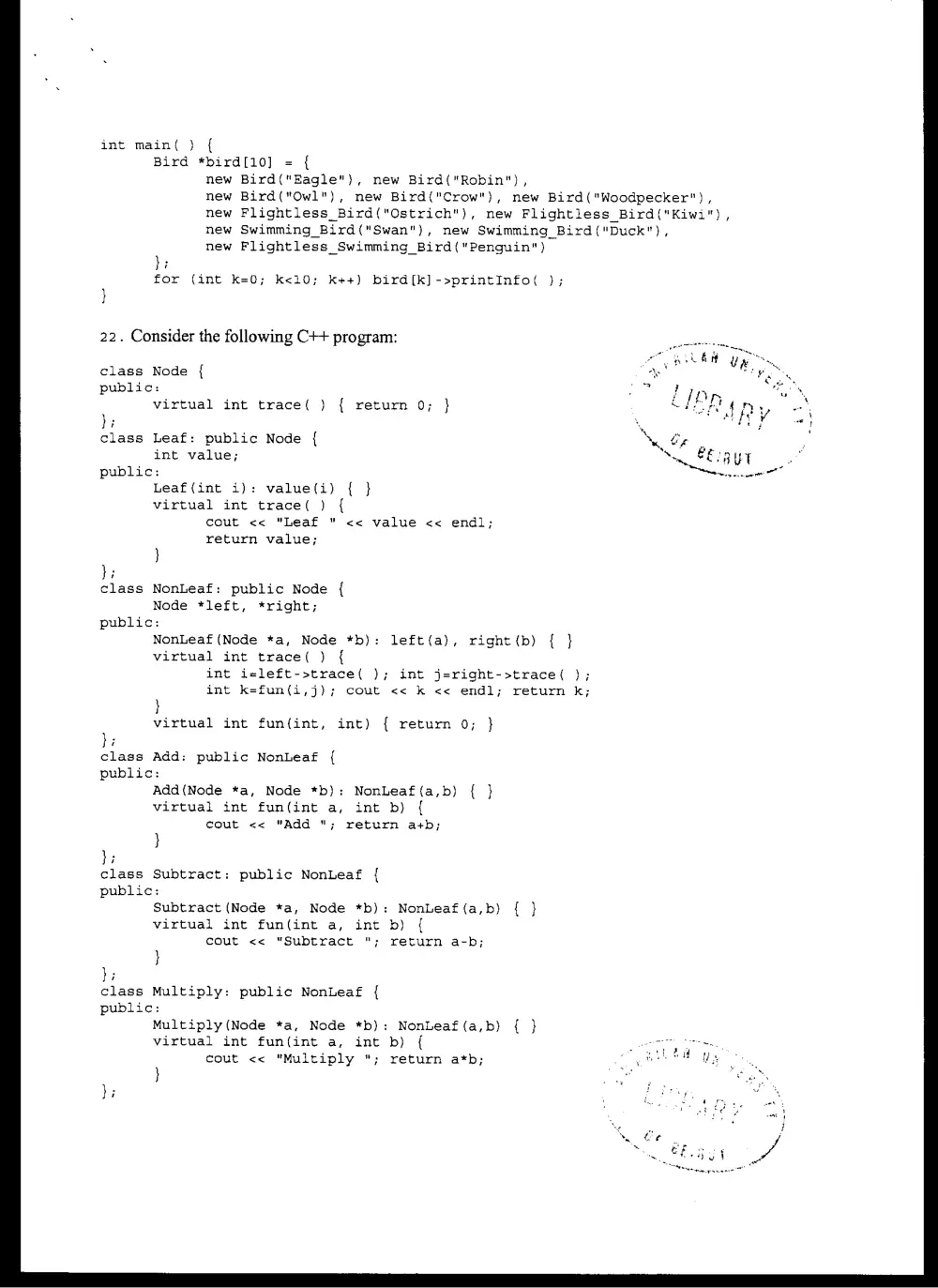
21. Complete this C++ program so that it will produce the output shown below. (15 pts)
Output:
Eagle: can fly, cannot swim
Robin: can fly, cannot swim
Owl: can fly, cannot swim
Crow: can fly, cannot swim
Woodpecker: can fly, cannot swim
Ostrich: cannot fly, cannot swim
Kiwi: cannot fly, cannot swim
Swan: can fly, can swim
Duck: can fly, can swim
Penguin: cannot fly, can swim
class Bird {
string name;
public:
Bird( ) { }
void printInfo( ) {
cout << name << ": ";
if (canFly( ))
cout << "can fly, "; nie
else ot ves DN
cout << "cannot fly, "; a . 7 \
if (canSwim( )) f oe ‘
cout << “can swim"; : i
else /
cout << "cannot swim"; 4
cout << endl;
}
};
class Flightiess_Bird: {
public:
Flightless Bird( ) { }
}i
class Swimming Bird: {
public:
Swimming _Bird( ) { }
hi
class Flightless Swimming_Bird: {
public:
int main( ) {
Bird *bird[10] = {
new Bird("Eagle"), new Bird("Robin"),
new Bird("Owl"), new Bird("Crow"), new Bird("Woodpecker")
new Flightless_Bird("Ostrich"), new Flightless _Bird("Kiwi"),
new Swimming Bird("Swan"), new Swimming _Bird("Duck"),
new Flightless Swimming Bird("Penguin")
}e
for (int k=0; k<10; k++) bird[(k]->printInfo( };
22. Consider the following C++ program:
class Node {
public:
virtual int trace( ) { return 0; }
};
class Leaf: public Node {
int value;
public:
Leaf{int i): value(i) { }
virtual int trace( ) {
cout << "Leaf " << value << endl;
return value;
}
};
class NonLeaf: public Node {
Node *left, *right;
public:
NonLeaf (Node *a, Node *b): left(a), right{(b) { }
virtual int trace( ) {
int isleft->trace( ); int j=right->trace( );
int k=fun(i,j); cout << k << endl; return k;
}
virtual int fun(int, int) { return 0; }
MM es Add: public NonLeaf {
public:
Add(Node *a, Node *b): NonLeaf(a,b) { }
virtual int fun(int a, int b) {
cout << "Add "; return a+b;
}
};
class Subtract: public NonLeaf {
public:
Subtract (Node *a, Node *b): NonLeaf(a,b) { }
virtual int fun(int a, int b) {
cout << "Subtract "; return a-b;
}
}i
class Multiply: public NonLeaf {
public:
Multiply (Node *a, Node *b): NonLeaf(a,b) { }
virtual int fun(int a, int b) {
cout << "Multiply "; return a*b;
}
}i