
CMPS 282 Final, Spring 2007
American University of Beirut · Software Engineering · 4 pages

More CMPS 282 files
Show the text of this final exam
CMPS 282 — Software Engineering
FINAL EXAM
2 hours
June 5, 2007,
8:00 a.m.
Please draw a horizontal line across the page between the answers to each question
1. (20 points)
The example below was discussed in class. The scope is given by 3 designations:
comp(x, y) = x is a company employee during time interval y
intl(x) = x is a time interval in the life of the company
superior(x, y, z) = x is the manager of y in time interval z
The description is for a “well-managed” company:
1. comp(x, y) ⇒ intl(y): if x is an employee during interval y, then y must be a time interval in
the life of the company
2. superior(x, y, z) ⇒ comp(x, z) ∧ comp(y, z): if x is the superior of y during interval z then x
and y must both be employees during interval y
3. superior(x1, y, z) ∧ superior(x2, y, z) ⇒ x1 = x2: an employee has at most one superior at
any time
Consider the following designation:
bosses(x, z) = the set of superiors and superiors of superiors, etc. of employee x during time interval
z, i.e., the “transitive closure” of the superior relation
Note that bosses(x, z) is a function, not a relation
(a) (10 points) Write a formal definition for bosses(x, z). Hint: use superior
(b) (10 points) Using the definition in (a) state the following global constraint formally:
no employee is their own boss
2. (30 points)
Write a Buchi automaton for the following properties:
(a) (15 points) if a occurs, then subsequently, either b occurs, or c and d both occur (in either
order)
(b) (15 points) if a occurs, then subsequently, b occurs and a does not occur again until the
occurrence of b
1
3. (20 points)
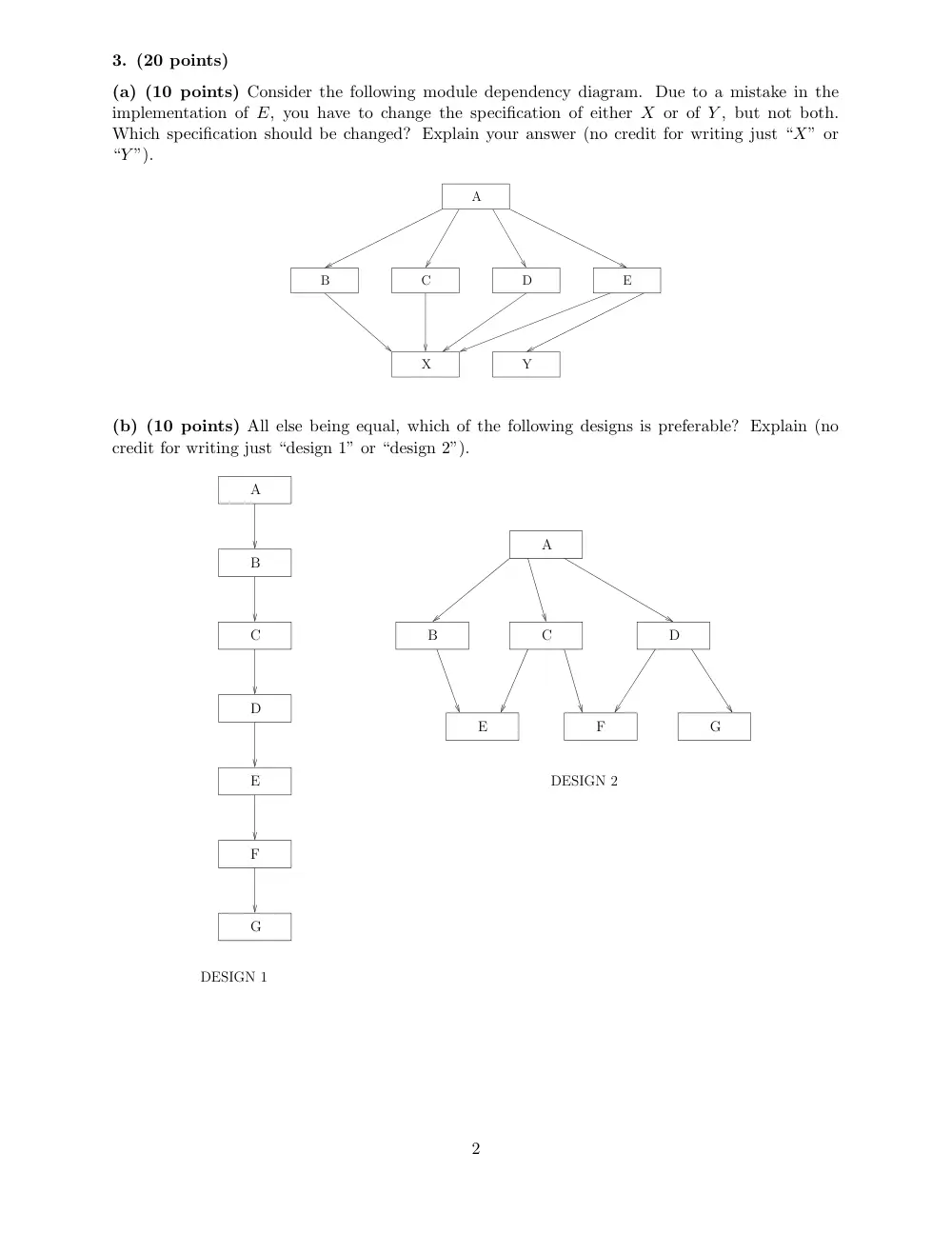
(a) (10 points) Consider the following module dependency diagram. Due to a mistake in the
implementation of E, you have to change the specification of either X or of Y , but not both.
Which specification should be changed? Explain your answer (no credit for writing just “X” or
“Y ”).
A
B
C
D
E
X
Y
(b) (10 points) All else being equal, which of the following designs is preferable? Explain (no
credit for writing just “design 1” or “design 2”).
B
D
E
F
G
C
A
A
D
C
B
E
F
G
DESIGN 1
DESIGN 2
2
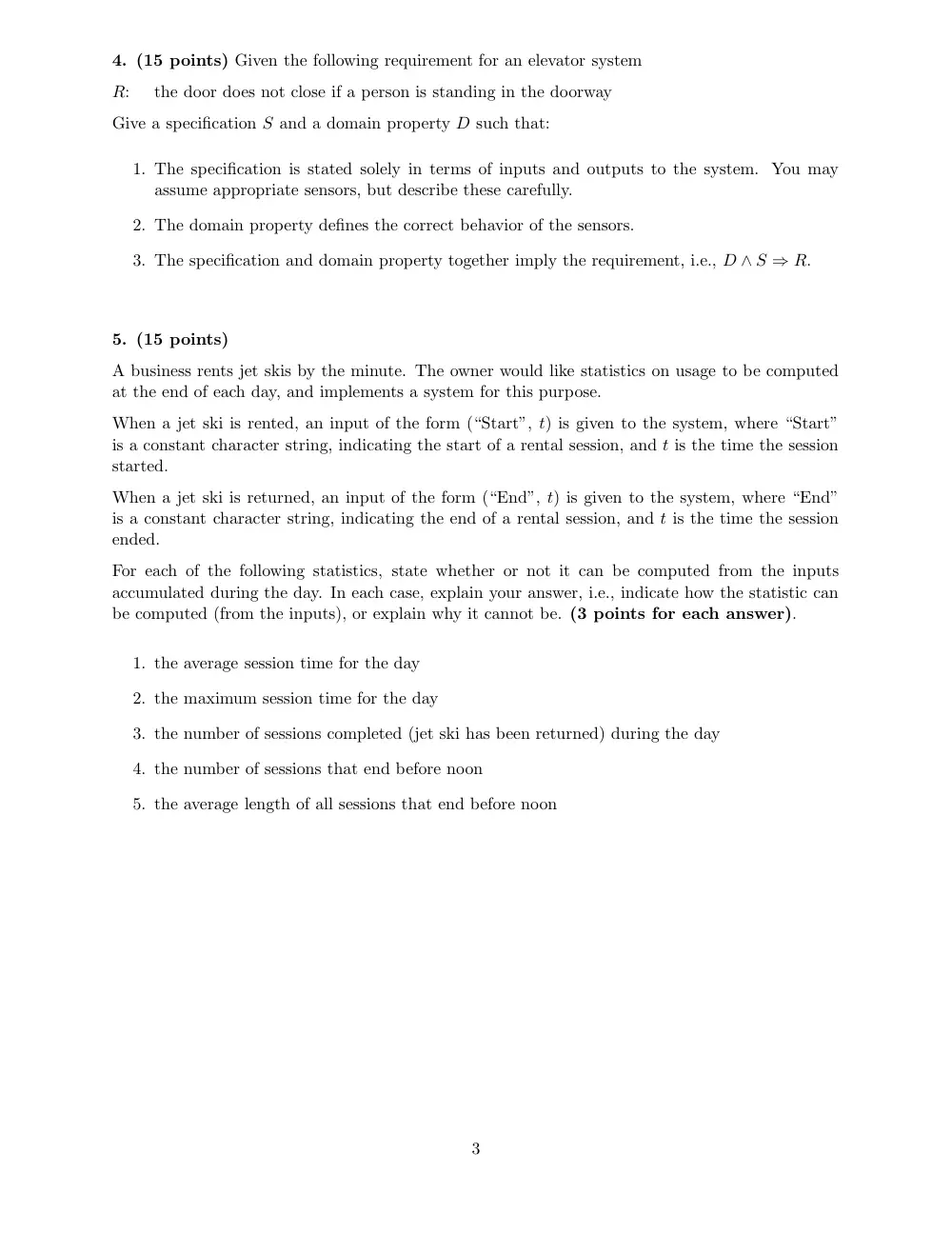
4. (15 points) Given the following requirement for an elevator system
R:
the door does not close if a person is standing in the doorway
Give a specification S and a domain property D such that:
1. The specification is stated solely in terms of inputs and outputs to the system. You may
assume appropriate sensors, but describe these carefully.
2. The domain property defines the correct behavior of the sensors.
3. The specification and domain property together imply the requirement, i.e., D ∧ S ⇒ R.
5. (15 points)
A business rents jet skis by the minute. The owner would like statistics on usage to be computed
at the end of each day, and implements a system for this purpose.
When a jet ski is rented, an input of the form (“Start”, t) is given to the system, where “Start”
is a constant character string, indicating the start of a rental session, and t is the time the session
started.
When a jet ski is returned, an input of the form (“End”, t) is given to the system, where “End”
is a constant character string, indicating the end of a rental session, and t is the time the session
ended.
For each of the following statistics, state whether or not it can be computed from the inputs
accumulated during the day. In each case, explain your answer, i.e., indicate how the statistic can
be computed (from the inputs), or explain why it cannot be. (3 points for each answer).
1. the average session time for the day
2. the maximum session time for the day
3. the number of sessions completed (jet ski has been returned) during the day
4. the number of sessions that end before noon
5. the average length of all sessions that end before noon
3
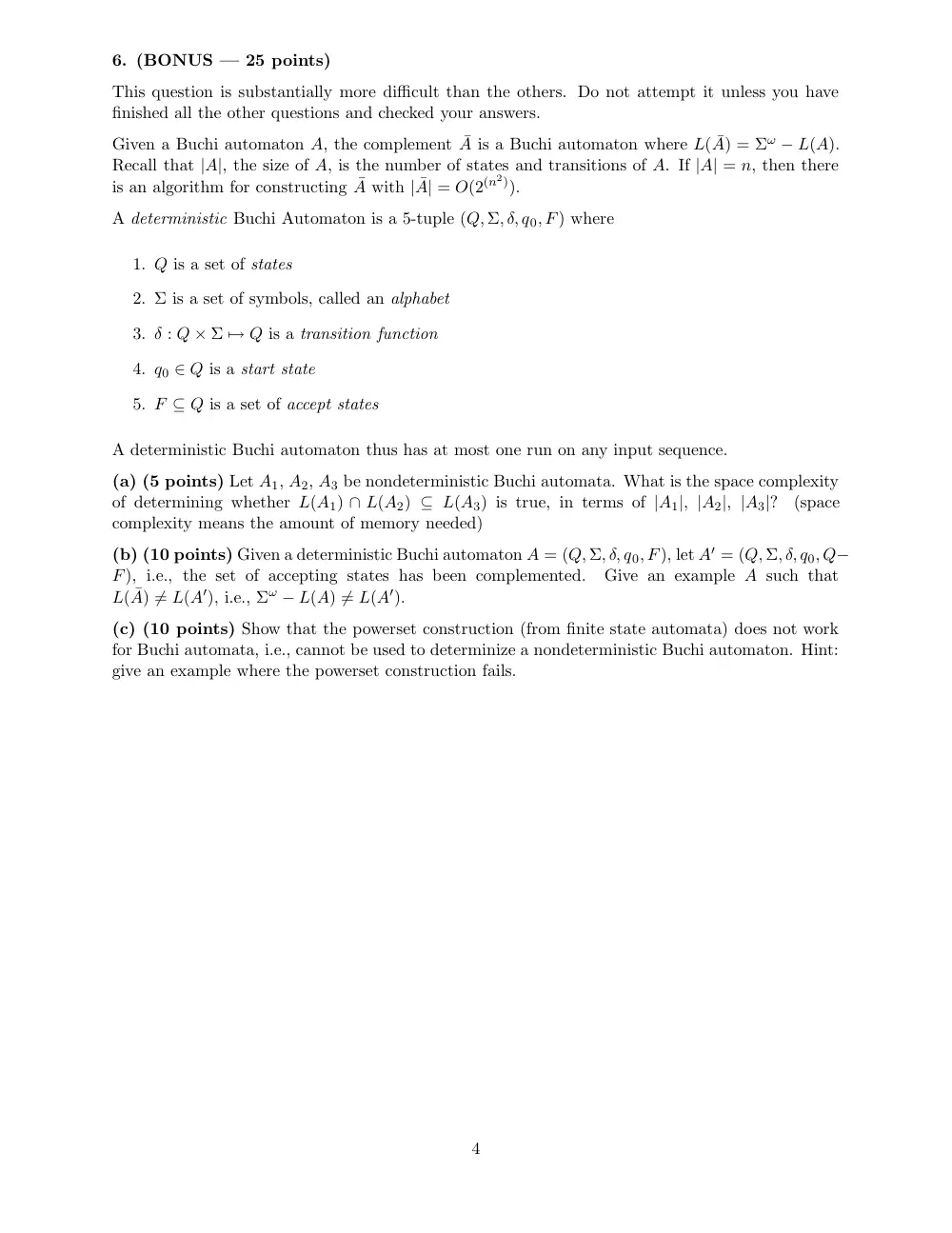
6. (BONUS — 25 points)
This question is substantially more difficult than the others. Do not attempt it unless you have
finished all the other questions and checked your answers.
Given a Buchi automaton A, the complement ¯A is a Buchi automaton where L( ¯A) = Σω − L(A).
Recall that |A|, the size of A, is the number of states and transitions of A. If |A| = n, then there
is an algorithm for constructing ¯A with | ¯A| = O(2(n2)).
A deterministic Buchi Automaton is a 5-tuple (Q, Σ, δ, q0, F) where
1. Q is a set of states
2. Σ is a set of symbols, called an alphabet
3. δ : Q × Σ �→ Q is a transition function
4. q0 ∈ Q is a start state
5. F ⊆ Q is a set of accept states
A deterministic Buchi automaton thus has at most one run on any input sequence.
(a) (5 points) Let A1, A2, A3 be nondeterministic Buchi automata. What is the space complexity
of determining whether L(A1) ∩ L(A2) ⊆ L(A3) is true, in terms of |A1|, |A2|, |A3|?
(space
complexity means the amount of memory needed)
(b) (10 points) Given a deterministic Buchi automaton A = (Q, Σ, δ, q0, F), let A′ = (Q, Σ, δ, q0, Q−
F), i.e., the set of accepting states has been complemented.
Give an example A such that
L( ¯A) ̸= L(A′), i.e., Σω − L(A) ̸= L(A′).
(c) (10 points) Show that the powerset construction (from finite state automata) does not work
for Buchi automata, i.e., cannot be used to determinize a nondeterministic Buchi automaton. Hint:
give an example where the powerset construction fails.
4