
CMPS 282 Final, Spring 2008
American University of Beirut · Software Engineering · 3 pages

More CMPS 282 files
Show the text of this final exam
CMPS 282 — Software Engineering
SAMPLE FINAL EXAM
2 hours
Please draw a horizontal line across the page between the answers to each question
You may refer to the following during the exam:
• the course textbook
• the course lecture notes
• your homework solutions
• any notes that you have taken in class
You may not refer to any other materials.
Good luck!
1. (20 points)
(a) (10 points) Consider the data model given in figure 1.
D
A
B
C
Figure 1: Data model for question 1 (a)
What can you say about the relationship between the sets A, B, C, and D?
Solution. From the data model graph, A ⊆ B ⊆ C ⊆ D ⊆ A. Hence A = B = C = D.
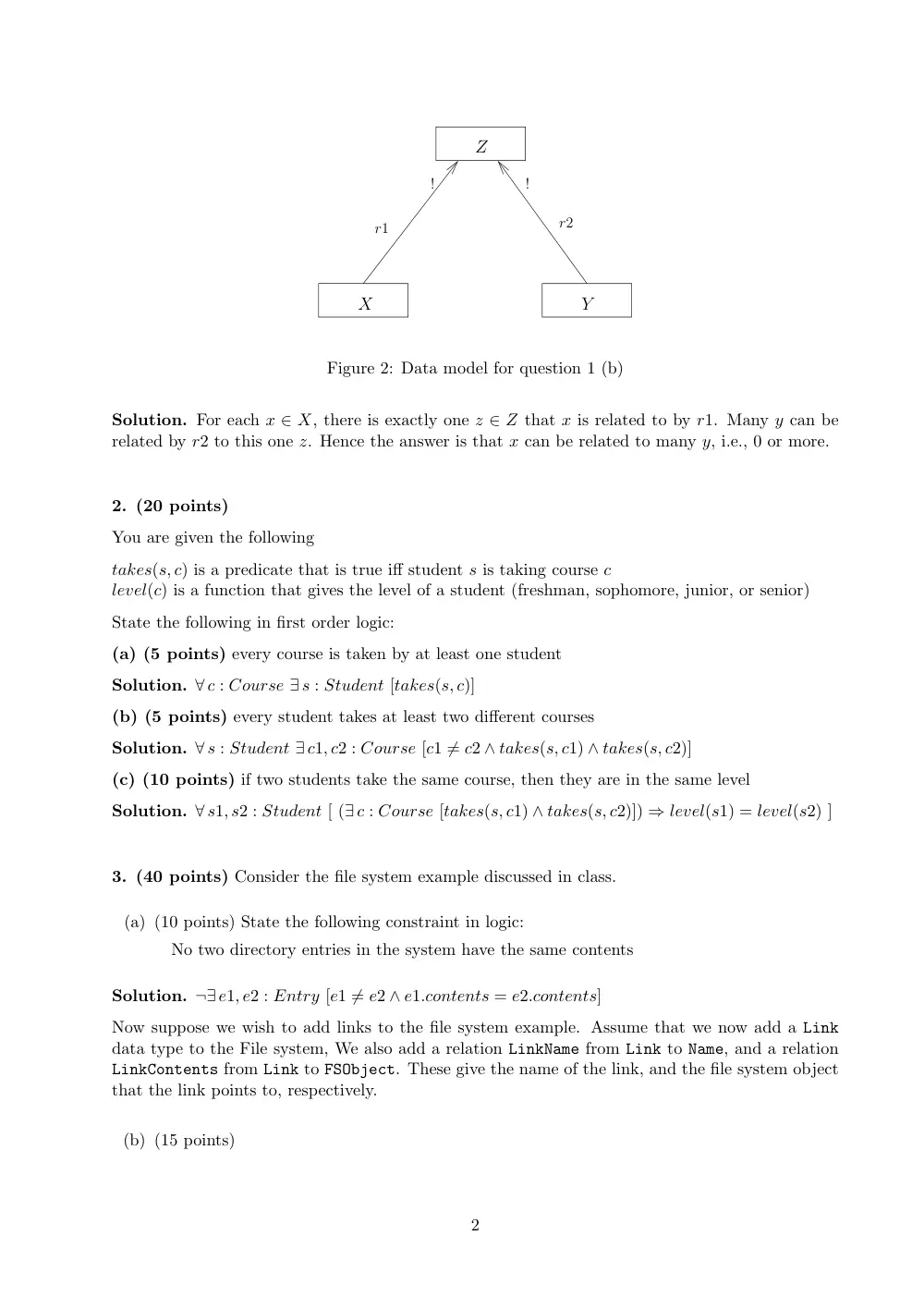
(b) (10 points) Consider the data model given in figure 2.
Consider the derived relation r3(x, y) ≜ (∃z : r1(x, z) ∧ r2(y, z)).
To how many elements of Y can an element of X be related to, in general?
1
Z
X
!
Y
!
r1
r2
Figure 2: Data model for question 1 (b)
Solution. For each x ∈ X, there is exactly one z ∈ Z that x is related to by r1. Many y can be
related by r2 to this one z. Hence the answer is that x can be related to many y, i.e., 0 or more.
2. (20 points)
You are given the following
takes(s, c) is a predicate that is true iff student s is taking course c
level(c) is a function that gives the level of a student (freshman, sophomore, junior, or senior)
State the following in first order logic:
(a) (5 points) every course is taken by at least one student
Solution. ∀ c : Course ∃ s : Student [takes(s, c)]
(b) (5 points) every student takes at least two different courses
Solution. ∀ s : Student ∃ c1, c2 : Course [c1 ̸= c2 ∧ takes(s, c1) ∧ takes(s, c2)]
(c) (10 points) if two students take the same course, then they are in the same level
Solution. ∀ s1, s2 : Student [ (∃ c : Course [takes(s, c1) ∧ takes(s, c2)]) ⇒ level(s1) = level(s2) ]
3. (40 points) Consider the file system example discussed in class.
(a) (10 points) State the following constraint in logic:
No two directory entries in the system have the same contents
Solution. ¬∃ e1, e2 : Entry [e1 ̸= e2 ∧ e1.contents = e2.contents]
Now suppose we wish to add links to the file system example. Assume that we now add a Link
data type to the File system, We also add a relation LinkName from Link to Name, and a relation
LinkContents from Link to FSObject. These give the name of the link, and the file system object
that the link points to, respectively.
(b) (15 points)
2
State the following constraint in logic:
Every link points to a file system object that is reachable from the root
Solution. ∀ l : Link ∀ o : FSObject[ l.contents = o ⇒ Root ∈ ancestors(o) ]
(c) (15 points) We introduce a deleteFile operation that removes a file object from the system.
What is an appropriate precondition for deleteFile? Make sure that all constraints are
preserved.
The appropriate precondition is that no link points to the file. In logic:
Solution. ∀ l : Link [l.contents ̸= f]
4. (20 points) Let / denote integer division with truncation, e.g., 11/2 = 5. Assume that all
variables are integer valued, and all ranges of quantification are over integers. Define even(a) =
(∃b : a = 2 ∗ b), odd(a) = ¬even(a).
State which of the following Hoare triples are valid. Answer “valid” or “not valid” (5 points each).
(a) {even(y) ∧ xy = c} x := x ∗ x; y := y/2 {xy = c}
Solution. valid
(b) {odd(y) ∧ xy = c} x := x ∗ x; y := y/2 {xy = c}
Solution. not valid
(c) {xy = c} x := x ∗ x; y := y/2 {xy = c}
Solution. not valid
(d) ⟨y > 0 ∧ odd(y)⟩ while y ̸= 0 do x := x ∗ d; y := y − 2 endwhile ⟨true⟩
Solution. not valid
3