
CMPS 282 Midterm, Spring 2010
American University of Beirut · Software Engineering · 2 pages
More CMPS 282 files
Show the text of this exam
CMPS 282 Software Engineering — Spring 2010
Section 1
MIDTERM EXAM
50 minutes
May 12, 2010
Please draw a horizontal line across the page between the answers to each question
You may refer to the following during the exam:
• the course textbook
• the course lecture notes
• your homework solutions
• any notes that you have taken in class
You may not refer to any other materials. Good luck!
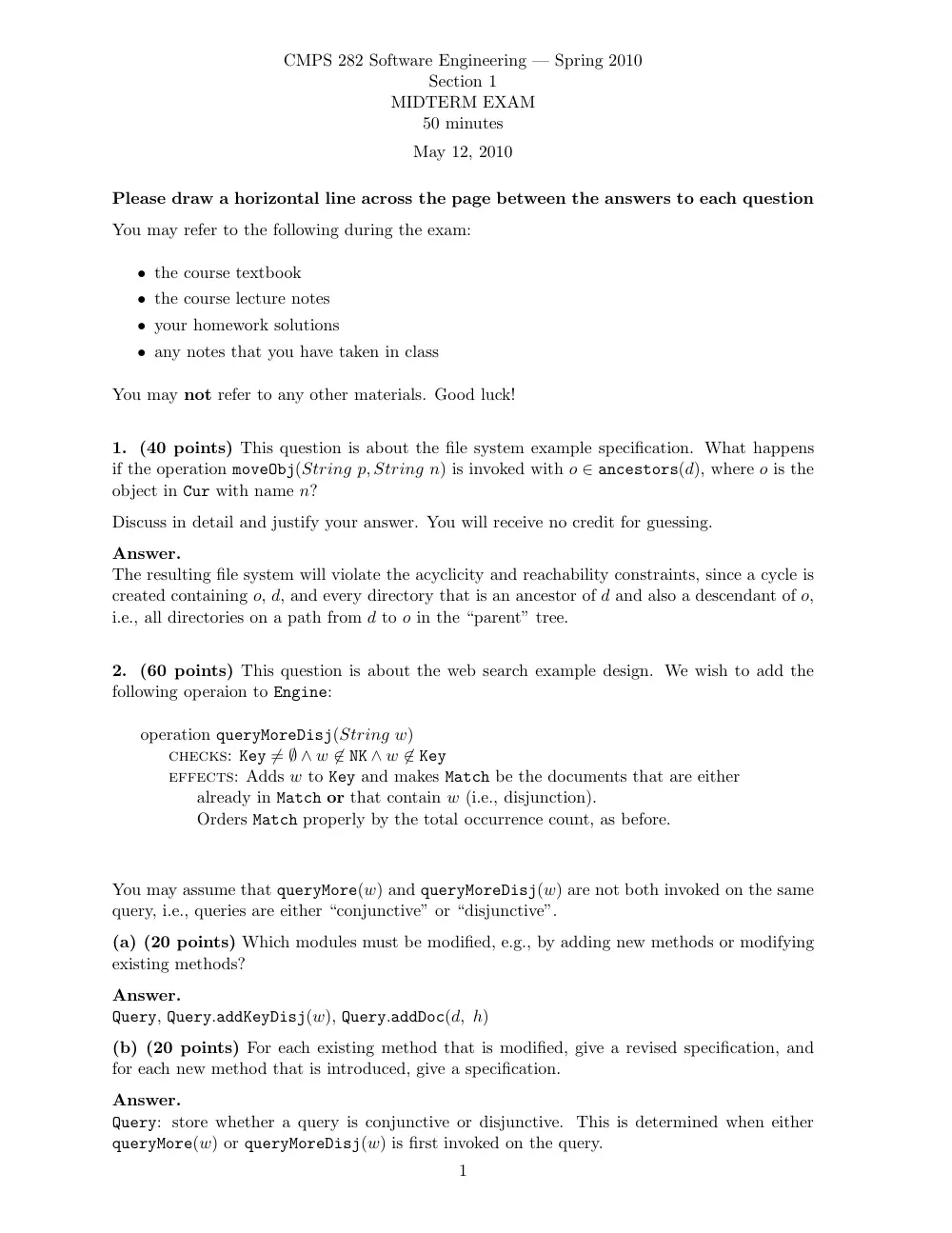
1. (40 points) This question is about the file system example specification. What happens
if the operation moveObj(String p, String n) is invoked with o ∈ ancestors(d), where o is the
object in Cur with name n?
Discuss in detail and justify your answer. You will receive no credit for guessing.
Answer.
The resulting file system will violate the acyclicity and reachability constraints, since a cycle is
created containing o, d, and every directory that is an ancestor of d and also a descendant of o,
i.e., all directories on a path from d to o in the “parent” tree.
2. (60 points) This question is about the web search example design. We wish to add the
following operaion to Engine:
operation queryMoreDisj(String w)
checks: Key ̸= ∅ ∧ w ̸∈ NK ∧ w ̸∈ Key
effects: Adds w to Key and makes Match be the documents that are either
already in Match or that contain w (i.e., disjunction).
Orders Match properly by the total occurrence count, as before.
You may assume that queryMore(w) and queryMoreDisj(w) are not both invoked on the same
query, i.e., queries are either “conjunctive” or “disjunctive”.
(a) (20 points) Which modules must be modified, e.g., by adding new methods or modifying
existing methods?
Answer.
Query, Query.addKeyDisj(w), Query.addDoc(d, h)
(b) (20 points) For each existing method that is modified, give a revised specification, and
for each new method that is introduced, give a specification.
Answer.
Query: store whether a query is conjunctive or disjunctive. This is determined when either
queryMore(w) or queryMoreDisj(w) is first invoked on the query.
1
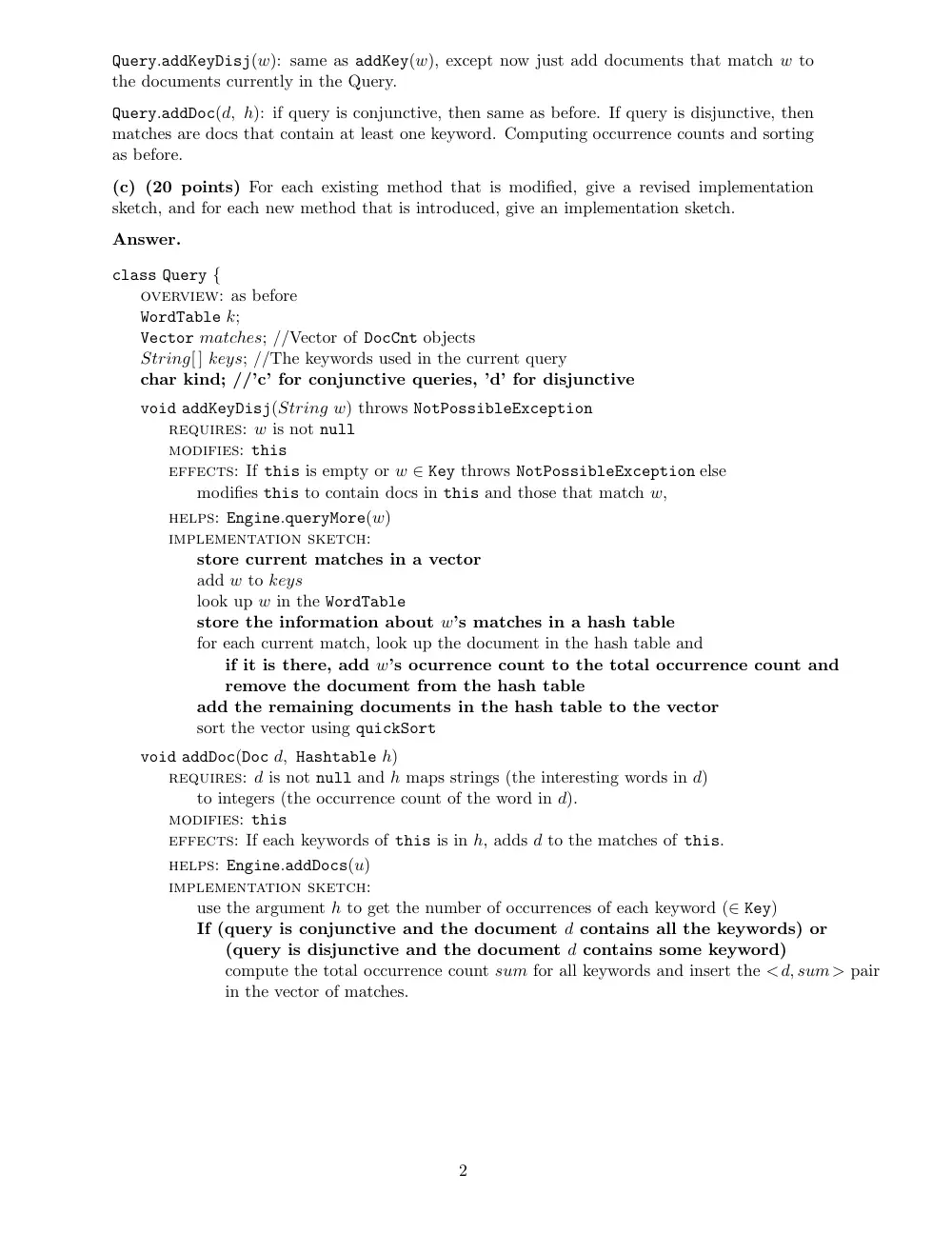
Query.addKeyDisj(w): same as addKey(w), except now just add documents that match w to
the documents currently in the Query.
Query.addDoc(d, h): if query is conjunctive, then same as before. If query is disjunctive, then
matches are docs that contain at least one keyword. Computing occurrence counts and sorting
as before.
(c) (20 points) For each existing method that is modified, give a revised implementation
sketch, and for each new method that is introduced, give an implementation sketch.
Answer.
class Query {
overview: as before
WordTable k;
Vector matches; //Vector of DocCnt objects
String[ ] keys; //The keywords used in the current query
char kind; //’c’ for conjunctive queries, ’d’ for disjunctive
void addKeyDisj(String w) throws NotPossibleException
requires: w is not null
modifies: this
effects: If this is empty or w ∈ Key throws NotPossibleException else
modifies this to contain docs in this and those that match w,
helps: Engine.queryMore(w)
implementation sketch:
store current matches in a vector
add w to keys
look up w in the WordTable
store the information about w’s matches in a hash table
for each current match, look up the document in the hash table and
if it is there, add w’s ocurrence count to the total occurrence count and
remove the document from the hash table
add the remaining documents in the hash table to the vector
sort the vector using quickSort
void addDoc(Doc d, Hashtable h)
requires: d is not null and h maps strings (the interesting words in d)
to integers (the occurrence count of the word in d).
modifies: this
effects: If each keywords of this is in h, adds d to the matches of this.
helps: Engine.addDocs(u)
implementation sketch:
use the argument h to get the number of occurrences of each keyword (∈ Key)
If (query is conjunctive and the document d contains all the keywords) or
(query is disjunctive and the document d contains some keyword)
compute the total occurrence count sum for all keywords and insert the <d, sum> pair
in the vector of matches.
2