
CMPS 396 Final, Fall 2004
American University of Beirut · Special Topics in Computer Science · 12 pages





Showing the first 10 of 12 pages. Download the PDF to see all of it.
More CMPS 396 files
Show the text of this final exam
AW eICAN UNIV ENSIT
LIBRARY
oF BEIROT
Faculty of Arts & Sciences
Department of Computer Sciences
CMPS 396B
Fall 2004-2005
Monday, January 24, 2005
Final Exam
Name: Student Id:
Signature:
Duration: 100 minutes
instructions
* There are 6 problems and 12 pages. Make sure you have all of them.
© The exam is closed book, closed notes, closed calculators, and closed neighbors.
« Answer questions in the space provided.
* The questions are not sorted by difficulty. Scan the whole exam before you start working.
¢ Your handwriting should be readable so it can be graded. Include all work or justification for partial credit.
Problem } 18
Problem 2 19
Problem 3 13
Problem 4 13
Problem 5 25
Problem 6 12
Total 100 |
Final Exam (2005-01-24) initials:
Problem 1 [18 points]
1. The figure below shows the path from host | to host 3. Assume that a flow will be generated from host | to
host 3. Show how the RSVP protocol can be used in order to guarantee that all routers on the path from host
1 to host 3 reserve the required resources for this flow. [5 points]
er
Bandwidth reserved
for source 1
2. Suppose that Router E in the figure above loses its reservation state, but remains running.
2.1. What will happen to the existing reserved flow if the router handles reserved and non-reserved flows
via a single FIFO queue? [2 points]
2.2. What might happen to the existing reserved flows if the router used weighted fair queuing to segregate
reserved and non-reserved traffic? [3 points]
CMPS 396B 2
Final Exam (2005-01-24) Initials:
The network in the figure below uses RSVP with multicast trees for host 1 and host 2. Suppose that host 3
requests a channel of bandwidth 2 MB/sec for a flow from host | and another channel of bandwidth 1
MB/sec for a flow from host 2. At the same time host 4 requests a channel of bandwidth 2 MB/sec for a
flow from host 1 and host 5 requests a channel of bandwidth 1 MB/sec for a flow from host 2.
How much total bandwidth will be reserved for these requests at routers A, B, C, E, H, J, K, and L? [8
points]
4]
\ 4
Receivers
(a)
CMPS 396B
Final Exam (2005-01-24) Initials:
Problem 2 [19 points]
Answer the following questions. Make your answer as short as possible as you will not get credit for long
answers.
1. Consider a cellular system with the following characteristics. Frequency bands are 815 to 845 MHz for
mobile unit transmission and 870 to 900 MHz for base station transmission. A duplex circuit consists of one
30 KHz channei in each direction. The system 1s distinguished by a reuse factor of 4 cells. Suppose that the
cluster of cells is duplicated 20 times. Find the number of simultaneous calls that can be supported by the
system.[4 points]
2. What do we mean by saying that GSM uses both FOMA and TDMA techniques? Explain [2 points]
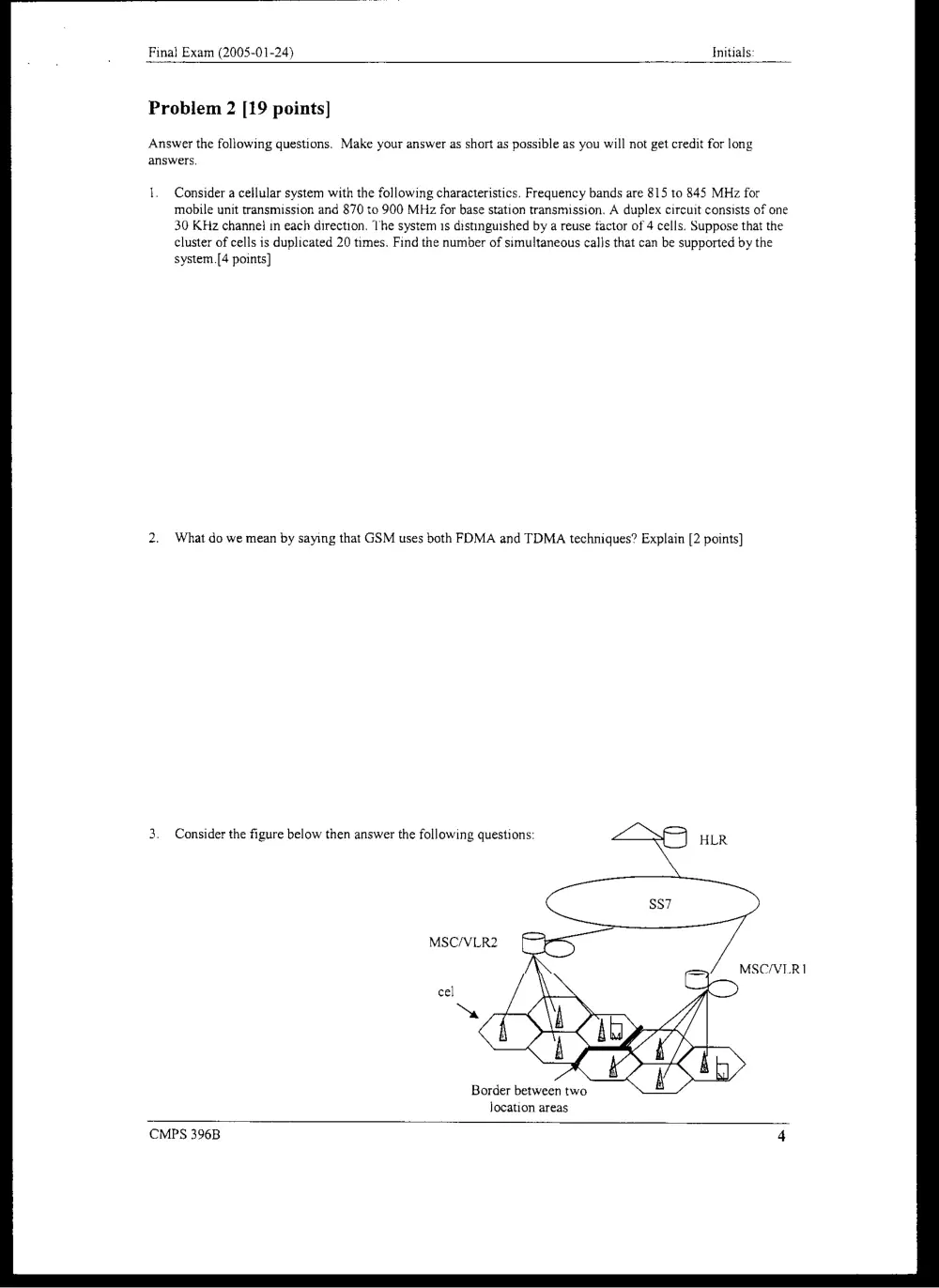
3. Consider the figure below then answer the following questions: HLR
MSC/VLRI1
Border between two
location areas
CMPS 396B 4
Final Exam (2005-01-24) Initials:
3.1 What ts the main task of the followmg components? [6 points]
]
|
i
|
1
3.2 Describe the sequence of event messages needed when the mobile node AN initiates a call to the
mobile node M (call delivery procedure). [4 points}
3.3 In cellular networks, when and why location update procedure is performed? [3 points]
CMPS 396B
Final Exam (2005-01-24) initials:
Problem 3 [13 points]
Answer the following questions, Make your answer as short as possible.
1. What a handoff is? [3 points]
2. How the handoff decision is made? [2 points]
3. What would happen in case of handoff failure? [1 points]
4. What is the inter-BSC handoff and who controls this handoff? [2 points]
5. What is the main difference between soft handoff and hard handoff? [3 points]
6. Handoff can also be performed due to load balancing. What does it mean? [2 points]
CMPS 396B 6
Final Exam (2005-01-24) Initials:
Problem 4 [13 points]
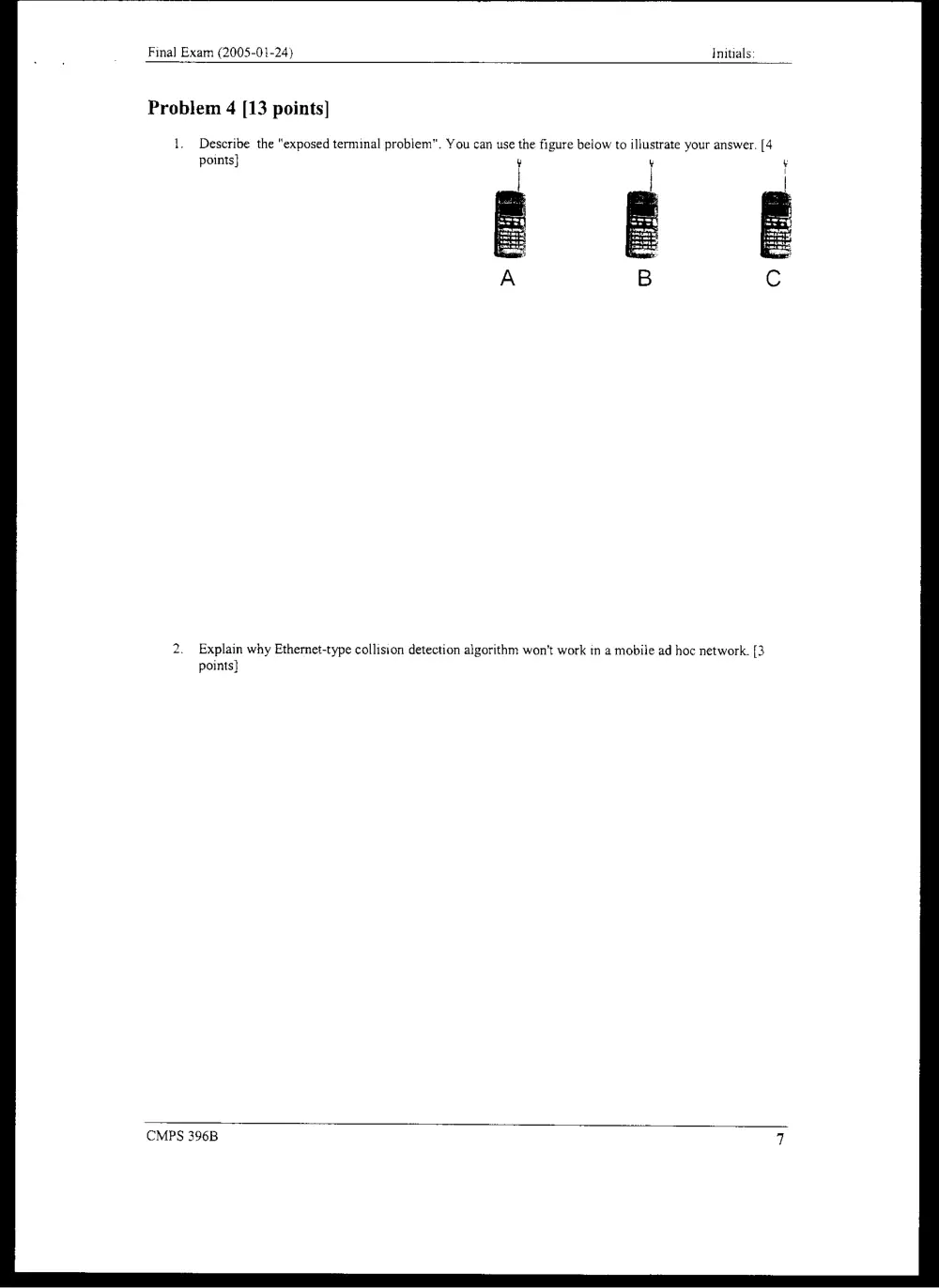
1. Describe the "exposed terminal problem". You can use the figure below to illustrate your answer. [4
points} ¥ 4
2, Explain why Ethernet-type collision detection algorithm won't work in a mobile ad hoc network. [3
points}
CMPS 396B 7
Final Exam (2005-01-24) Initials:
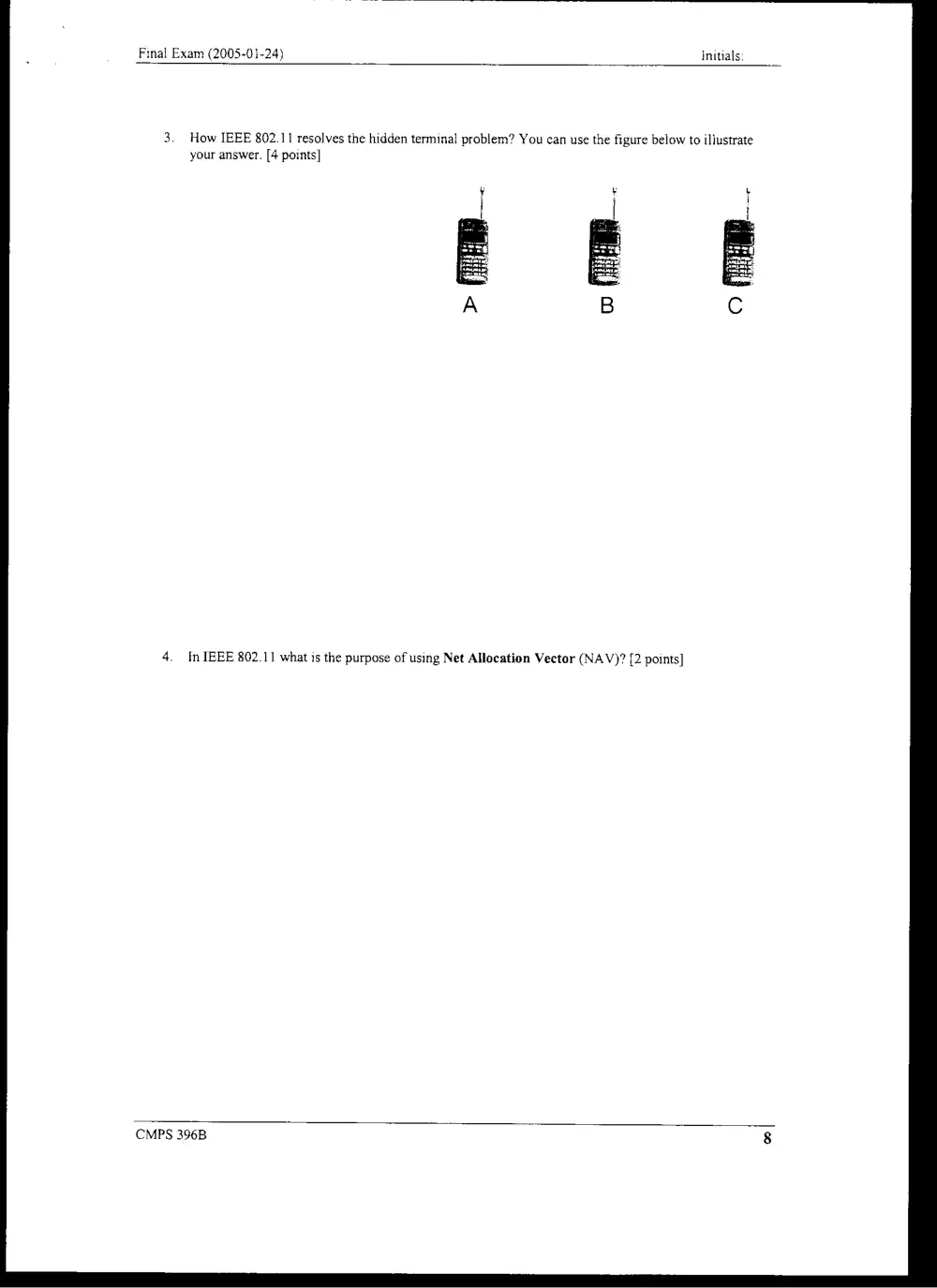
3. How IEEE 802.11 resolves the hidden terminal problem? You can use the figure below to illustrate
your answer. [4 points]
4. In IEEE 802.11 what is the purpose of using Net Allocation Vector (NAV)? [2 points]
CMPS 396B
Fina] Exam (2005-01-24) Initials:
Problem 5 [25 points]
Answer the following questions. Make your answer as short as possible as you will not get credit for long
answers.
1. Assume that Net 4 is the home network of a mobile node 4, Assume also that M moves to Net B
a. What is the name of the entity that manages M in Net A? [1 point]
b. What is the name of the entity that manages Min Net B? [1 point]
c, What steps are taken when M moves from Net A to Net B? [2 points]
9 Assume that a node CN that helongs to Net C wants to communicate with node M.
a. Describe the triangle routing when CN and M communicate. (If tunneling is used, specify
where) [3 points]
b. Why triangle routing is considered a problem? [2 points}
CMPS 396B 9
Final Exam (2005-01-24) Initials:
3. Route optimization mechanism was proposed to solve the problem caused by the triangle routing.
Describe the data flow between CN and M when route optimization is used. (If tunneling is used,
specify where) [4 points]
4. Assuming route optimization is used, what would happen if Af moves from Net B to Net C while
receiving packets from the CN?. [4 points]
5. What ts reverse tunneling? (describe the data flow between M and CN when both reverse tunneling
and route optimization are used assuming that M is roaming in Net B and CN belongs to Net C) [3
points]
CMPS 396B