
CMPS 396 Final, Fall 2004
American University of Beirut · Special Topics in Computer Science · 13 pages




Showing the first 10 of 13 pages. Download the PDF to see all of it.
More CMPS 396 files
Show the text of this final exam
ne,
‘
fear NaN CNIVERSIT
LIBRARY
cee at nent
Jace tea UNIVERSITET
| ctesey |
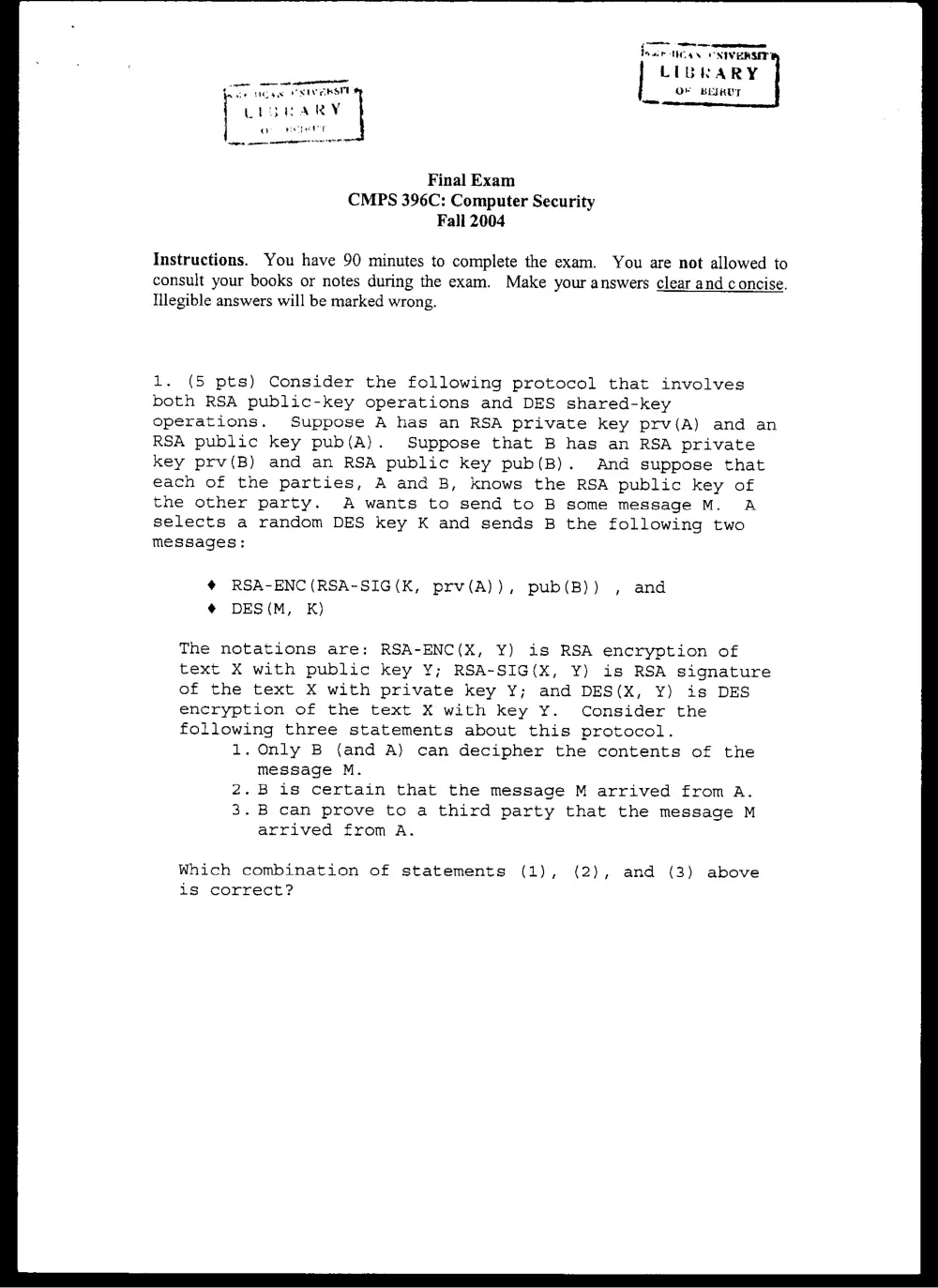
Final Exam
CMPS 396C: Computer Security
Fall 2004
OF BEIRUT
Instructions. You have 90 minutes to complete the exam. You are not allowed to
consult your books or notes during the exam. Make your answers clear and concise.
Illegible answers will be marked wrong.
1. (5 pts) Consider the following protocol that involves
both RSA public-key operations and DES shared-key
Operations. Suppose A has an RSA private key prv(A) and an
RSA public key pub(A). Suppose that B has an RSA private
key prv(B) and an RSA public key pub(B). And suppose that
each of the parties, A and B, knows the RSA public key of
the other party. A wants to send to B some message M. A
selects a random DES key K and sends B the following two
messages:
# RSA-ENC(RSA-SIG(K, prv(A)), pub(B)) , and
¢ DES(M, K)
The notations are: RSA-ENC(X, Y) is RSA encryption of
text X with public key Y; RSA-SIG(X, Y) is RSA signature
of the text X with private key Y; and DES(X, Y) is DES
encryption of the text X with key Y. Consider the
following three statements about this protocol.
1. Only B (and A) can decipher the contents of the
message M.
2.B is certain that the message M arrived from A.
3.B can prove to a third party that the message M
arrived from A.
Which combination of statements (1), (2), and (3) above
is correct?
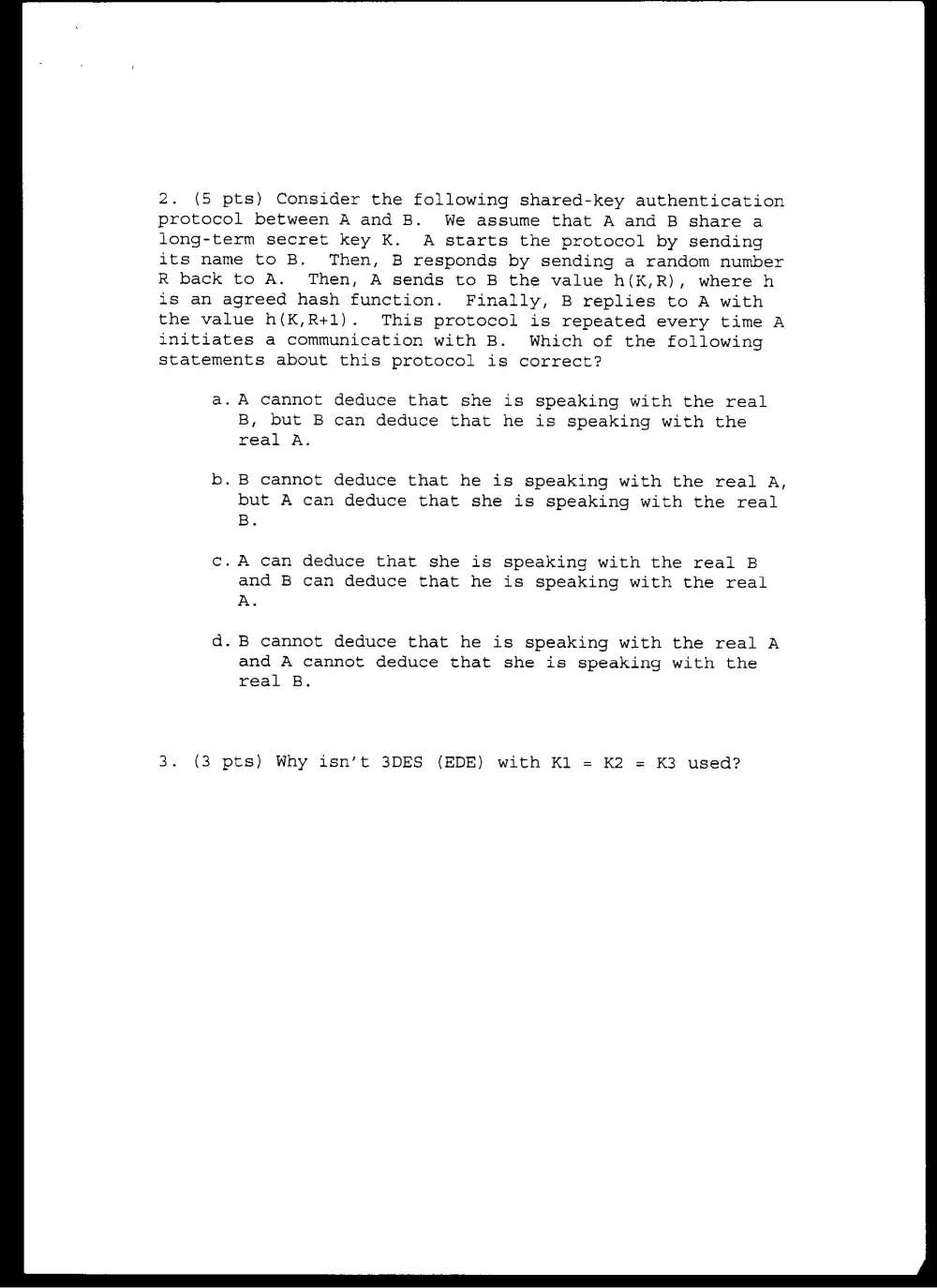
2. (5 pts) Consider the following shared-key authentication
protocol between A and B. We assume that A and B share a
long-term secret key K. A starts the protocol by sending
its name to B. Then, B responds by sending a random number
R back to A. Then, A sends to B the value h(K,R), where h
is an agreed hash function. Finally, B replies to A with
the value h(K,R+1). This protocol is repeated every time A
initiates a communication with B. Which of the following
statements about this protocol is correct?
a. A cannot deduce that she is speaking with the real
B, but B can deduce that he is speaking with the
real A.
. B cannot deduce that he is speaking with the real A,
but A can deduce that she is speaking with the real
B.
c. A can deduce that she is speaking with the real B
and B can deduce that he is speaking with the real
A.
- B cannot deduce that he is speaking with the real A
and A cannot deduce that she is speaking with the
real B.
(3 pts) Why isn’t 3DES (EDE) with Kil = K2 =
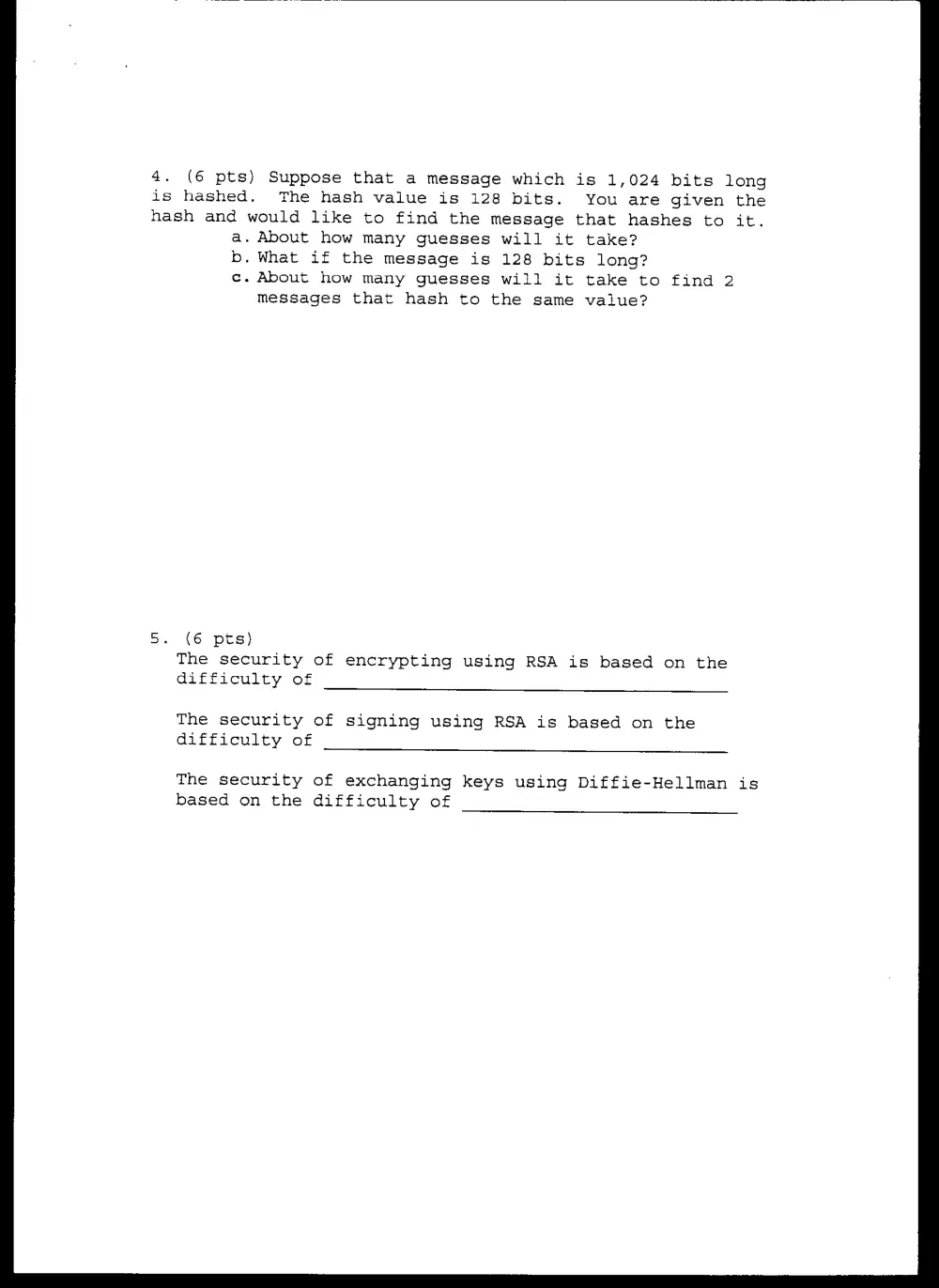
4. (6 pts) Suppose that a message which is 1,024 bits long
is hashed. The hash value is 128 bits. You are given the
hash and would like to find the message that hashes to it.
a. About how many guesses will it take?
b. What if the message is 128 bits long?
¢. About how many guesses will it take to find 2
messages that hash to the same value?
5. (6 pts)
The security of encrypting using RSA is based on the
difficulty of
The security of signing using RSA is based on the
difficulty of
The security of exchanging keys using Diffie-Hellman is
based on the difficulty of
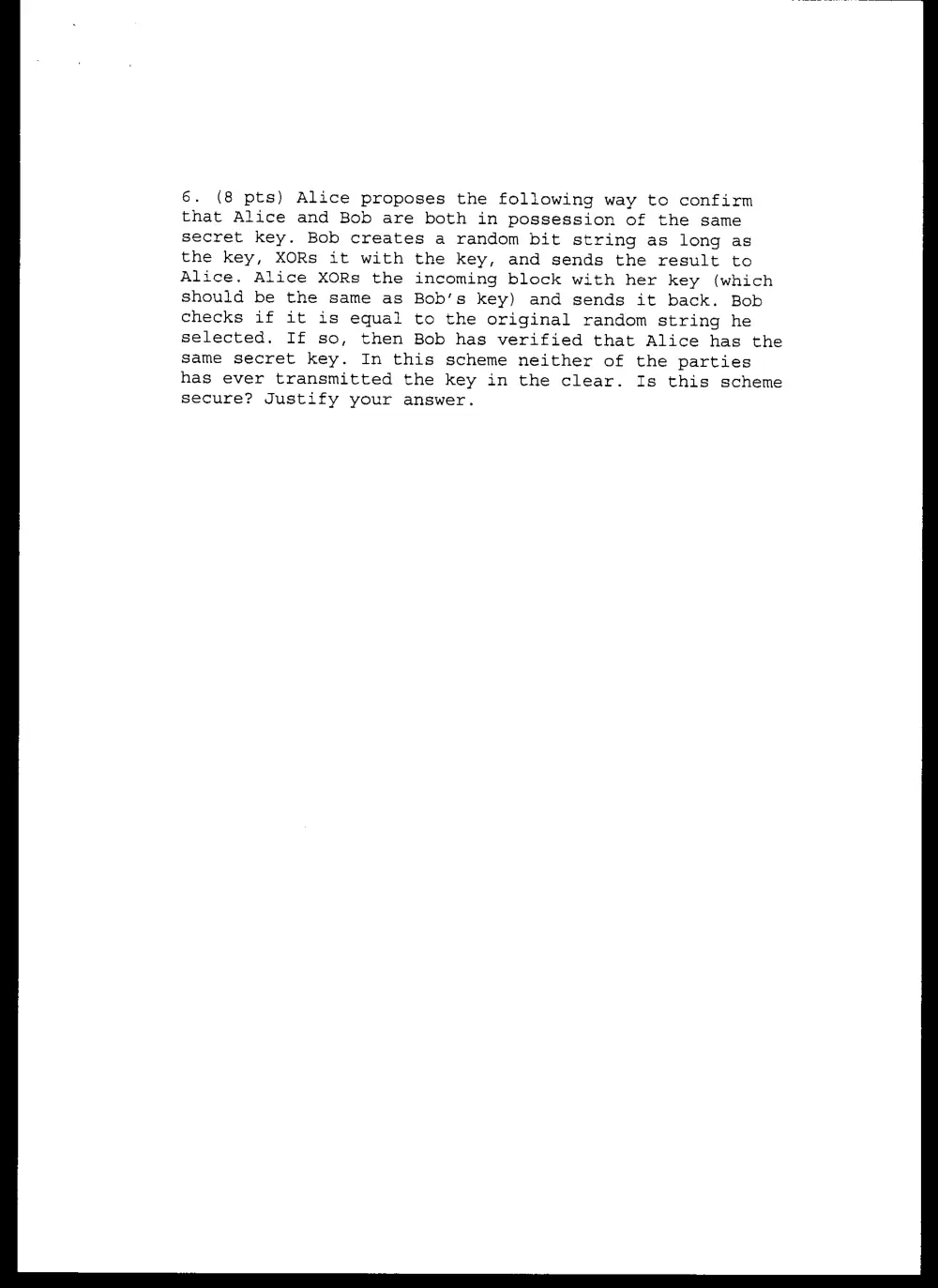
6. (8 pts) Alice proposes the following way to confirm
that Alice and Bob are both in possession of the same
secret key. Bob creates a random bit string as long as
the key, XORs it with the key, and sends the result to
Alice. Alice XORs the incoming block with her key (which
should be the same as Bob’s key) and sends it back. Bob
checks if it is equal to the original random string he
selected. If so, then Bob has verified that Alice has the
same secret key. In this scheme neither of the parties
has ever transmitted the key in the clear. Is this scheme
secure? Justify your answer.
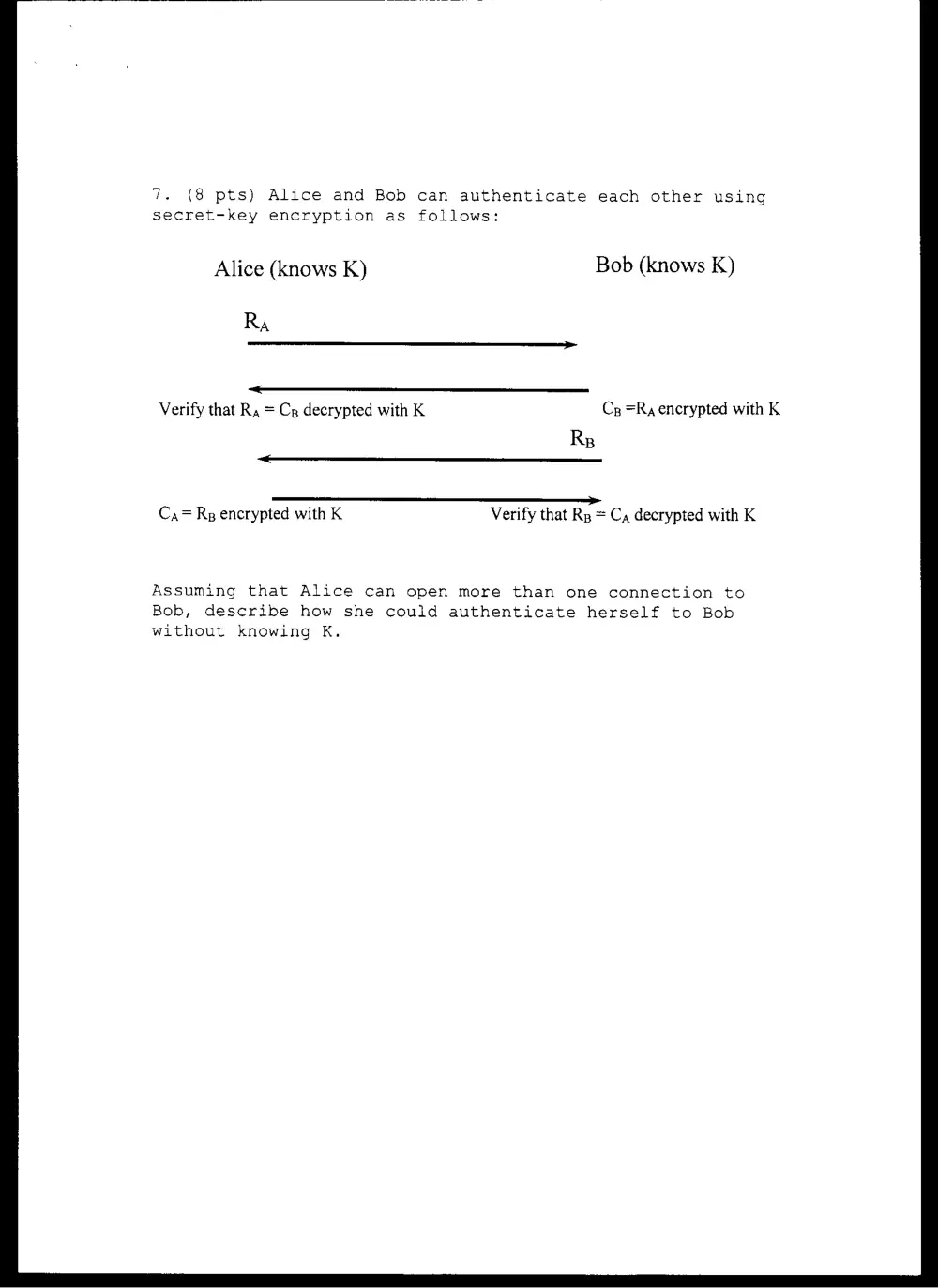
7. {8 pts) Alice and Bob can authenticate each other using
secret-key encryption as follows:
Alice (knows K) Bob (knows K)
Ra
a
—_—_—_—_—_—
Verify that Ra = Cp decrypted with K Cg =Ra encrypted with K
Rg
Sanne
—_—————
Ca= Rg encrypted with K Verify that Rg = Ca decrypted with K
Assuming that Alice can open more than one connection to
Bob, describe how she could authenticate herself to Bob
without knowing K.
8. {10 pts) Give an argument on why the initial and final
permutations in DES have no security value.
9. (13 points)
a) Describe why 2DES with same key is not much more secure
than single DES.
b) Describe why 2DES with 2 keys is not much more secure
than single DES. Assume that you have at least 2 known
(PlainfText, Cipher) pairs.
10. (5 pts) Bob suspects that his private key d for using
RSA has been compromised. Rather than generating a new n,
he decides to generate a new d and e with the old n. Is
this safe? Defend your answer.
11. (5 pts) What is the difference between a MAC and a
plain hash? When would you use a MAC as opposed to a plain
hash?
12. (5 pts) Alice wants to send a signed message to Bob
using RSA. Alice’s public and private keys are (e, n) and
(d, n) respectively. Let M be the message and S$ the
signature, then S = M? mod n.
Since Bob knows M, n and § couldn't he just compute d?