
CVSP 110 Final, Fall 2002
American University of Beirut · Gods and Creation East and West · 3 pages
More CVSP 110 files
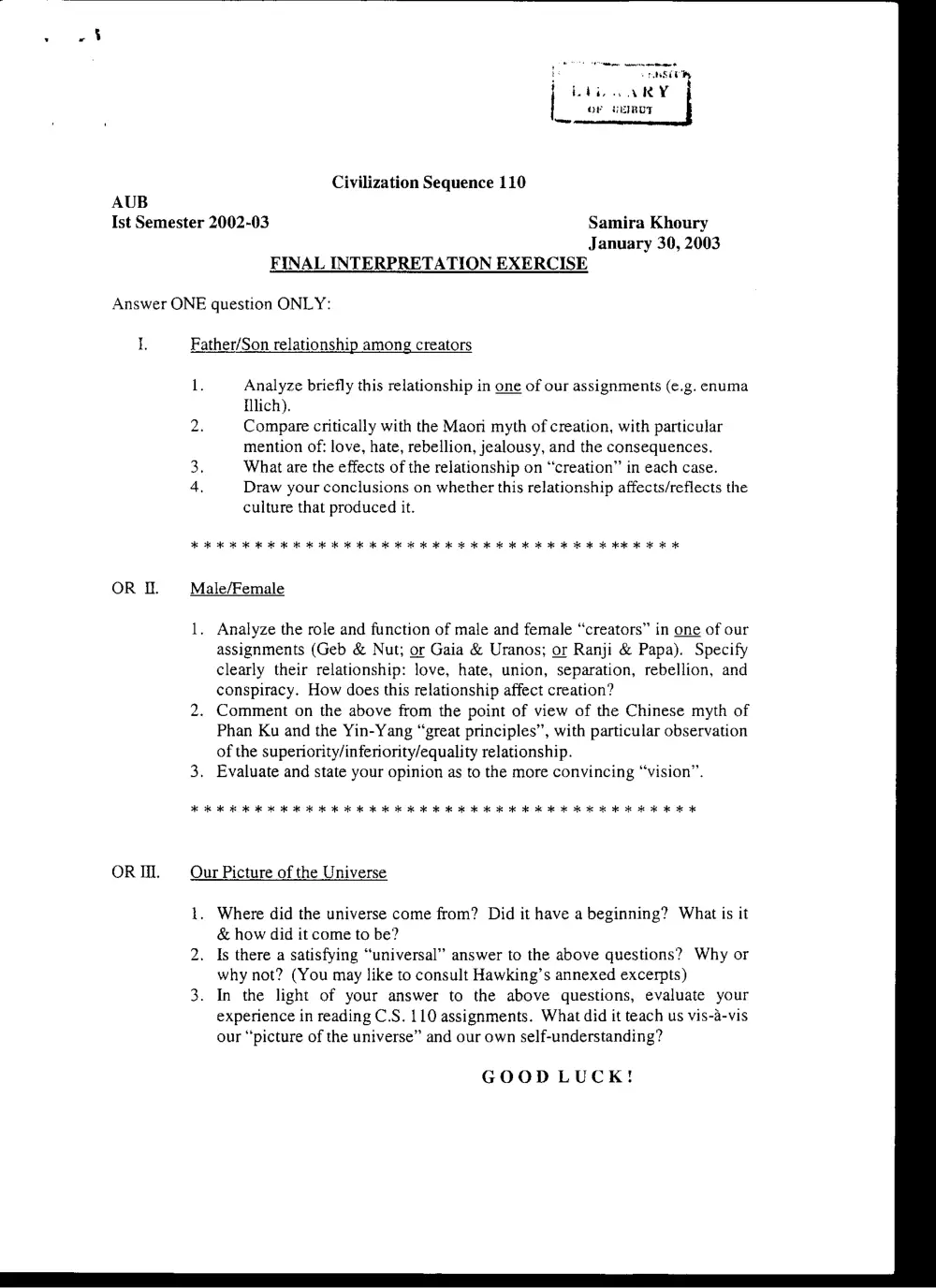
Show the text of this final exam
AUB
i SET
| bli. ARY
OF LEIROT
Civilization Sequence 110
Ist Semester 2002-03 Samira Khoury
January 30, 2003
FINAL INTERPRETATION EXERCISE
Answer ONE question ONLY:
1
OR IL.
OR Ii.
Father/Son relationship among creators
1.
2.
cvs)
Analyze briefly this relationship in one of our assignments (e.g. enuma
Ulich).
Compare critically with the Maori myth of creation, with particular
mention of: love, hate, rebellion, jealousy, and the consequences.
What are the effects of the relationship on “creation” in each case.
Draw your conclusions on whether this relationship affects/reflects the
culture that produced it.
AOR ROR OR RHR RR GR OK aR AK Rokk kok oR RR OK oR oR OK ok oR ok ok oR ok
Male/Female
nm
3.
Analyze the role and function of male and female “creators” in one of our
assignments (Geb & Nut; or Gaia & Uranos; or Ranji & Papa). Specify
clearly their relationship: love, hate, union, separation, rebellion, and
conspiracy. How does this relationship affect creation?
Comment on the above from the point of view of the Chinese myth of
Phan Ku and the Yin-Yang “great principles”, with particular observation
of the superiority/inferiority/equality relationship.
Evaluate and state your opinion as to the more convincing “vision”.
ee ee ee ee
Our Picture of the Universe
i,
Ww
Where did the universe come from? Did it have a beginning? What is it
& how did it come to be?
Is there a satisfying “universal” answer to the above questions? Why or
why not? (You may like to consult Hawking’s annexed excerpts)
In the light of your answer to the above questions, evaluate your
experience in reading C.S. 110 assignments. What did it teach us vis-a-vis
our “picture of the universe” and our own self-understanding?
GOOD LUCK!
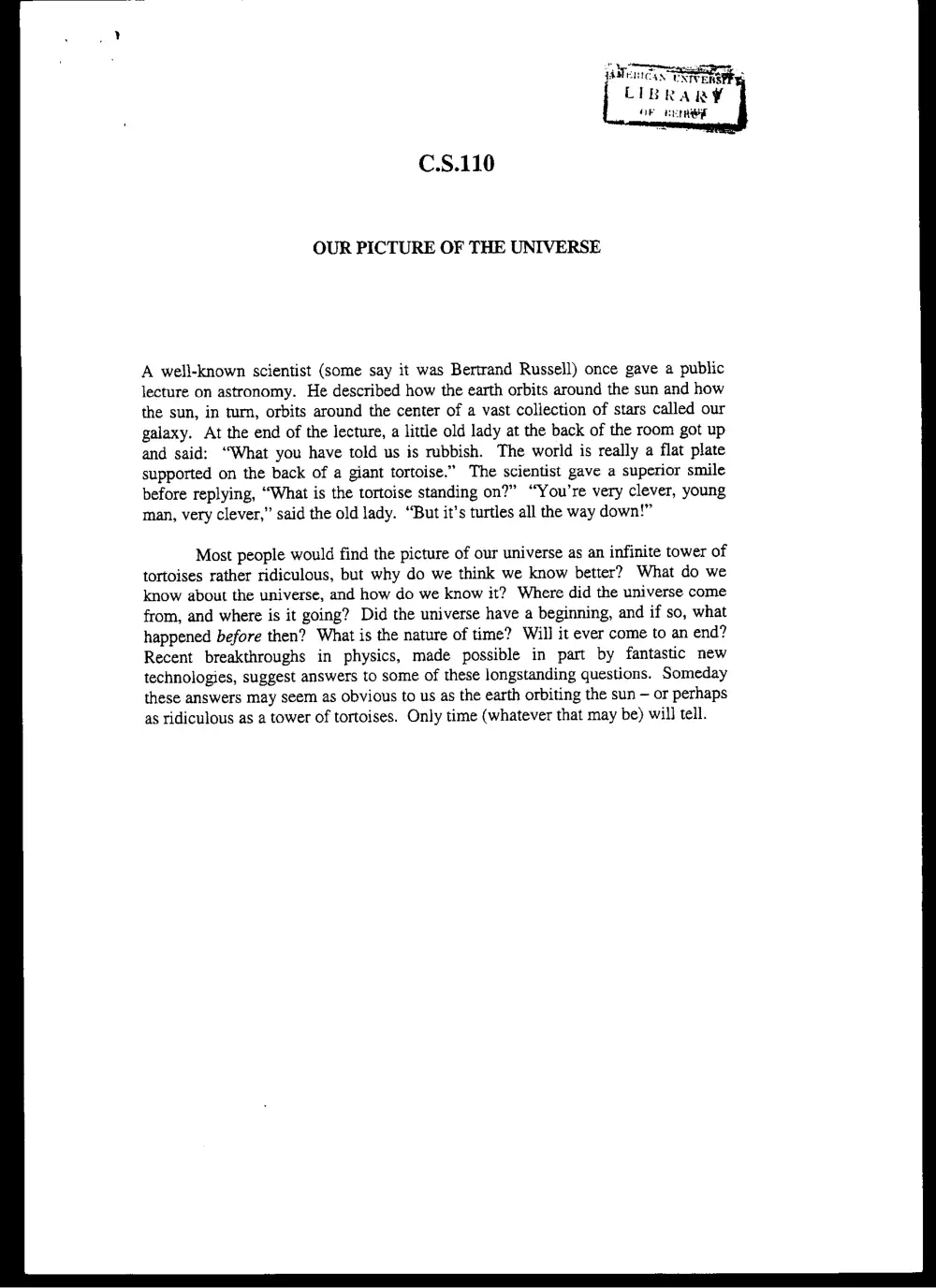
C.S.110
OUR PICTURE OF THE UNIVERSE
A well-known scientist (some say it was Bertrand Russell) once gave a public
lecture on astronomy. He described how the earth orbits around the sun and how
the sun, in turn, orbits around the center of a vast collection of stars called our
galaxy. At the end of the lecture, a little old lady at the back of the room got up
and said: “What you have told us is rubbish. The world is really a flat plate
supported on the back of a giant tortoise.” The scientist gave a superior smile
before replying, “What is the tortoise standing on?” “You're very clever, young
man, very clever,” said the old lady. “But it’s turtles all the way down!”
Most people would find the picture of our universe as an infinite tower of
tortoises rather ridiculous, but why do we think we know better? What do we
know about the universe, and how do we know it? Where did the universe come
from, and where is it going? Did the universe have a beginning, and if so, what
happened before then? What is the nature of time? Will it ever come to an end?
Recent breakthroughs in physics, made possible in part by fantastic new
technologies, suggest answers to some of these longstanding questions. Someday
these answers may seem as obvious to us as the earth orbiting the sun — or perhaps
as ridiculous as a tower of tortoises. Only time (whatever that may be) will tell.
nw .
AMERICUS ONSVERSITR)
LIBRARY
UF BEIRUT
—
117
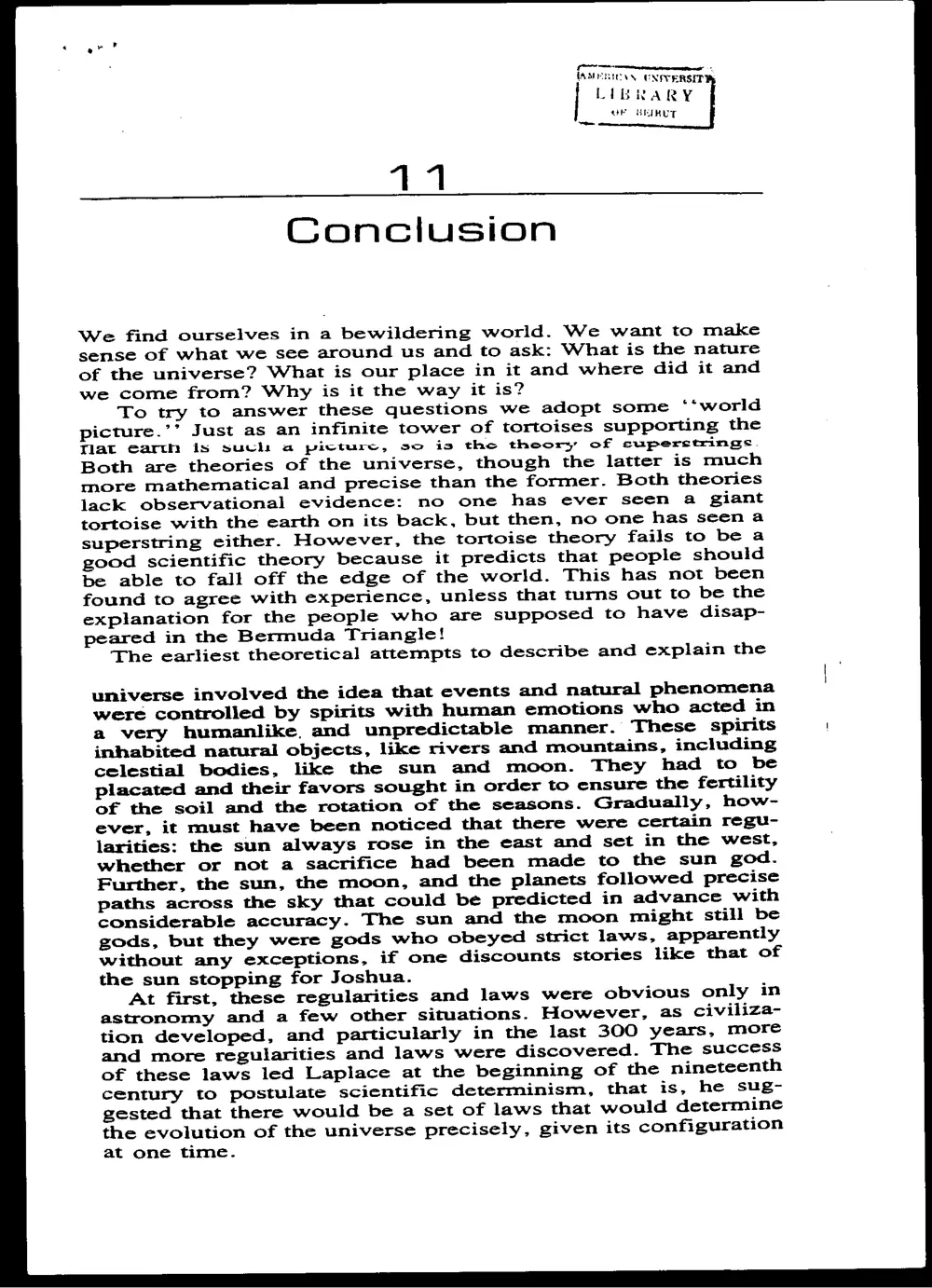
Conclusion
We find ourselves in a bewildering world. We want to make
sense of what we see around us and to ask: What is the nature
of the universe? What is our place in it and where did it and
we come from? Why is it the way it is?
To try to answer these questions we adopt some ‘*world
picture.’’ Just as an infinite tower of tortoises supporting the
Tlat earth is such a picture, so ia the theory of euperctrings.
Both are theories of the universe, though the latter is much
more mathematical and precise than the former. Both theories
lack observational evidence: no one has ever seen a giant
tortoise with the earth on its back, but then, no one has seen a
superstring either. However, the tortoise theory fails to be a
good scientific theory because it predicts that people should
be able to fall off the edge of the world. This has not been
found to agree with experience, unless that turns out to be the
explanation for the people who are supposed to have disap-
peared in the Bermuda Triangle!
The earliest theoretical attempts to describe and explain the
universe involved the idea that events and natural phenomena
were controlled by spirits with human emotions who acted in
a very humanlike, and unpredictable manner. These spirits
inhabited natural objects, like rivers and mountains, including
celestial bodies, like the sun and moon. They had to be
placated and their favors sought in order to ensure the fertility
of the soil and the rotation of the seasons. Gradually, how-
ever, it must have been noticed that there were certain regu-
larities: the sun always rose in the east and set in the west,
whether or not a sacrifice had been made to the sun god.
Further, the sun, the moon, and the planets followed precise
paths across the sky that could be predicted in advance with
considerable accuracy. The sun and the moon might still be
gods, but they were gods who obeyed strict laws, apparently
without any exceptions, if one discounts stories like that of
the sun stopping for Joshua.
At first, these regularities and laws were obvious only in
astronomy and a few other situations. However, as civiliza-
tion developed, and particularly in the last 300 years, more
and more regularities and laws were discovered. The success
of these laws led Laplace at the beginning of the nineteenth
century to postulate scientific determinism, that is, he sug-
gested that there would be a set of laws that would determine
the evolution of the universe precisely, given its configuration
at one time.