
CVSP 110 Final, Fall 2003
American University of Beirut · Gods and Creation East and West · 4 pages

More CVSP 110 files
Show the text of this final exam
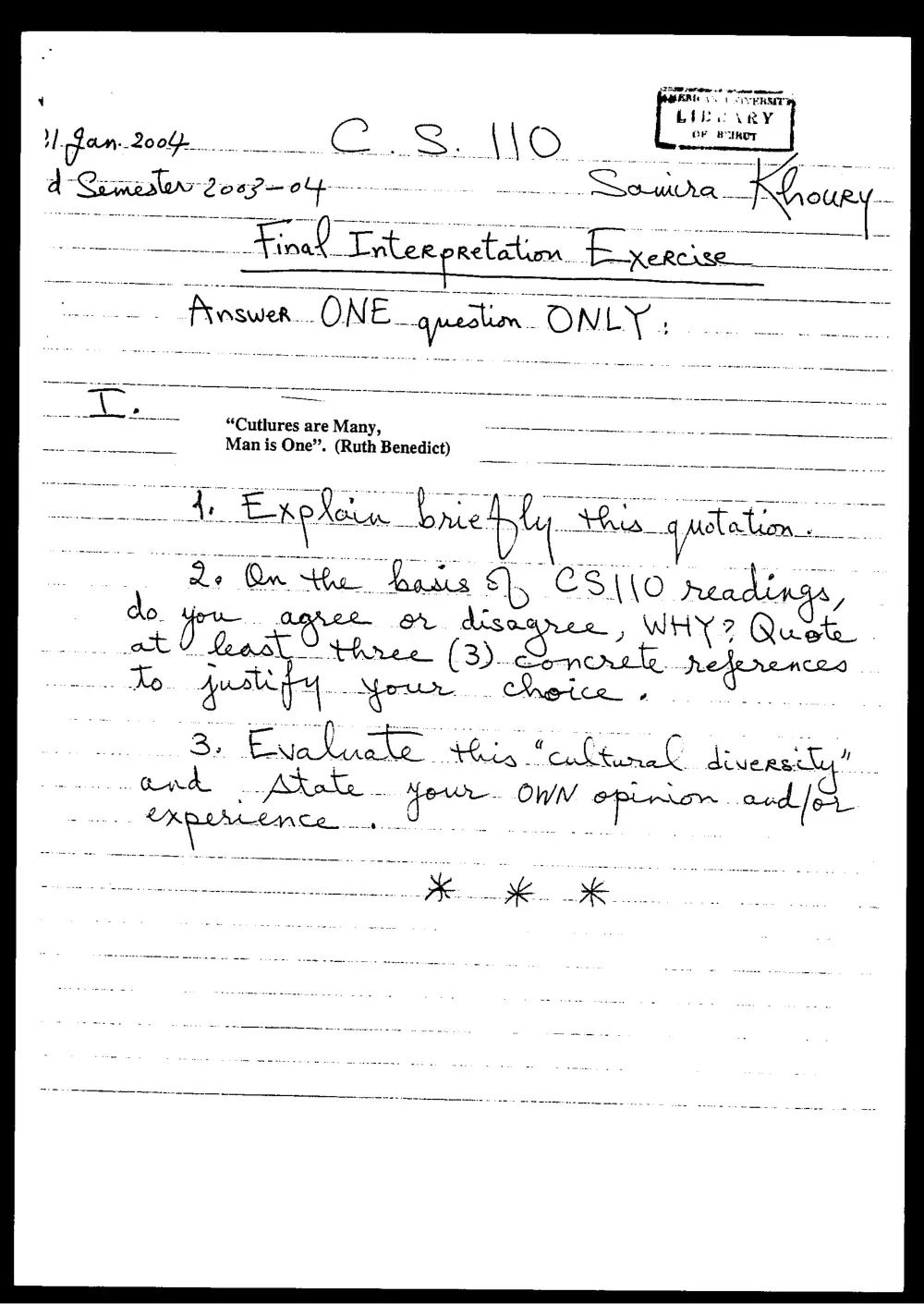
“Cutlures are Many, —
Man is One’’, (Ruth Benedict)
cos jo on op ol
RR
Or _iL. Archetypes or cultural diffusion
1, Select any (3) three myths and analyze one of the following with a
view to point out:
a. the similarities.
b. whether this/these similarities are archetypes or cultural
diffusion (elaborate your reasons):
- ¥ Earth, or monotheism or chaos, or language or love.
Which is the more convincing explanation in your opinion, Busty °
Fee Ek aR Rao aR oa ok ak ROK eK a Ok
OR I. Our Picture of the Universe
1. Where did the universe come from? Did it have a beginning? What is it
& how did it come to be?
2. Is there a satisfying “universal” answer to the above questions? Why or
why not? (You may like to consult Hawking’s annexed excerpts)
3. In the light of your answer to the above questions, evaluate your
experience in reading C.S. 110 assignments. What did it teach us vis-a-vis :
our “picture of the universe” and our own self-understanding? (eo oe bass
eh ~RR (3) coments Arderences) -
NTE
ins
| LiBpianry
OF BEIRUE
oW
C.8.110
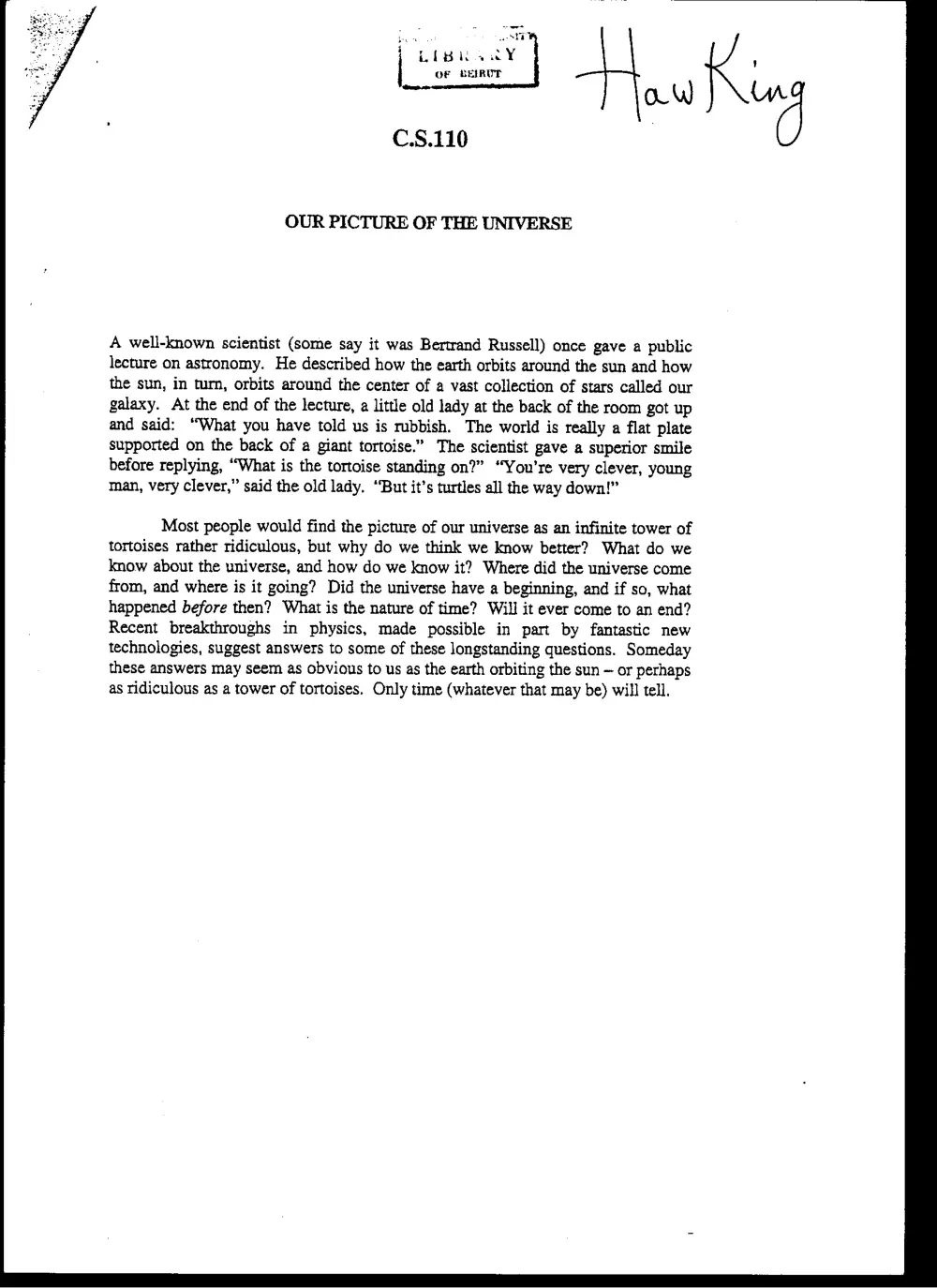
OUR PICTURE OF THE UNIVERSE
A well-known scientist (some say it was Bertrand Russell) once gave a public
lecture on astronomy. He described how the earth orbits around the sun and how
the sun, in turn, orbits around the center of a vast collection of stars called our
galaxy. At the end of the lecture, a little old lady at the back of the room got up
and said: “What you have told us is rubbish. The world is really a flat plate
supported on the back of a giant tortoise.” The scientist gave a superior smile
before replying, “What is the tortoise standing on?” “You're very clever, young
man, very clever,” said the old lady. “But it’s turtles all the way down!”
Most people would find the picture of our universe as an infinite tower of
tortoises rather ridiculous, but why do we think we know better? What do we
know about the universe, and how do we know it? Where did the universe come
from, and where is it going? Did the universe have a beginning, and if so, what
happened before then? What is the nature of time? Will it ever come to an end?
Recent breakthroughs in physics, made possible in part by fantastic new
technologies, suggest answers to some of these longstanding questions. Someday
these answers may seem as obvious to us as the earth orbiting the sun -- or perhaps
as ridiculous as a tower of tortoises. Only time (whatever that may be) will tell.
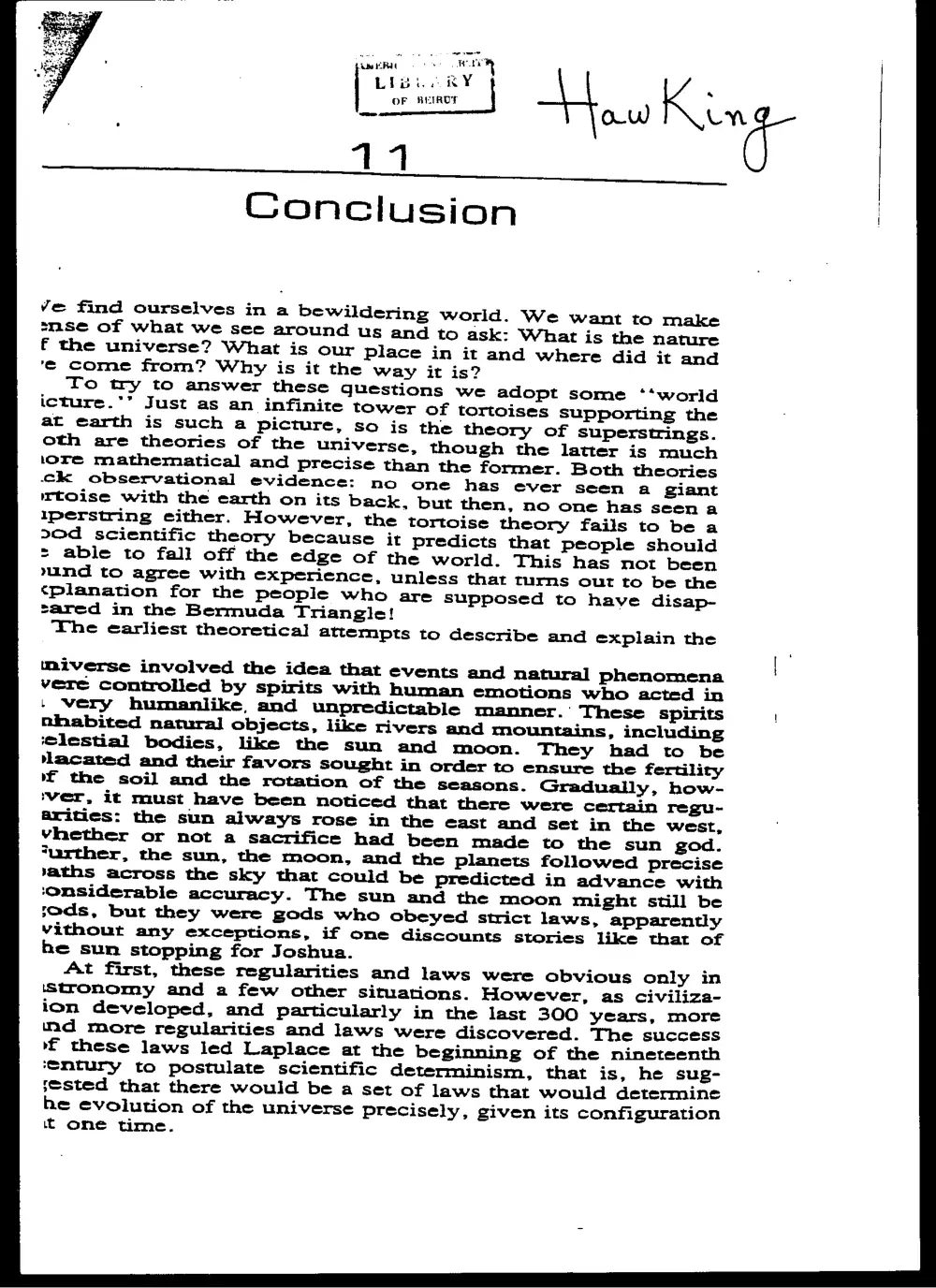
Conclusion
Ve find ourselves in a bewilde
*nse of what we see around us and to ask: What is the nature
f the universe? What is our Place in it and where did it and
‘¢ come from? Why is it the way it is?
To try to answer these questions we adopt some ‘‘world
icture.’” Just as an infinite tower of tortoises supporting the
at earth is such a picture, so is the theory of superstrings.
oth are theories of the universe, though the latter is mauch
ore mathematical and precise than the former. Both theories
ck observational evidence: no one has ever seen a giant
rtoise with the earth on its back, but then, no one has seen a
iperstring either. However, the tortoise theory fails to be a
20d scientific theory because it predicts that people should
able to fall off the
ring world. We want to make
» ii i mountains, including
‘elestial bodies, like the sun and moon. They had to be
tacated and their favors sought in order to ensure the fertility
€ the soil and the rotation of the seasons. Gradually, how-
‘ver, it must have been noticed that there were certain regu-
arities: the sun always rose in the east and set in the west,
vhether or not a sacrifice had been made to the sun god.
*urther, and the planets followed precise
uld be predicted in advance with
‘Omsiderable accuracy. The sun and the moon might still be
sods, but they were gods who obeyed strict laws, apparently
vithout any exceptions, if ome discounts Stories like that of
he sun stopping for Joshua.
At first, these regularities and laws were obvious only in
‘stronomy and a few other situations. However, as civiliza-
ion developed, and particularly in the last 300 years, more
tad more regularities and laws were discovered. The success
£ these laws led Laplace at the beginning of the nineteenth
‘entury to postulate scientific determinism, that is, he sug-
;ested that there would be a set of laws that would determine
he evolution of the universe Precisely, given its configuration
tt one time.