
CVSP 150 Final, Fall 2004
American University of Beirut · Art Appreciation · 4 pages



More CVSP 150 files
Show the text of this final exam
AMERICAN UNVERSITY OF BEIRUT
ART APPRECIATION
CVSP 150
Dr. Lina Abyad
FALL 2005
FINAL EXAM footcen ex vena:
| LIBRARY i
|. Fill in the blanks, and answer the questions when needed: 20%
An art style of the 1960s, deriving its
imagery from mass- produced culture. Deliberately mundane, it focused
on the over familiar objects of daily life to give them new meanings as
visual emblems.
The technique of creating a sculpture by
joining together individual pieces or segments, sometimes “found”
objects that originally served another purpose. Also a sculpture made by
this method.
An event performed by artists, usually
spontaneous and unrehearsed, that may include music, dance, mime, art,
reading, or any combination of these.
4.
Mark Rothko’s works belong to a style of painting prominent from 1950s
to 1970s known as . The paintings
usually featured one or more soft-edged color rectangles floating in the
larger color rectangle of the canvas.
"
2
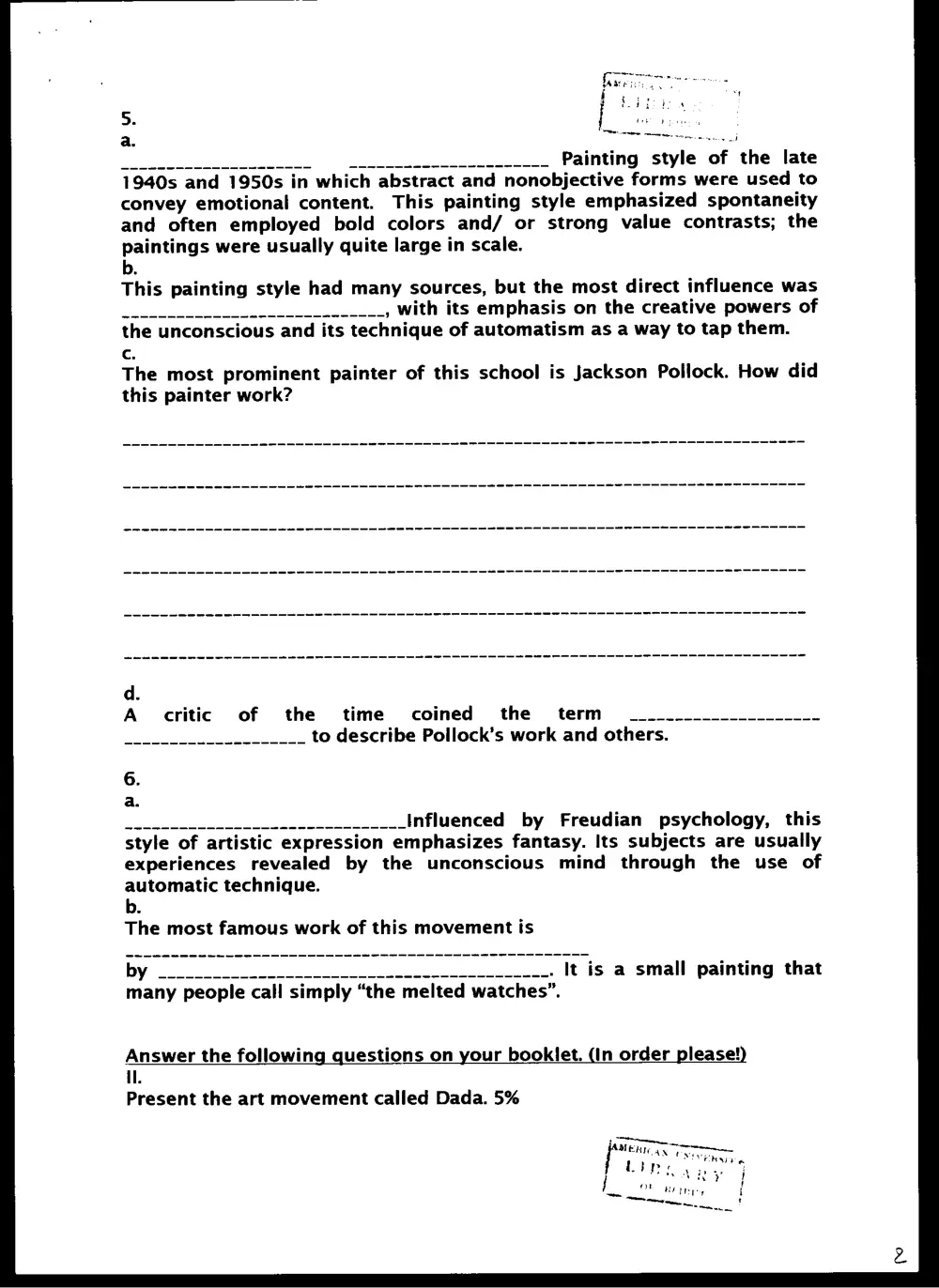
Doe ee Painting style of ‘the late
1940s and 1950s in which abstract and nonobjective forms were used to
convey emotional content. This painting style emphasized spontaneity
and often employed bold colors and/ or strong value contrasts; the
paintings were usually quite large in scale.
b.
This painting style had many sources, but the most direct influence was
eee , with its emphasis on the creative powers of
the unconscious and its technique of automatism as a way to tap them.
c.
The most prominent painter of this school is Jackson Pollock. How did
this painter work?
A critic of the time coined the term = $_.-_....
to describe Pollock’s work and others.
penne eee Influenced by Freudian psychology, this
style of artistic expression emphasizes fantasy. Its subjects are usually
experiences revealed by the unconscious mind through the use of
automatic technique.
b.
The most famous work of this movement is
many people call simply “the melted watches”.
Answer the following questions on your booklet. (In order please!)
Il.
Present the art movement called Dada. 5%
Men
MHI ANT Usewpo ta
Line ., aa
oF mine
—e ne
MB ERICA N EN Ia sre *
LIBR aR y
Ry
11.
Present Bottle Dryer by Marcel Duchamp. 8% —.!
IV.
a.
How do artists illustrate the Qur'an? What are the ornaments that can be
used and why? 8%
b.
From where did early Islamic architects draw their inspiration to build the
mosques? Develop. 4%
V.
In 1863, Edouard Manet presented Le Déjeuner sur I’Herbe- Luncheon on
the Grass- that was refused at the annual Salon.
a.
Manet was inspired by two works of the Renaissance. 4%
Cite these two works and there authors:
b. What were the two goals Manet wanted to achieve with this work? 6%
Vi.
Les Demoiselles d’Avignon is widely regarded as a pivotal work in the
development of the 20"-century art.
a
Give the name of the painter, and the movement to which this art work
belongs. 4%
b.
In this work the painter is experimenting with several ideas that he
will explore in his art in the years to come. What are the three main
ideas? 6%
Vil.
Eugene Delacroix was considered the champion of the Romantic
Movement.
a. What are the characteristics of this movement? 5%
Vill.
Four important artists near the end of the nineteenth century who once
were inspired by impressionism abandoned it. They put forward that it
was limiting their personal explorations. These pioneers sought to
restore formal organization, decorative unity and expressive meaning to
art.
a. Name the artists to whom this name applied.
b. How are these artists called?
c. What was the specificity of each artist? 10%
IX.
In disagreement with Romanticism and Neoclassicism, an artistic
movement led by Gustave Courbet developed in France.
Name this movement and define its characteristics. 5%
x.
Present the art movement called Futurism. 5%
xi.
Claude Monet painted almost 100 views of the Waterloo Bridge from his
room in the Savoy Hotel in London.
a. What were Monet's interests?
b. To which movement he belonged? 10%
XI.
Bonus
Fill in the blanks: 6%
A style, initiated in the late 1700s in France,
which centered upon the reintroduction of the Classical Greek and
Roman forms of art, as then understood. It became the basis for the
“approved” or official art of the French government until about the
middle of the nineteenth century.
A form of art in which there is a desire to
express what is felt rather than perceived or reasoned. The form is
defined by an obvious exaggeration of natural objects for the purpose of
emphasizing an emotion, mood, or concept. The term is best applied to a
movement in art of the early twentieth century particularly strong in
Germany prior to World War I.
An art movement of the first decade of the
twentieth century, using color boldly to express the inner qualities
rather than superficial appearance of things.