
CVSP 203 Final, Fall 2007
American University of Beirut · Modern and Contemporary Culture · 2 pages
More CVSP 203 files
Show the text of this final exam
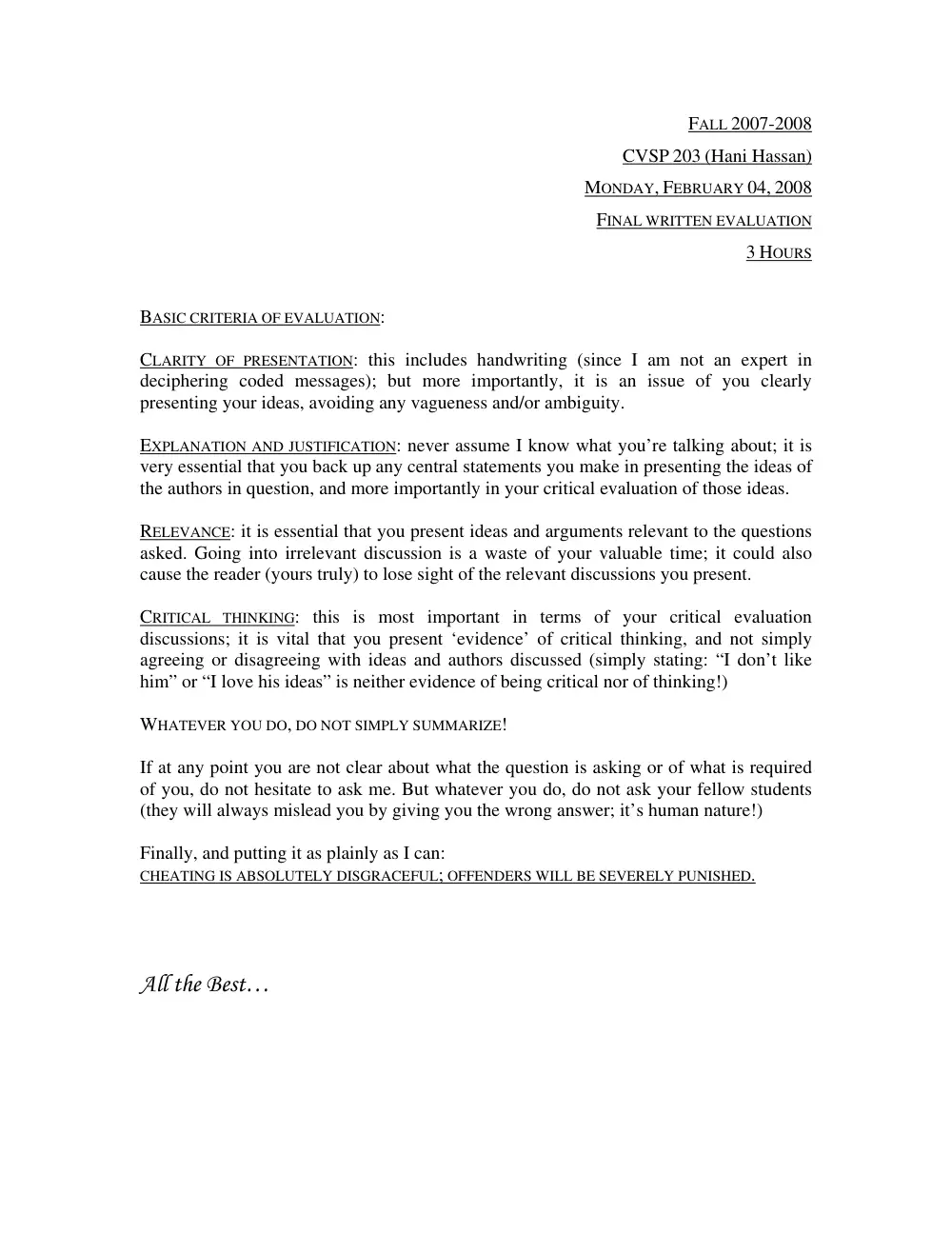
FALL 2007-2008
CVSP 203 (Hani Hassan)
MONDAY, FEBRUARY 04, 2008
FINAL WRITTEN EVALUATION
3 HOURS
BASIC CRITERIA OF EVALUATION:
CLARITY OF PRESENTATION: this includes handwriting (since I am not an expert in
deciphering coded messages); but more importantly, it is an issue of you clearly
presenting your ideas, avoiding any vagueness and/or ambiguity.
EXPLANATION AND JUSTIFICATION: never assume I know what you’re talking about; it is
very essential that you back up any central statements you make in presenting the ideas of
the authors in question, and more importantly in your critical evaluation of those ideas.
RELEVANCE: it is essential that you present ideas and arguments relevant to the questions
asked. Going into irrelevant discussion is a waste of your valuable time; it could also
cause the reader (yours truly) to lose sight of the relevant discussions you present.
CRITICAL THINKING: this is most important in terms of your critical evaluation
discussions; it is vital that you present ‘evidence’ of critical thinking, and not simply
agreeing or disagreeing with ideas and authors discussed (simply stating: “I don’t like
him” or “I love his ideas” is neither evidence of being critical nor of thinking!)
WHATEVER YOU DO, DO NOT SIMPLY SUMMARIZE!
If at any point you are not clear about what the question is asking or of what is required
of you, do not hesitate to ask me. But whatever you do, do not ask your fellow students
(they will always mislead you by giving you the wrong answer; it’s human nature!)
Finally, and putting it as plainly as I can:
CHEATING IS ABSOLUTELY DISGRACEFUL; OFFENDERS WILL BE SEVERELY PUNISHED.
All the Best…
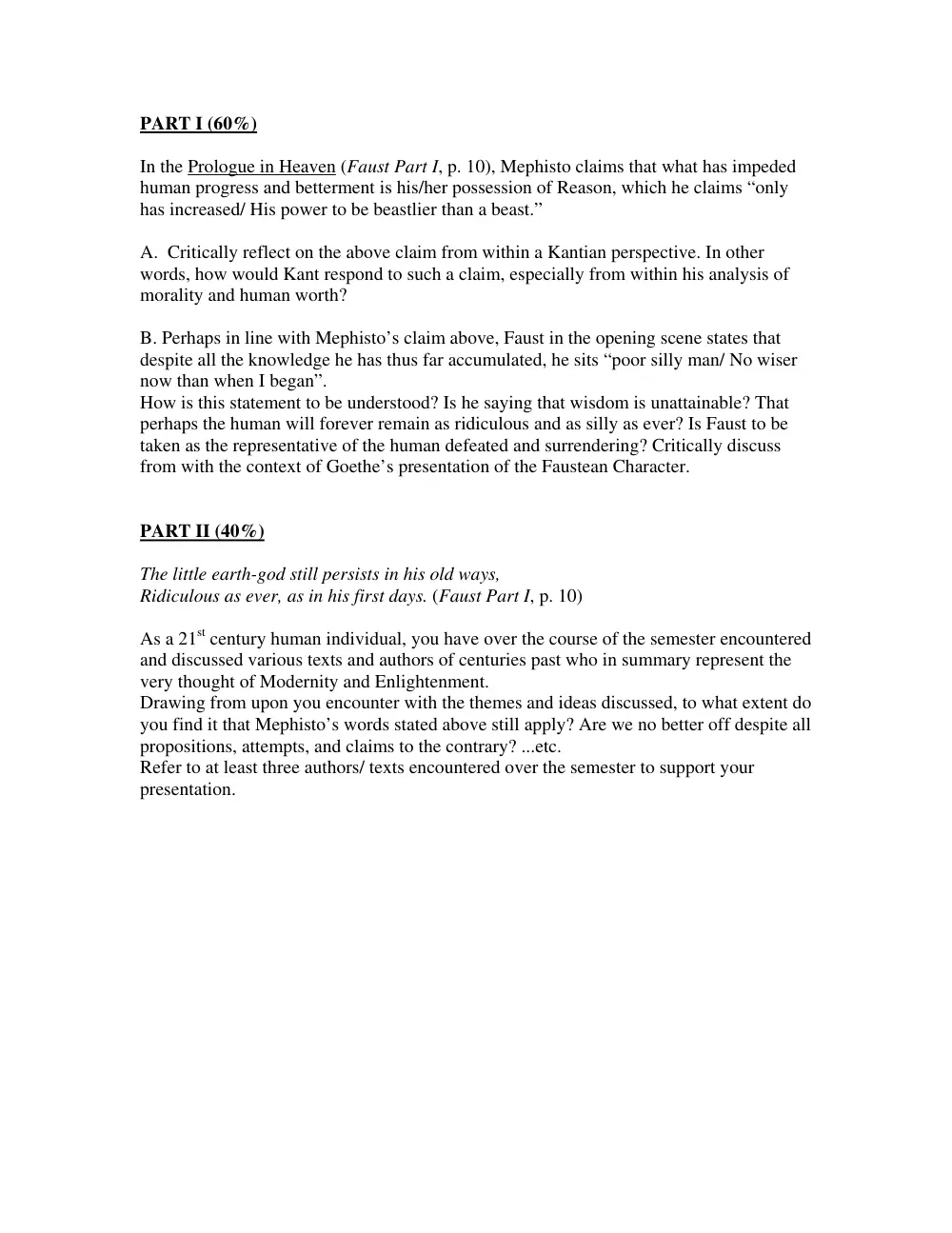
PART I (60%)
In the Prologue in Heaven (Faust Part I, p. 10), Mephisto claims that what has impeded
human progress and betterment is his/her possession of Reason, which he claims “only
has increased/ His power to be beastlier than a beast.”
A. Critically reflect on the above claim from within a Kantian perspective. In other
words, how would Kant respond to such a claim, especially from within his analysis of
morality and human worth?
B. Perhaps in line with Mephisto’s claim above, Faust in the opening scene states that
despite all the knowledge he has thus far accumulated, he sits “poor silly man/ No wiser
now than when I began”.
How is this statement to be understood? Is he saying that wisdom is unattainable? That
perhaps the human will forever remain as ridiculous and as silly as ever? Is Faust to be
taken as the representative of the human defeated and surrendering? Critically discuss
from with the context of Goethe’s presentation of the Faustean Character.
PART II (40%)
The little earth-god still persists in his old ways,
Ridiculous as ever, as in his first days. (Faust Part I, p. 10)
As a 21st century human individual, you have over the course of the semester encountered
and discussed various texts and authors of centuries past who in summary represent the
very thought of Modernity and Enlightenment.
Drawing from upon you encounter with the themes and ideas discussed, to what extent do
you find it that Mephisto’s words stated above still apply? Are we no better off despite all
propositions, attempts, and claims to the contrary? ...etc.
Refer to at least three authors/ texts encountered over the semester to support your
presentation.