
CVSP 203 Final, Spring 2008
American University of Beirut · Modern and Contemporary Culture · 2 pages

More CVSP 203 files
Show the text of this final exam
a nenntanannney
ASTERIC AN UNIVERS:
LIBRARY
OF REtRET
—
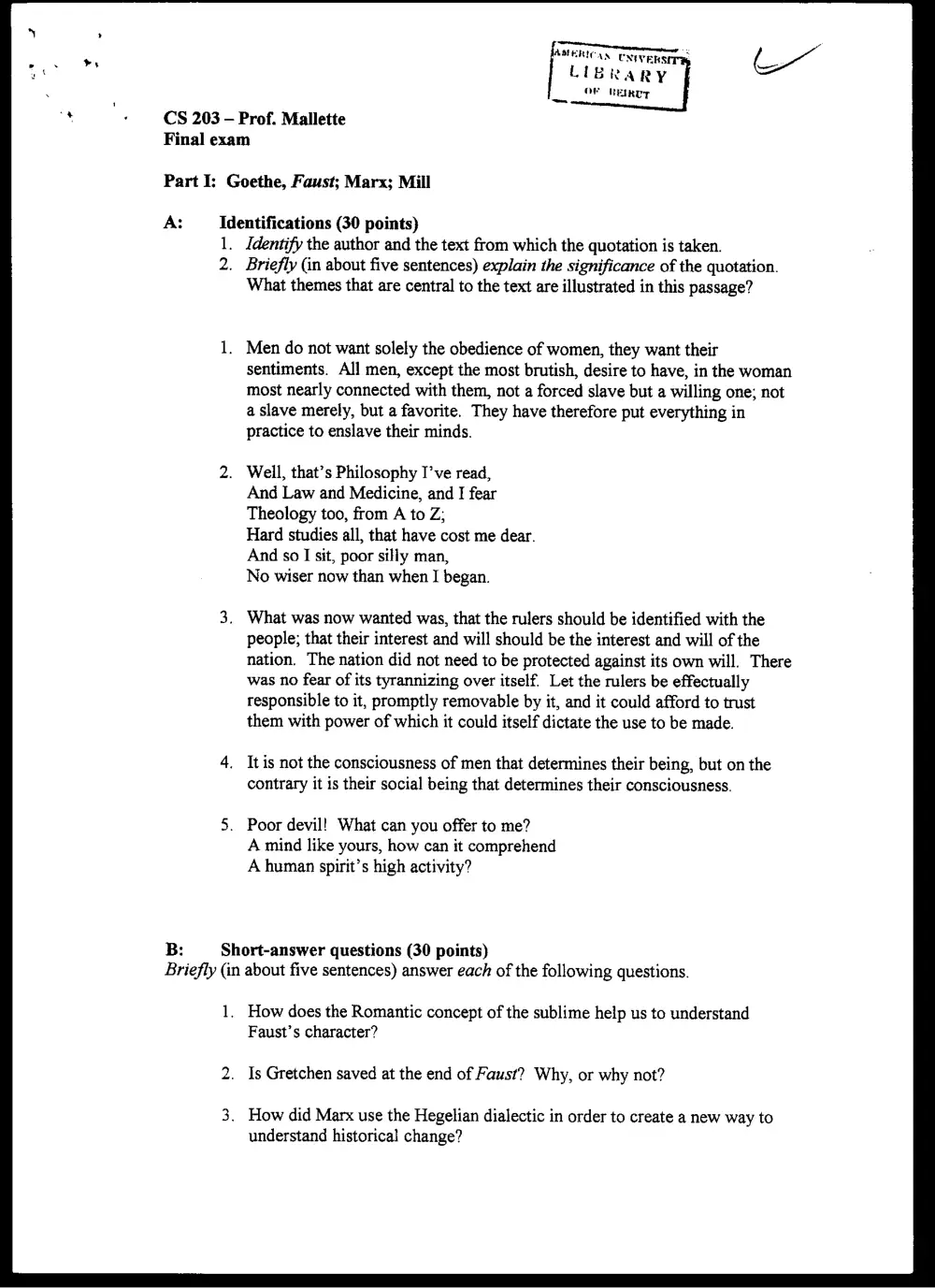
CS 203 — Prof. Mallette
Final exam
Part I: Goethe, Faust; Marx; Mill
A: Identifications (30 points)
1. Identify the author and the text from which the quotation is taken.
2. Briefly (in about five sentences) explain the significance of the quotation.
What themes that are central to the text are illustrated in this passage?
. Men do not want solely the obedience of women, they want their
sentiments. All men, except the most brutish, desire to have, in the woman
most nearly connected with them, not a forced slave but a willing one; not
a slave merely, but a favorite. They have therefore put everything in
practice to enslave their minds.
. Well, that’s Philosophy I’ve read,
And Law and Medicine, and I fear
Theology too, from A to Z;
Hard studies all, that have cost me dear.
And so I sit, poor siliy man,
No wiser now than when I began.
. What was now wanted was, that the rulers should be identified with the
people; that their interest and will should be the interest and will of the
nation. The nation did not need to be protected against its own will. There
was no fear of its tyrannizing over itself. Let the rulers be effectually
responsible to it, promptly removable by it, and it could afford to trust
them with power of which it could itself dictate the use to be made.
. Itis not the consciousness of men that determines their being, but on the
contrary it is their social being that determines their consciousness.
. Poor devil! What can you offer to me?
A mind like yours, how can it comprehend
A human spirit’s high activity?
B: Short-answer questions (30 points)
Briefly (in about five sentences) answer each of the following questions.
1. How does the Romantic concept of the sublime help us to understand
Faust’s character?
. Is Gretchen saved at the end of Faust? Why, or why not?
. How did Marx use the Hegelian dialectic in order to create a new way to
understand historical change?
{wieniene UNIVER .
LIBRARY
OF BEIRUT
. Briefly describe the four periods of human history, according to Marx.
. How does Mill use an orientalist argument to support his critique of
European culture in the essay “On Liberty”?
. Why does Mill believe that we have no real understanding of the nature of
women? What changes must be made in human society before we are able
to understand women better?
Part II: Comprehensive
Essay question (40 points)
Write an answer to one of the following questions.
1.
What is the distinction that Kant makes between the public sphere and the
private sphere? Why does he give individuals liberty in one sphere and not
the other? Does Mill agree with this distinction? Why, or why not?
. Describe and compare Hobbes’ and Marx’s conceptions of class, and of
political sovereignty. How does Hobbes view political struggle, including
class warfare? How does Marx view political struggle and class warfare?
Who does Hobbes believe should have political sovereignty in the state?
Who does Marx believe should have political sovereignty?
. Compare two depictions of intellectuals we have read: Descartes’ self-
portrait, and the portrait of Faust. How does the difference between these
two portraits help us to understand changes in the ways that European
intellectuals thought about the limits of human knowledge between the
Enlightenment and the Romantic era?