
CVSP 204 Final, Fall 2000
American University of Beirut · Modern and Contemporary Culture · 3 pages
More CVSP 204 files
Show the text of this final exam
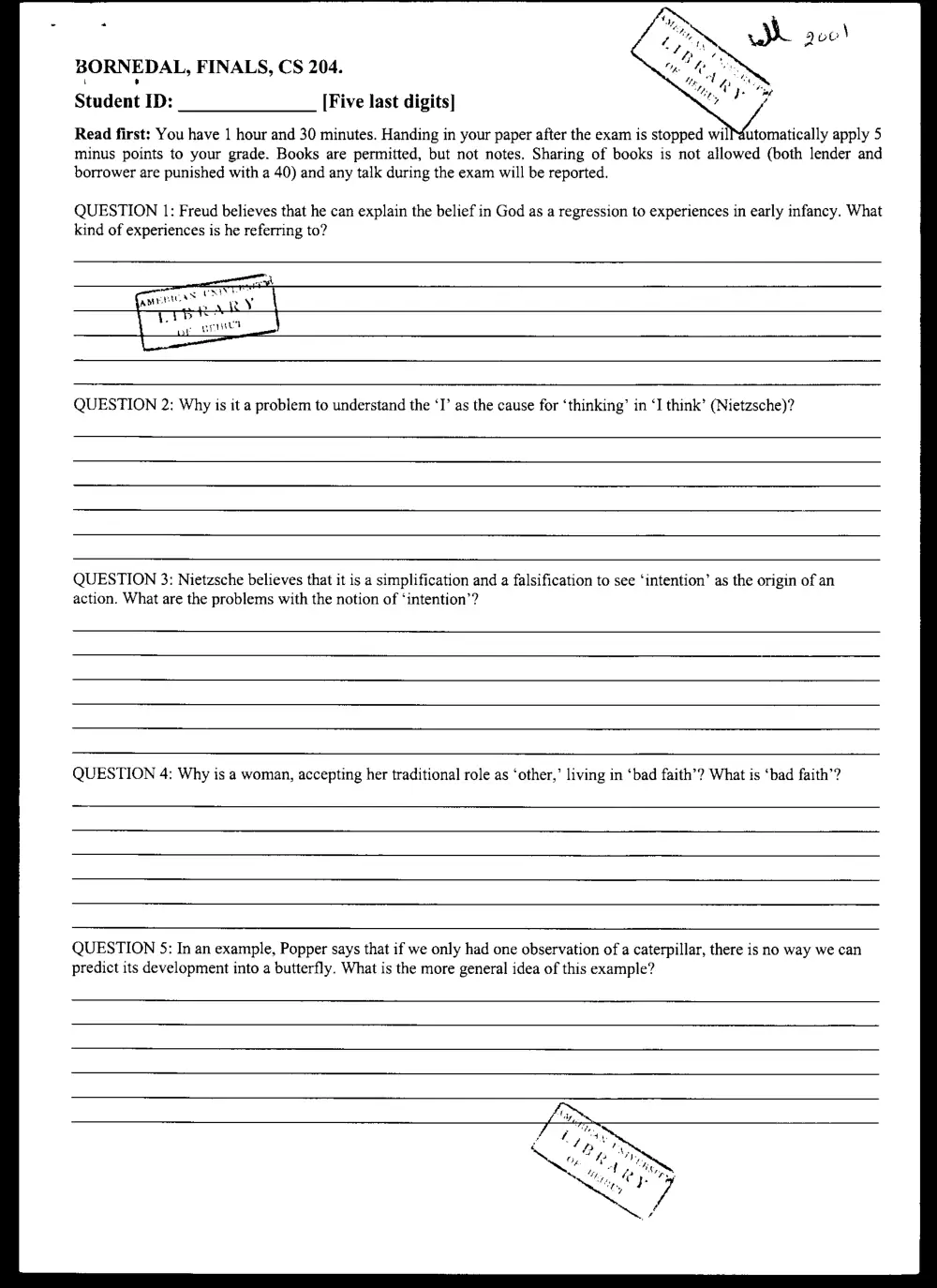
BORNEDAL, FINALS, CS 204.
Student ID: [Five last digits]
Read first: You have 1 hour and 30 minutes. Handing in your paper after the exam is stopped wi
minus points to your grade. Books are permitted, but not notes. Sharing of books is not allowed (both lender and
borrower are punished with a 40) and any talk during the exam will be reported.
QUESTION 1: Freud believes that he can explain the belief in God as a regression to experiences in early infancy. What
kind of experiences is he referring to?
QUESTION 2: Why is it a problem to understand the ‘I’ as the cause for ‘thinking’ in ‘I think’ (Nietzsche)?
QUESTION 3: Nietzsche believes that it is a simplification and a falsification to see ‘intention’ as the origin of an
action. What are the problems with the notion of ‘intention’?
QUESTION 4: Why is a woman, accepting her traditional role as ‘other,’ living in ‘bad faith’? What is ‘bad faith’?
QUESTION 5S: In an example, Popper says that if we only had one observation of a caterpillar, there is no way we can
predict its development into a butterfly. What is the more general idea of this example?
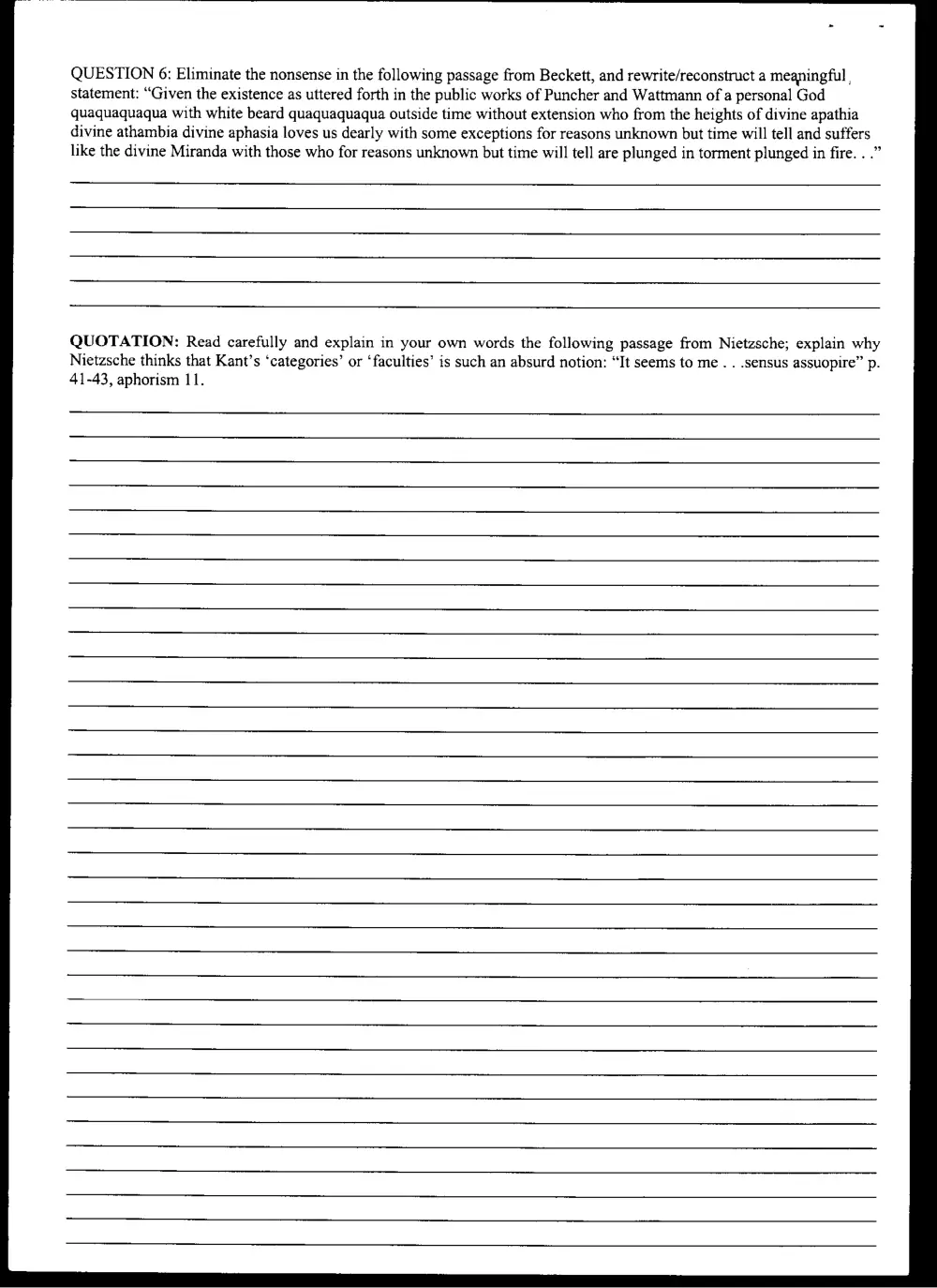
QUESTION 6: Eliminate the nonsense in the following passage from Beckett, and rewrite/reconstruct a meaningful ,
statement: “Given the existence as uttered forth in the public works of Puncher and Wattmann of a personal God
quaquaquaqua with white beard quaquaquaqua outside time without extension who from the heights of divine apathia
divine athambia divine aphasia loves us dearly with some exceptions for reasons unknown but time will tell and suffers
like the divine Miranda with those who for reasons unknown but time will tell are plunged in torment plunged in fire. . .”
QUOTATION: Read carefully and explain in your own words the following passage from Nietzsche; explain why
Nietzsche thinks that Kant’s ‘categories’ or ‘faculties’ is such an absurd notion: “It seems to me . . .sensus assuopire” p.
41-43, aphorism 11.
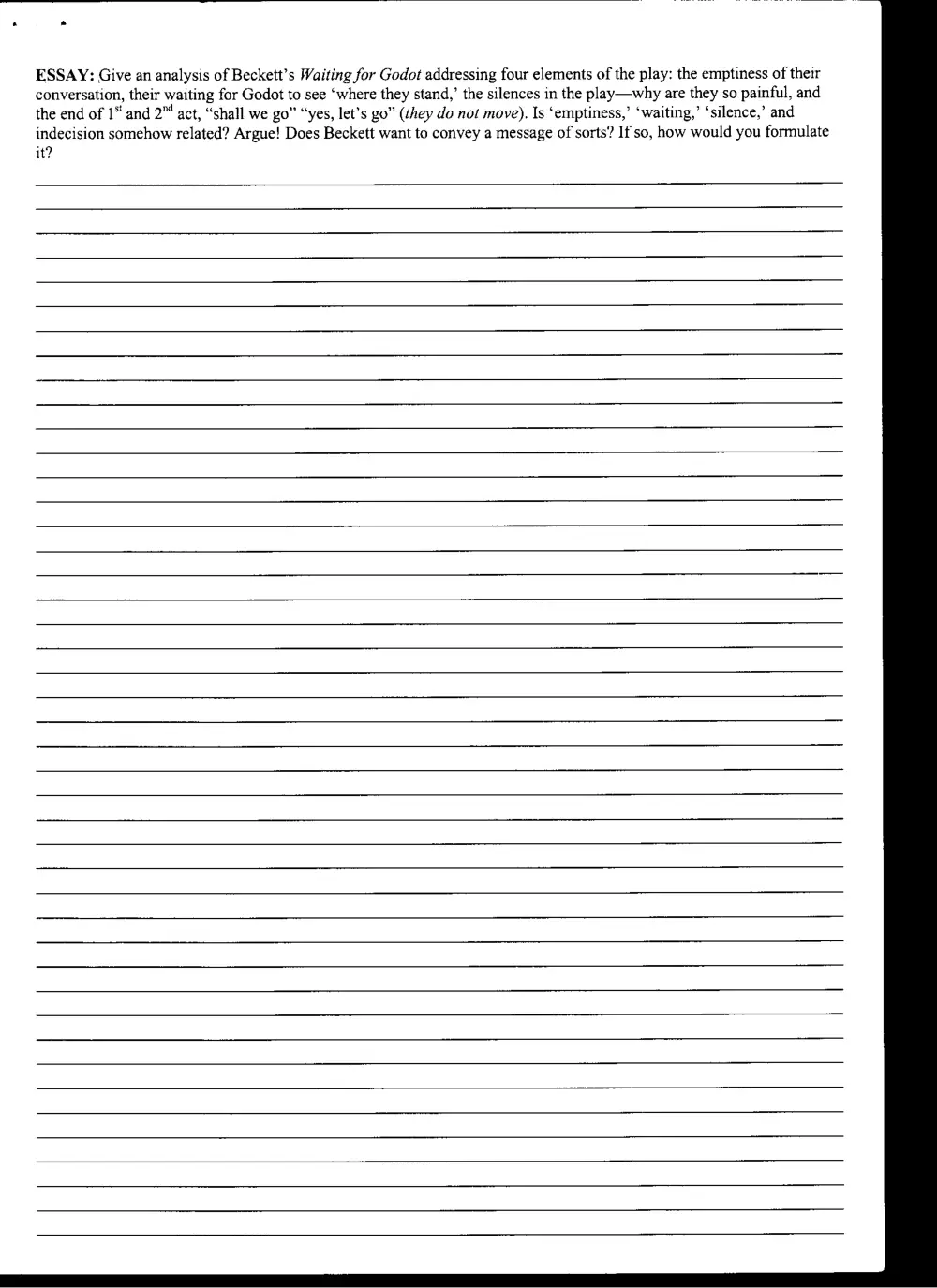
ESSAY: Give an analysis of Beckett’s Waiting for Godot addressing four elements of the play: the emptiness of their
conversation, their waiting for Godot to see ‘where they stand,’ the silences in the play—why are they so painful, and
the end of 1“ and 2™ act, “shall we go” “yes, let’s go” (they do not move). Is ‘emptiness,’ ‘waiting,’ ‘silence,’ and
indecision somehow related? Argue! Does Beckett want to convey a message of sorts? If so, how would you formulate
it?