
CVSP 204 Final, Fall 2002
American University of Beirut · Modern and Contemporary Culture · 3 pages
More CVSP 204 files
Show the text of this final exam
o>?)
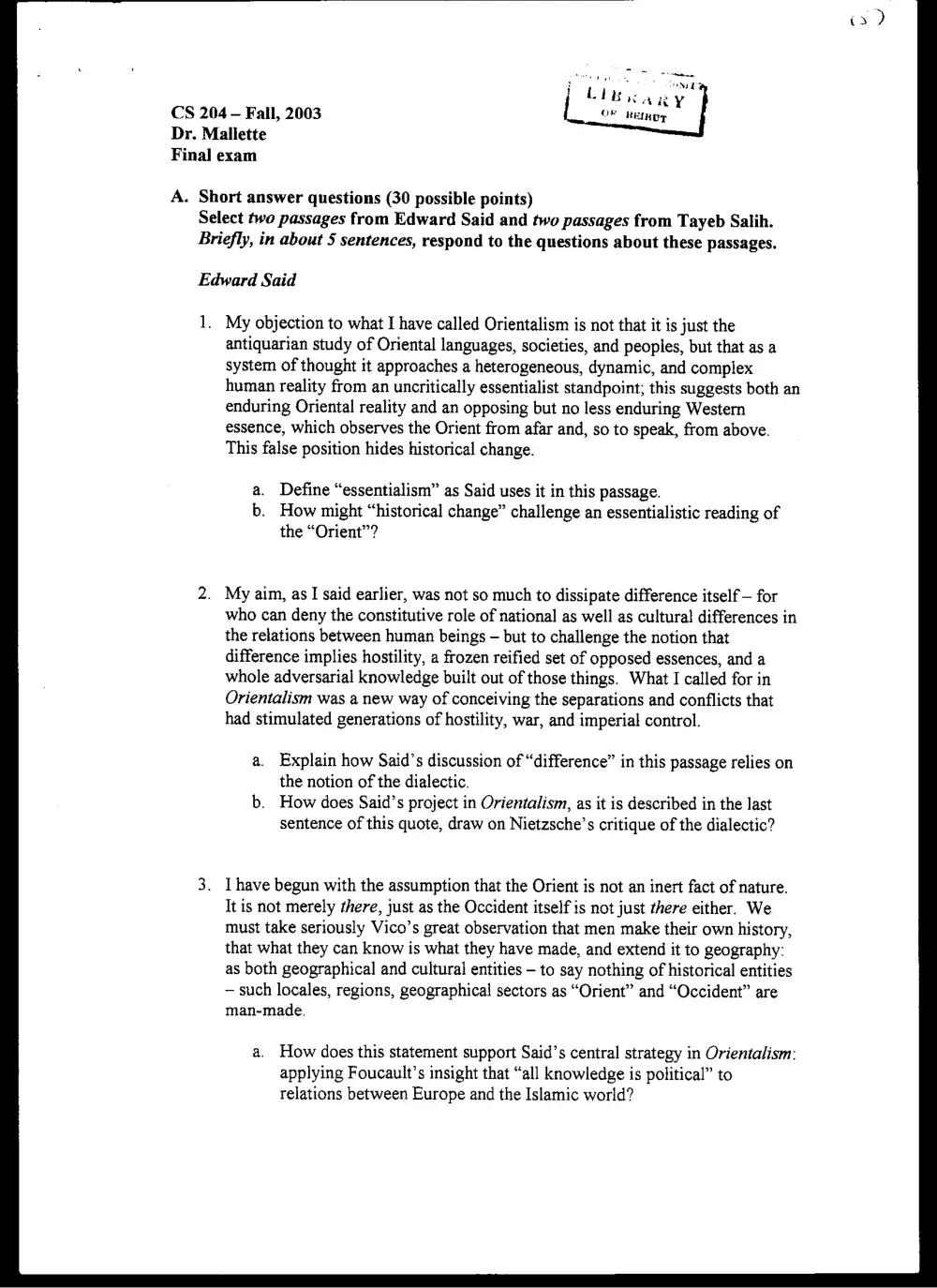
CS 204 — Fall, 2003
Dr. Mallette
Final exam
A. Short answer questions (30 possible points)
Select two passages from Edward Said and two passages from Tayeb Salih.
Briefly, in about 5 sentences, respond to the questions about these passages.
Edward Said
1, My objection to what I have called Orientalism is not that it is just the
antiquarian study of Oriental languages, societies, and peoples, but that as a
system of thought it approaches a heterogeneous, dynamic, and complex
human reality from an uncritically essentialist standpoint; this suggests both an
enduring Oriental reality and an opposing but no less enduring Western
essence, which observes the Orient from afar and, so to speak, from above.
This false position hides historical change.
a. Define “essentialism” as Said uses it in this passage.
b. How might “historical change” challenge an essentialistic reading of
the “Orient”?
2. My aim, as I said earlier, was not so much to dissipate difference itself — for
who can deny the constitutive role of national as well as cultural differences in
the relations between human beings — but to challenge the notion that
difference implies hostility, a frozen reified set of opposed essences, and a
whole adversarial knowledge built out of those things. What I called for in
Orientalism was a new way of conceiving the separations and conflicts that
had stimulated generations of hostility, war, and imperial control.
a. Explain how Said’s discussion of “difference” in this passage relies on
the notion of the dialectic.
b. How does Said’s project in Orientalism, as it is described in the last
sentence of this quote, draw on Nietzsche’s critique of the dialectic?
3. Ihave begun with the assumption that the Orient is not an inert fact of nature.
It is not merely there, just as the Occident itself is not just there either. We
must take seriously Vico’s great observation that men make their own history,
that what they can know is what they have made, and extend it to geography:
as both geographical and cultural entities - to say nothing of historical entities
— such locales, regions, geographical sectors as “Orient” and “Occident” are
man-made.
a. How does this statement support Said’s central strategy in Orientalism:
applying Foucault’s insight that “all knowledge is political” to
relations between Europe and the Islamic world?
Vina. 0o
LIBRARY
OF BEIRUT
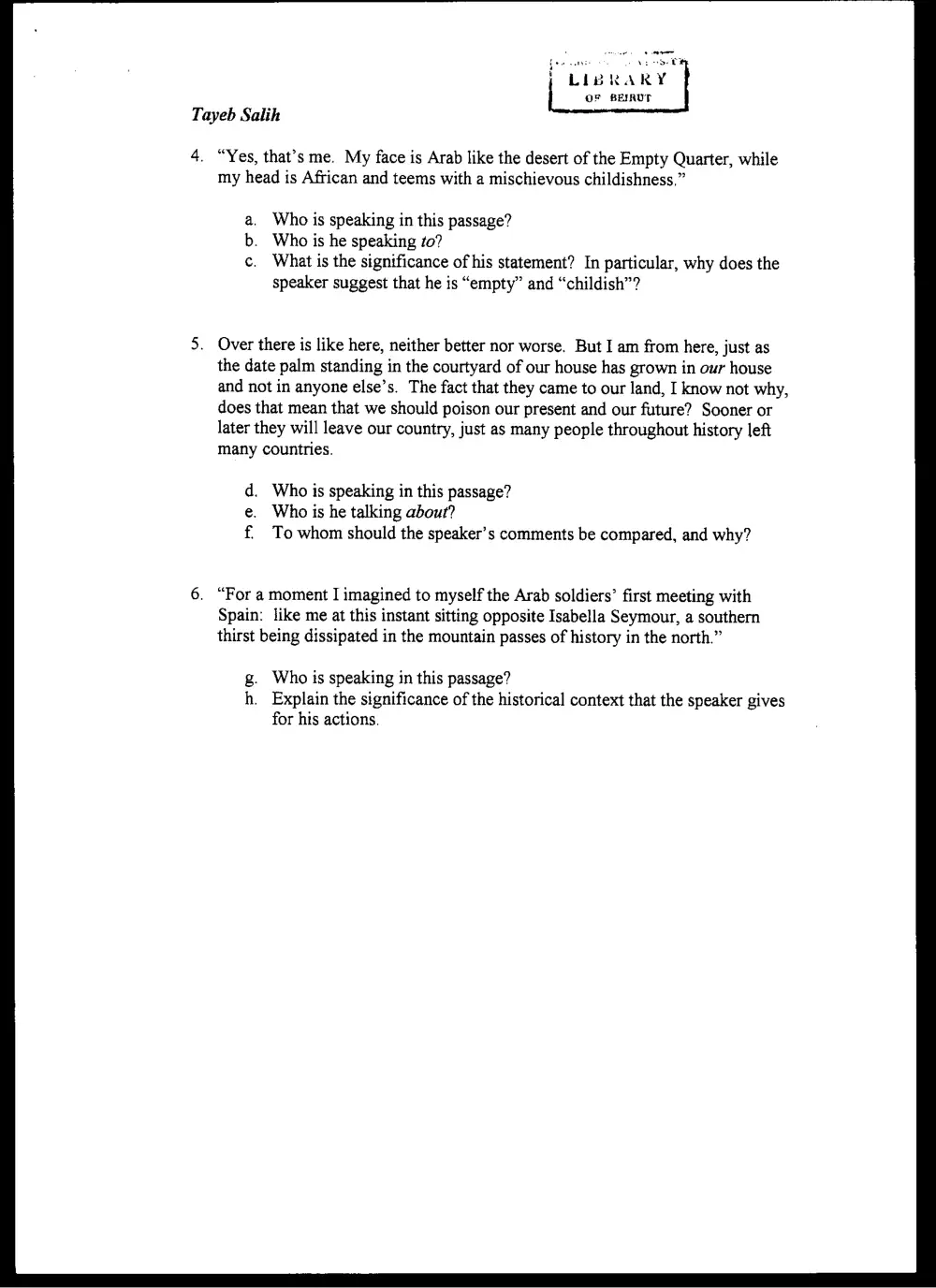
Tayeb Salih
4. “Yes, that’s me. My face is Arab like the desert of the Empty Quarter, while
my head is African and teems with a mischievous childishness.”
a. Who is speaking in this passage?
b. Who is he speaking to?
c. What is the significance of his statement? In particular, why does the
speaker suggest that he is “empty” and “childish”?
Over there is like here, neither better nor worse. But I am from here, just as
the date palm standing in the courtyard of our house has grown in our house
and not in anyone else’s. The fact that they came to our land, I know not why,
does that mean that we should poison our present and our future? Sooner or
later they will leave our country, just as many people throughout history left
many countries.
d. Who is speaking in this passage?
e. Who is he talking about?
f. To whom should the speaker’s comments be compared, and why?
. “For a moment I imagined to myself the Arab soldiers’ first meeting with
Spain: like me at this instant sitting opposite Isabella Seymour, a southern
thirst being dissipated in the mountain passes of history in the north.”
g. Who is speaking in this passage?
h. Explain the significance of the historical context that the speaker gives
for his actions.
Jaa. a
Libeary
OF BEIRUT
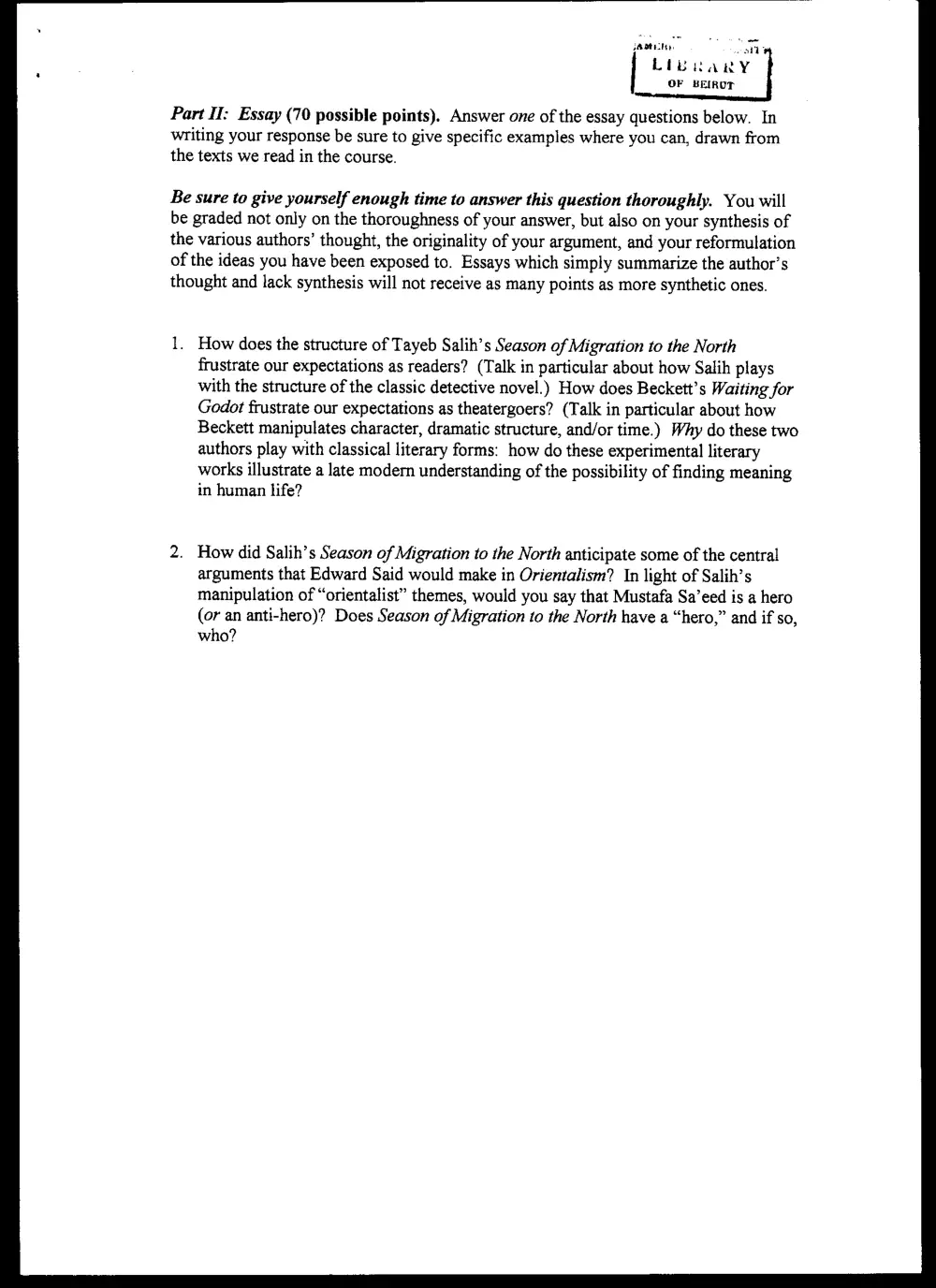
Part II: Essay (70 possible points). Answer one of the essay questions below. In
writing your response be sure to give specific examples where you can, drawn from
the texts we read in the course.
Be sure to give yourself enough time to answer this question thoroughly. You will
be graded not only on the thoroughness of your answer, but also on your synthesis of
the various authors’ thought, the originality of your argument, and your reformulation
of the ideas you have been exposed to. Essays which simply summarize the author’s
thought and lack synthesis will not receive as many points as more synthetic ones.
1. How does the structure of Tayeb Salih’s Season of Migration to the North
frustrate our expectations as readers? (Talk in particular about how Salih plays
with the structure of the classic detective novel.) How does Beckett’s Waiting for
Godot frustrate our expectations as theatergoers? (Talk in particular about how
Beckett manipulates character, dramatic structure, and/or time.) Why do these two
authors play with classical literary forms: how do these experimental literary
works illustrate a late modern understanding of the possibility of finding meaning
in human life?
How did Salih’s Season of Migration to the North anticipate some of the central
arguments that Edward Said would make in Orientalism? In light of Salih’s
manipulation of “orientalist” themes, would you say that Mustafa Sa’eed is a hero
(or an anti-hero)? Does Season of Migration to the North have a “hero,” and if so,
who?