
CVSP 204 Final, Fall 2004
American University of Beirut · Modern and Contemporary Culture · 2 pages · Dr. Aida Arasoghli
More CVSP 204 files
Show the text of this final exam
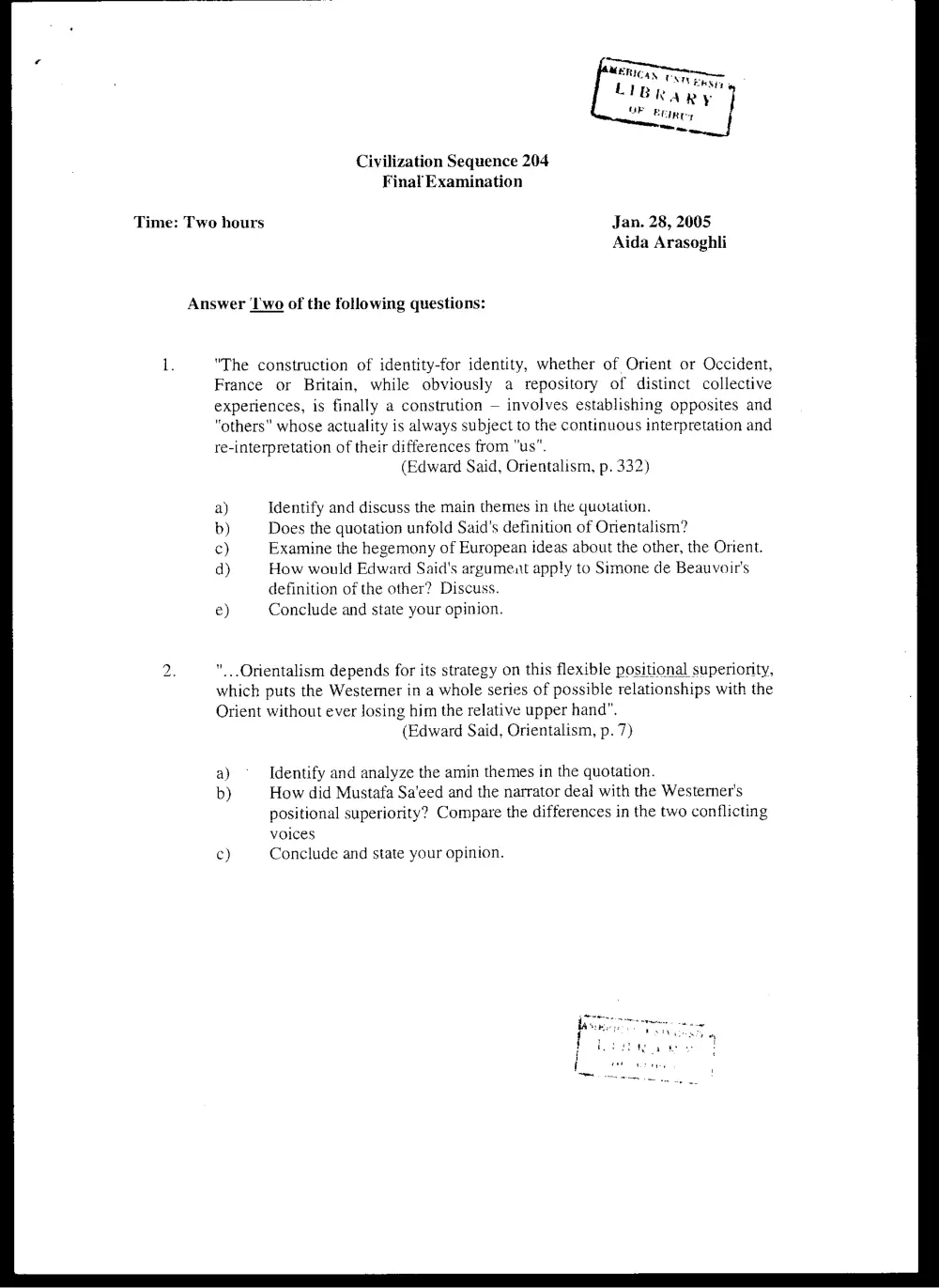
Civilization Sequence 204
Final Examination
Time: Two hours Jan. 28, 2005
Aida Arasoghli
Answer ‘Iwo of the following questions:
1. "The construction of identity-for identity, whether of Orient or Occident,
France or Britain, while obviously a repository of distinct collective
experiences, is finally a constrution — involves establishing opposites and
"others" whose actuality is always subject to the continuous interpretation and
re-interpretation of their differences from "us".
(Edward Said, Orientalism, p, 332)
a) Identify and discuss the main themes in the quotation.
b) Does the quotation unfold Said's definition of Orientalism?
c) Examine the hegemony of European ideas about the other, the Orient.
d) How would Edward Said's argumeut apply to Simone de Beauvoir's
definition of the other? Discuss.
e) Conclude and state your opinion.
i)
"...Orientalism depends for its strategy on this flexible positional superiority,
which puts the Westerner in a whole series of possible relationships with the
Orient without ever losing him the relative upper hand”.
(Edward Said, Orientalism, p. 7)
a) ° Identify and analyze the amin themes in the quotation.
b) How did Mustafa Sa'eed and the narrator deal with the Westerner's
positional superiority? Compare the differences in the two conflicting
voices
¢) Conclude and state your opinion.
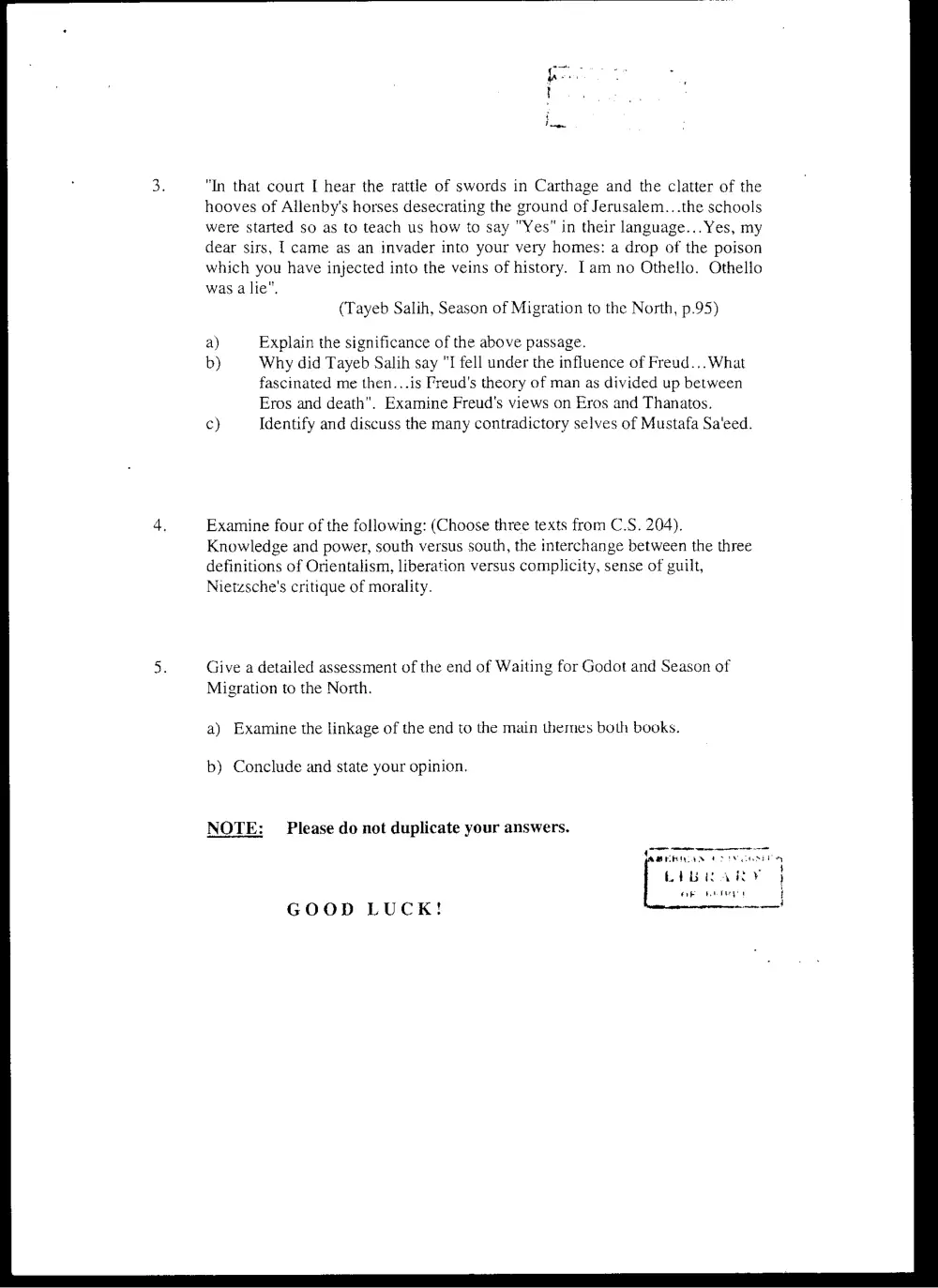
"In that court I hear the rattle of swords in Carthage and the clatter of the
hooves of Allenby's horses desecrating the ground of Jerusalem...the schools
were started so as to teach us how to say “Yes" in their language... Yes, my
dear sirs, | came as an invader into your very homes: a drop of the poison
which you have injected into the veins of history. Iam no Othello. Othello
was a lie”.
(Tayeb Salih, Season of Migration to the North, p.95)
a) Explain the significance of the above passage.
b) Why did Tayeb Salih say "I fell under the influence of Freud...What
fascinated me then...is Freud's theory of man as divided up between
Eros and death". Examine Freud's views on Eros and Thanatos.
c) Identify and discuss the many contradictory selves of Mustafa Sa'eed.
Examine four of the following: (Choose three texts from C.S. 204).
Knowledge and power, south versus south, the interchange between the three
definitions of Orientalism, liberation versus complicity, sense of guilt,
Nietzsche's critique of morality.
Give a detailed assessment of the end of Waiting for Godot and Season of
Migration to the North.
a) Examine the linkage of the end to the main themes both books.
b) Conclude and state your opinion.
NOTE: Please do not duplicate your answers.
GOOD LUCK!