
CVSP 204 Final, Spring 2000
American University of Beirut · Modern and Contemporary Culture · 2 pages
More CVSP 204 files
Show the text of this final exam
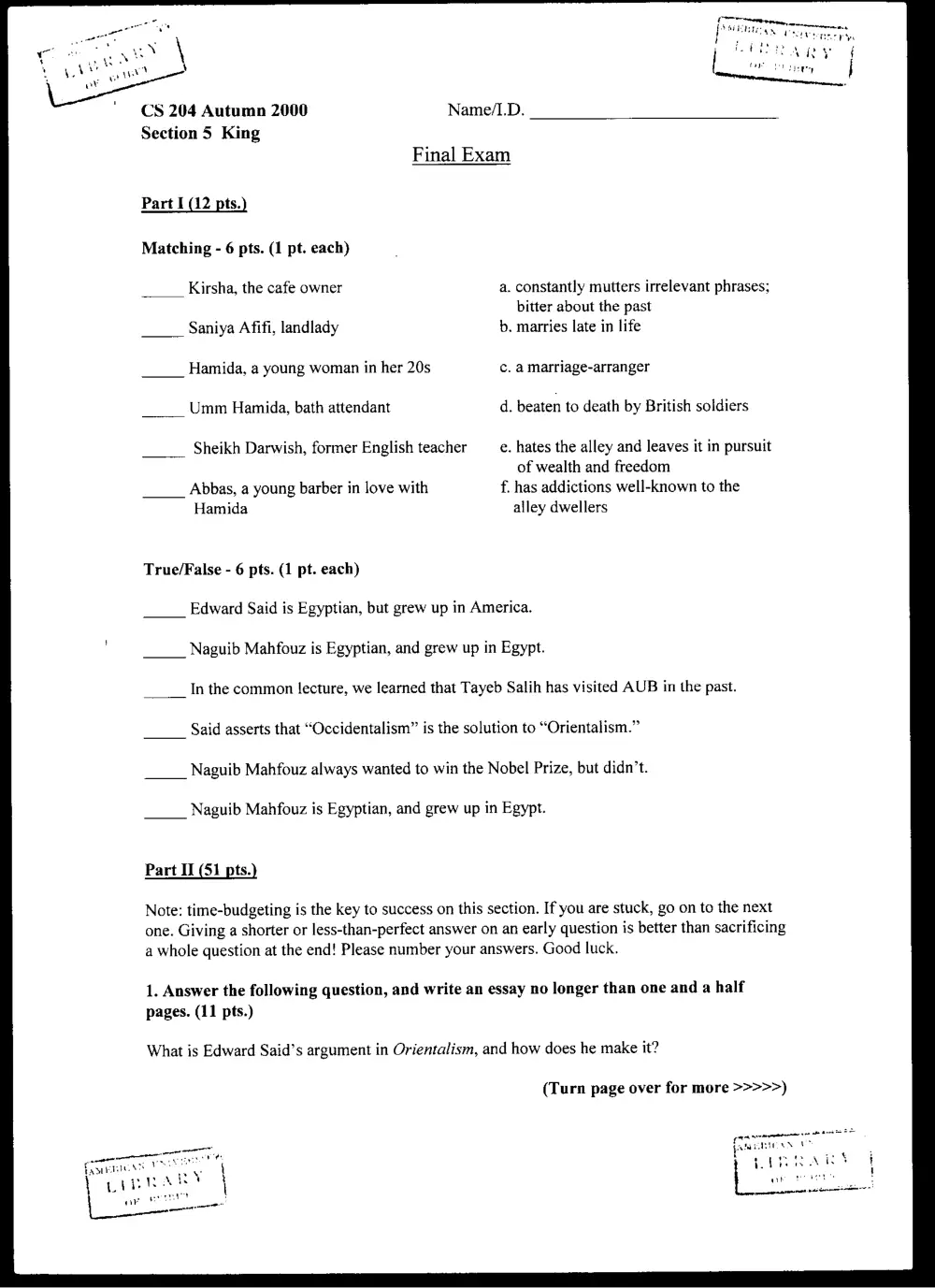
CS 204 Autumn 2000 Name/I1.D.
Section 5 King
Final Exam
Part I (12 pts.)
Matching - 6 pts. (1 pt. each)
Kirsha, the cafe owner a. constantly mutters irrelevant phrases;
bitter about the past
Saniya Afifi, landlady b. marries late in life
Hamida, a young woman in her 20s c. a marriage-arranger
Umm Hamida, bath attendant d. beaten to death by British soldiers
Sheikh Darwish, former English teacher e. hates the alley and leaves it in pursuit
of wealth and freedom
Abbas, a young barber in love with f. has addictions well-known to the
Hamida alley dwellers
True/False - 6 pts. (1 pt. each)
Edward Said is Egyptian, but grew up in America.
Naguib Mahfouz is Egyptian, and grew up in Egypt.
In the common lecture, we learned that Tayeb Salih has visited AUB in the past.
Said asserts that “Occidentalism” is the solution to “Orientalism.”
Naguib Mahfouz always wanted to win the Nobel Prize, but didn’t.
Naguib Mahfouz is Egyptian, and grew up in Egypt.
Part II (51 pts.)
Note: time-budgeting is the key to success on this section. If you are stuck, go on to the next
one. Giving a shorter or less-than-perfect answer on an early question is better than sacrificing
a whole question at the end! Please number your answers. Good luck.
1. Answer the following question, and write an essay no longer than one and a half
pages. (11 pts.)
What is Edward Said’s argument in Orientalism, and how does he make it?
(Turn page over for more >>>>>)
oo sete
AMEDIEAN &
\ ‘
rim adics
| ae ore
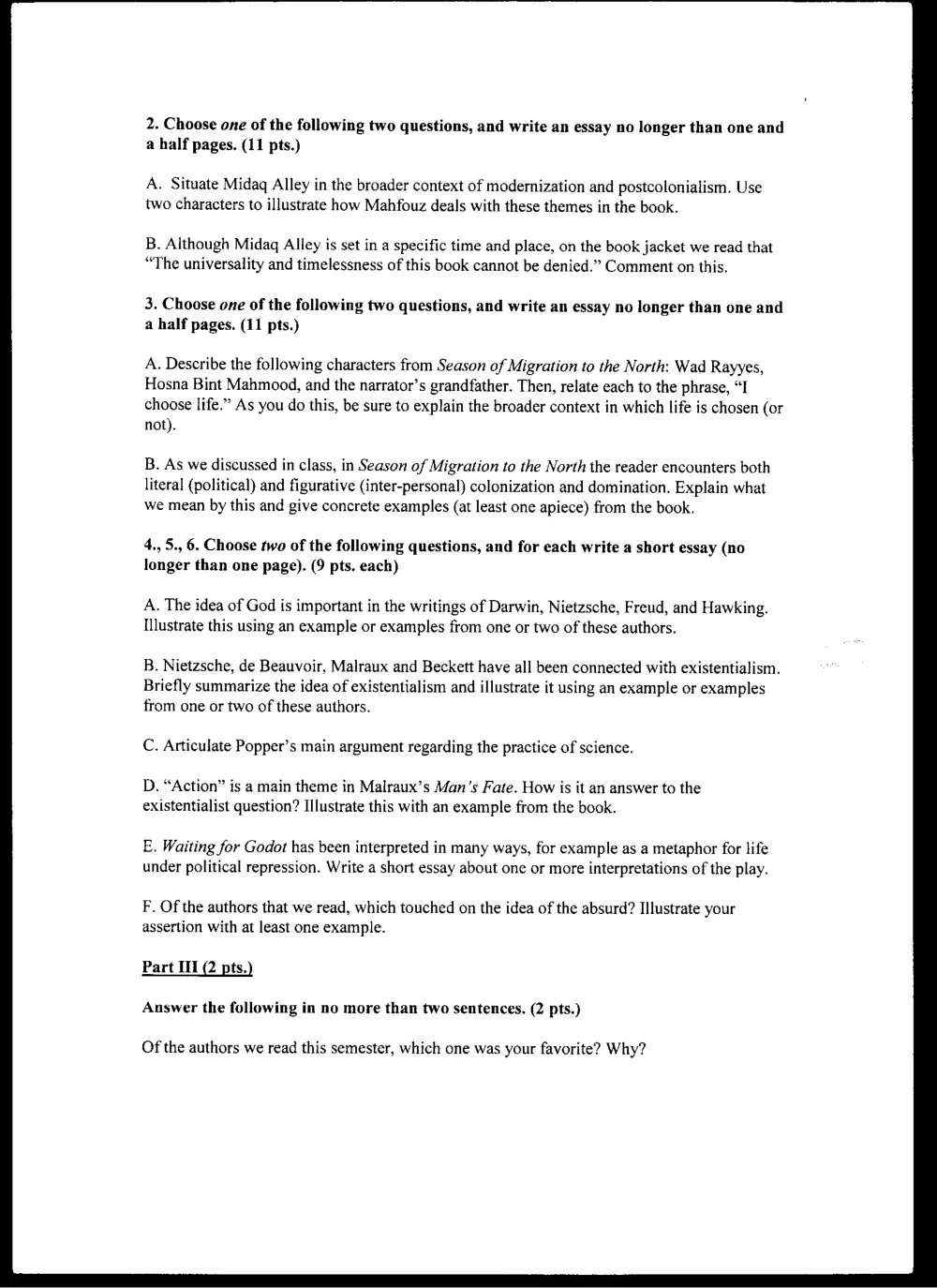
2. Choose one of the following two questions, and write an essay no longer than one and
a half pages. (11 pts.)
A. Situate Midaq Alley in the broader context of modernization and postcolonialism. Use
two characters to illustrate how Mahfouz deals with these themes in the book.
B. Although Midagq Alley is set in a specific time and place, on the book jacket we read that
“The universality and timelessness of this book cannot be denied.” Comment on this.
3. Choose one of the following two questions, and write an essay no longer than one and
a half pages. (11 pts.)
A. Describe the following characters from Season of Migration to the North: Wad Rayyes,
Hosna Bint Mahmood, and the narrator’s grandfather. Then, relate each to the phrase, “I
choose life.” As you do this, be sure to explain the broader context in which life is chosen (or
not).
B. As we discussed in class, in Season of Migration to the North the reader encounters both
literal (political) and figurative (inter-personal) colonization and domination. Explain what
we mean by this and give concrete examples (at least one apiece) from the book.
4., 5., 6. Choose two of the following questions, and for each write a short essay (no
longer than one page). (9 pts. each)
A. The idea of God is important in the writings of Darwin, Nietzsche, Freud, and Hawking.
Illustrate this using an example or examples from one or two of these authors.
B. Nietzsche, de Beauvoir, Malraux and Beckett have all been connected with existentialism.
Briefly summarize the idea of existentialism and illustrate it using an example or examples
from one or two of these authors.
C. Articulate Popper’s main argument regarding the practice of science.
D. “Action” is a main theme in Malraux’s Man’s Fate. How is it an answer to the
existentialist question? Illustrate this with an example from the book.
E. Waiting for Godot has been interpreted in many ways, for example as a metaphor for life
under political repression. Write a short essay about one or more interpretations of the play.
F. Of the authors that we read, which touched on the idea of the absurd? Illustrate your
assertion with at least one example.
Part III (2 pts.)
Answer the following in no more than two sentences. (2 pts.)
Of the authors we read this semester, which one was your favorite? Why?