
CVSP 204 Final, Spring 2002
American University of Beirut · Modern and Contemporary Culture · 2 pages
More CVSP 204 files
Show the text of this final exam
AME ET VS ONIVER:
LIBRARY
OF BEIRUT
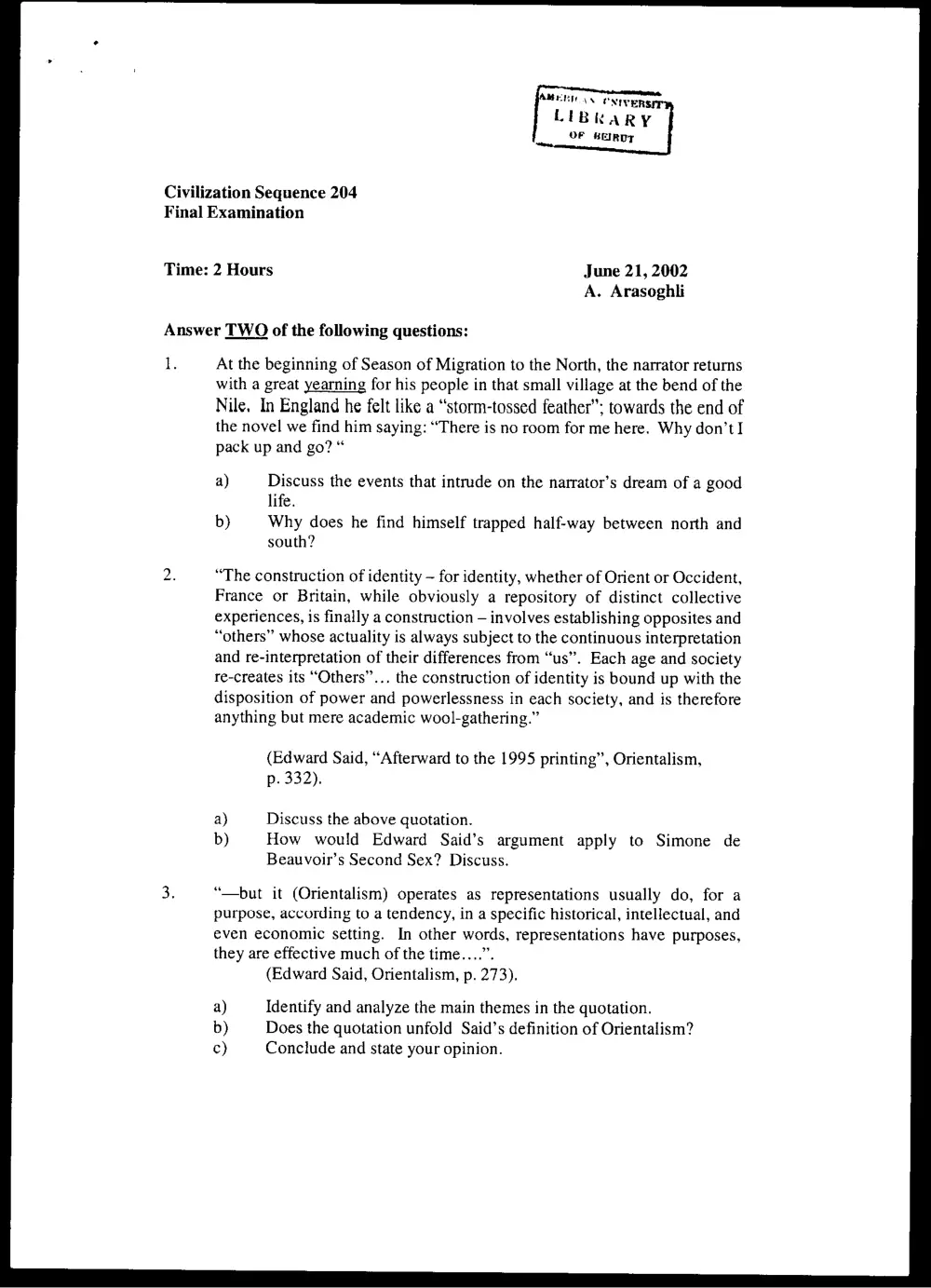
Civilization Sequence 204
Final Examination
Time: 2 Hours June 21, 2002
A. Arasoghli
Answer TWO of the following questions:
1.
At the beginning of Season of Migration to the North, the narrator returns
with a great yearning for his people in that small village at the bend of the
Nile. In England he felt like a “storm-tossed feather’; towards the end of
the novel we find him saying: “There is no room for me here. Why don’t I
pack up and go? “
a) Discuss the events that intrude on the narrator’s dream of a good
life.
b) Why does he find himself trapped half-way between north and
south?
“The construction of identity — for identity, whether of Orient or Occident,
France or Britain, while obviously a repository of distinct collective
experiences, is finally a constriction — involves establishing opposites and
“others” whose actuality is always subject to the continuous interpretation
and re-interpretation of their differences from “us”. Each age and society
re-creates its “Others”... the construction of identity is bound up with the
disposition of power and powerlessness in each society, and is therefore
anything but mere academic wool-gathering.”
(Edward Said, “Afterward to the 1995 printing”, Orientalism,
p. 332).
a) Discuss the above quotation.
b) How would Edward Said’s argument apply to Simone de
Beauvoir’s Second Sex? Discuss.
“—but it (Orientalism) operates as representations usually do, for a
purpose, according to a tendency, in a specific historical, intellectual, and
even economic setting. In other words, representations have purposes,
they are effective much of the time....”.
(Edward Said, Orientalism, p. 273).
a) Identify and analyze the main themes in the quotation.
b) Does the quotation unfold Said’s definition of Orientalism?
c) Conclude and state your opinion.
MEK ws CNIVERSIT
LIBKARY
OF BEIRUT
_
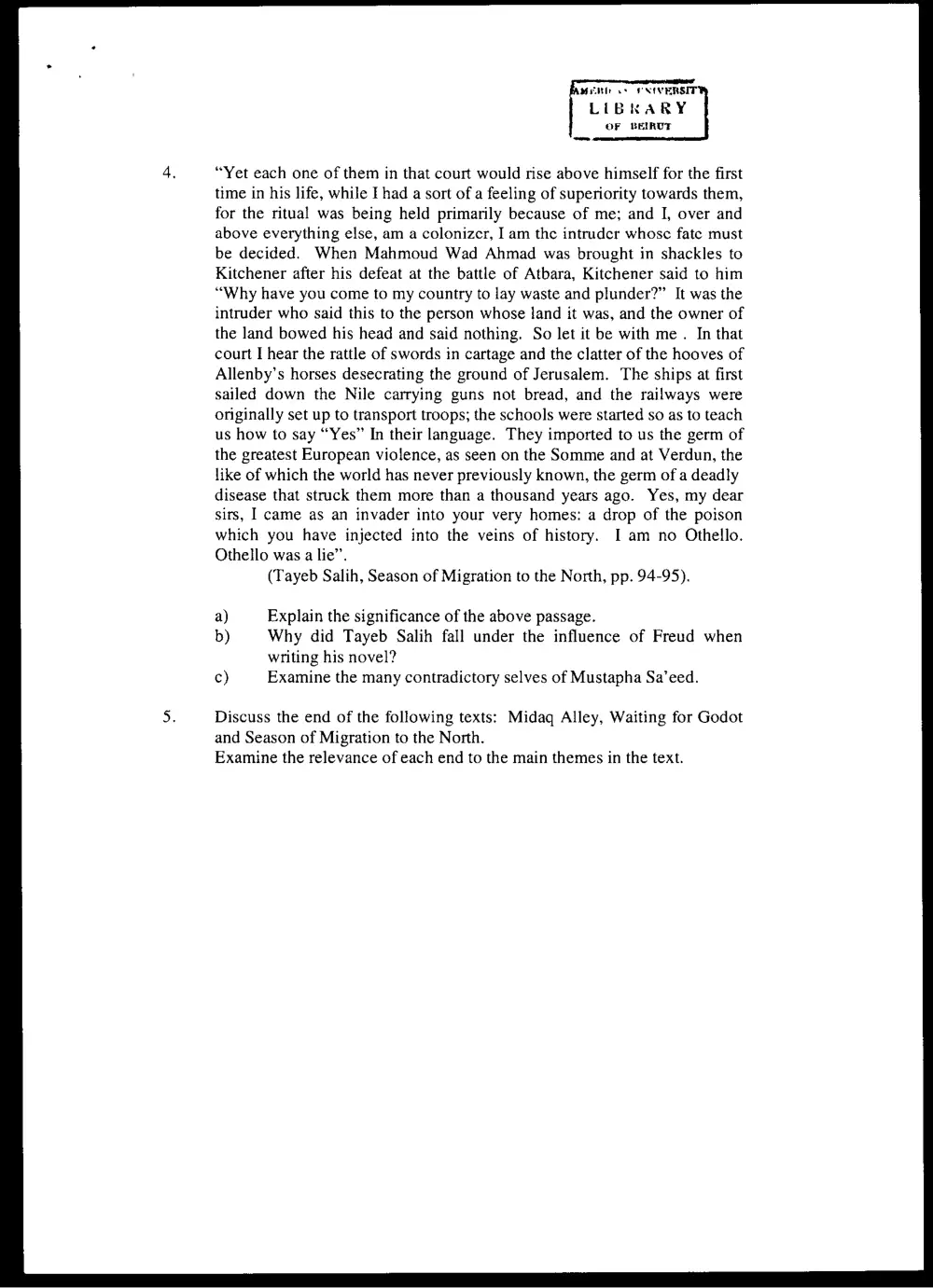
“Yet each one of them in that court would rise above himself for the first
time in his life, while I had a sort of a feeling of superiority towards them,
for the ritual was being held primarily because of me; and I, over and
above everything else, am a colonizcr, I am the intruder whose fate must
be decided. When Mahmoud Wad Ahmad was brought in shackles to
Kitchener after his defeat at the battle of Atbara, Kitchener said to him
“Why have you come to my country to lay waste and plunder?” It was the
intruder who said this to the person whose land it was, and the owner of
the land bowed his head and said nothing. So let it be with me . In that
court I hear the rattle of swords in cartage and the clatter of the hooves of
Allenby’s horses desecrating the ground of Jerusalem. The ships at first
sailed down the Nile carrying guns not bread, and the railways were
originally set up to transport troops; the schools were started so as to teach
us how to say “Yes” In their language. They imported to us the germ of
the greatest European violence, as seen on the Somme and at Verdun, the
like of which the world has never previously known, the germ of a deadly
disease that struck them more than a thousand years ago. Yes, my dear
sirs, I came as an invader into your very homes: a drop of the poison
which you have injected into the veins of history. I am no Othello.
Othello was a lie”.
(Tayeb Salih, Season of Migration to the North, pp. 94-95).
a) Explain the significance of the above passage.
b) Why did Tayeb Salih fall under the influence of Freud when
writing his novel?
c) Examine the many contradictory selves of Mustapha Sa’eed.
Discuss the end of the following texts: Midaq Alley, Waiting for Godot
and Season of Migration to the North.
Examine the relevance of each end to the main themes in the text.