
CVSP 206 Final, Spring 2004
American University of Beirut · Modern and Contemporary Studies · 1 page
Stuck on a question? A tutor can walk you through it.
More CVSP 206 files
Show the text of this final exam
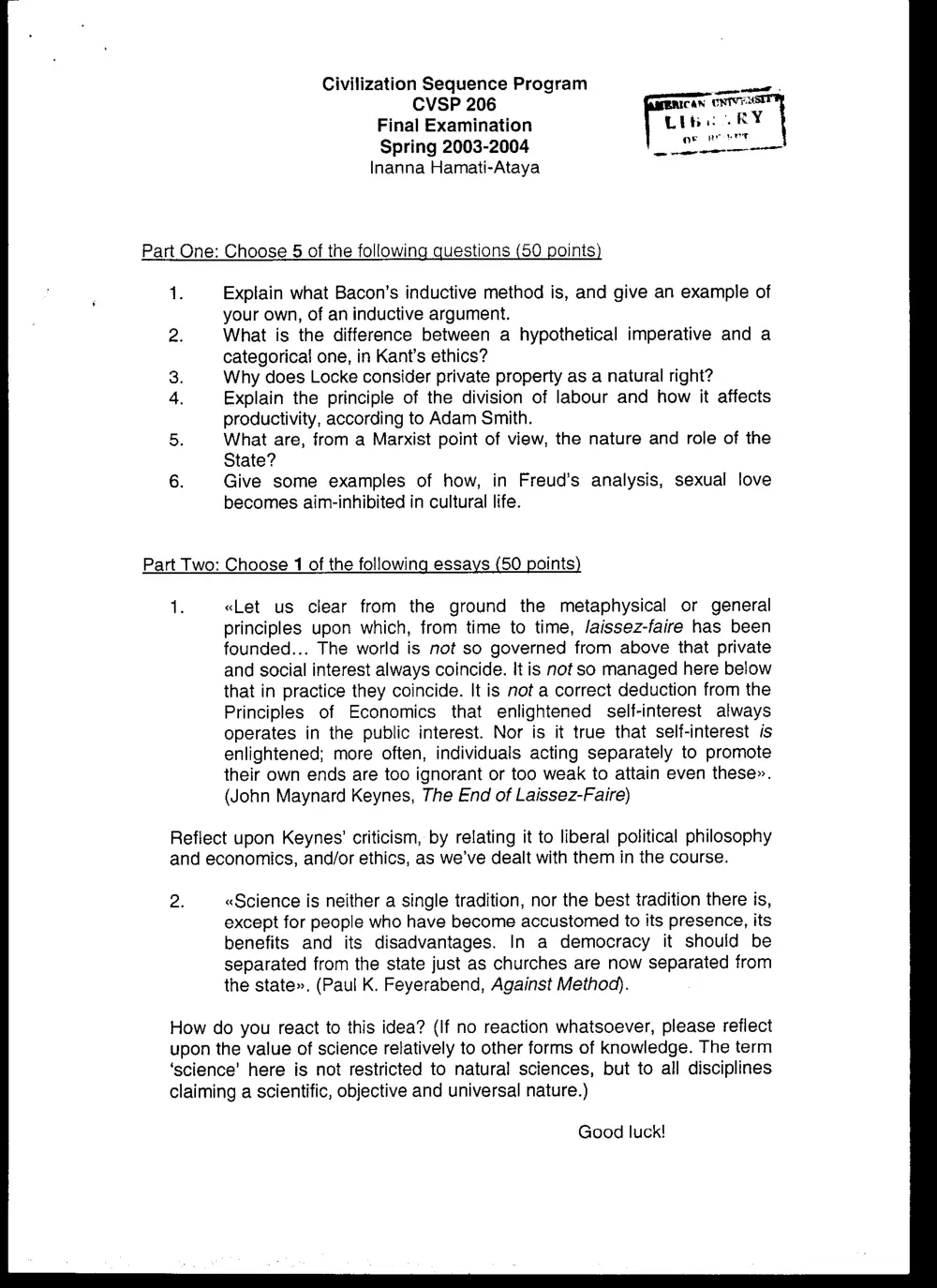
Civilization Sequence Program nena
CVSP 206 CaN ENTE
Final Examination Lit: RY
Spring 2003-2004 ee
Inanna Hamati-Ataya ~
Part One: Choose 5 of the following questions (50 points)
; 1. Explain what Bacon’s inductive method is, and give an example of
your own, of an inductive argument.
2. What is the difference between a hypothetical imperative and a
categorical one, in Kant’s ethics?
3. Why does Locke consider private property as a natural right?
4, Explain the principle of the division of labour and how it affects
productivity, according to Adam Smith.
5. What are, from a Marxist point of view, the nature and role of the
State?
6. Give some examples of how, in Freud’s analysis, sexual love
becomes aim-inhibited in cultural life.
Part Two: Choose 1 of the following essays (50 points)
1. «Let us clear from the ground the metaphysical or general
principles upon which, from time to time, laissez-faire has been
founded... The world is not so governed from above that private
and social interest always coincide. It is not so managed here below
that in practice they coincide. It is not a correct deduction from the
Principles of Economics that enlightened self-interest always
operates in the public interest. Nor is it true that self-interest is
enlightened; more often, individuals acting separately to promote
their own ends are too ignorant or too weak to attain even these».
(John Maynard Keynes, The End of Laissez-Faire)
Reflect upon Keynes’ criticism, by relating it to liberal political philosophy
and economics, and/or ethics, as we’ve dealt with them in the course.
2. «Science is neither a single tradition, nor the best tradition there is,
except for people who have become accustomed to its presence, its
benefits and its disadvantages. In a democracy it should be
separated from the state just as churches are now separated from
the state». (Paul K. Feyerabend, Against Method).
How do you react to this idea? (If no reaction whatsoever, please reflect
upon the value of science relatively to other forms of knowledge. The term
‘science’ here is not restricted to natural sciences, but to all disciplines
claiming a scientific, objective and universal nature.)
Good luck!