
CVSP 206 Final, Spring 2005
American University of Beirut · Modern and Contemporary Studies · 2 pages

More CVSP 206 files
Show the text of this final exam
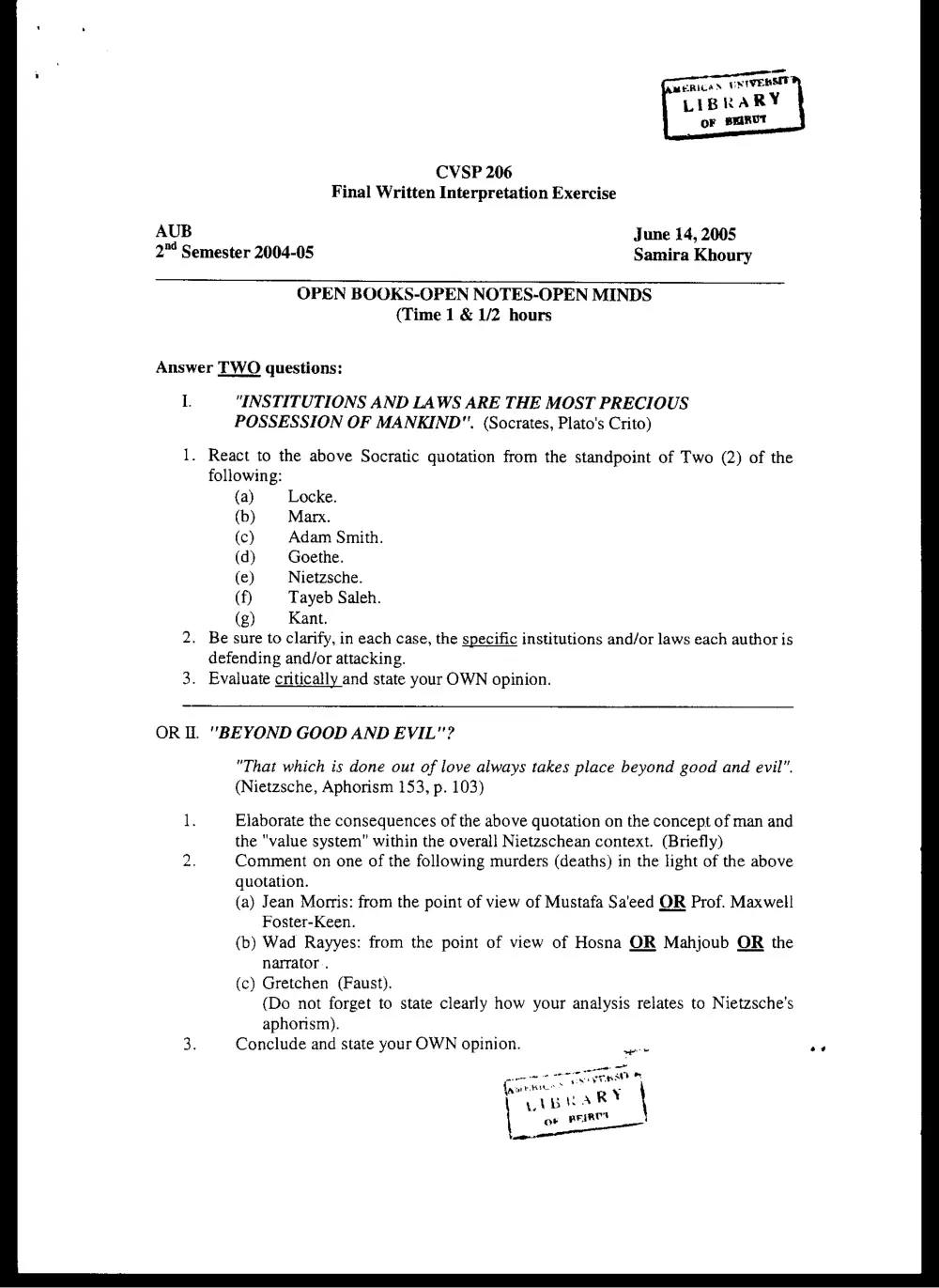
CVSP 206
Final Written Interpretation Exercise
AUB June 14, 2005
2" Semester 2004-05 Samira Khoury
OPEN BOOKS-OPEN NOTES-OPEN MINDS
(Time 1 & 1/2 hours
Answer TWO questions:
L "INSTITUTIONS AND LAWS ARE THE MOST PRECIOUS
POSSESSION OF MANKIND". (Socrates, Plato's Crito)
1. React to the above Socratic quotation from the standpoint of Two (2) of the
following:
(a) Locke.
(b) Marx.
(c) Adam Smith.
(d) Goethe.
(e) Nietzsche.
(f) Tayeb Saleh.
(g) Kant.
Be sure to clarify, in each case, the specific institutions and/or laws each author is
defending and/or attacking.
3. Evaluate critically and state your OWN opinion.
N
OR I. "BEYOND GOOD AND EVIL"?
"That which is done out of love always takes place beyond good and evil”.
(Nietzsche, Aphorism 153, p. 103)
l. Elaborate the consequences of the above quotation on the concept of man and
the "value system” within the overall Nietzschean context. (Briefly)
Comment on one of the following murders (deaths) in the light of the above
quotation.
(a) Jean Morris: from the point of view of Mustafa Sa'eed OR Prof. Maxwell
Foster-Keen.
(b) Wad Rayyes: from the point of view of Hosna OR Mahjoub OR the
narrator.
(c) Gretchen (Faust).
(Do not forget to state clearly how your analysis relates to Nietzsche's
aphorism).
3. Conclude and state your OWN opinion.
nN
a Se eee a
MERICAN UNIVENSIT
LIBRARY
OF BEIRUT
OR I. WOMAN
"The most mediocre of males feels himself a demigod as compared with
women". (S.de Beauvoir, p. 11)
1. Why? Analyze very briefly. Is there a remedy recommended? Specify.
2 Respond to the above on the basis of ONE concrete example from Nietzsche,
OR Freud, OR Tayeb Saleh, OR Marx.
3. Conclude and state your OWN opinion.
OR IV.IN THIS IMMENSE CONFUSION ONE THING ALONE IS CLEAR..."
(Beckett)
1. Analyze the above quotation with a view to clarify what this immense
confusion represents, and what the one clear thing stands for vis-a-vis Man's
image of himself or his self-understanding as presented in “Waiting for
Godot".
2. Select one character in ONE (1) of the following works and develop an
adequate argument which reflects the “one thing alone is clear..." according to
his/her self-understanding:
(a) Faust. __
(b) Season of Migration to the North. pre enn SL nat aa}
3. Conclude and state your own opinion and/or evaluation. :
oF rEMet
OR V. THE SYMBOL OF THE HAT
1. Analyze briefly the significance of this symbol in both "Waiting for Godot"
and “Season of Migration to the North".
2. Compare critically the function of the “hat” in both texts, (by pointing out the
similarities and the differences).
3. Conclude and state your OWN opinion.
OR VL"IN MENTAL LIFE NOTHING WHICH ONCE HAS BEEN FORMED CAN
PERISH". (Freud, p. 16)
1. Analyze briefly this Freudian principle within its context by pointing out clearly
its consequences on our self-understanding.
2. Take this quotation as your criterion and analyze ONE of the following:
a) Lucky in “Waiting for Godot" (with particular reference to his speech);
b) Mostapha Sa'eed;
c) Hosna or the narrator.
3. Conclude and state your OWN opinion.