
DCSN 200 Syllabus, Spring 2011
American University of Beirut · Managerial Decision Making · 6 pages · Dr. Victor Araman




More DCSN 200 files
- Lecture Chapter 8 · Fall 2011LabView
- Other SAMPLE · Spring 2019FileView
- Homework Solution Assignment 5 · Spring 2013Homework · with solutionView
- Midterm Spring 2011 · Spring 2011ExamView
- Final · Spring 2011Final examView
- Other · Spring 2010FileView
- Midterm · Fall 2010ExamView
- Final · Fall 2009Final examView
Show the text of this lab
Competitive Advantage from Operations – Spring 11
Victor F. Araman
Competitive Advantage from Operations
DCSN 200 (operations management)
Course Syllabus - Spring 2011
(Subject to Some Revisions)
COURSE DESCRIPTION:
This course serves as an introduction to Operations Management. The coverage of the
discipline is very selective: We concentrate on a small number of powerful themes that have
emerged recently as the central building blocks of world-class operations. We also present a
sample of operations management tools and techniques that have been proved extremely
useful over the years. The topics are equally relevant in the manufacturing and service
sectors.
INSTRUCTOR Contacts:
Victor F. Araman
OSB bldg - Room 311
Email: va03@aub.edu.lb
Office hours: By appointment
MEETINGS: T TR | Room: 206 | Time: 14:0 - 15:15 | 17:00 -18:15
TEXT:
Required material:
Operations Management (Tenth Edition), by Heizer J. and Render, B., Prentice
Hall 2010
Other Operations Management References (Optional):
o Designing and Managing the Supply Chain: Concepts, Strategies, and Cases, by
David Simchi-Levi, Philip Kaminsky and Edith Simchi-Levi, Irwin / McGraw-Hill
Grading scheme:
Midterm:
30%
Final:
30%
Various Assignments + class participation : 30%
Case Study and the Beer Game:
10%
Co-requisite:
CMPS209
Competitive Advantage from Operations – Spring 11
Victor F. Araman
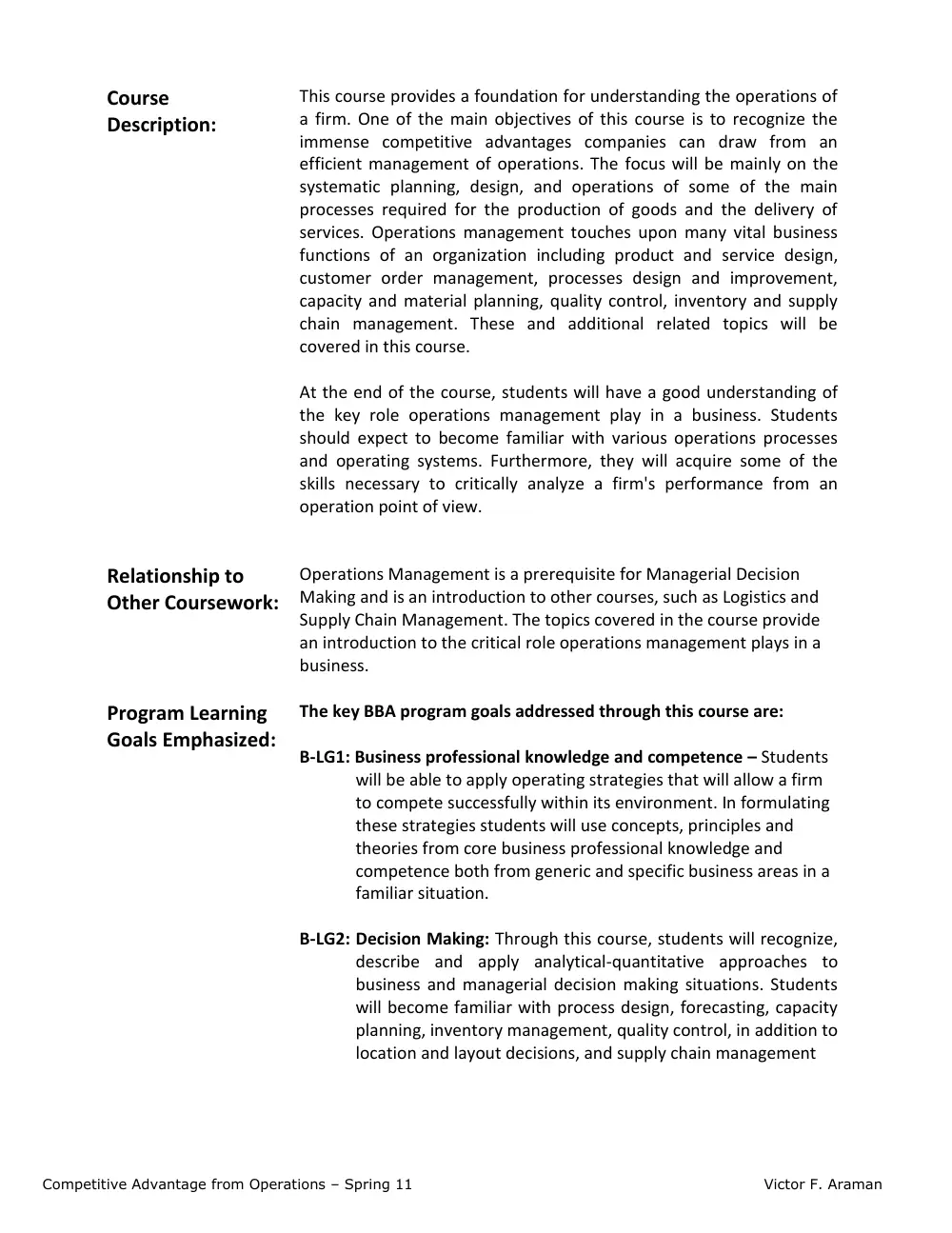
Course
Description:
This course provides a foundation for understanding the operations of
a firm. One of the main objectives of this course is to recognize the
immense competitive advantages companies can draw from an
efficient management of operations. The focus will be mainly on the
systematic planning, design, and operations of some of the main
processes required for the production of goods and the delivery of
services. Operations management touches upon many vital business
functions of an organization including product and service design,
customer order management, processes design and improvement,
capacity and material planning, quality control, inventory and supply
chain management. These and additional related topics will be
covered in this course.
At the end of the course, students will have a good understanding of
the key role operations management play in a business. Students
should expect to become familiar with various operations processes
and operating systems. Furthermore, they will acquire some of the
skills necessary to critically analyze a firm's performance from an
operation point of view.
Relationship to
Other Coursework:
Operations Management is a prerequisite for Managerial Decision
Making and is an introduction to other courses, such as Logistics and
Supply Chain Management. The topics covered in the course provide
an introduction to the critical role operations management plays in a
business.
Program Learning
Goals Emphasized:
The key BBA program goals addressed through this course are:
B-LG1: Business professional knowledge and competence – Students
will be able to apply operating strategies that will allow a firm
to compete successfully within its environment. In formulating
these strategies students will use concepts, principles and
theories from core business professional knowledge and
competence both from generic and specific business areas in a
familiar situation.
B-LG2: Decision Making: Through this course, students will recognize,
describe and apply analytical-quantitative approaches to
business and managerial decision making situations. Students
will become familiar with process design, forecasting, capacity
planning, inventory management, quality control, in addition to
location and layout decisions, and supply chain management
Competitive Advantage from Operations – Spring 11
Victor F. Araman
Specific Learning
Objectives (SLO)
for the course
The Specific Learning Objectives(SLOs) for this course that map to the
BBA Program Learning Goals mentioned above are as follows:
B-LG1: Business professional knowledge and competence:
1. Define Operations Management functions and strategy and how
OM can lead to a competitive advantage
2. Describe and define products (goods and services) and apply some
of the techniques used in the design process.
3. Describe and define process strategy and apply the tools needed
for process analysis and design.
4. Define quality and Total Quality Management (TQM) and its
required tools. Understand process capability.
5. Understand and measure operation efficiency and effectiveness.
Apply Single and Multi-factor productivity, process capability,
utilization and efficiency and various objectives for short-term
scheduling.
B-LG2: Decision Making:
6. Understand and apply single stage decision trees and calculate
Expected Monetary Value(EMV)
7. Understand qualitative and quantitative methods for demand
forecasting. Apply quantitative methods such as exponential
smoothing, trend projection, seasonal indexes and regression and
correlation analysis.
8. Understand and apply Statistical process Control and determine
process capability. That includes using control charts (x-chart, R-
chart, p-charts and c-charts) cp and cpk.
9. Understand location and layout strategies.
10. Understand inventory and supply chain management. Apply
Economic Order Quantity (EOQ), Production Order Quantity
(POQ), quantity discount and simple safety stock calculation
models
11. Understand planning and scheduling in operations applying
various techniques such as crossover points and break-even
analysis, short-term scheduling (priority and Johnson’s rules)
Use of Technology:
Students are expected to be familiar with Excel.
Instructional
Methodology:
Lecture, cases, class discussion, individual assignments
Competitive Advantage from Operations – Spring 11
Victor F. Araman
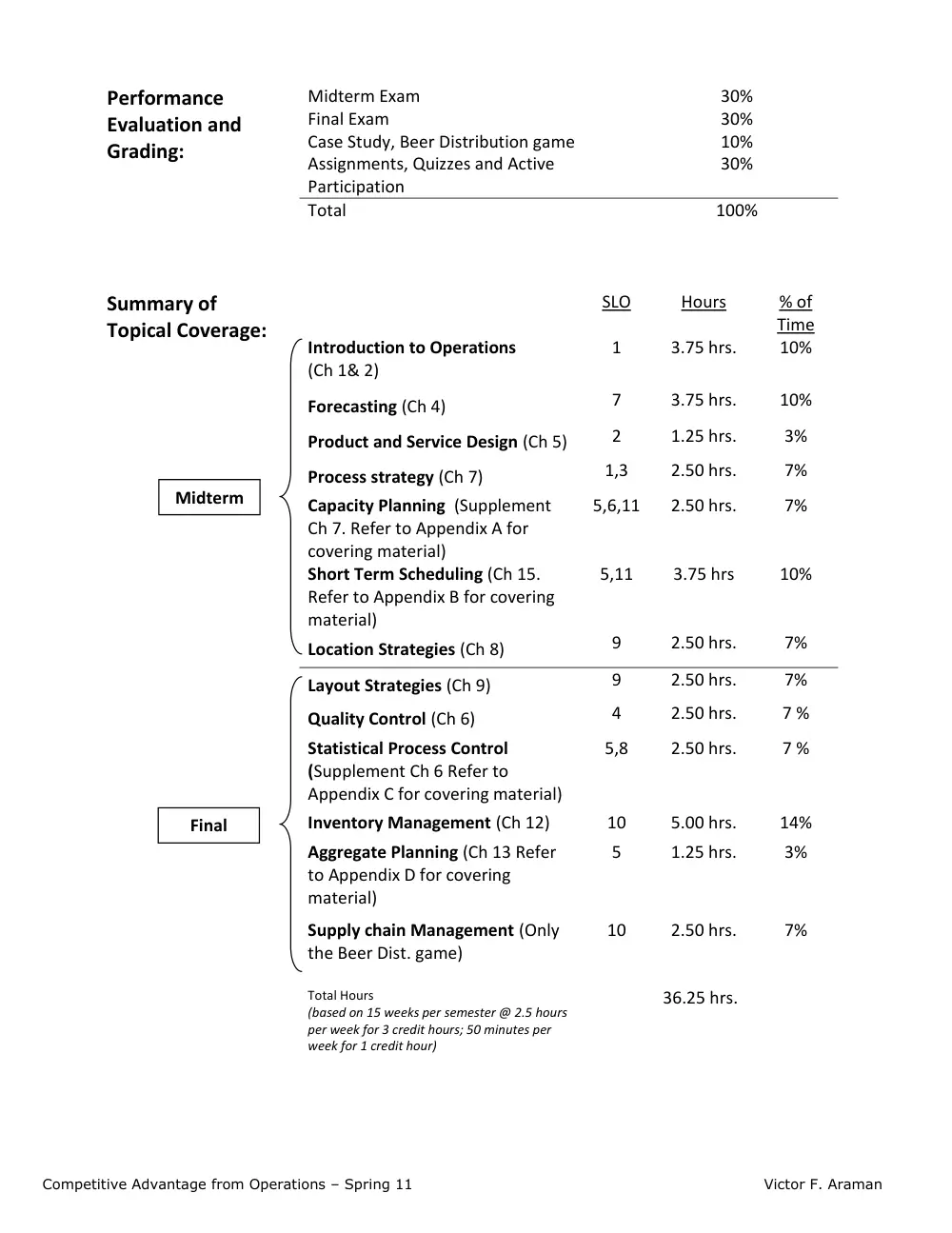
Performance
Evaluation and
Grading:
Midterm Exam
30%
Final Exam
30%
Case Study, Beer Distribution game
10%
Assignments, Quizzes and Active
Participation
30%
Total
100%
Summary of
Topical Coverage:
SLO
Hours
% of
Time
Introduction to Operations
(Ch 1& 2)
1
3.75 hrs.
10%
Forecasting (Ch 4)
7
3.75 hrs.
10%
Product and Service Design (Ch 5)
2
1.25 hrs.
3%
Process strategy (Ch 7)
1,3
2.50 hrs.
7%
Capacity Planning (Supplement
Ch 7. Refer to Appendix A for
covering material)
5,6,11
2.50 hrs.
7%
Short Term Scheduling (Ch 15.
Refer to Appendix B for covering
material)
5,11
3.75 hrs
10%
Location Strategies (Ch 8)
9
2.50 hrs.
7%
Layout Strategies (Ch 9)
9
2.50 hrs.
7%
Quality Control (Ch 6)
4
2.50 hrs.
7 %
Statistical Process Control
(Supplement Ch 6 Refer to
Appendix C for covering material)
5,8
2.50 hrs.
7 %
Inventory Management (Ch 12)
10
5.00 hrs.
14%
Aggregate Planning (Ch 13 Refer
to Appendix D for covering
material)
5
1.25 hrs.
3%
Supply chain Management (Only
the Beer Dist. game)
10
2.50 hrs.
7%
Total Hours
(based on 15 weeks per semester @ 2.5 hours
per week for 3 credit hours; 50 minutes per
week for 1 credit hour)
36.25 hrs.
Final
Midterm
Competitive Advantage from Operations – Spring 11
Victor F. Araman
Appendix: Covered Materials for Ch 4 ; Ch
S7 ; Ch 15 ; Ch S6 ; Ch13 | 10th edition.
(In parenthesis are the corresponding
pages in the 9th edition)
A. Chapter 4: Forecasting
Time Series Forecasting
Pages 136 – 158 (106-128)
B. Chapter S7: Capacity Planning
I.
Capacity
Pages 314 – 319 (288 - 294)
a. Design and Effective Capacity
b. Capacity and Strategy
c. Capacity Considerations
d. Managing Demand
e. Demand and Capacity Management in the Service Sector
II.
Bottleneck Analysis and the Theory of Constraints
Pages 320 – 324
a. Process Times for Stations, Systems and Cycles
b. Theory of Constraints
c. Bottleneck Management
III. Break-Even Analysis
Page 324 – 328 (296-300)
a. Single-Product Case
b. Multiproduct Case
IV. Reducing Risk with Incremental Changes
Pages 328 – 329
V.
Applying EMV to Capacity Decisions
Pages 329-330 (300-301)
Competitive Advantage from Operations – Spring 11
Victor F. Araman
C. Chapter 15: Short Term Scheduling
I.
The Importance of Short-Term Scheduling
Page 616 (602)
II.
Scheduling Issues
Pages 616 – 619 (602-605)
a. Forward and Backward Scheduling
b. Scheduling Criteria
III. Loading Jobs
Pages 622 – 623 (607-609)
a. Gantt Charts
IV. Sequencing Jobs
Pages 626 – 632 (612-618)
a. Priority Rules for Dispatching Jobs
b. Critical Ratio
c. Sequencing N Jobs on Two Machines (Johnson’s Rule)
d. Limitations of Rule-Based Dispatching System
D. Chapter S6: Statistical Process Control
I.
Statistical Process Control
Pages 250 – 263 (222-234)
II.
Process Capability
Pages 263 – 265 (235-236)
E. Chapter 13: Aggregate Planning
I.
Aggregate Planning in Services
Pages 556 – 559 (541-543)
II.
Yield Management
Pages 559 – 562 (543-546)